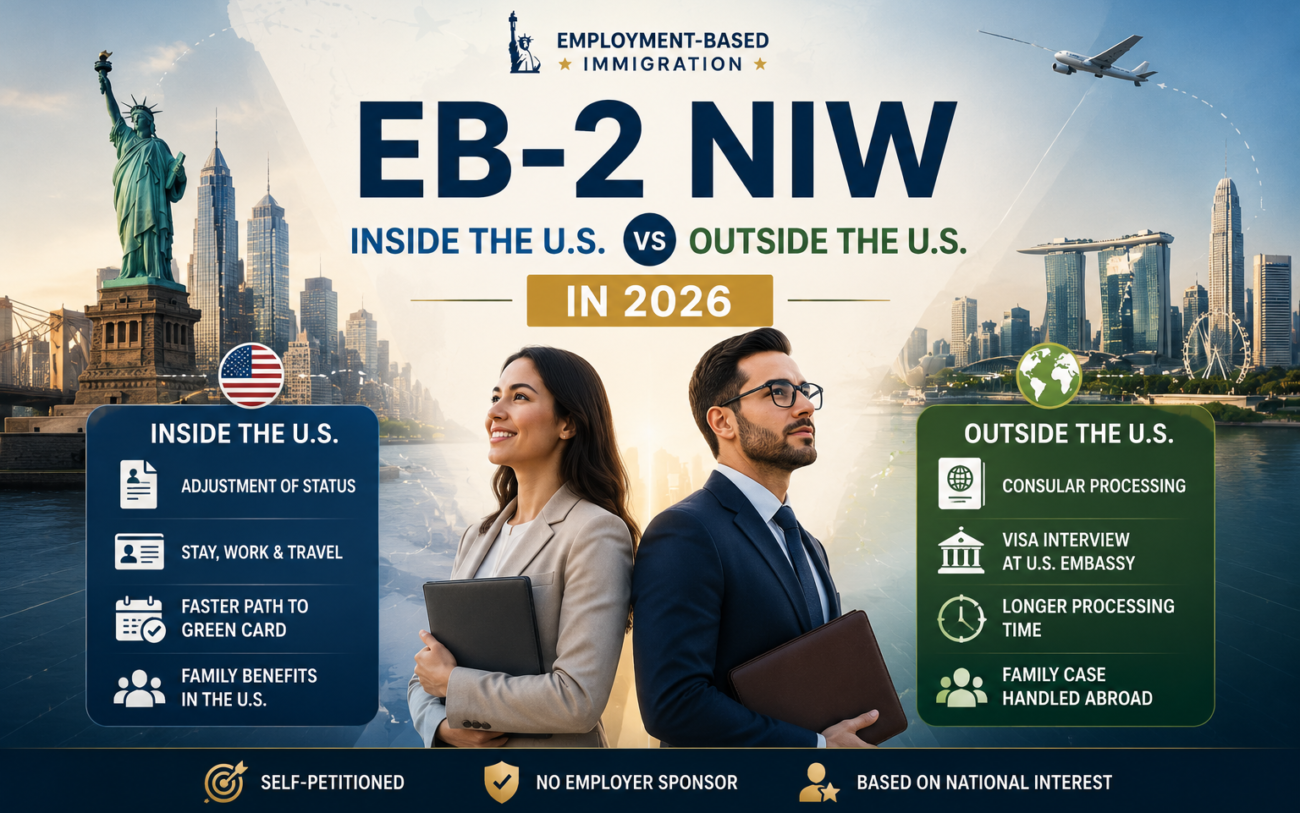
EB-2 NIW Inside the U.S. vs Outside the U.S. in 2026
Last Updated on July 2, 2026 by Amelia
Written by Emily Carter, Immigration-Law Specialist
Reviewed by Jonathan Miller, Esq., Licensed U.S. Immigration Attorney
EB-2 NIW Inside the U.S. vs Outside the U.S. in 2026: Adjustment of Status vs Consular Processing
The EB-2 National Interest Waiver (EB-2 NIW), commonly called EB-2 NIW inside the U.S, is one of the most valuable U.S. green card options for professionals, researchers, entrepreneurs, scientists, physicians, engineers, technologists, and other qualified individuals whose work can serve the national interest of the United States.
One reason EB-2 NIW inside the U.S is attractive is that a qualified applicant may self-petition. This means the applicant does not need a specific U.S. employer sponsor or a PERM labor certification if USCIS agrees that waiving those requirements is in the national interest.
However, the EB-2 NIW inside the U.S. process does not look the same for every applicant. A person already living in the United States may be able to complete the final green card stage through adjustment of status. A person outside the United States usually completes the final stage through consular processing at a U.S. embassy or consulate. The difference matters because it affects timing, travel, work authorization, filing fees, interview location, family planning, and risk management. This guide explains the main differences in 2026.
| Quick answer Applicants inside the United States may be able to fileForm I-485 for adjustment of status when the priority date is current and they are otherwise eligible. Applicants outside the United States generally wait for I-140 approval and visa availability, then proceed through the National Visa Center, Form DS-260, medical examination, and a consular interview. The I-140 petition is only the first major step; it is not the green card itself. |
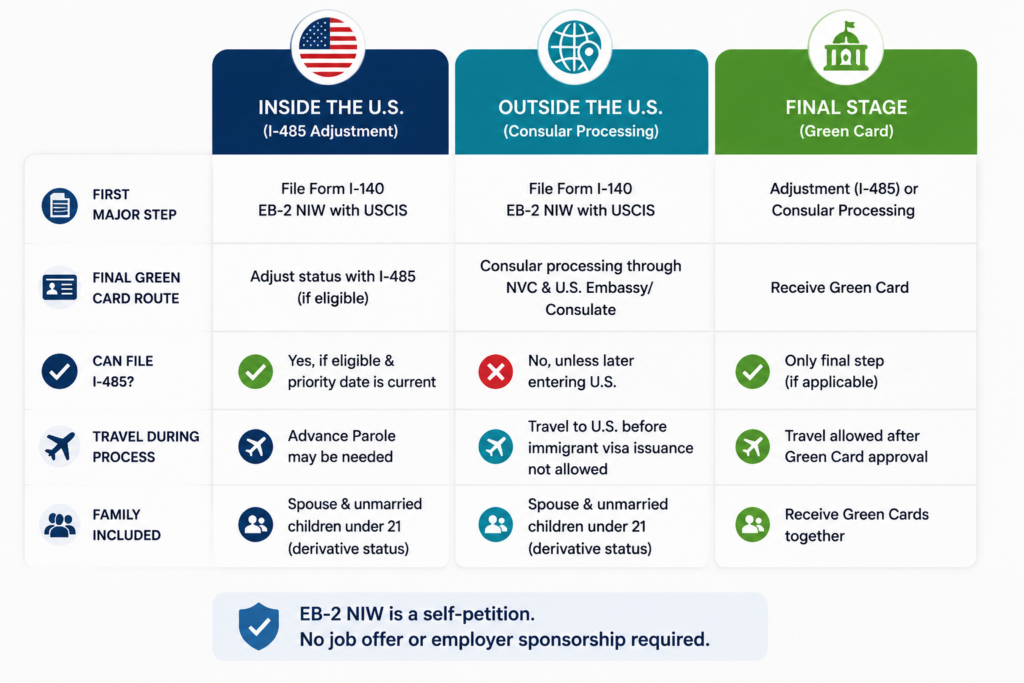
| Issue | Applicant inside the United States | Applicant outside the United States |
| First major step | Form I-140 EB-2 NIW petition with USCIS | Form I-140 EB-2 NIW petition with USCIS |
| Final green card route | Adjustment of status through Form I-485, if eligible | Consular processing through NVC and a U.S. embassy or consulate |
| Can file I-485? | Yes, if the applicant is in the U.S., eligible to adjust, and the priority date is current under the chart USCIS allows for that month | No. A person outside the U.S. does not file I-485 unless they later enter the U.S. in a status that permits adjustment and meet all requirements |
| Work authorization while waiting | May apply for an adjustment-based EAD if I-485 is properly filed | No U.S. work authorization from the EB-2 NIW case until immigrant visa admission as a permanent resident |
| Travel during final stage | Advance Parole may be needed if I-485 is pending; travel without the correct permission can create serious risk | Travel to the U.S. before immigrant visa issuance depends on any valid nonimmigrant visa and immigrant-intent issues |
| Interview location | Usually inside the U.S. if USCIS requires an interview | U.S. embassy or consulate abroad |
| Family members | Spouse and unmarried children under 21 may file derivative I-485s if eligible and visa numbers are available | Spouse and unmarried children under 21 complete derivative immigrant visa processing |
| Main practical advantage | Potential EAD/Advance Parole and ability to remain in the U.S. while I-485 is pending | No need to maintain U.S. nonimmigrant status while waiting abroad |
| Main practical challenge | Lawful status, travel restrictions, admissibility, medical exam filing, and I-485 fee burden | Embassy scheduling, NVC document review, local medical exam, and limited ability to work or live in the U.S. before approval |
1. The I-140 Stage Is the Same Starting Point
Whether the applicant is inside or outside the United States, the EB-2 NIW process begins with Form I-140, Immigrant Petition for Alien Worker. For a national interest waiver, the applicant may self-petition and does not need a U.S. employer to file the petition.
The petition must first show that the applicant qualifies for the underlying EB-2 classification as an advanced degree professional or a person of exceptional ability. After that, the petition must satisfy the national interest waiver standard. USCIS evaluates whether the proposed endeavor has substantial merit and national importance, whether the applicant is well positioned to advance it, and whether, on balance, the United States benefits from waiving the job offer and labor certification requirements.
The location of the applicant does not remove these legal requirements. A strong EB-2 NIW petition must still define the proposed endeavor clearly, connect the applicant’s qualifications to that endeavor, and provide evidence that the work matters beyond a private career goal.
Important point: I-140 approval is not the green card
Approval of Form I-140 confirms that USCIS approved the immigrant petition. It does not automatically grant permanent residence, work authorization, or permission to remain in the United States. The applicant must still complete adjustment of status or consular processing, and a visa number must be available under the Visa Bulletin.
2. Applicants Inside the United States: Adjustment of Status
An applicant who is physically present in the United States may be able to complete the final stage through adjustment of status by filing Form I-485. This route is available only if the applicant is eligible to adjust status and an immigrant visa number is available for the EB-2 category and the applicant’s country of chargeability.
If the priority date is current under the filing chart that USCIS permits for that month, the applicant may sometimes file Form I-140 and Form I-485 together. This is called concurrent filing. If the priority date is not current, the applicant may file the I-140 first and wait until the priority date becomes eligible for I-485 filing.
Adjustment of status can be especially useful for applicants who are already in the United States on F-1, OPT, STEM OPT, H-1B, L-1, O-1, or another lawful status. However, each case must be reviewed carefully because not every person inside the United States is eligible to adjust status.
Benefits of adjustment of status
- The applicant may remain in the United States while the I-485 is pending, provided the filing is proper and the applicant does not create separate status or admissibility problems.
- The applicant may file Form I-765 for an adjustment-based Employment Authorization Document after or with the I-485.
- The applicant may file Form I-131 for Advance Parole, which can allow international travel while the I-485 is pending if approved before travel.
- Eligible spouses and unmarried children under 21 may file derivative I-485 applications when visa numbers are available.
- The applicant may avoid the need to attend an immigrant visa interview abroad. USCIS may still schedule an adjustment interview in the United States.
Risks and cautions for applicants inside the United States
- Filing only Form I-140 does not protect lawful status. Applicants should maintain valid underlying status whenever possible until the I-485 is properly filed and should understand the risks of status gaps.
- Travel while Form I-485 is pending can be risky if Advance Parole has not been approved. Certain H-1B and L-1 holders may have different travel rules, but this should be checked case by case.
- USCIS now requires certain adjustment applicants to submit Form I-693 medical examination documentation with Form I-485, or the I-485 may be rejected.
- If the I-140 is denied, any I-485 based on that petition is at serious risk.
- If the priority date retrogresses after I-485 filing, the application may remain pending until a visa number becomes available again, but final approval cannot occur unless a visa number is available.
Common 2026 government fees for the U.S.-based route
| Form / fee | Typical role | Current amount noted in official sources |
| Form I-140 | EB-2 NIW immigrant petition | $715 |
| Asylum Program Fee | Additional fee attached to many I-140 filings; reduced or zero amount may apply depending on petitioner type | $600 / $300 / $0 depending on petitioner type |
| Form I-907 | Optional premium processing for Form I-140 | $2,965 for Form I-140 premium processing requests postmarked on or after March 1, 2026 |
| Form I-485 | Adjustment of status application | $1,440 for applicants age 14 or older; $950 for certain children under 14 filing with a parent |
| Form I-765 | Optional adjustment-based EAD while I-485 is pending | $260 for applicants who filed Form I-485 with a fee after April 1, 2024 and whose I-485 remains pending |
| Form I-131 | Optional Advance Parole/travel document | $630 for Advance Parole, reentry permit, and other travel documents |
3. Applicants Outside the United States: Consular Processing
An applicant who is outside the United States usually completes the green card process through consular processing. The applicant first files the EB-2 NIW Form I-140 with USCIS. After approval, the case moves forward through the Department of State and the National Visa Center when a visa number is available.
Consular processing usually includes payment of immigrant visa fees, completion of Form DS-260, submission of civil documents, a medical examination by an authorized panel physician, and an interview at a U.S. embassy or consulate.
If the immigrant visa is issued, the applicant enters the United States as a lawful permanent resident. The physical green card is produced after admission and required post-visa steps are completed.
Benefits of consular processing
- The applicant does not need to maintain a U.S. nonimmigrant status while waiting abroad.
- The applicant avoids the I-485, I-765, and I-131 filing package unless they later become eligible to adjust inside the United States.
- For some applicants, consular processing can be cleaner when they have no current U.S. status or do not need interim U.S. work authorization.
- The applicant can continue employment, business, or family life abroad while waiting for I-140 approval and visa availability.
Risks and cautions for applicants outside the United States
- Embassy and consulate interview availability can vary by country and post.
- The applicant generally cannot work in the United States until they enter with the immigrant visa and become a permanent resident.
- Trying to enter the United States on a temporary visa while an immigrant petition is pending may raise immigrant-intent questions, especially for B-1/B-2 visitors.
- The applicant must prepare civil documents, police certificates, translations, and medical examination documents according to the local post’s instructions.
- Administrative processing after interview can delay vi
Common 2026 government fees for the consular route
| Form / fee | Typical role | Current amount noted in official sources |
| Form I-140 | EB-2 NIW immigrant petition filed with USCIS | $715 plus any applicable Asylum Program Fee |
| Form I-907 | Optional premium processing for the I-140 | $2,965 for eligible I-140 premium processing requests postmarked on or after March 1, 2026 |
| DS-260 employment-based immigrant visa fee | Immigrant visa application processing at NVC/consular stage | $345 per applicant for employment-based applications processed on the basis of an approved I-140 or I-526 petition |
| Medical examination | Required before immigrant visa issuance | Varies by country and panel physician |
| USCIS Immigrant Fee | Generally paid after immigrant visa issuance and before or after travel for green card production | Check the current USCIS fee page before payment |
4. Visa Bulletin Timing Matters for Both Groups
A major issue in EB-2 NIW cases is that I-140 approval does not remove Visa Bulletin waiting time. The applicant must still have an available immigrant visa number before the green card can be granted through adjustment of status or consular processing.
In 2026, this issue is especially important for applicants chargeable to India and China. The July 2026 Visa Bulletin made EB-2 numbers for India unavailable for the remainder of FY 2026 and warned that EB-2 China could retrogress or become unavailable if demand requires it. This shows why applicants should not rely on outdated statements such as ‘EB-2 NIW is always fast’ or ‘approval means immediate green card.’ Applicants should check the Visa Bulletin every month and should also check whether USCIS is allowing employment-based adjustment applicants to use the Dates for Filing chart or the Final Action Dates chart for that month.
| Practical note for India and China For applicants from high-demand countries, the question is not only whether the EB-2 NIW petition can be approved. The second question is when the applicant can actually file or complete the green card stage. This is one reason some candidates later evaluate EB-1A, if their evidence supports the higher extraordinary ability standard. |
5. Timeline Comparison
| Stage | Inside the U.S. – adjustment of status | Outside the U.S. – consular processing |
| I-140 preparation | Same evidence-building stage: proposed endeavor, EB-2 eligibility, Dhanasar prongs, expert letters, and supporting documents | Same evidence-building stage: proposed endeavor, EB-2 eligibility, Dhanasar prongs, expert letters, and supporting documents |
| I-140 filing | Filed with USCIS; premium processing may be requested | Filed with USCIS; premium processing may be requested |
| Green card filing trigger | Priority date must be eligible for I-485 filing under the chart USCIS allows | Priority date must be current or eligible for NVC/consular movement based on Department of State processing |
| Interim work/travel | Possible through I-765 and I-131 after I-485 filing, if approved | No adjustment-based EAD or Advance Parole because no I-485 is filed |
| Final decision | USCIS approves Form I-485 when eligibility is met and visa number is available | Consular officer issues immigrant visa after document review, medical exam, and interview |
| Green card moment | Applicant becomes a permanent resident when I-485 is approved | Applicant becomes a permanent resident upon admission to the U.S. with the immigrant visa |
6. Which Route Is Better?
There is no single best answer. The right route depends on the applicant’s location, immigration status, family needs, priority date, travel plans, admissibility history, budget, and risk tolerance.
Adjustment of status may be better if:
- The applicant is already lawfully present in the United States.
- The priority date is current or eligible for filing.
- The applicant wants the possibility of an adjustment-based EAD and Advance Parole.
- The applicant’s family members are also in the United States and eligible to file derivatives.
- The applicant has a strong plan to manage travel and status while the I-485 is pending.
Consular processing may be better if:
- The applicant lives outside the United States.
- The applicant does not have a lawful U.S. status that allows adjustment.
- The applicant does not need to work in the United States before immigrant visa approval.
- The applicant prefers to continue life and work abroad until the immigrant visa stage is ready.
- The applicant wants to avoid the I-485 package unless there is a later strategic reason to adjust inside the United States.
Frequently Asked Questions
Can I apply for EB-2 NIW while outside the United States?
Yes. EB-2 NIW can be filed from outside the United States. The I-140 is filed with USCIS, and after approval and visa availability, the applicant generally proceeds through consular processing.
Can I file EB-2 NIW while in the United States?
Yes. Applicants inside the United States may file Form I-140. If the priority date is eligible and the applicant can adjust status, they may also file Form I-485 either concurrently or later.
Does an approved EB-2 NIW give me work authorization?
No. An approved I-140 does not itself provide work authorization. Work authorization inside the United States may be available through a separate valid status or through an approved I-765 based on a pending I-485.
Can I travel after filing I-485?
Travel after filing I-485 requires careful planning. Many applicants need approved Advance Parole before leaving the United States. Certain H-1B and L-1 holders may have different rules, but the facts should be reviewed before travel.
Can my spouse and children be included?
Yes. A spouse and unmarried children under 21 may generally be included as derivative beneficiaries, either through derivative I-485 filings in the United States or derivative immigrant visa processing abroad.
Is consular processing faster than adjustment of status?
Sometimes, but not always. Consular timing depends on I-140 processing, Visa Bulletin availability, NVC review, document readiness, embassy scheduling, medical exam timing, interview outcome, and any administrative processing.
Can I visit the United States while my EB-2 NIW is pending?
Possibly, if you have a valid nonimmigrant visa and can satisfy the requirements for that visa at entry. However, a pending immigrant petition may raise questions about immigrant intent, especially for visitor visa categories.
What is the biggest mistake in EB-2 NIW location planning?
The biggest mistake is treating the I-140 as the full green card process. The I-140 petition, adjustment or consular stage, Visa Bulletin, medical exam, fees, travel, and family strategy must all be planned together.
How Immignis Can Help
Immignis helps EB-2 NIW applicants evaluate whether their case should be prepared for adjustment of status, consular processing, or a staged strategy. The right plan begins before filing Form I-140 because the proposed endeavor, documentation, timing, family members, and post-approval route all affect the final result.
Our work can include EB-2 NIW eligibility review, proposed endeavor development, evidence mapping, petition-letter preparation, recommendation-letter strategy, filing-stage planning, and post-I-140 green card route assessment.
Conclusion
EB-2 NIW can be a strong green card pathway for qualified professionals whose work serves the U.S. national interest. However, the applicant’s location changes the final strategy. Applicants inside the United States may be able to use adjustment of status when eligible. Applicants outside the United States generally complete consular processing after I-140 approval and visa availability.
In 2026, applicants should not rely on outdated assumptions. Current USCIS policy guidance, fee rules, medical exam requirements, premium processing fees, and Visa Bulletin movement must all be considered. A successful EB-2 NIW strategy is not only about getting the I-140 approved. It is about planning the full route from petition filing to permanent residence.