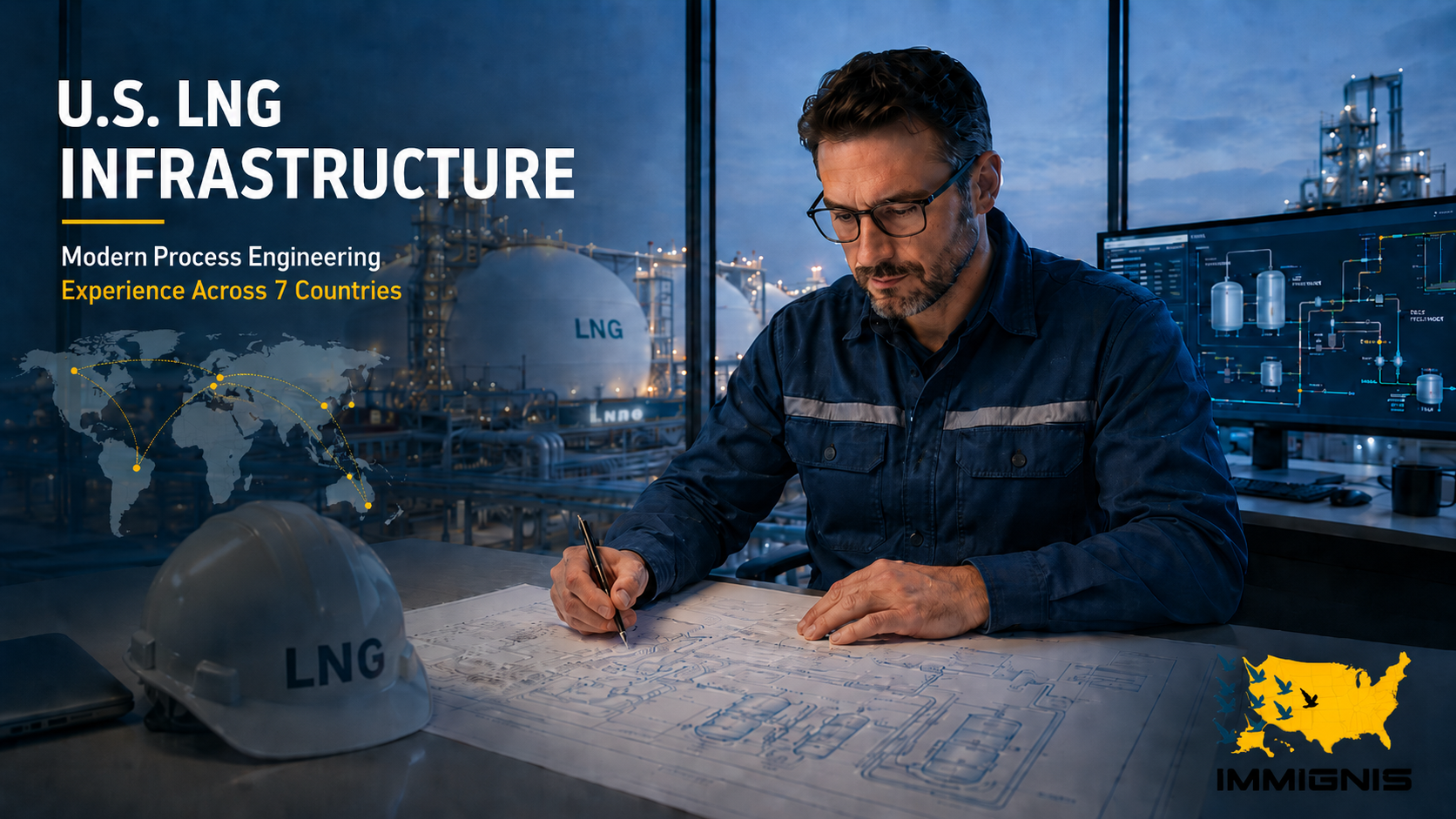
A Canadian chemical engineer with 18 years of LNG and oil-and-gas process experience was approved for an EB-2 NIW to help modernize U.S. LNG infrastructure through digital twins, energy-efficiency optimization, modular LNG, emissions reduction, and safety-aligned process design.
In short: A Canadian citizen and chemical engineer holding a B.Sc. in Chemical Engineering and a Shell Technical
Authority Level-3 certification, with 18 years of progressive process-engineering experience across LNG facilities,
offshore platforms, upstream oil projects, oil sands, sour-gas operations, and refineries in Qatar, Iraq, Canada, Kuwait,
the UAE, Ghana, and Pakistan, was approved for an EB-2 National Interest Waiver as a self-petitioner.
His experience
includes work for major LNG and oil-and-gas operators, direct participation in North American and Gulf of Mexico
projects, $140 million in total installed cost savings on a major oil-sands program, energy-efficiency projects linked to
production gains and emissions reduction, and technical leadership over teams of process engineers. Proposed endeavor:
provide independent LNG process-engineering consulting in the United States, initially focused on the Gulf Coast, to
modernize LNG infrastructure through AI-enabled digital twins, compander-based liquefaction, modular deployment,
computational-fluid-dynamics optimization, renewable integration, floating LNG concepts, boil-off gas recovery, and
safety-ready process design. Approved under Matter of Dhanasar.
The petitioner’s name, employer names, client names, university, referee names, and personal identifiers have been withheld for privacy.
Why This Case Mattered
The United States has become the world’s largest LNG exporter, and its export capacity has continued to expand. That growth creates a clear engineering challenge: LNG terminals must operate safely, efficiently, and reliably while handling higher throughput, updated safety expectations, emissions concerns, and global energy-security demand.
This EB-2 NIW case was built around that national need. The petitioner was not proposing a general oil-and-gas consulting business. His EB-2 NIW proposed work focused on the technical core of LNG infrastructure: process efficiency, thermodynamic optimization, boil-off gas handling, compressor and heat-exchanger performance, digital process monitoring, and pre-compliant safety design.
For USCIS, that distinction matters. A broad energy career can sound useful but vague. A defined LNG process-engineering endeavor linked to current U.S. export capacity, Gulf Coast infrastructure, safety rulemaking, and federal energy policy gives the EB-2 NIW First Prong a much clearer national-importance foundation.
Eighteen Years Across Seven Countries
The petitioner’s career began in refinery process operations, where he worked on crude distillation, hydrocracking, amine treatment, and downstream process optimization. That early foundation gave him direct exposure to the systems-level discipline required in complex energy facilities: every process decision affects throughput, safety, energy use, emissions, and operating cost.
He later moved into major engineering roles in Canada, working on oil-and-gas facility projects, heavy-oil and SAGD thermal recovery design, brownfield debottlenecking, FPSO topside development, and early-phase Gulf of Mexico project work. One major North American oil-sands assignment produced approximately $140 million in total installed cost savings through design optimization.
His LNG experience then expanded through the Middle East. He worked on national energy operations in Kuwait, gas projects in Iraq, and complex sour-gas operations requiring flare reduction, compression-field oversight, and mentoring of local graduate engineers. Since 2024, he has served as Senior Process Engineer at the world’s largest LNG-producing environment in Qatar, contributing to energy-efficiency projects, compressor rebundling, boil-off gas recycling, and acid-gas recovery studies.
This sequence created a strong EB-2 NIW Second Prong record: refinery operations, Canadian project design, North American cost optimization, Middle East sour-gas work, LNG production-scale engineering, and current technical responsibility at one of the most demanding LNG environments in the world.
That EB-2 NIW experience showed a clear pattern of specialized technical growth across multiple energy systems. It also strengthened the EB-2 NIW case by demonstrating that his expertise was not theoretical, but grounded in real-world project execution across major international facilities.
The Credential That Strengthened the Well-Positioned Argument
A central piece of the well-positioned evidence was his Shell Technical Authority Level-3 certification. This is not a short training certificate. In the process-engineering context, it reflects expert-level technical authority, assessed competence, and the ability to approve or advise on high-stakes engineering decisions within defined technical domains.
For an NIW petition, that credential helped translate his career from “experienced engineer” into “recognized technical authority.” It supported the argument that he was positioned to advise U.S. LNG facilities on complex process-engineering decisions involving safety, efficiency, emissions, and lifecycle performance.
The Proposed Endeavor: Modernizing LNG Through Process Engineering
The approved endeavor focused on independent LNG consulting for the U.S. market, beginning with Texas and Louisiana, where much of the U.S. export infrastructure is concentrated. The plan was structured around practical process interventions that match real LNG-facility needs:
- AI-enabled digital twins and intelligent automation to improve visibility, anomaly detection, and predictive maintenance.
- Compander-based liquefaction concepts to reduce energy use and simplify plant design where technically suitable.
- Modular LNG deployment to shorten construction timelines and support flexible capacity expansion.
- Boil-off gas recovery and gas recycling studies to reduce loss, improve efficiency, and support emissions-control objectives.
- Computational fluid dynamics for heat-exchanger, compressor, and process-flow optimization.
- Renewable-energy integration for auxiliary LNG systems where project economics and reliability allow.
- Floating LNG and bunkering concepts for offshore and marine-fuel applications.
- Safety-ready process design aligned with evolving PHMSA LNG safety requirements.
The petition did not present these as isolated ideas. It framed them as a coherent LNG modernization portfolio grounded in the petitioner’s actual project experience across process design, energy efficiency, emissions reduction, operational reliability, and major-project assurance.
Why the U.S. Policy Timing Helped
The policy context was unusually current. In January 2025, the White House declared a National Energy Emergency and also issued the Unleashing American Energy order, both of which shifted federal energy policy toward expanded domestic energy capacity and faster project execution. PHMSA later announced an effort to update outdated LNG regulations, directly supporting the need for process-safety and compliance-ready technical expertise.
The U.S. Energy Information Administration has also identified the United States as the world’s largest LNG exporter, with exports rising sharply since the first Sabine Pass cargo in 2016. For a process engineer proposing to improve LNG terminal efficiency and reliability, this provided a direct national-importance connection: the country’s export leadership depends on infrastructure that can operate safely, efficiently, and competitively.
The petition therefore avoided a generic “energy is important” argument. It tied the proposed endeavor to a specific national infrastructure problem: modern LNG terminals must expand and operate under higher demand, updated safety rules, tighter reliability expectations, and geopolitical pressure for secure energy supply.
How the Petition Was Built
This was a direct petition filed without a U.S. employer. The evidence strategy focused on three points: national infrastructure need, technical authority, and the petitioner’s ability to execute across major LNG and oil-and-gas systems.
- National importance evidence: 2025 federal energy policy, LNG export growth, PHMSA LNG regulatory activity, EIA LNG export data, Gulf Coast export infrastructure, energy-security demand, LNG safety and efficiency concerns, and emissions-reduction needs within energy infrastructure.
- Well-positioned evidence: 18 years of process-engineering experience, seven-country project history, Shell Technical Authority Level-3 certification, current LNG process-engineering role in Qatar, prior Gulf of Mexico project exposure, $140 million in documented project-cost savings, energy-efficiency contributions, team leadership, and major international LNG and oil-and-gas assignments.
- Third Prong strategy: independent LNG consulting allows multi-site, cross-operator work that would be difficult to perform through a single employer-sponsored role. The waiver supports broader deployment of the petitioner’s expertise across U.S. LNG infrastructure rather than limiting it to one company.
The Outcome
Approved.
USCIS approved the self-petitioned EB-2 NIW for a Canadian chemical and process engineer whose career spans LNG, refinery, upstream, offshore, heavy-oil, and sour-gas systems across seven countries. The approval recognized that his proposed work in LNG process optimization, digital-twin modernization, energy-efficiency improvement, modular LNG, and safety-aligned design addressed a nationally important U.S. infrastructure need, and that his technical background positioned him to advance that work.
The strength of this case came from alignment. The United States needed LNG infrastructure modernization. The petitioner had spent 18 years doing the exact kind of process-engineering work that LNG modernization requires. His Shell Technical Authority credential, current LNG role, international project record, and quantified cost and efficiency outcomes gave the petition a credible foundation under all three Dhanasar prongs.
For LNG, Chemical, and Process Engineers
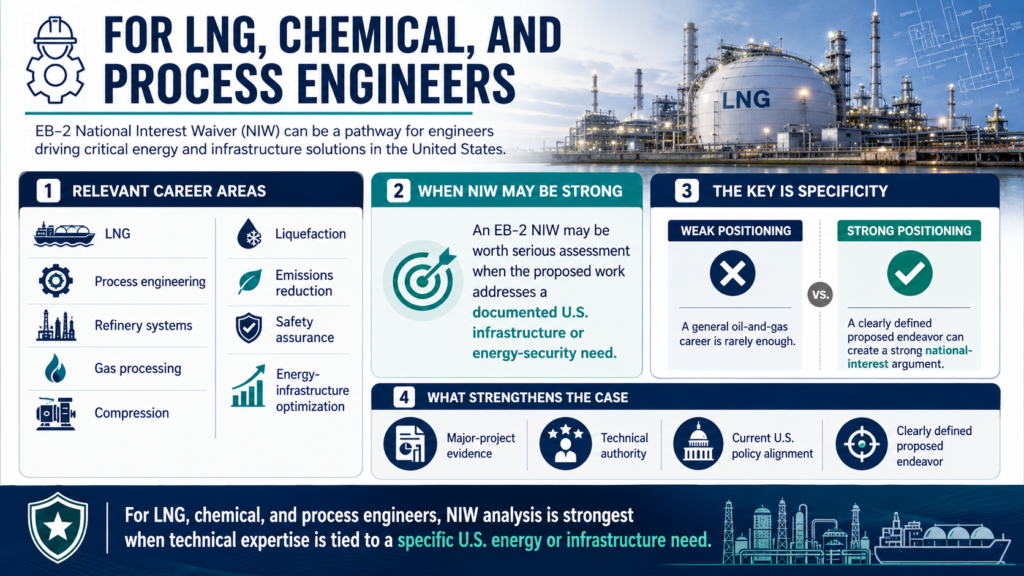
If your career is in LNG, process engineering, refinery systems, gas processing, compression, liquefaction, emissions reduction, safety assurance, or energy-infrastructure optimization, an EB-2 NIW may be worth serious assessment when your proposed work addresses a documented U.S. infrastructure or energy-security need. The key is specificity. A general oil-and-gas career is rarely enough. A clearly defined proposed endeavor, supported by major-project evidence, technical authority, and current U.S. policy alignment, can create a strong national-interest argument.
Questions LNG and Process Engineers Ask Us
Can an LNG process engineer qualify for an EB-2 NIW?
Yes. An LNG process engineer can qualify when the proposed endeavor addresses a nationally important need, such as LNG infrastructure modernization, safety compliance, energy-efficiency improvement, emissions reduction, or export-capacity reliability. The strongest cases connect the petitioner’s own project record to a specific U.S. infrastructure gap rather than relying on a broad statement that energy is important.
Why does Shell Technical Authority Level-3 matter?
It helps the well-positioned argument because it shows expert-level technical recognition within a major global energy-operator framework. For USCIS, this type of credential can show that the petitioner is trusted to make or support complex engineering judgments in high-risk process environments, which is directly relevant to LNG modernization work.
Does a Canadian citizen living in Qatar need a U.S. employer for NIW?
No. An EB-2 NIW is a self-petition and does not require a job offer or labor certification. The petitioner must show that the proposed endeavor has substantial merit and national importance, that he is well-positioned to advance it, and that waiving the job-offer requirement would benefit the United States.
How is LNG process engineering different from LNG turbomachinery?
LNG turbomachinery focuses on the mechanical equipment inside the plant, such as compressors, turbines, and expanders. LNG process engineering focuses on the chemical, thermodynamic, and facility-level systems those machines serve: gas treatment, liquefaction, heat integration, boil-off gas handling, process safety, and emissions performance. The two fields overlap in plant operations, but they are different professional disciplines.
Does USCIS expect every technical strategy in the proposed endeavor to be implemented immediately?
No. The proposed endeavor describes the intended direction of work. The petitioner does not need to prove that every method will be implemented at once. The petition should show that the strategies are coherent, technically grounded, nationally important, and within the petitioner’s demonstrated area of expertise.