
A Pakistani EB2 NIW biomedical engineer already pursuing graduate study in the United States was approved for an EB-2 National Interest Waiver to advance AI-enabled wearable and portable medical-device integration for chronic disease monitoring, telemedicine, and underserved healthcare access.
In Short: An EB2 NIW biomedical engineer with a Bachelor of Science in Biomedical Engineering, an MBA in Supply Chain, and
ongoing graduate study in Engineering Management at a U.S. university was approved for an EB-2 NIW as a self-
petitioner. Her professional background includes medical-device sales support, supply-chain coordination, capital-
equipment procurement, product management, hospital account coordination, distributor training, and technical
documentation for imaging and diagnostic technologies.
Her proposed endeavor was framed around AI-enabled wearable and portable medical-device integration, remote patient
monitoring, and telemedicine-linked chronic disease management. The approval was supported by the national need to
reduce avoidable healthcare costs, improve chronic-disease monitoring, expand digital health access, and bring medical
technology closer to patients in rural and underserved communities.
Privacy note: The petitioner's name, employer names, university name, hospital account names, and personal identifiers have been withheld for privacy. The credentials, field, proposed endeavor, and approval outcome are presented in anonymized form.
The $5.3 Trillion Chronic-Disease Problem
The United States spends an enormous share of its healthcare resources on chronic and mental health conditions (source: CDC chronic disease data). The CDC reports that 90% of the nation's annual healthcare expenditures are directed toward people with chronic and mental health conditions, and current CDC figures place annual healthcare spending at about $5.3 trillion. For a proposed endeavor involving early detection, remote monitoring, and home-based health tracking, that statistic matters because it links the petitioner's work to one of the largest cost drivers in the U.S. healthcare system.
The case narrative for this EB2 NIW Biomedical Engineer did not depend on a claim that one engineer could personally solve chronic disease. It focused on a narrower and more credible contribution: improving how wearable and portable medical devices are selected, integrated, deployed, and connected to clinical workflows so that patients at risk of diabetes, cardiac events, respiratory decline, and maternal-fetal complications can be monitored earlier and more consistently.
The Career Behind the Case
Her career began inside a major medical technology environment, where this EB2 NIW biomedical engineer supported advanced imaging and diagnostic equipment used by hospitals and clinical buyers. Her responsibilities involved order configuration, technical documentation, supply-chain coordination, distributor and user training, and coordination with manufacturing and hospital stakeholders. That work gave her exposure to how complex medical devices move from specification to installation and clinical use.
She later worked in a hospital procurement role, evaluating medical equipment, coordinating vendors, managing purchase processes, and helping clinical teams access technology suited to patient-care needs. In a later product-management role focused on women's health ultrasound, this EB2 NIW biomedical engineer supported clinical workshops, product education, hospital relationships, and adoption of diagnostic technologies in real healthcare settings.
This background was not presented as pure device invention. That would have been risky. The stronger and more honest positioning was that she understands the bridge between biomedical technology, clinical users, hospital procurement, device deployment, regulatory expectations, and patient-care workflows. That bridge is exactly where many wearable and remote-monitoring programs fail: the technology may exist, but the clinical implementation does not work unless the device is properly selected, validated, integrated, trained, and supported.
The Proposed Endeavor: Wearable and Portable Monitoring That Reaches Patients Earlier
The approved endeavor was structured around AI-enabled wearable and portable medical-device integration for chronic-disease monitoring and telemedicine support. The focus included wearable cardiac and heart-rate monitors, glucose-monitoring technologies, portable ultrasound tools, respiratory monitoring devices, and maternal-fetal monitoring systems, with emphasis on secure data flow to healthcare providers and remote-care platforms.
The strongest framing was implementation-oriented: not simply designing a device in isolation, but helping bring clinically useful devices into practice. That includes device specification, clinical-use-case analysis, workflow mapping, telehealth integration, user training, procurement strategy, vendor coordination, regulatory awareness, and post-deployment performance monitoring.
This reframing made the case more credible. It connected the proposed work to her actual experience in imaging equipment, hospital procurement, product education, and clinical technology adoption while still allowing the endeavor to remain forward-looking and nationally important.
Why the National-Importance Argument Worked
For this EB2 NIW biomedical engineer, The national-importance argument rested on four points. First, chronic disease imposes a massive and continuing cost burden on the United States. Second, remote monitoring and digital health tools can help clinicians detect deterioration earlier, reduce unnecessary hospital visits, and support home-based care. Third, FDA's Digital Health Center of Excellence and FDA-authorized sensor-based digital health technologies show that federal regulators are actively engaged with wearable, minimally invasive, and remote-monitoring devices. Fourth, CMS value-based care programs reward better outcomes, lower costs, and improved care quality, which aligns with EB2 NIW biomedical engineer’s proposed work to help monitor patients outside traditional hospital settings.
The petition also fit the current public-health policy environment. The Make America Healthy Again Commission, established by executive order in February 2025, focuses on chronic disease and broader health challenges facing Americans. The case did not need to rely on unverifiable policy citations. The stronger approach was to rely on real federal materials from CDC, FDA, CMS, HHS, and ARPA-H, together with peer-reviewed literature on wearable biosensors, non-invasive glucose sensing, and remote vital-sign monitoring.
How the Well-Positioned Argument Was Rebuilt
The successful strategy was to close that gap by repositioning the Second Prong around documented strengths. The case emphasized her biomedical engineering degree, current U.S. graduate study, medical-device industry exposure, hospital procurement experience, women's health ultrasound product role, training and documentation work, and understanding of FDA, CE, ISO 13485, cybersecurity, and remote-monitoring concepts. The argument was that she was well-positioned to advance the implementation and integration side of wearable and portable medical technologies, especially in settings where hospitals and clinics need practical guidance to adopt such devices safely and effectively.
That approach was more defensible than claiming she had already invented a wearable device. USCIS does not require a petitioner to have solved the entire national problem before filing. It does require a credible connection between the proposed endeavor and the petitioner's demonstrated record. The revised case made that connection clear.
How the Petition Was Structured
The First Prong focused on chronic disease, remote monitoring, telehealth, FDA digital health activity, CMS value-based care, rural and underserved access, and the need to reduce preventable hospital utilization. The technical discussion was supported by verifiable literature and official government sources.
The Second Prong focused on her practical medical-device background: specifying, supporting, procuring, explaining, and helping deploy advanced healthcare technologies in clinical environments. The petition treated her commercial and procurement experience as a strength because these roles required technical judgment, device knowledge, vendor coordination, training, and clinical workflow understanding.
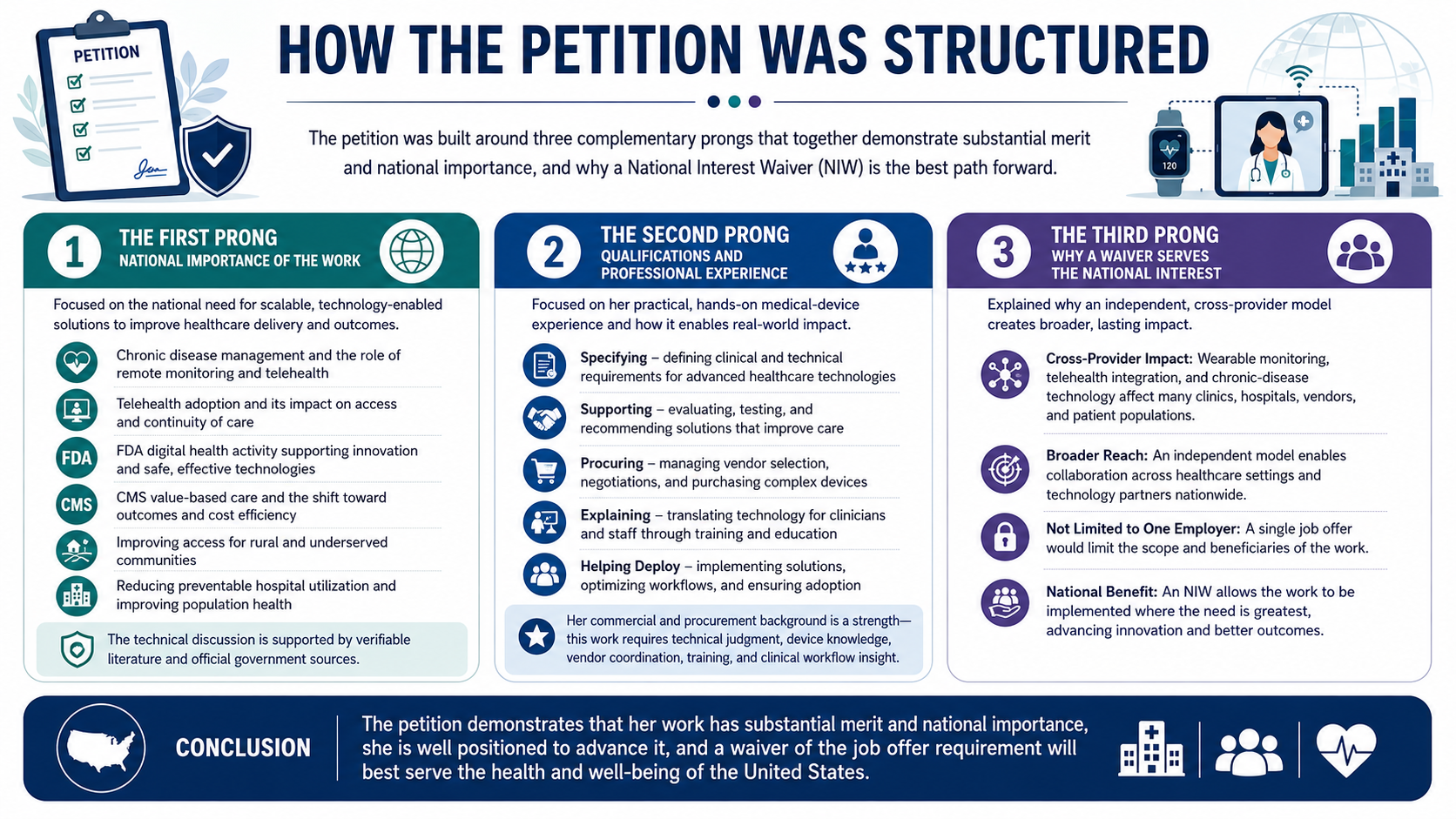
The Third Prong explained why an independent, cross-provider implementation model served the national interest better than tying her to one employer. Wearable monitoring, telehealth integration, and chronic-disease technology deployment affect many clinics, hospitals, vendors, and patient populations. A single job offer would limit the reach of the work, while an NIW allowed her to build collaborations across healthcare settings and technology partners.
The Outcome
Approved.
A self-petitioned EB-2 NIW was approved for a Pakistani biomedical engineer in the United States whose background connects biomedical technology, hospital procurement, medical-device product support, and graduate engineering management study. The approval recognized the national importance of AI-enabled wearable and portable medical-device integration for chronic disease monitoring and the petitioner's credible position to advance that work through healthcare technology deployment and remote-monitoring implementation.
The case succeeded after the narrative was moved away from overstated device-invention language and toward a stronger, more evidence-based implementation story: getting the right medical technologies into real clinical use, especially for patients who need earlier monitoring and better access outside major hospital centers.
Questions Biomedical and Digital Health Professionals Ask Us
Can someone with sales, procurement, and product-support experience qualify for EB-2 NIW in biomedical engineering?
Yes, if the endeavor is framed correctly. The safer argument is not that the petitioner is already a device inventor. The stronger argument is that her biomedical engineering training, medical-device industry experience, hospital procurement work, and product education background position her to advance the implementation, integration, and adoption of wearable and portable medical technologies.
Why was the wearable-medical-device field nationally important?
The field connects directly to chronic disease, remote patient monitoring, telemedicine, rural healthcare access, and value-based care. These are documented U.S. healthcare priorities. Wearable and portable monitoring devices can help detect risk earlier and support care outside hospital settings.