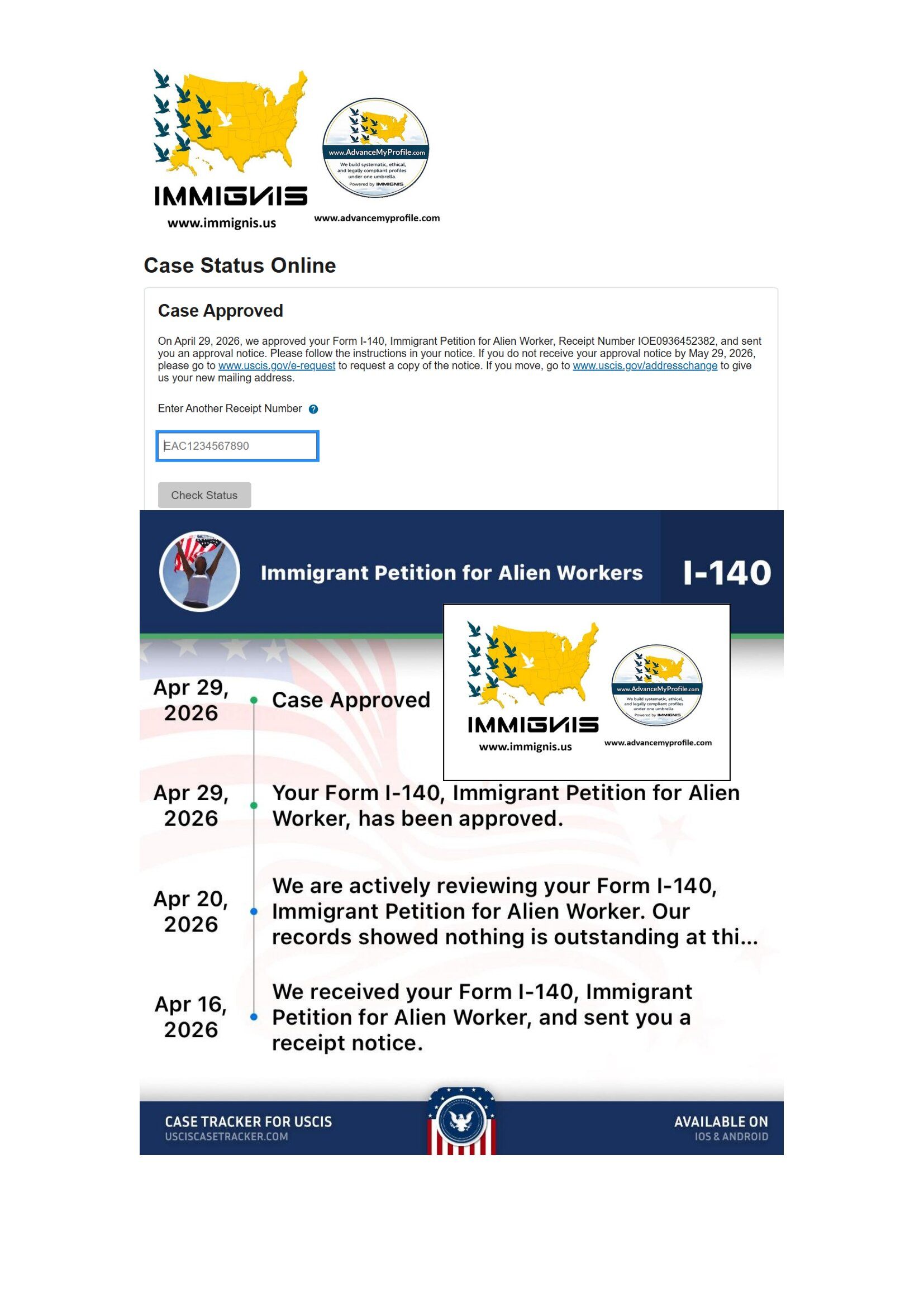
EB-1A for Marketing Executives explains how a product-led growth leader turned employer-cleared impact briefs, marketing-press bylines, industry keynotes, awards materials, judging roles, and salary benchmarking into a USCIS-readable EB-1A approval record.
Key facts at a glance
| Petition outcome | Form I-140 approved under EB-1A on April 29, 2026. |
| Professional profile | Indian SaaS growth-marketing executive who scaled a B2B SaaS firm’s revenue across three markets. |
| Field niche | Product-led growth marketing for enterprise SaaS. |
| Starting weakness | Revenue impact was confidential, public authorship was limited, and marketing risked being viewed as a soft business function. |
| Profile-building focus | Employer-cleared impact brief, marketing-press bylines, industry-conference keynotes, awards submissions, judging for marketing awards, and salary benchmarking. |
| EB-1A criteria supported | Leading role, high remuneration, published material, original contributions, and judging. |
| Central issue | Proving measurable top-of-field impact without disclosing confidential revenue dashboards or internal strategy. |
| Approval lesson | Business-function cases become stronger when confidential results are translated into verified, employer-cleared evidence. |
The approval
On April 29, 2026, USCIS approved the Form I-140 petition of an Indian SaaS growth-marketing executive whose work had helped scale a B2B software company across three markets. The business impact was real, but the original record had a familiar problem: the strongest proof lived inside confidential dashboards.
Inside the company, the petitioner’s value was easy to understand. Product adoption improved. Revenue channels expanded. Customer acquisition became more disciplined. Sales and marketing teams had clearer data for growth decisions. But EB-1A does not approve a case because a company privately knows that someone is valuable.
For EB-1A, the petition had to show that his work reflected extraordinary ability in a defined field, not merely strong performance in a marketing department. That meant turning private revenue impact into evidence that could be reviewed without exposing the company’s confidential strategy or financial data.
That became the heart of the case: making a “soft” business function read as measurable, top-of-field expertise.
The evidence problem in SaaS growth marketing
Growth marketing is often misunderstood in immigration cases. To people inside software companies, it can be highly technical, data-driven, and central to revenue strategy. To a non-specialist reader, however, the word “marketing” can sound broad or ordinary unless the petition explains the field carefully.
The petitioner’s starting weakness was not lack of impact. It was lack of public evidence. His strongest results were stored in internal dashboards, product analytics, revenue reports, customer-acquisition models, and board-facing summaries. Those materials were powerful inside the company but could not simply be copied into an immigration file.
This required a narrower field definition. The case was not presented as general marketing, sales support, or brand promotion. It was built around product-led growth marketing for enterprise SaaS: the specialized work of using product behavior, customer data, lifecycle design, and market expansion strategy to grow recurring software revenue.
That field definition mattered. It gave the petition a realistic measuring stick. The question was not whether the petitioner was a famous public marketer. The question was whether his work showed recognized expertise in a high-impact SaaS growth function that directly affected business performance.
Why internal dashboards were only the beginning
It would have been tempting to rely on revenue growth numbers alone. That would have been risky. USCIS could reasonably ask whether growth came from the product, sales team, pricing changes, market demand, investor funding, or broader company momentum rather than from the petitioner’s own work.
The record therefore treated revenue outcomes as a starting point, not the conclusion. The petition had to show what the petitioner actually built, what decisions he influenced, and why the company and outside industry professionals credited his growth-marketing work as important.
The strongest evidence came from employer-cleared impact documents, leadership records, technical explanations of growth systems, independent marketing visibility, salary benchmarking, and judging roles. Together, those materials made the petitioner’s contribution specific without revealing confidential information.
That distinction changed the case. Instead of asking USCIS to trust private dashboards, the petition translated internal results into verified, permission-cleared evidence that an adjudicator could review.
Employer-cleared impact evidence became the backbone of the case
In some fields, acclaim appears in citations, patents, or formal awards. In SaaS growth marketing, some of the strongest evidence may appear in a company’s internal metrics: annual recurring revenue growth, product activation, retention, expansion revenue, customer-acquisition efficiency, pipeline contribution, or multi-market growth.
The petition used that reality carefully. The goal was not to publish confidential revenue tables. The goal was to create an employer-cleared impact brief that confirmed the petitioner’s role, described the business problem, summarized the growth-marketing systems he helped build, and explained the measurable importance of the results in safe terms.
Good evidence did not say only that he “increased revenue.” It explained what he did: refined product-led acquisition channels, improved customer journey design, built market-specific growth playbooks, used data to identify expansion opportunities, and helped align product, sales, and marketing around measurable growth goals.
Those materials gave USCIS a way to understand confidential business impact without requiring the company to disclose sensitive data. They also helped separate the petitioner’s own contribution from the general success of the employer.
Leading-role evidence had to show more than a senior title
A business title can be helpful, but it is rarely enough. Many executives have impressive titles. EB-1A requires evidence showing why the petitioner’s role was leading or critical within a distinguished organization or important business function.
The petition documented the petitioner’s authority within the SaaS growth operation. It focused on his responsibility across multiple markets, his influence over product-led growth strategy, his role in revenue expansion planning, and his work with leadership teams that depended on his analysis and execution.
That evidence helped show that his role was not limited to routine campaign management. He was positioned as a growth architect whose decisions affected how the company entered markets, converted users, retained accounts, and scaled revenue through measurable systems.
For business professionals, this is often the difference between a weak and strong record. A résumé may list leadership. An EB-1A petition must show why the leadership mattered to the organization and the field niche.
Original contribution in a business-function case
Original contribution can be difficult in marketing cases because many adjudicators may assume marketing is promotional rather than technical. The petition therefore had to explain the petitioner’s work as a contribution to SaaS growth methodology, not simply a collection of campaigns.
For this petitioner, the original-contribution evidence was built around product-led growth systems. The petition showed how he connected product analytics, customer segmentation, market-entry strategy, lifecycle communication, and revenue operations into a repeatable growth model for enterprise software.
That mattered because USCIS looks for contributions of significance, not ordinary job performance. The evidence had to show that his work created measurable business value, influenced internal decision-making, and reflected a level of expertise that other growth and SaaS professionals would recognize.
The petition did not claim that he invented SaaS marketing. It made a narrower and more defensible point: within product-led growth marketing for enterprise SaaS, his methods and execution helped scale a company across markets in a way that showed field-level expertise.
Published material and industry visibility
The original profile had little public authorship. That is common for business executives whose work happens inside companies rather than academic or public settings. The profile-building work therefore focused on creating legitimate visibility around the petitioner’s expertise without overstating his record.
Marketing-press bylines, interviews, and thought-leadership articles helped explain the field and show that he could speak with authority about product-led growth, enterprise SaaS expansion, customer acquisition, retention, and data-driven revenue strategy. Industry-conference keynotes and panels helped move the record beyond an internal company role.
The petition treated public visibility as supporting evidence, not decoration. The best published material did more than repeat a job title. It explained his expertise and showed that his knowledge had relevance to other SaaS founders, marketers, operators, and growth teams.
High remuneration had to be benchmarked correctly
The high-remuneration criterion can be useful for business executives, but it must be handled carefully. A SaaS growth executive’s compensation should not be compared to unrelated marketing assistants, celebrity entrepreneurs, or general corporate managers. The comparison has to fit the field niche.
In this case, salary benchmarking was organized around relevant peer groups: B2B SaaS growth leaders, enterprise software marketing executives, product-led growth professionals, and senior revenue-growth roles in comparable markets. That context made the compensation evidence more meaningful.
The remuneration evidence became stronger when paired with the rest of the record. Compensation alone rarely proves extraordinary ability. But when higher earnings align with leadership responsibility, measurable impact, industry visibility, judging roles, and independent recognition, they help confirm that the market valued the petitioner’s expertise at a high level.
Judging and peer evaluation in the marketing field
The judging criterion in a business case does not always look like academic peer review. In marketing, it may appear through judging awards, reviewing growth campaigns, evaluating startup marketing competitions, selecting conference submissions, or serving on panels that assess the work of other professionals.
The petition used judging for marketing awards and related evaluation roles to show that the petitioner was trusted to assess the work of others in his field. That is important because it shows recognition from the industry rather than recognition only from his employer.
The record identified the judging body, explained the selection process, described what he evaluated, and connected the work to his product-led growth expertise. That made the judging evidence more useful and more credible.
How the EB-1A criteria worked together
The petition did not depend on one perfect document. It worked because multiple forms of evidence pointed in the same direction and supported the same professional identity:
- Leading role: Employer-cleared records showed responsibility for growth strategy, market expansion, and product-led revenue systems within a serious SaaS organization.
- High remuneration: Salary and compensation evidence was benchmarked against relevant SaaS growth and enterprise software leadership roles.
- Published material: Marketing-press bylines and industry commentary made his expertise visible outside confidential internal dashboards.
- Original contributions: Impact briefs and technical explanations showed that his growth systems contributed to measurable SaaS expansion.
- Judging: Marketing-award and peer-evaluation roles showed that the field trusted him to assess the work of other professionals.
The strongest part of the record was coherence. The case did not drift into generic claims about being a hardworking marketer. It stayed focused on product-led growth marketing as a measurable, technical business function.
The final-merits argument
At the final-merits stage, the petition had to show more than satisfaction of individual criteria. It had to demonstrate that the petitioner had sustained acclaim and belonged near the top of his defined field.
The argument centered on measurable expertise rather than public fame. The petitioner was not a consumer celebrity or a general marketing influencer. He was a growth-marketing executive whose work had been valued by a serious SaaS company, explained through employer-cleared evidence, recognized through industry visibility, and reinforced by compensation and judging roles.
The final record showed that his expertise had been recognized through leadership responsibility, revenue-impact evidence, public authorship, conference visibility, peer evaluation, and high remuneration. Those pieces worked together because they all supported the same narrative.
That is why the case was stronger than a list of company growth numbers. It told USCIS who the petitioner was within the SaaS growth field and why his work should be treated as extraordinary.
Why the approval mattered
The approval mattered because it showed how a business professional in a supposedly “soft” function can qualify when the evidence is made specific, measurable, and field-aware. Marketing is not automatically weak for EB-1A. Poorly documented marketing is weak.
For this Indian SaaS executive, the petition did not try to make him look like an engineer, founder, or academic. It documented him as what he was: a product-led growth leader whose decisions and systems helped scale enterprise software revenue across multiple markets.
The approval confirmed the central lesson of the case: confidential business impact can support EB-1A when it is translated into clear, authorized, and adjudicator-readable evidence.
Lessons for SaaS growth leaders and business executives
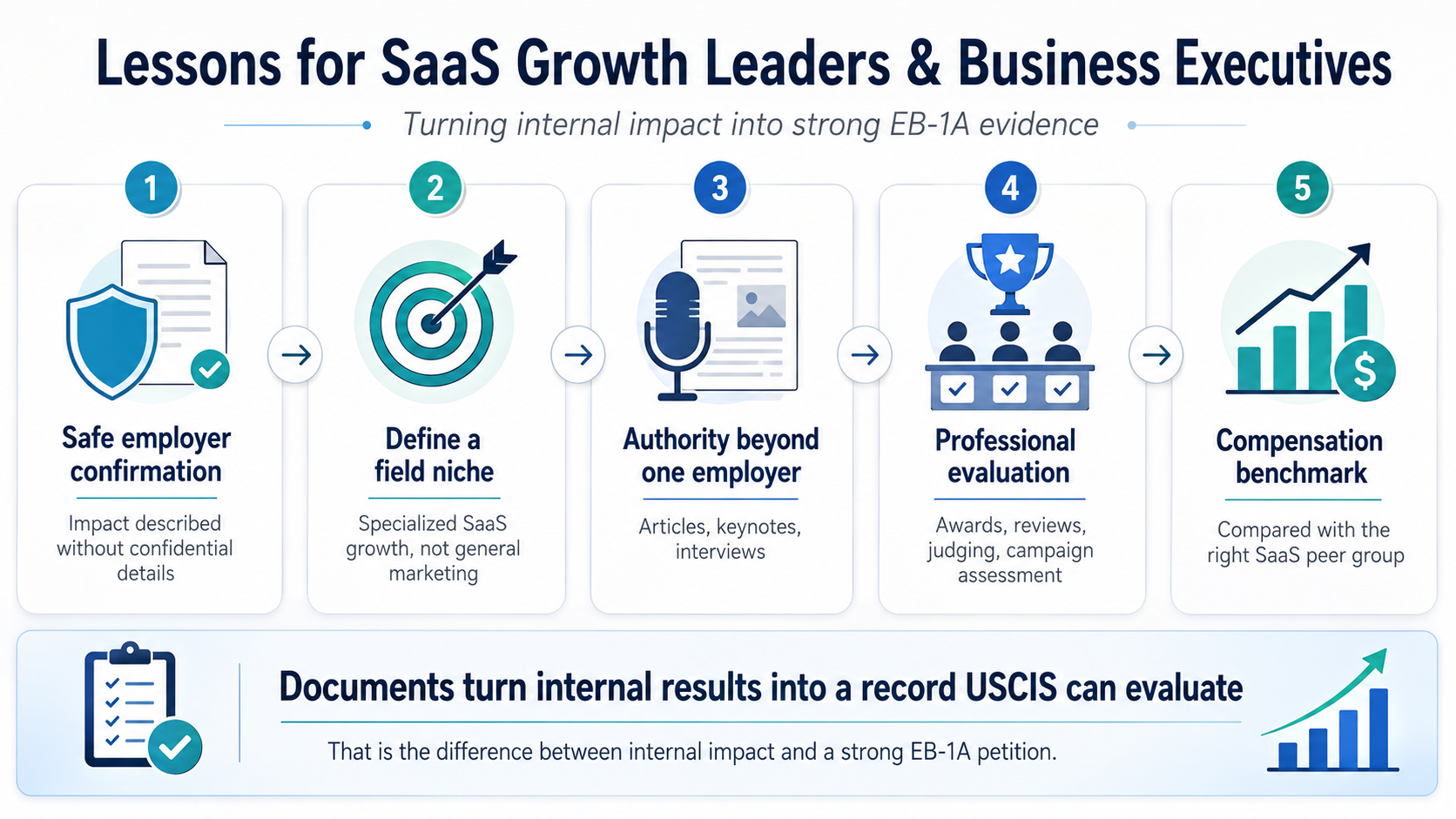
This case is useful for SaaS marketers, growth executives, revenue leaders, product marketers, demand-generation leaders, and business operators whose strongest results are real but mostly internal.
A strong record usually begins with the following questions:
- Can your employer confirm your impact in safe, non-confidential terms?
- Can your work be defined as a specialized field niche rather than general marketing?
- Do your articles, keynotes, or interviews show authority beyond one employer?
- Have you judged awards, evaluated campaigns, reviewed startup growth work, or assessed other professionals in the field?
- Can your compensation be benchmarked against the correct SaaS growth or enterprise software peer group?
When those questions are answered with documents, a business career can become a record USCIS can evaluate. That is the difference between strong internal impact and a strong EB-1A petition.
Frequently asked questions
Can a marketing executive qualify for EB-1A?
Yes. A marketing executive may qualify for EB-1A if the evidence shows sustained acclaim and extraordinary ability in a clearly defined marketing or business field. The petition must document the executive’s own recognition, leadership, contribution, and measurable impact.
Can confidential revenue growth support an EB-1A petition?
It can support the petition when the information is documented safely. Useful evidence may include employer-cleared impact briefs, executive letters, non-confidential metric summaries, compensation records, public case studies, and independent commentary that explains the petitioner’s contribution.
SaaS growth marketing a strong EB-1A field niche?
It can be strong when defined carefully. Product-led growth marketing for enterprise SaaS is more specific than general marketing and can be supported by evidence involving product analytics, customer acquisition, retention, expansion revenue, market entry, and revenue operations.
Does high remuneration help a SaaS executive’s EB-1A case?
High remuneration can help when compensation is documented and compared to the right peer group. For a SaaS growth-marketing executive, the comparison should be against relevant enterprise software, product-led growth, revenue leadership, and senior marketing roles.
Can judging marketing awards support the EB-1A judging criterion?
It may support the criterion when the petitioner was invited to evaluate the work of other professionals and the judging body, selection process, and evaluation responsibilities are properly documented. The petition should explain why the judging role reflects field trust.
Can Immignis and Advance My Profile help business executives build EB-1A evidence?
Immignis and Advance My Profile help business executives, SaaS leaders, marketers, founders, and growth professionals identify a focused field niche, organize impact evidence, document recognition, and build a professional record that can be presented clearly in an EB-1A petition.
Build an EB-1A record around measurable business impact
Many SaaS and growth leaders are highly valuable inside their companies but almost invisible outside them. Employer-cleared impact briefs, public authorship, keynotes, judging roles, salary benchmarking, and industry recognition can support an EB-1A case when organized around a clear professional niche.