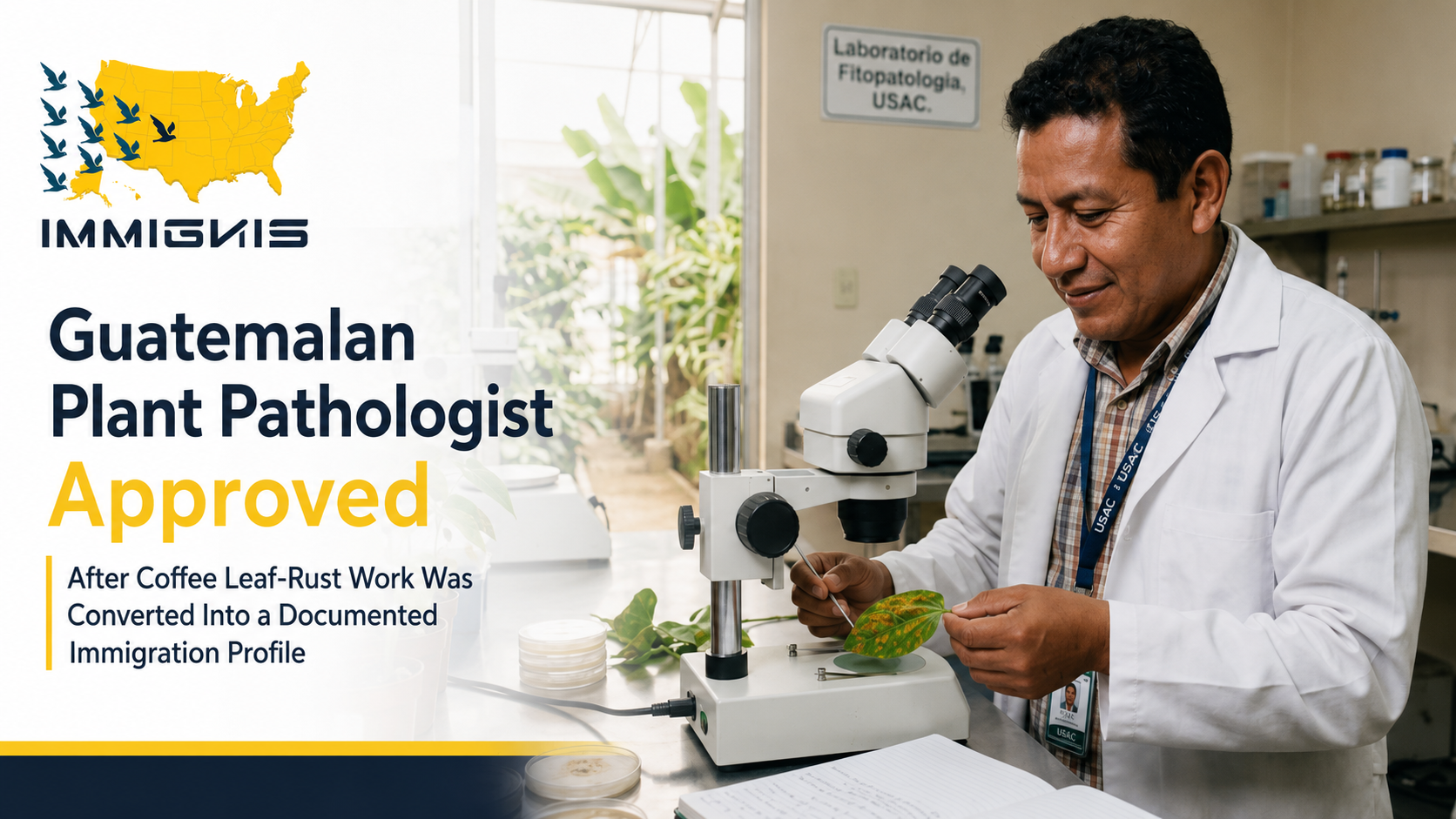
EB-1A Plant Pathologist: How a Guatemalan plant pathologist secured EB-1A approval by turning resistant-variety work, coffee leaf-rust epidemiology, farmer-facing extension impact, regional research leadership, coffee-sector letters, publication strategy, and international phytopathology roles into a petition-ready immigration profile through ethical profile building.
Key facts at a glance
| Petition outcome | Form I-140 approved under EB-1A on October 24, 2024. |
| Professional profile | Guatemalan plant pathologist whose resistant-variety and disease-management work responded to coffee leaf-rust epidemics affecting smallholder farmers. |
| Field niche | Coffee leaf-rust epidemiology and management. |
| Starting weakness | The work reached farmers and extension systems, but the strongest impact did not naturally appear in journals, citations, or individual public recognition. |
| Profile-building focus | Variety-adoption documentation, publication push, regional research-network leadership, industry coffee-sector letters, international phytopathology roles, peer review, and immigration-specific profile building. |
| EB-1A criteria supported | Original contributions, scholarly articles, leading role, membership, and judging. |
| Central issue | Showing that farmer-facing plant-disease work was not routine extension service, but a field-significant contribution to coffee rust management, resistant-variety adoption, and smallholder livelihood protection. |
| Approval lesson | Agricultural scientists can build strong EB-1A profiles when practical adoption, farmer impact, and industry validation are converted into person-centered, USCIS-ready evidence. |
The approval
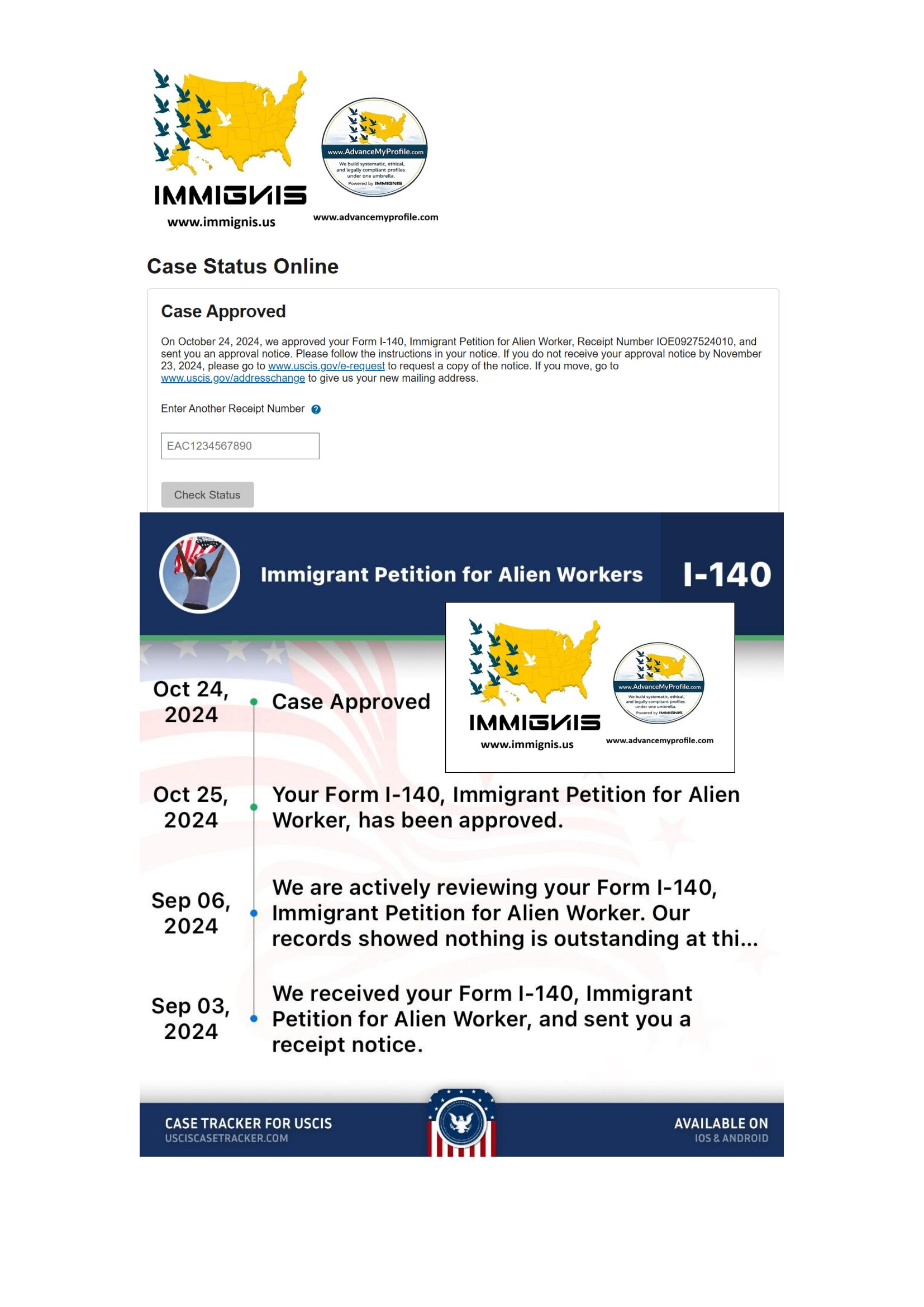
On October 24, 2024, USCIS approved the Form I-140 petition of a Guatemalan plant pathologist whose work focused on coffee leaf-rust epidemiology and management.
The approval was important because the petitioner worked in a field where the most meaningful results often occur outside conventional academic visibility. Coffee leaf rust can devastate harvests, incomes, and long-term farm stability, especially for smallholders. Yet the scientists behind resistant-variety work, disease monitoring, and farmer-facing management systems are often hidden behind extension programs, research networks, or institutional reports.
That made the case a strong example of EB-1A profile building, agricultural profile building, and immigration profile building. The petitioner already had significant practical impact, but the evidence had to be reorganized so USCIS could understand why disease-management work in coffee systems reflected extraordinary ability.
Immignis and Advance My Profile helped convert the petitioner's record into a petition-ready EB-1A profile. The strategy focused on variety-adoption documentation, a publication push, regional research-network leadership, industry coffee-sector letters, international phytopathology roles, judging and peer review, and ethical profile building that made farmer-facing science legally legible.
The evidence problem in coffee leaf-rust science
Coffee leaf-rust epidemiology and management is a narrow but high-impact field. The work sits at the intersection of plant pathology, climate pressure, crop genetics, resistant-variety deployment, farm-level disease management, and regional agricultural economics. When rust epidemics spread, the consequences are not theoretical. They affect yields, export revenue, rural employment, and the livelihoods of smallholder families.
The challenge was that this type of work does not always produce a clean academic record. Extension activity reaches farmers, cooperatives, agronomists, and producer groups, but it may not create the same citation footprint as laboratory research. Disease alerts, field recommendations, and variety-adoption support may be central to the industry but not prominently tied to one scientist's name.
That was the petitioner's starting weakness. The science mattered, and the results were visible in farms and coffee-sector decisions, but the individual paper trail was incomplete. Without profile improvement, the record could look like routine agricultural support rather than original contribution to a specialized plant-disease field.
The petition therefore defined the field precisely as coffee leaf-rust epidemiology and management. It did not present the petitioner as a general agronomist or broad agricultural consultant. It framed the case around a specific disease burden, a specific crop system, a specific smallholder economy, and a specific scientific problem with regional significance.
That field definition gave USCIS a measuring stick. It explained why resistant varieties, rust-management protocols, field monitoring, coffee-sector letters, and phytopathology roles were meaningful indicators of top-level expertise in this particular niche.
Why extension impact had to be treated as evidence, not background
One of the main risks in this case was that extension work could be misunderstood as routine outreach. In agricultural science, however, extension can be the point where research becomes real-world impact. A model, variety, or disease-management method only matters if growers, cooperatives, and industry actors can apply it successfully.
The petition addressed that problem directly. It did not treat the petitioner's farmer-facing work as background service. It treated it as evidence of original contribution, adoption, and practical significance. The record showed how the petitioner's work helped translate coffee rust science into tools that producers could use during damaging disease pressure.
This was a critical immigration-specific profile-building step. USCIS needed to see that the petitioner was not only communicating existing science, but helping shape the disease-management response through resistant-variety work, field guidance, and regional technical leadership.
For agricultural professionals searching for profile building, EB-1A profile building, EB-2 NIW profile building, professional profile building, or immigration profile building, this is an important lesson: extension evidence becomes powerful when it is connected to adoption, authorship, and measurable field influence.
Variety-adoption documentation made farmer impact measurable
Variety-adoption documentation became one of the strongest pillars of the case. In coffee rust management, resistant varieties and appropriate disease-management systems can change outcomes at farm, cooperative, and regional levels. But adoption must be documented carefully if it is going to support an EB-1A original-contribution argument.
The petition organized adoption evidence around the petitioner's role in research, evaluation, recommendations, technical guidance, and implementation support. It connected the science to actual use by growers, producer organizations, or regional programs. That made the contribution easier for USCIS to evaluate.
This evidence showed that the petitioner's work did not remain abstract. It entered the production environment. It influenced how coffee-sector stakeholders responded to rust pressure and helped protect smallholder livelihoods through better disease-management choices.
As part of profile improvement and immigration-specific profile building, adoption documentation turned practical agricultural impact into a structured EB-1A evidence pillar. It showed scale, relevance, and person-centered attribution.
A publication push gave the field work a stronger scholarly record
Publication evidence was also important because the petitioner's strongest work had not always appeared in conventional academic channels. Agricultural extension, field trials, disease monitoring, and variety evaluation often move faster than journal pipelines. Still, EB-1A benefits from a public technical record that shows the petitioner's knowledge can stand in scholarly or professional form.
The publication push helped convert field experience into written scientific authority. Articles, technical papers, case studies, or applied research publications allowed the petitioner to explain coffee leaf-rust epidemiology, resistant-variety adoption, and management recommendations in a format that USCIS could connect to the scholarly-articles criterion.
This did not mean inventing scholarship after the fact. It meant organizing real field knowledge into a visible record. The petitioner's work already existed in practice; publication profile building helped make it reviewable, searchable, and professionally recognizable.
For scientific profile building and professional profile building for immigration, this step was essential. It helped bridge the gap between field impact and adjudicator-readable evidence.
Regional research-network leadership showed authority beyond one employer
Regional research-network leadership helped show that the petitioner's expertise was not limited to one lab, one farm group, or one institution. Coffee rust is a regional problem. Disease pressure, variety performance, climate conditions, and management practices move across borders and production systems.
The petition used research-network leadership to show that other scientists, producer groups, or agricultural organizations looked to the petitioner for technical coordination and disease-management insight. This supported both leading role and final merits because it placed the petitioner inside the professional structure of the field.
The record also explained why regional leadership mattered. In a field like coffee leaf-rust management, recognized expertise may appear through technical working groups, research networks, trial coordination, grower training platforms, and disease-response collaboration rather than through highly public academic appointments alone.
This was valuable profile building because it made the petitioner visible as a field actor, not merely a contributor inside an institution. It helped USCIS understand the professional hierarchy of a practical agricultural science niche.
Coffee-sector letters created independent validation
Industry coffee-sector letters were critical because they translated the science into practical significance. Letters from breeder associations, producer organizations, cooperatives, industry leaders, or regional coffee stakeholders can explain why a plant pathologist's work mattered to the people who depended on disease-management decisions.
The strongest letters did more than praise the petitioner. They connected the petitioner's work to variety adoption, rust-response strategy, farmer training, disease-management outcomes, or smallholder resilience. They also clarified why the petitioner's contribution was distinctive rather than routine.
This evidence supported original contributions and leading role because it provided independent confirmation that the petitioner's science affected the field outside academic circles. In a farmer-facing discipline, industry validation can be just as important as academic recognition when it is specific, credible, and tied to measurable adoption.
As part of ethical profile building, these letters did not exaggerate the petitioner as the sole reason smallholders survived rust pressure. They explained the petitioner's real role in a larger scientific and agricultural response.
International phytopathology roles and judging strengthened the final merits picture
International phytopathology roles helped place the petitioner inside the broader plant-disease community. Membership, committee activity, technical participation, conference engagement, peer review, or evaluative service showed that the petitioner was not working only in a local extension environment.
Judging and peer review were especially helpful. These roles showed that the field trusted the petitioner to evaluate research, assess technical work, review methods, or help judge professional quality. In EB-1A terms, that kind of responsibility can be powerful because it demonstrates recognition by professional peers.
The petition connected these roles to the petitioner's coffee rust specialization. It showed that the same expertise used to support smallholders also placed the petitioner in a position to evaluate others' work in plant pathology and crop-disease management.
For EB-1A profile building, this evidence helped complete the final merits analysis. It showed not only impact and publication, but also professional trust, technical authority, and recognition within the field.
How profile building changed the case
The case changed once the evidence was reorganized around the petitioner's actual scientific contribution. Before profile building, the work could have been seen as agricultural extension activity scattered across farmers, cooperatives, research networks, and program records. After profile building, the same work appeared as a coherent career in coffee leaf-rust epidemiology and management.
Immignis and Advance My Profile helped build that structure. The profile-building process connected resistant-variety work, adoption evidence, publications, regional research leadership, coffee-sector letters, international phytopathology roles, judging, and smallholder impact into one immigration-ready record.
This was not artificial branding. It was profile improvement and immigration-specific profile building. The purpose was to make real agricultural science visible in the language USCIS uses to evaluate extraordinary ability.
For scientists searching online for profile building, immigration profile building, EB-1A profile building, EB-2 NIW profile building, agriculture profile building, research profile improvement, publication profile building, or USCIS evidence building, this case shows how practical field impact can become a strong extraordinary-ability record.
Why this case worked
The case worked because it avoided a vague agricultural-service story. It did not say only that the petitioner helped farmers or worked on an important crop disease. It proved a narrower and stronger point: that the petitioner contributed to coffee leaf-rust epidemiology and management in a way that affected adoption, disease response, and smallholder livelihoods.
Variety-adoption documentation made the contribution measurable. Publications created a scholarly record. Research-network leadership established authority. Coffee-sector letters provided independent validation. International phytopathology roles and judging showed professional trust.
Most importantly, the petition solved the extension-work problem. It showed that farmer-facing science can be original, significant, and top-of-field when it changes how a crop sector responds to a major disease burden.
That is why the approval hook was strong: smallholder livelihoods became the significance narrative behind the science. The petition did not treat farmer impact as a soft humanitarian detail. It treated it as proof that the science mattered.
Conclusion
The Guatemalan plant pathologist's EB-1A approval shows that agricultural scientists can build strong extraordinary-ability cases even when their most important work happens outside high-citation academic channels.
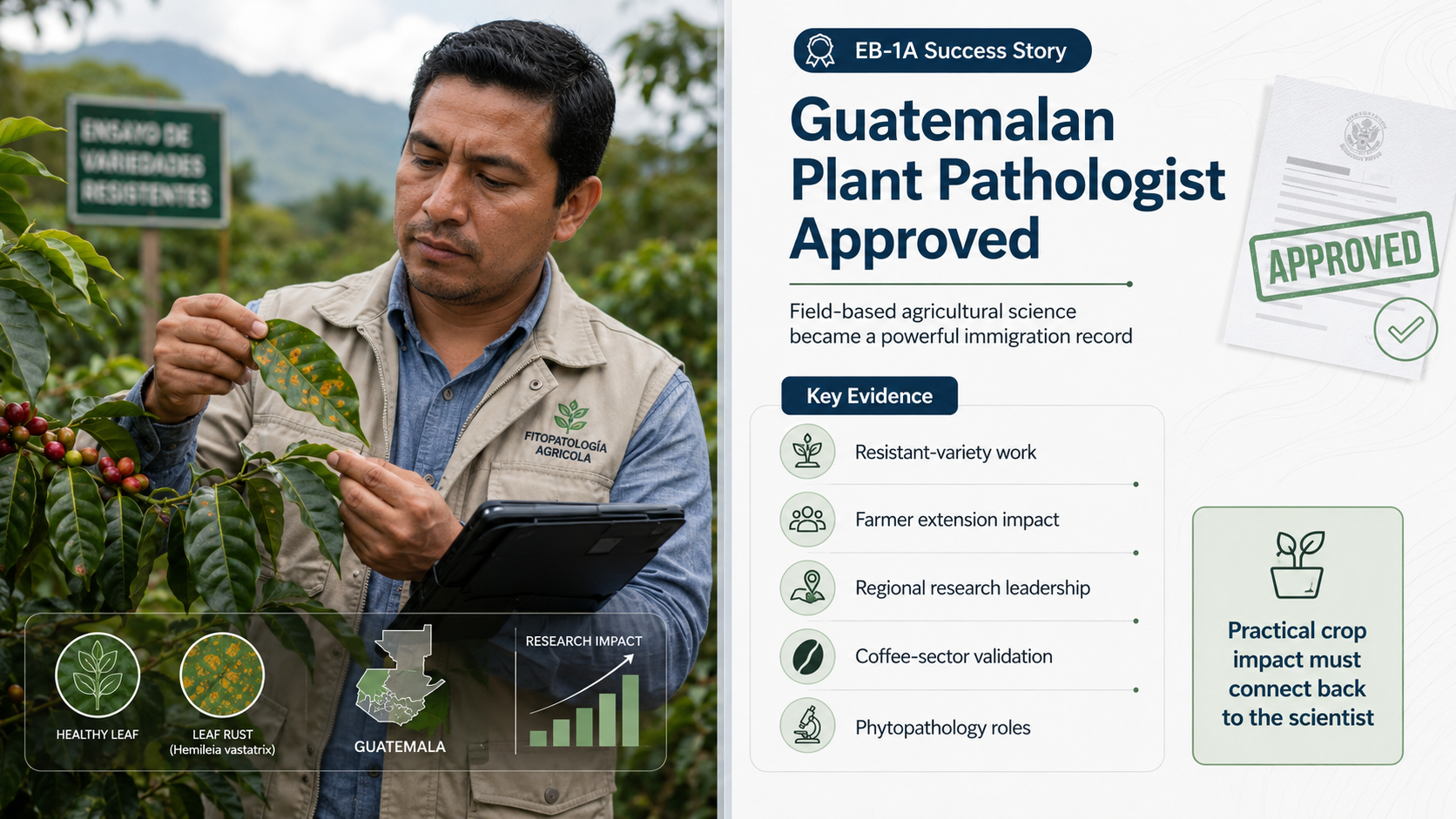
The petition succeeded because it used ethical profile building to convert resistant-variety work, farmer-facing extension impact, regional research leadership, publication, coffee-sector validation, and phytopathology roles into a structured immigration profile.
The broader lesson is clear: when science protects crops, livelihoods, and national export systems, the evidence must connect that practical impact back to the scientist. With careful profile improvement and immigration-specific profile building, field-based agricultural work can become a powerful EB-1A record.
Frequently asked questions
Can a plant pathologist qualify for EB-1A?
Yes. A plant pathologist may qualify for EB-1A when the record shows extraordinary ability through original contributions, scholarly articles, leading roles, professional membership, judging, and strong final-merits evidence.
Can coffee leaf-rust research support an EB-1A petition?
Yes. Coffee leaf-rust epidemiology, resistant-variety work, disease-management strategy, and crop-protection research can support EB-1A when the petition documents field significance and personal contribution.
Can farmer-facing extension work count as EB-1A evidence?
Yes. Extension work can be powerful evidence when it is tied to adoption, measurable outcomes, industry validation, and the petitioner's original role in the science or implementation strategy.
Do coffee-sector letters help an agricultural EB-1A case?
Yes. Letters from breeder associations, cooperatives, producer organizations, research networks, or industry leaders can help prove that the petitioner's work mattered outside academia.
Can publication profile building help agricultural scientists?
Yes. Publication profile building can help turn field knowledge, trials, disease-management methods, and applied research into a public record that supports EB-1A or EB-2 NIW evidence strategy.
Can Immignis and Advance My Profile help agricultural scientists build EB-1A evidence?
Yes. Immignis and Advance My Profile help agricultural scientists, plant pathologists, crop researchers, extension experts, and food-security professionals define a precise field niche, document impact, improve visibility, and build a petition-ready immigration profile through ethical profile building.
Build an EB-1A record around agricultural science, crop-disease expertise, and smallholder impact
Many agricultural scientists already have meaningful field impact, but the evidence is often scattered across extension programs, cooperative records, research networks, industry reports, publication drafts, and technical letters.