EB-1A Construction Engineer: How a Jamaican structural engineer secured EB-1A approval by turning low-cost hurricane-resistant construction methods, post-storm performance documentation, building-code contribution records, engineering publication, regional disaster-agency letters, construction-industry training leadership, and immigration-specific profile building into a petition-ready extraordinary-ability record.
Key facts at a glance
| Petition outcome | Form I-140 approved under EB-1A on February 10, 2025. |
| Professional profile | Jamaican structural engineer whose hurricane-resilient building methods survived storms that damaged or flattened neighboring structures. |
| Field niche | Low-cost hurricane-resistant construction for the Caribbean. |
| Starting weakness | The strongest proof was physical survival after storms, but standing buildings are not automatically petition-ready paperwork. |
| Profile-building focus | Post-storm performance documentation, building-code contribution records, engineering publication, regional disaster-agency letters, construction-industry training leadership, expert letters, and ethical immigration profile building. |
| EB-1A criteria supported | Original contributions, leading role, scholarly articles, published material, and judging. |
| Central issue | Showing that the petitioner did not simply design good buildings, but developed and disseminated construction methods with broader significance for hurricane-prone Caribbean communities. |
| Approval lesson | Storm performance can become powerful EB-1A evidence when profile building converts damage surveys, code contributions, training records, and independent disaster-agency validation into a clear immigration profile. |
The approval
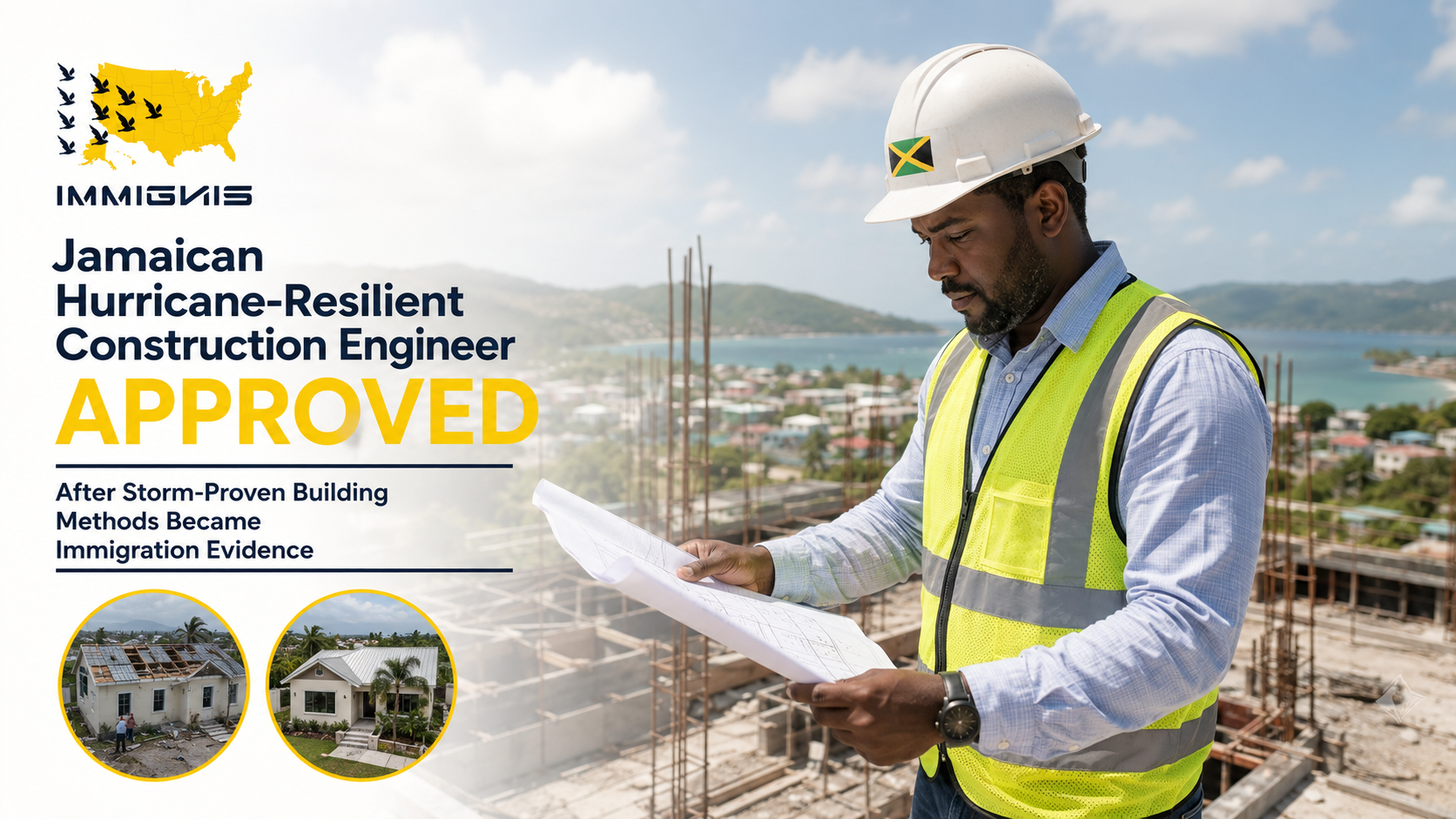
On February 10, 2025, USCIS approved the Form I-140 petition of a Jamaican hurricane-resilient construction engineer whose work focused on low-cost hurricane-resistant construction for the Caribbean.
The approval was important because the petitioner worked in a field where some of the strongest evidence does not begin as paper. A building that remains standing after a major storm can say more than a brochure, but USCIS still needs documentary proof, attribution, expert explanation, and a clear link between the physical result and the person who created the method.
That made the case a strong example of EB-1A profile building, engineering profile building, construction profile building, and immigration profile building. The petitioner already had real field impact, but the record needed to be organized so a non-engineer immigration officer could understand why storm survival, code influence, and regional training showed extraordinary ability rather than routine engineering competence.
Immignis and Advance My Profile helped convert the record into a petition-ready EB-1A profile. The strategy focused on post-storm performance documentation, building-code contribution records, engineering publication, regional disaster-agency letters, construction-industry training leadership, expert letters, and immigration-specific profile building that made the petitioner’s work legible under EB-1A criteria.
The evidence problem in hurricane-resilient construction
Low-cost hurricane-resistant construction is a high-impact engineering niche because it deals with the practical question of whether homes, schools, clinics, and small commercial structures can survive severe storms without becoming financially impossible to build. In the Caribbean, that question is not theoretical. It affects public safety, insurance loss, recovery time, displacement, and local economic resilience.
The challenge was that engineering proof in this field often appears after disaster. The evidence may be a roof that stayed on, a wall system that held, a structure that remained habitable, or a neighborhood comparison after a storm. Those facts can be dramatic, but they do not automatically identify the engineer, the method, the design logic, or the broader significance of the work.
That was the petitioner’s starting weakness. Buildings standing after storms were proof, but not paperwork. The record needed to move from visual and practical survival to documented engineering significance. It also had to separate the petitioner’s contribution from contractors, developers, clients, and general construction teams.
The petition therefore defined the field precisely as low-cost hurricane-resistant construction for the Caribbean. It did not present the petitioner as a general structural engineer. It presented a specialized professional whose methods responded to a regional hazard environment and whose work helped translate resilience engineering into practical construction systems.
That field definition gave USCIS a measuring stick. It explained why post-hurricane performance, code-related work, disaster-agency validation, training leadership, and engineering publications were meaningful indicators of extraordinary ability in this particular niche.
Why post-storm performance had to be documented like peer review
One of the strongest ideas in the case was also the approval hook: post-hurricane damage surveys functioned as the most dramatic peer review in engineering. In a controlled academic setting, a paper is reviewed by experts. In hurricane engineering, the design is reviewed by wind, water, debris impact, roof uplift, construction quality, and the reality of whether people can safely return home afterward.
The petition used that concept carefully. It did not exaggerate storm survival as magic or luck. It documented what survived, what failed nearby, what the petitioner’s method changed, and how the performance could be attributed to design choices rather than coincidence.
This was a critical immigration-specific profile-building step. USCIS needed evidence that the petitioner’s work had been tested in real conditions and that those results were significant within the field. Damage surveys, photographs, inspection records, expert explanations, and client or agency confirmations helped turn physical performance into adjudicator-readable evidence.
For professionals searching for profile building, EB-1A profile building, EB-2 NIW profile building, professional profile building, or immigration profile building, this case shows that real-world performance can be stronger than ordinary publicity when it is documented correctly.
Post-storm performance documentation made the contribution measurable
Post-storm performance documentation became one of the strongest pillars of the case. The petition organized the evidence around actual storm events, comparison structures, damage patterns, repair needs, and the design features that explained why the petitioner’s buildings performed better than surrounding stock.
This evidence was not presented as a general claim that the engineer built strong structures. It was connected to specific engineering methods: load paths, roof anchoring, material choices, structural detailing, foundation logic, construction sequencing, and cost-conscious resilience strategies appropriate for Caribbean communities.
The record also emphasized affordability. In hurricane-prone regions, an engineering method that survives storms but is too expensive to scale may have limited public value. The petitioner’s niche was low-cost hurricane-resistant construction, so the evidence had to show that resilience was achieved in a way that builders and communities could realistically adopt.
As part of profile improvement and USCIS evidence building, the documentation converted field performance into a structured EB-1A argument. It showed that the petitioner’s original contributions were practical, measurable, and relevant to a serious regional need.
Building-code contribution records showed field-level influence
Building-code contribution records helped move the case beyond individual projects. For a structural engineer, influence on standards, codes, technical guidance, or compliance practices can be strong evidence that the field has recognized the person’s expertise.
The petition organized records showing how the petitioner contributed to discussions or technical materials related to hurricane-resistant design, safer construction practices, or regional resilience standards. This evidence helped demonstrate that the petitioner was not only applying existing rules, but helping shape how the field understood safer and more practical construction.
This was especially important because EB-1A requires more than being good at one’s job. Code contribution records helped show that the petitioner’s knowledge had value to others in the industry, including regulators, builders, disaster agencies, or professional bodies.
For engineering profile building and immigration-specific profile building, this kind of evidence is powerful because it shows a contribution beyond a single employer or client. It places the petitioner inside the professional infrastructure of the field.
Engineering publication gave the practical work a technical record
Engineering publication helped formalize the petitioner’s practical methods. A hurricane-resistant construction technique may exist first in drawings, job sites, inspections, and field performance, but USCIS benefits from seeing the work explained in a written technical format.
The publication record showed that the petitioner’s methods could be described, analyzed, and shared as engineering knowledge. Articles, technical papers, case studies, design notes, or applied engineering publications helped convert construction practice into a visible professional record.
This supported the scholarly-articles and published-material criteria while also reinforcing original contributions. It showed that the petitioner’s work was not merely a private building method, but a technical approach that could inform the broader field of hurricane-resilient construction.
As part of publication profile building, professional profile building, and immigration profile building, this step bridged the gap between field-tested performance and formal adjudication. It gave the officer a paper trail to match the buildings that remained standing.
Regional disaster-agency letters created independent validation
Regional disaster-agency letters were critical because they supplied independent validation from organizations that understood the stakes. In hurricane engineering, disaster agencies, emergency-management professionals, and resilience stakeholders are often better positioned than ordinary clients to explain why a building method matters.
The strongest letters did more than praise the petitioner as a competent engineer. They explained how the construction methods performed, why they were relevant to disaster preparedness, how they helped reduce risk, and why the petitioner’s work had significance for Caribbean communities facing repeated storm exposure.
This evidence helped support original contributions and leading role. It also gave the final merits analysis a stronger public-interest dimension because the petitioner’s work was tied to safety, continuity, disaster recovery, and resilience rather than only private construction success.
As part of ethical profile building, the letters were used to confirm real impact without overstating the petitioner as the sole reason a community was protected. They showed that the petitioner’s engineering methods formed a meaningful part of a broader resilience solution.
Construction-industry training leadership showed dissemination
Construction-industry training leadership helped show that the petitioner’s work did not stop at individual designs. In practical engineering fields, training builders, inspectors, contractors, technicians, and younger engineers can be one of the clearest indicators that a method is influencing the profession.
The petition documented training leadership through workshops, curriculum materials, technical sessions, contractor guidance, professional presentations, and industry education activity. This evidence helped prove that others relied on the petitioner’s expertise to improve hurricane-resilient construction practices.
Training also helped support judging and leading-role arguments when the petitioner was asked to evaluate construction quality, review technical approaches, assess resilience practices, or guide professional standards. These roles showed that the field trusted the petitioner not only to design but also to teach and assess.
For profile building services, construction profile improvement, and professional profile building for immigration, training evidence is especially valuable because it shows knowledge transfer. USCIS can see that the petitioner’s expertise moved from private projects into the wider industry.
How profile building changed the case
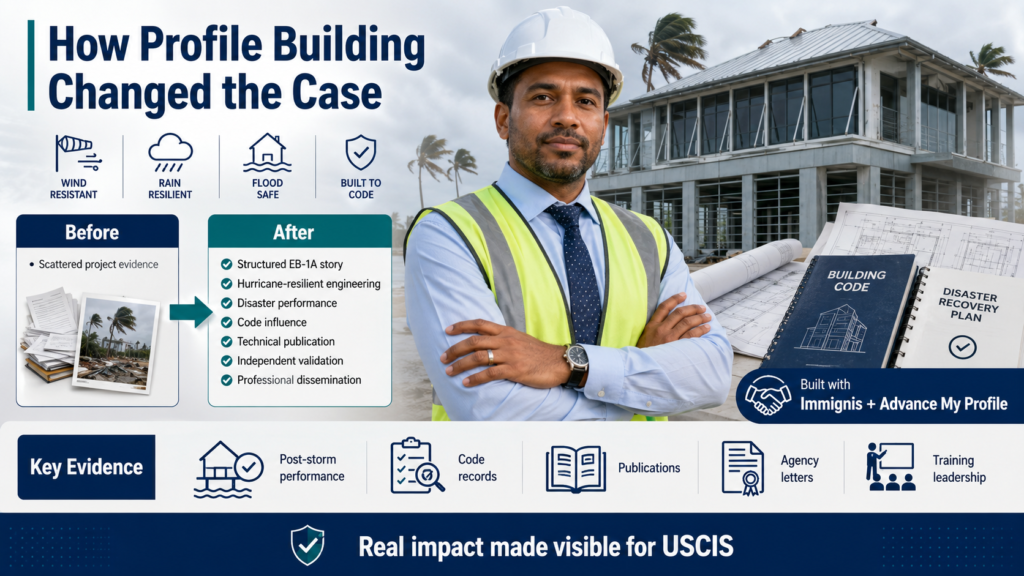
The case changed once the evidence was reorganized around the petitioner’s actual contribution. Before profile building, the record could have looked like a successful construction career supported by strong but scattered project evidence. After profile building, it became a structured EB-1A story about hurricane-resilient engineering, disaster performance, code influence, technical publication, independent validation, and professional dissemination.
Immignis and Advance My Profile helped build that structure. The profile-building process connected post-storm performance, building-code records, publications, disaster-agency letters, and training leadership to the EB-1A criteria that mattered most.
This was not artificial branding. It was profile improvement and immigration-specific profile building. The purpose was to make real engineering impact visible in the form USCIS expects, while keeping the story grounded in verifiable facts.
For engineers searching online for profile building, immigration profile building, EB-1A profile building, EB-2 NIW profile building, engineering profile building, construction profile building, or professional profile improvement, this case shows how field-tested work can become a strong immigration profile when the evidence is assembled properly.
Why this case worked
The case worked because it avoided a vague disaster-resilience narrative. It did not say only that the petitioner cared about safer buildings or worked in a hurricane-prone region. It showed how the petitioner’s specific methods performed, how those methods were documented, how others recognized the contribution, and how the work influenced construction practice.
Post-storm performance documentation made the contribution measurable. Building-code contribution records showed field influence. Engineering publication created a technical paper trail. Disaster-agency letters supplied independent validation. Training leadership showed dissemination and professional trust.
Most importantly, the petition translated a physical fact into legal evidence. Buildings that survived storms became more than impressive examples. They became documented proof of original engineering contribution, leadership, and field significance.
That is why the approval hook was strong: post-hurricane damage surveys became the petitioner’s peer review. The storms tested the work, and the petition made the results count.
Conclusion
The Jamaican hurricane-resilient construction engineer’s EB-1A approval shows that practical engineering impact can support an extraordinary-ability petition when the evidence is documented with discipline and framed around a precise field niche.
The petition succeeded because it used ethical profile building to convert storm-tested building performance, code contributions, engineering publication, disaster-agency validation, and construction-industry training into a clear USCIS record.
The broader lesson is clear: in fields where the proof stands in concrete, steel, timber, and roof systems, immigration evidence must still connect the physical result back to the person. When that connection is made properly, real-world engineering performance can become a powerful EB-1A profile.
Frequently asked questions
Can a structural engineer qualify for EB-1A?
Yes. A structural engineer may qualify for EB-1A when the record shows extraordinary ability through original contributions, leading roles, publications, judging, published material, membership, and strong final-merits evidence.
Can hurricane-resistant construction work support an EB-1A petition?
Yes. Hurricane-resistant construction work can support EB-1A when the evidence shows that the petitioner created or significantly advanced methods with measurable performance, recognized field value, and impact beyond routine project execution.
Can post-storm damage surveys be used as immigration evidence?
Yes. Post-storm damage surveys can be powerful evidence when they document how specific buildings performed, connect that performance to the petitioner’s design methods, and include independent expert or agency confirmation.
Do building-code contributions help an engineering EB-1A case?
Yes. Building-code contributions, technical standards work, or recognized participation in resilience guidance can help show field-level influence and original contribution.
Can training builders or engineers support EB-1A criteria?
Yes. Construction-industry training can support leading role, judging, original contribution, and final merits arguments when it shows that others rely on the petitioner’s expertise to improve professional practice.
Can Immignis and Advance My Profile help engineers build EB-1A or EB-2 NIW evidence?
Yes. Immignis and Advance My Profile help engineers, construction experts, disaster-resilience specialists, and technical professionals build stronger immigration profiles through ethical profile building, evidence development, publication strategy, expert letters, and USCIS-ready documentation.
Build an EB-1A record around engineering impact, construction evidence, and disaster-resilience expertise
Many engineers already have high-value technical achievements, but the evidence is often scattered across project files, internal records, drawings, inspection reports, code discussions, client letters, conference activity, and field performance data.