How an Armenian astrophysicist secured EB-1A approval by turning stellar-survey contributions, variable-object detection work, international collaboration roles, scholarly articles, telescope time-allocation committee service, science-media visibility, and immigration-specific profile building into a petition-ready record of extraordinary ability.
Key facts at a glance
| Petition outcome | Form I-140 approved under EB-1A on October 18, 2024. |
| Professional profile | Armenian observatory scientist continuing a storied astronomical tradition through modern stellar-survey research and variable-object detection. |
| Field niche | Stellar-survey astrophysics and variable-object detection. |
| Starting weakness | The petitioner worked within a prestigious heritage institution, but modern citation counts were modest and the strongest contributions were spread across survey teams, telescope access, collaboration records, and technical discovery work. |
| Profile-building focus | Survey-contribution documentation, international collaboration roles, publication strategy, telescope time-allocation committee service, science-media features, expert letters, and ethical immigration-specific profile building. |
| EB-1A criteria supported | Scholarly articles, judging through telescope time-allocation committees, original contributions, membership, and published material. |
| Central issue | Showing that modest citation counts did not define the petitioner’s standing because astronomy often recognizes expertise through survey responsibility, telescope access decisions, collaboration roles, observation infrastructure, and peer evaluation. |
| Approval lesson | Astrophysics cases can succeed when profile building connects publications, survey contribution, committee service, collaboration records, science communication, and peer validation into one coherent immigration profile. |
The approval
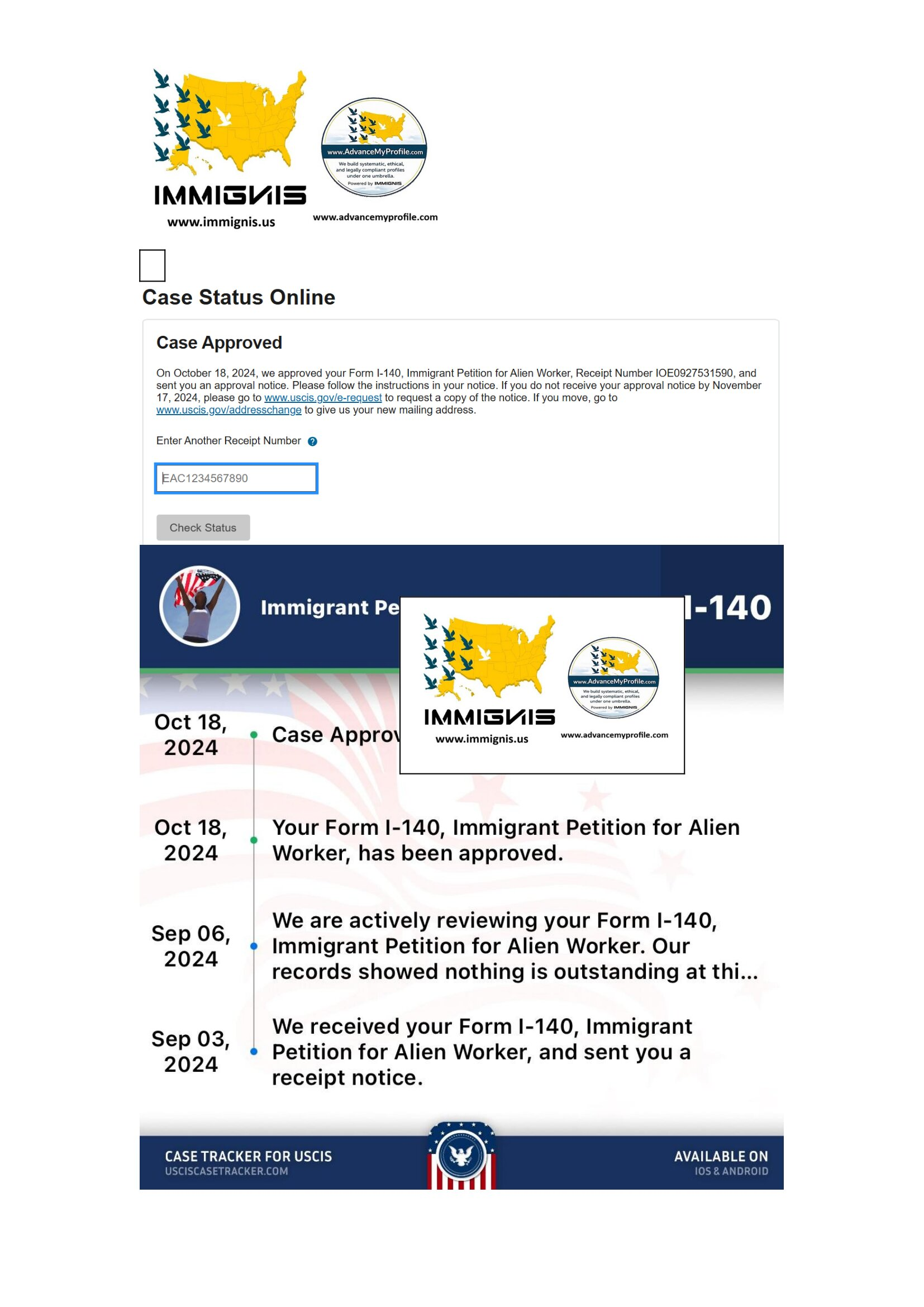
On October 18, 2024, USCIS approved the Form I-140 petition of an EB-1A for Astrophysicists whose work focused on stellar-survey astrophysics and variable-object detection.
The approval was significant because the petitioner did not rely on very high citation counts alone. Instead, the case showed a broader professional record: contribution to survey work, scholarly publication, international collaboration, committee-based judging, science-media visibility, and a documented role in modern observational astronomy.
The petitioner’s starting weakness was common in astronomy cases. A scientist may contribute to a respected observatory, participate in important surveys, and help identify variable objects, yet still appear modest on paper if citations are not high or if collaborative work dilutes individual authorship.
Immignis and Advance My Profile helped structure the record through ethical profile building, professional profile building, and immigration-specific profile building. The strategy turned a quiet but credible scientific career into a petition ready EB-1A profile.
Why astronomy cases require field-specific evidence strategy
Astrophysics is not evaluated in the same way as many other scientific fields. Some recognition appears through publications and citations, but much of the field’s professional trust is also shown through telescope access, survey responsibility, collaboration invitations, observing programs, data-release contributions, committee service, and specialized peer review.
That is why the petition defined the field niche carefully as stellar-survey astrophysics and variable-object detection. This made the evidence easier to understand. The case was not about a generic physicist. It was about a specialist working in observational astronomy where survey participation and variable-object identification can carry real scientific importance.
This field definition helped explain why modest citation counts did not end the analysis. In survey-based science, the importance of a contribution can appear through database use, observational infrastructure, catalog work, international collaboration, and expert reliance, not only through a single citation metric.
For professionals searching for EB-1A profile building, EB-2 NIW profile building, immigration profile building, profile improvement, or professional visibility, this case shows why the first step is defining the field correctly. The petition must teach the officer how achievement is recognized inside that field.
Survey-contribution documentation turned team science into personal evidence
One of the strongest parts of the case was survey-contribution documentation. Modern astronomy is often team-based, which creates a difficult EB-1A evidence problem: the project may be important, but the individual scientist’s role can be hard to see.
The petition therefore documented the petitioner’s specific role in survey planning, observation strategy, data analysis, variable-object detection, catalog contribution, classification work, or follow-up interpretation. The goal was to show exactly what the petitioner contributed and why that contribution mattered.
This supported original contributions because the evidence connected the petitioner’s work to scientific outputs used by other astronomers. It also showed that the petitioner was not merely present inside a famous institution, but actively contributing to the modern research program attached to it.
In immigration-specific profile building, this type of evidence is critical. Team science can be persuasive only when the petition separates the person from the project and explains the person’s identifiable scientific role.
Telescope time-allocation committee service became a powerful judging criterion
The approval hook in this case was telescope time-allocation committee service. In astronomy, access to observing time is one of the field’s most important competitive resources. Scientists who help evaluate proposals are not performing routine administration; they are judging the work of other professionals.
This made the judging criterion especially strong. A time-allocation committee evaluates scientific merit, feasibility, priority, and the value of proposed observations. Serving in that role shows that the field trusts the petitioner to assess research quality.
The petition framed this evidence clearly: time-allocation committees are astronomy’s built in judging criterion. That language helped make a technical form of peer evaluation understandable to USCIS.
For profile building, this is a useful lesson. Every field has its own native forms of peer review. In astronomy, telescope-time decisions may be just as important as judging a competition, reviewing a journal article, or evaluating conference submissions.
Scholarly articles and publication strategy strengthened the formal scientific record
Scholarly articles remained an important part of the case. The petition highlighted relevant publications connected to stellar surveys, variable-object detection, observational data, catalog work, astrophysical interpretation, or collaboration outputs.
The strategy did not pretend that citation counts alone were overwhelming. Instead, it used publication evidence as one pillar among several. The record showed that the petitioner had contributed to the scientific literature and that those publications fit the defined field niche.
Publication strategy also mattered going forward. Profile building for scientists often includes identifying the petitioner’s strongest technical themes and presenting them consistently across articles, conference abstracts, expert letters, media profiles, and the petition narrative.
This helped USCIS see the petitioner as a scientist with a coherent research identity, not just a name appearing in scattered astronomy publications.
International collaboration roles showed recognition beyond the home observatory
International collaboration roles helped solve another challenge: the petitioner came from a respected astronomical tradition, but USCIS still needed evidence of recognition beyond institutional heritage.
The petition documented collaboration with foreign observatories, survey networks, research groups, telescope programs, or astronomy consortia. This evidence showed that other professionals relied on the petitioner’s expertise and included the petitioner in work crossing national and institutional boundaries.
That was important because EB-1A is not about having a famous employer or heritage institution. It is about the person’s own distinction. International collaboration evidence helped show that the petitioner had standing as an individual scientist within the field.
For professional profile building, collaboration records are often undervalued. When documented correctly, they can show trust, technical relevance, and field-level engagement.
Science-media features made a technical career more visible
Science-media features gave the case a public-facing dimension. Astrophysics is technically complex, and officers may not immediately understand why a particular survey, variable-star detection, or observing program matters. Public-facing coverage can help translate that significance.
The petition used science-media visibility carefully. The goal was not to replace scientific evidence with publicity. The goal was to show that the petitioner’s work had enough relevance to be discussed outside a narrow internal circle.
This supported published-material evidence where the coverage focused on the petitioner, the petitioner’s research, observatory activity, survey findings, or the significance of the work. It also helped strengthen the overall immigration profile by making a highly technical field more accessible.
For SEO and online profile building, this type of visibility is useful beyond the petition itself. It helps search engines, AI systems, and future readers connect the scientist’s name with the field niche and achievements.
Membership and professional standing helped complete the EB-1A profile
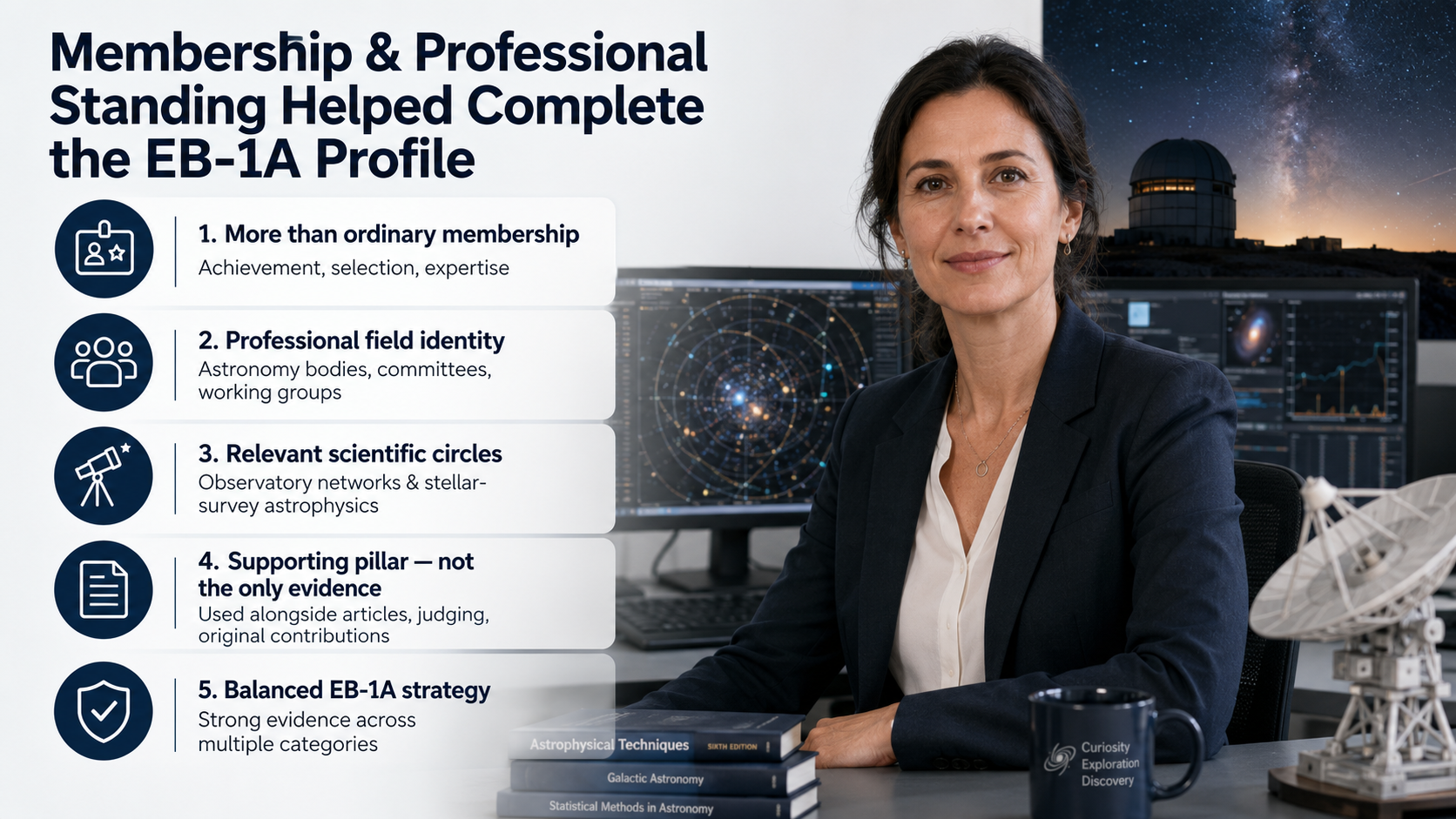
Professional membership evidence was used where it showed more than ordinary association participation. In EB-1A cases, membership is strongest when admission or role depends on achievement, selection, expertise, or professional standing.
The petition connected memberships, committee roles, working-group involvement, observatory networks, or professional astronomy bodies to the petitioner’s field identity. These records helped show that the petitioner participated in serious professional circles relevant to stellar-survey astrophysics.
The case did not rely on membership alone. It used membership as a supporting pillar alongside scholarly articles, judging, original contributions, published material, and international collaboration.
This balanced approach is often the best profile-building strategy for scientists whose evidence is strong but distributed across several categories rather than concentrated in one overwhelming achievement.
How Immignis built the petition ready record
Immignis and Advance My Profile organized the case around the petitioner’s strongest truthful evidence: scholarly articles, telescope time-allocation committee service, survey contribution, original research, international collaboration, published material, and professional standing.
The strategy was immigration-specific profile building, not generic branding. It explained the field, identified the petitioner’s distinct role, and showed how astronomy recognizes expertise through mechanisms that may not be obvious to a non-specialist officer.
The petition also avoided overclaiming. It did not argue that institutional prestige alone proved extraordinary ability. Instead, it showed how the petitioner personally contributed to modern survey work and how the field trusted the petitioner through collaboration, committee service, publication, and recognition.
The result was a record that converted a modest-looking citation profile into a more complete portrait of field-level scientific distinction.
Why this case worked
The case worked because it translated astronomy’s internal evidence systems into USCIS language. Telescope committee service became judging. Survey contribution became original contribution. Science-media coverage became published material. Collaboration roles became independent recognition. Publications became formal scholarly support.
Each piece of evidence reinforced the same point: the petitioner was not merely working inside a respected observatory. The petitioner was contributing to a specialized field and was trusted by other professionals to produce, evaluate, and communicate scientific work.
This is the purpose of ethical profile building. It does not invent achievement. It identifies where achievement already exists and builds the documentation needed to make it visible in an immigration petition.
For scientists with niche or technical records, this case shows that modest citation counts can be overcome when the petition presents a wider, field specific evidence architecture.
Conclusion
The Armenian astrophysicist’s EB-1A approval shows that stellar-survey and observational astronomy cases can succeed when the record is built around more than citation counts.
The petition worked because survey-contribution documentation, scholarly articles, telescope time-allocation committee service, international collaboration, membership evidence, science-media features, and expert letters were organized into one coherent immigration profile.
The broader lesson is simple: every scientific field has its own evidence language. Strong profile building translates that language into USCIS criteria without losing the truth of the career.
Frequently asked questions
Can an astrophysicist qualify for EB-1A with modest citation counts?
Yes. Citation counts can help, but they are not the only way to prove extraordinary ability. Survey contributions, judging, committee service, international collaboration, published material, and expert validation can also support a strong EB-1A case.
Does telescope time-allocation committee service count as judging?
Yes. It can support the judging criterion because committee members evaluate the scientific merit and priority of other researchers’ observing proposals.
Can team-based astronomy work support original contributions?
Yes. Team-based work can support original contributions when the petition documents the petitioner’s specific role and explains how that role affected survey outputs, discoveries, catalog work, or scientific use.
Does science-media coverage help an EB-1A petition?
Yes. Science-media coverage can support published-material evidence when it discusses the petitioner, the petitioner’s research, or the significance of the work in the field.
Can a heritage observatory strengthen an EB-1A case?
It can provide useful context, but the petition must still prove the petitioner’s personal achievements. Institutional prestige alone is not enough.
Can Immignis and Advance My Profile help scientists build stronger EB-1A profiles?
Yes. Immignis and Advance My Profile help scientists, researchers, engineers, healthcare professionals, and technical specialists with ethical profile building, evidence development, professional visibility, and petition-ready EB-1A or EB-2 NIW strategy.
Build an EB-1A record around scientific contribution, peer evaluation, and field-specific recognition
Many scientists already have strong evidence, but it may be scattered across publications, committees, collaborations, telescope programs, conference activity, media coverage, and expert networks. Ethical profile building can turn that scattered record into a clear immigration strategy.