
EB-2 NIW IT infrastructure specialist: A senior infrastructure specialist with two decades of storage, disaster recovery, and continuity experience across banking and telecom – two sectors that fail together and must recover together – approved for an EB-2 NIW to build a national financial continuity architecture for the United States.
In short: A Senior Infrastructure Specialist and System Administrator holding a Master’s in Information Technology
with 24+ years of progressive experience across enterprise storage, disaster recovery, and IT continuity for major
banks and telecom operators in Pakistan, Qatar, Iraq, and Saudi Arabia was approved for an EB-2 National Interest
Waiver as a self-petitioner. Pakistani citizen.
Proposed endeavor: design and build a National Financial Continuity and Security Architecture covering resilient infrastructure, AI-driven threat prediction, decentralized continuity nodes, and automated compliance assurance. Approved under Matter of Dhanasar with a career spanning nationally significant infrastructure projects across multiple countries, team leadership of 8-12 engineers, and deep mastery of the specific vendor platforms that run critical financial systems.
The petitioner’s name and employer names have been withheld for privacy. Career record, projects, credentials, and outcome are real.
When a Bank Fails, the Infrastructure Fails First
In March 2023, Silicon Valley Bank collapsed in 48 hours. The speed was not just financial. The panic spread through the same digital payment rails and telecom networks that process every transaction in the U.S. economy. Within days, regulators were asking a practical question: if a larger bank fails during a cyberattack or a natural disaster, how quickly can the systems that process deposits, payments, and payroll switch to something else?
The answer, for much of the U.S. financial sector, is: not quickly enough. Reported internet crime losses in the U.S. hit $16+ billion in 2024, up 33% year on year. Credit unions alone recorded 892 cyber incidents in just eight months, with 73% involving third parties. The FDIC has recorded 570 U.S. bank failures since 2001. And the Federal Reserve has warned that a single significant cyber incident can propagate system-wide, exactly because banking and telecom infrastructure are so deeply intertwined that a failure in one moves through the other.
The infrastructure layer that prevents cascading failures is not a policy document or a cybersecurity tool. It is the storage architecture, the disaster recovery systems, the replication protocols, and the failover mechanisms that sit underneath everything else. When those fail, nothing else works.
He has spent 24 years building and fixing exactly those systems.
The Work Itself
Most people who work in IT infrastructure stay in one sector. They understand banking systems or they understand telecom networks. The knowledge overlaps in theory, but the projects rarely do.
His career crossed both, and did so at a level of technical depth that is uncommon. Six years at a leading Pakistani GSM operator, leading the storage, SAN, and disaster recovery infrastructure that kept a national mobile network running for millions of subscribers. Six years as a storage and disaster recovery consultant at a major Qatari bank, managing the physical systems that kept transactions, account data, and operations intact through daily operations and planned DR exercises. Assignments across a major Iraqi telecom operator, a World Bank social protection project, IBM Saudi managed services, and his current role at a major Pakistani telecom company managing critical OSS infrastructure.
The tools he works with are the specific platforms running inside U.S. financial institutions right now. DELL-EMC VMAX, XtremIO, and Unity storage arrays. DELL-EMC SRDF replication. HPE XP24K and 3PAR. Oracle Exadata. VMware vSphere. Cisco MDS SAN switches. Commvault, Data Domain, HPE Data Protector, and Networker for backup. These are not general IT skills. They are the exact vendor stack that major U.S. banks and financial institutions use to protect data and ensure continuity.
His certifications reflect the same specificity: DELL-EMC Associate in Information Storage and Management (EMCISA), HPE Data Protector Accredited Integration Specialist, ITIL V3 Foundation, AWS Cloud Practitioner, and Azure Fundamentals.
Projects That Became National Models
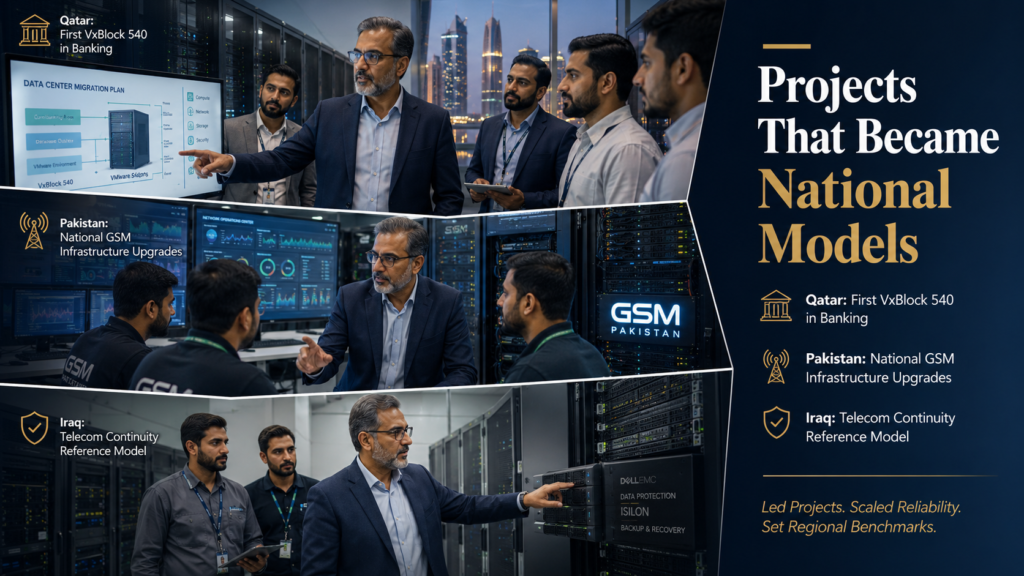
The work he led was not routine maintenance. Several projects shaped what came after them.
At a leading Qatari bank, he served as Technical Lead on the first VCE VxBlock 540 deployment in Qatar’s banking sector. He supervised 12 engineers and coordinated directly with the manufacturer’s specialists through the migration from DELL-EMC VMAX-40K to a converged VxBlock infrastructure with XtremIO all-flash storage. Other Qatari banks adopted similar models afterward. The project became a reference point for what converged banking infrastructure in the region could look like.
At Pakistan’s leading GSM operator, he led a series of nationally significant infrastructure overhauls: consolidating storage from multiple aging systems into HPE XP24K SAN with advanced replication pools; migrating the national CRM platform from Oracle Non-RAC to RAC for high availability; completing the CRM migration from Sun V890 to HPE Superdome; and then migrating again to Oracle Exadata for performance at scale. Each migration improved reliability for tens of millions of subscribers and set benchmarks that other Pakistani operators followed.At a major Iraqi telecom operator, he implemented DELL-EMC VMAX-10K storage with Networker and Data Domain backup integration across Oracle Sun servers – a hybrid SAN-backup model that became a reference for telecom continuity in the region.
When projects become national reference models, it means the person who led them solved something that other
organizations could not figure out alone. That is the definition of being well-positioned.
What He Proposes to Build
His proposed endeavor is a National Financial Continuity and Security Architecture a framework that addresses the U.S. financial sector’s core infrastructure vulnerability: it is fragmented, institution-specific, and reactive.
The architecture has four components, each building on the previous one.
The resilience backbone standardizes failover, redundancy, and interoperability across banking, telecom, and cloud infrastructure. Recovery time objectives measured in seconds for critical services. Recovery point objectives within minutes. Automated failover rather than manual recovery steps. The goal is that when something goes down, services continue without a human intervention being the bottleneck.
The AI-driven threat prediction and zero-trust security layer sits on top of the backbone. Current financial cybersecurity in the U.S. is largely reactive – it detects threats after the fact. Predictive behavioral analytics and continuous zero-trust verification shift the posture toward catching threats before they cause disruption. His cross-domain knowledge of both banking and telecom data flows is directly relevant here: the attack patterns that target financial transactions often travel through telecom pathways.
The decentralized continuity nodes address a specific documented vulnerability: the U.S. financial sector depends heavily on a small number of centralized cloud providers. When one of those providers has an outage, multiple institutions fail simultaneously. Regional, distributed nodes – each able to sustain local financial operations independently – break that dependency. Community banks and credit unions, which lack the resources to build their own secondary data centers, benefit most.
The automated compliance and resilience assurance layer replaces periodic manual audits with continuous, real-time validation. Regulators see the actual resilience status of institutions at any moment. Smaller banks reduce the cost and burden of compliance. Systemic risk warnings surface before they become systemic crises.
Why the National Importance Case Was Solid
The federal policy backing for this proposed endeavor is extensive and recent.
– The White House’s 2025 executive orders on cybersecurity innovation and on guaranteeing fair banking access directly name financial resilience and equitable continuity as federal priorities.
– Treasury’s Financial Services Sector Risk Management Plan explicitly identifies cloud concentration risks, third-party dependencies, and operational fragility as urgent national vulnerabilities the exact problems his architecture addresses.
– CISA’s Zero Trust and Microsegmentation guidance calls for the type of distributed, adaptive security posture his AI-driven layer introduces.
– The Federal Reserve’s 2024 Cybersecurity and Financial System Resilience Report emphasizes rapid containment, continuous testing, and resilience support for smaller institutions.
– NIST’s SP 800-18 Rev. 2 guidance on supply chain risk management aligns with his vendor-neutral, decentralized architecture.
His petition cited each of these directly, connecting the specific components of his proposed endeavor to named federal programs and documented national gaps.
How the Petition Was Built
This was a direct petition. The 24-year career, the nationally significant projects, the specific platform expertise, and the detailed proposed endeavor were already in place. Immignis built the case around Dhanasar precisely.
– National importance: FBI IC3 2024 cybercrime data, Federal Reserve operational resilience report, FDIC bank failure data, Treasury risk management plan, White House cybersecurity directives, CISA zero-trust guidance, NIST supply chain frameworks, OCC semiannual risk report.
– Well-positioned evidence: first-ever VxBlock deployment in Qatar’s banking sector, six nationally significant storage and DR projects at Pakistan’s largest GSM operator, cross-sector expertise spanning banking and telecom, platform mastery across the specific vendor stack running U.S. financial infrastructure, team leadership of 8–12 engineers on mission-critical projects.
– Proposed endeavor: four-pillar architecture tied to documented U.S. vulnerabilities, self-funded at USD 20,000, structured five-year rollout from community bank pilots to nationwide adoption.
The I-140 was filed as a self-petition without a U.S. employer.
The Outcome |EB-2 NIW IT infrastructure specialist
Approved.A self-petitioned EB-2 NIW filed from Pakistan, by an IT infrastructure specialist with 24 years of storage, disaster recovery, and continuity work across banks and telecom operators in four countries. The case was built on a career’s worth of nationally significant projects, a specific and detailed proposed endeavor, and a federal policy landscape that had explicitly documented the need
The rarest thing in IT infrastructure is someone who understands how banking systems and telecom systems fail at the
same time. That combination does not come from a job description. It comes from two decades of doing both.
For IT Infrastructure Professionals in Financial or Telecom Sectors
If your career has been built in enterprise storage, disaster recovery, SAN architecture, or system continuity – particularly across both financial and telecom environments – the NIW can be worth pursuing seriously. The Dhanasar test does not require publications or academic credentials. It requires a proposed endeavor with national importance and evidence that you are positioned to advance it. A 24-year career building the specific infrastructure that U.S. financial institutions depend on, leading nationally significant projects across multiple countries, is strong evidence of both.
Questions IT Infrastructure Specialists Ask Us
Can an IT infrastructure specialist or system administrator qualify for an EB-2 NIW?
Yes. The EB-2 NIW requires an advanced degree and a proposed endeavor of substantial merit and national importance. A Master’s in Information Technology plus 24+ years of progressive experience in enterprise storage and disaster recovery satisfies the advanced degree requirement through equivalent combination. A proposed endeavor focused on financial continuity architecture addresses documented federal priorities – Treasury, the Fed, CISA, and NIST have all published explicit guidance on the need to modernize financial infrastructure resilience. Real-world project leadership at nationally significant scale supports the well-positioned argument.
Why does cross-sector experience in both banking and telecom make an NIW case stronger?
Because the proposed endeavor benefits from it directly. U.S. financial infrastructure and telecom infrastructure are interdependent – payment processing depends on telecom networks, and telecom operations depend on banking rails. An architect designing a national financial continuity framework needs to understand how both fail and how they recover together. A career that spans both sectors with demonstrated project success in each is a more compelling well-positioned argument than expertise in only one.
How do nationally significant infrastructure projects (like a first-of-its-kind deployment that other banks adopted) help an NIW case?
They directly support the well-positioned prong by showing that the petitioner’s work has already had impact beyond a single employer. When a project becomes a model that other organizations adopt, it demonstrates that the petitioner’s approach has been evaluated and found valuable by independent parties. USCIS looks for evidence of recognized expertise that extends beyond routine employment duties, and national reference projects are a clear form of that evidence.
Does working in Qatar, Pakistan, Iraq, and Saudi Arabia count toward a U.S. NIW petition?
Yes. The platforms, protocols, and vendors in use at major banks and telecom operators across the Middle East and South Asia are the same ones running U.S. financial infrastructure. DELL-EMC, HPE, Oracle, VMware, and Cisco SAN systems do not change by geography. Project experience designing and leading DR systems for major banks in Qatar or storage consolidations for major telecom operators in Pakistan is directly applicable to the same work in the U.S. context.
Is financial continuity architecture a strong enough basis for national importance?
Yes, and the U.S. government has made it explicit. Treasury’s Financial Services Sector Risk Management Plan, the Federal Reserve’s cybersecurity and resilience report, CISA’s zero-trust guidance, and White House executive orders on cybersecurity and fair banking access all document financial continuity as a national priority. A proposed endeavor that addresses the specific gaps identified in those publications (fragmented continuity, cloud concentration risk, inadequate small-bank resilience) with a detailed technical approach and a career demonstrating the capability to execute it, meets the Dhanasar test.
Understanding how banking and telecom systems fail together and recover together is a rare combination that doesn’t come from a job description. See how Immignis builds NIW cases around exactly that cross-sector depth.