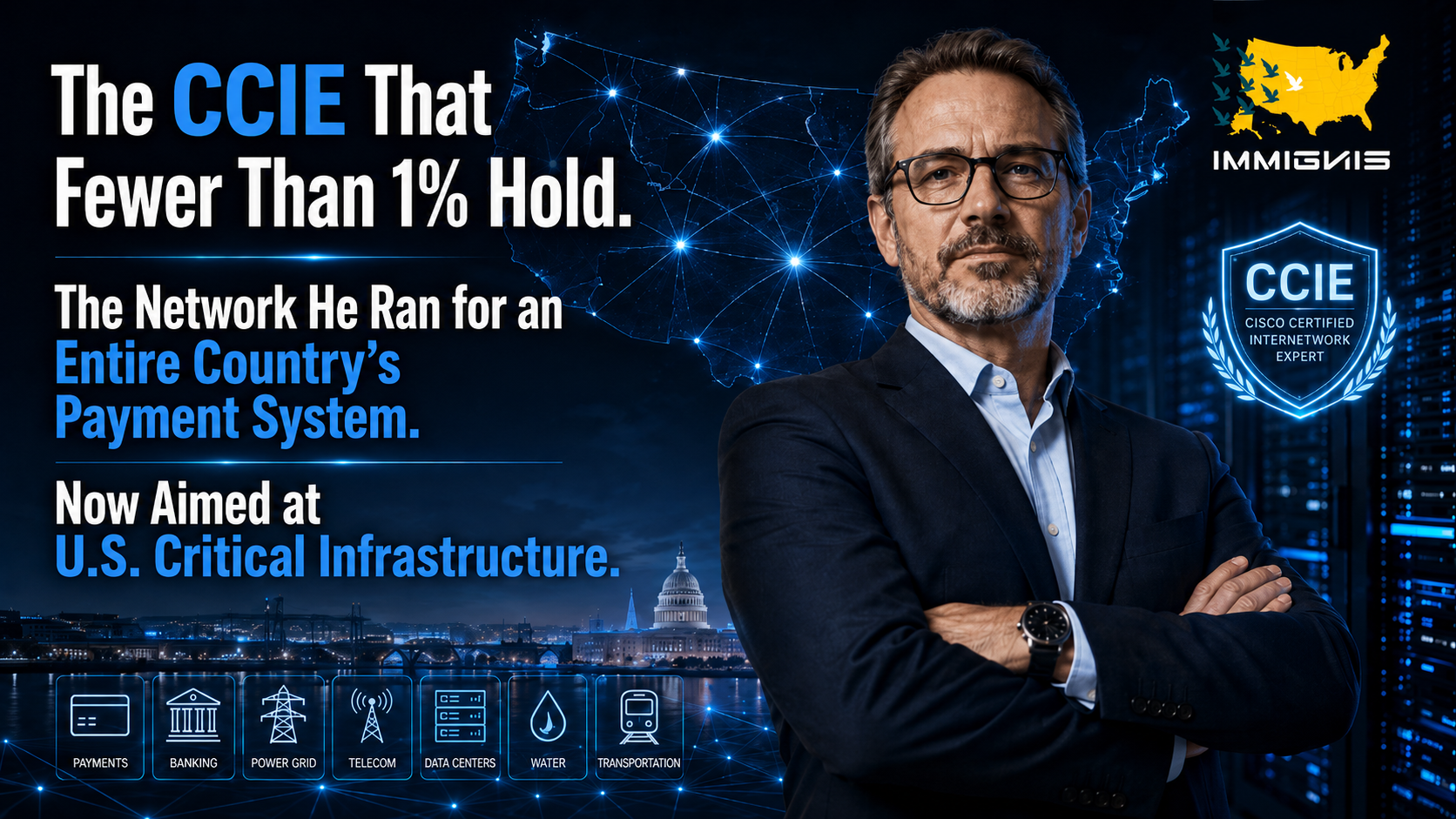
A network engineer with a decade-long CCIE Service Provider credential, a UAE-wide backbone deployment documented in national press releases, and a prior role managing the infrastructure behind every interbank transaction in Pakistan – approved for an EB-2 NIW to build AI-powered resilience across U.S. critical infrastructure
In short: An EB-2 NIW network engineer holding a Master’s in Computer Networking and Telecommunications, with 13+ years of progressive experience in IP backbone engineering, multi cloud security architecture, and AI-driven network automation at major service providers and critical financial institutions, was approved for an EB-2 National Interest Waiver as a self-petitioner. Pakistani national, UAE-based. He holds the Cisco Certified Internetwork Expert (CCIE Service Provider) credential, active since 2015 and recognized by Cisco with a 10-Year Anniversary distinction in March 2025, along with Microsoft Azure Solutions Architect Expert, Azure Security Engineer Associate, AWS Solutions Architect Associate, and Nokia NRS-I certifications. His prior role included managing the network infrastructure behind Pakistan’s national interbank payment switch responsible for all VISA, MasterCard, JCB, and UnionPay transactions nationally. His current role involves leading a UAE-wide IP backbone deployment of 142+ core routers, documented in published Nokia press releases. Proposed endeavor: design and implement a national AI-powered, self-healing infrastructure for U.S. critical sectors. Approved under Matter of Dhanasar.
The petitioner’s name and employer names have been withheld for privacy. Career record, certifications, projects, awards, and outcome are real.
Two Credentials That Tell the Story Before the Story:
The Cisco Certified Internetwork Expert Service Provider is held by fewer than 1% of networking professionals worldwide, making this directly relevant to an EB-2 NIW network engineer. It is not an advanced certification in the way that most certifications are – it is one of the most technically demanding credentials in the entire networking industry, testing the ability to design, implement, and troubleshoot the large-scale, carrier-grade networks that national and international infrastructure runs on. He earned it in 2015. He has maintained it without lapse for a decade. In March 2025, Cisco formally recognized his 10-year anniversary at the expert level.
The second credential is not a certificate. It is a role. For nearly three years at Pakistan’s national interbank payment switch, he managed the network infrastructure behind every interbank transaction in the country VISA, MasterCard, JCB, UnionPay, every ATM withdrawal, every point of sale payment. That organization functions as the financial clearing layer connecting all of Pakistan’s commercial banks. If the network fails, the payment infrastructure of the entire country stops. He maintained PCI DSS compliance, coordinated directly with international card networks, and oversaw zero-downtime data center migration during his tenure, strengthening the EB-2 NIW network engineer case.
Together, these two facts establish the scale of what he is qualified for before anything else in the petition is read. His proposed endeavor is to bring that combination of elite technical depth and national-scale infrastructure accountability to the U.S. critical infrastructure problem as an EB-2 NIW network engineer.
Why U.S. Critical Infrastructure Is the Right Problem:
Cyberattacks against U.S. healthcare increased by 74% in 2023. Attacks targeting government and military systems surged by 153%. The financial sector faces cyber incidents 300 times more frequently than other industries. Total cybercrime losses in 2024 reached $16.6 billion a 33% year-over-year increase. The average time to identify and contain a breach is 277 days nearly a year during which adversaries have undetected access. The U.S. faces a shortage of more than 700,000 cybersecurity professionals, leaving teams stretched and response times slow.
The core structural problem is not a lack of monitoring tools. The core problem is that current systems are reactive by design. They detect incidents after they happen, flag them to human analysts who may not be available, and trigger responses that take hours or days. Against machine-speed attacks on increasingly interconnected infrastructure, that gap is where the damage accumulates.
His proposed endeavor addresses the gap at its root. Not more monitoring. An entirely different approach: predictive, autonomous, and designed so that the system can identify, isolate, and remediate threats before they escalate into service disruptions.
The Career Built for This Work:
He currently serves as Expert Planning and Design Engineer at a major GCC telecommunications group – one of the largest telecom operators globally by subscriber base, strengthening his profile as an EB-2 NIW network engineer. His flagship project at this organization is the UAE-wide IP backbone deployment: the design and implementation of more than 142 high-capacity core routers across multiple regions, forming the foundation for the country’s digital services for millions of subscribers. His role includes developing architectural blueprints, ensuring international standards compliance, and collaborating with vendors across Microsoft, Cisco, Forcepoint, Huawei, Fortinet, and Nokia.
Two of his projects at this organization were covered in published Nokia press releases. The first: a national IP Core network upgrade to support 800GE and 5G transport slicing. The second: the implementation of a cloud interconnect solution enabling the operator to provide high-performance connectivity to hyperscale cloud providers. These are not internal project descriptions – they are publicly documented contributions to nationally significant infrastructure, independently verified by the vendor, supporting the EB-2 NIW network engineer case.
Before this role, he spent eight months in Dubai at a technology services company managing IT NOC operations. Before that, nearly three years at Pakistan’s national interbank payment switch where he held full responsibility for maintaining all international card payment integrations and network security, coordinated with VISA, MasterCard, JCB, and UnionPay, and was formally recognized with a Star Performer Award at the CEO-level annual conference for exceptional contributions to security and network modernization.
And before that, three and a half years as Team Lead at a Pakistani ISP, where he built ISP-scale backbone connectivity across multiple cities, managed core routing protocols, and conducted the migration of the organization’s primary data center – leading the project independently in the absence of the Network Manager and reporting directly to the CEO.
A decade of CCIE active status. A nationally significant IP backbone. A national payment switch. A star performer award from a CEO for work that protected the financial transactions of an entire country. Each role was bigger and harder than the previous one for an EB-2 NIW network engineer.
The AI-Driven Resilience Framework:
His proposed endeavor as an EB-2 NIW network engineer is not a new monitoring platform. It is a five pillar AI-powered resilience framework designed to change how critical U.S. infrastructure behaves when it is under attack or experiencing failure.
The first pillar is predictive analytics AI and machine learning models continuously analyzing system and network data across healthcare, energy, finance, and public safety to detect anomalies before they escalate. The framework uses multivariate time-series models, unsupervised anomaly detection, and a predictive risk scoring engine that fuses IT, operational technology, and cloud telemetry into a single monitoring fabric. The goal is to move from detecting breaches after they start to identifying the precursors of breaches before they begin, strengthening the EB-2 NIW network engineer case.
The second is autonomous self healing infrastructure AI guided remediation that isolates compromised components, reroutes operations, applies corrective actions, and restores services in real time without waiting for a human analyst to be available. Current incident response takes an average of 277 days. Autonomous remediation does not.
The third is an AI-driven adaptive zero trust security model continuous verification of every user and device, with access controls that adjust dynamically based on real time risk scoring. Not periodic re-authentication. Continuous behavioral analysis that adjusts permissions as risk signals change. When anomalous behavior is detected, access is restricted or revoked automatically, without waiting for a policy update.
The fourth is a cross-sector digital twin for resilience simulation virtual replicas of interconnected critical infrastructure sectors, enabling planners to simulate cyberattacks, grid failures, and natural disasters in a safe environment before they happen in the real world. When a power grid failure also takes down hospitals and payment systems, the interdependency can be modeled and planned for. It cannot currently be modeled with existing tools.
The fifth is resilience-centric architecture – embedding redundancy, modularity, and AI guided recovery orchestration at the design level rather than as retrofitted add-ons. Decentralized nodes that prevent single points of failure. Resilience as a foundation, not a feature for an EB-2 NIW network engineer.
The Policy Alignment Is Unusually Direct:
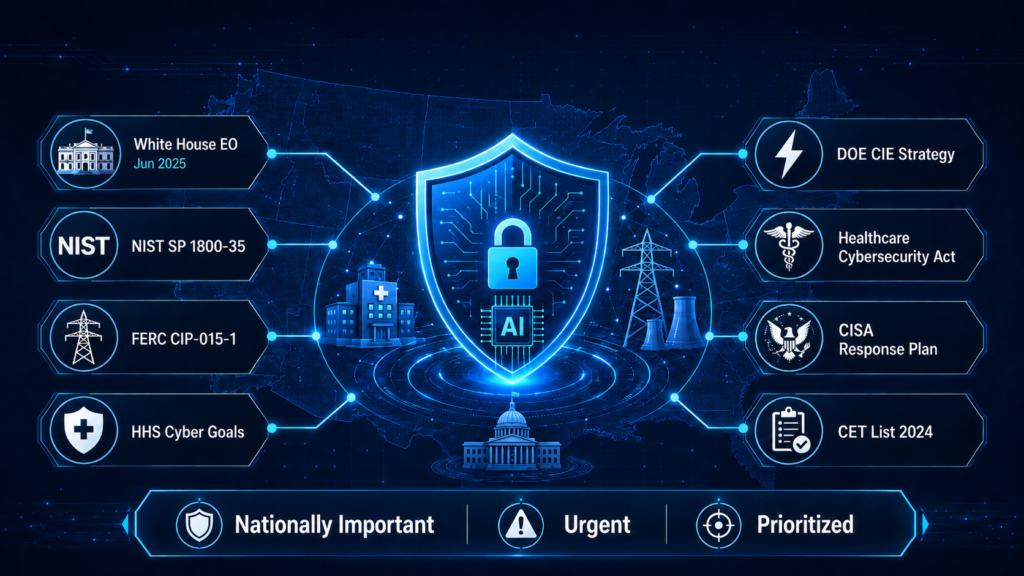
The federal policy context for this proposed endeavor is comprehensive and current for an EB-2 NIW network engineer.
White House Executive Order on Sustaining and Strengthening Cybersecurity (June 2025): directs the federal government to reinforce cybersecurity resilience through sustained, risk-based measures and advanced automated defenses.
NIST SP 1800-35: Implementing a Zero Trust Architecture (June 2025): the authoritative federal blueprint for zero-trust, which his AI-driven zero trust model is designed to operationalize.
FERC Reliability Standard CIP-015-1 (July 2025): mandates internal network security monitoring for bulk power system operators a requirement his predictive analytics layer is designed to fulfill, strengthening the EB-2 NIW network engineer case.
HHS Healthcare and Public Health Cybersecurity Performance Goals: sector-specific targets for access control, vulnerability mitigation, network segmentation, and incident preparedness.
DOE Cyber Informed Engineering Strategy: embedding cybersecurity from design inception precisely the approach his resilience centric architecture pillar takes.
Healthcare Cybersecurity Act of 2025 (H.R. 3841): Congressional intent to strengthen continuity and resilience of clinical and administrative healthcare systems.
National Cyber Incident Response Plan (CISA 2025): multi stakeholder coordination framework for major cyber events his cross-sector platform is designed to function as a node in exactly that kind of coordinated response.
Critical and Emerging Technologies List 2024: AI, advanced computing, and cybersecurity explicitly designated as national priority domains.
This convergence of executive orders, federal standards, sector specific guidelines, and Congressional legislation is the clearest possible documentation that the problem the proposed endeavor addresses is nationally important, urgently acknowledged, and actively being prioritized for an EB-2 NIW network engineer.
How the Petition Was Built:
This was a direct petition for an EB-2 NIW network engineer. The career record, the certifications, the project documentation, and the award history were already in place.
- National importance sourcing: FBI IC3 annual crime reports, GAO critical infrastructure reports, CISA cybersecurity advisories, HHS, IBM Cost of a Data Breach Report, FBI ransomware infrastructure data, White House cybersecurity executive orders (2025), NIST SP 1800-35 (Zero Trust, June 2025), FERC CIP-015-1, HHS Healthcare CPGs, DOE CIE Strategy, Healthcare Cybersecurity Act 2025, CISA NCIRP 2025, Critical and Emerging Technologies List 2024.
Well positioned evidence: CCIE Service Provider active since 2015 with Cisco 10 Year Anniversary recognition (March 2025), UAE-wide 142+ router backbone deployment documented in Nokia press releases, national interbank payment switch network management with PCI DSS compliance, Star Performer Award from payment switch CEO, twice VP-signed Certificate of Appreciation from the GCC telecom employer, AI-driven predictive analytics framework deployed reducing manual intervention by 60%, cross-vendor cloud security architecture spanning Microsoft, Cisco, Huawei, Fortinet, Nokia, strengthening the EB-2 NIW network engineer case.
Proposed endeavor: five pillar AI-driven resilience framework, each component tied to a named federal standard, documented national gap, and existing work the petitioner has already executed in production environments.
$50,000 personal investment committed across the five components. I-140 filed as a self-petition without a U.S. employer for an EB-2 NIW network engineer.
The Outcome:
Approved.
A self-petitioned EB-2 NIW for a network engineer and infrastructure specialist with a decade long CCIE Service Provider credential, publicly documented UAE national backbone contributions, former management of a national payment switch, multiple formal employer awards, and a proposed AI-driven resilience framework directly responsive to federal policy priorities across healthcare, energy, finance, and public safety.
The U.S. faces a 277 day average breach containment window, a 700,000 professional workforce shortage, and escalating cross-sector attacks. These are not abstract statistics. They are the specific gaps that an autonomous, predictive, AI-driven infrastructure is designed to close.
For Network and Infrastructure Engineers in Critical Infrastructure:
If your career is in IP backbone engineering, multi-cloud security, network automation, or infrastructure resilience particularly in critical infrastructure environments like finance, telecom, utilities, or healthcare and you hold advanced credentials and a track record of nationally significant projects, the NIW is worth a serious assessment. The combination of elite technical certifications, documented project contributions at national scale, and a proposed endeavor tied to specific federal policy priorities satisfies the Dhanasar test directly.
Questions Network and Infrastructure Engineers Ask Us:
Can a network engineer or infrastructure specialist qualify for an EB-2 NIW?
Yes. The EB-2 NIW evaluates whether the proposed endeavor has substantial merit and national importance, and whether the petitioner is positioned to advance it. A proposed endeavor focused on AI-driven resilience across U.S. critical infrastructure – healthcare, energy, finance, public safety, telecom addresses documented national priorities including the White House’s June 2025 cybersecurity executive order, FERC’s CIP-015-1 standard, and the Critical and Emerging Technologies List. An engineer who has designed and led nationally significant infrastructure projects at the expert certification level is well-positioned to advance such an endeavor.
Does the CCIE Service Provider credential matter for an NIW petition?
It matters substantially for the well positioned argument. The CCIE Service Provider is one of the most technically demanding certifications in the networking industry, held by fewer than 1% of professionals worldwide. Cisco’s formal recognition of a 10-year anniversary at the expert level is an independent institutional confirmation that the petitioner has maintained that standard continuously over time. In the Dhanasar analysis, independent recognition that elevates the petitioner above peers is directly relevant evidence. A sub 1% global credential, formally anniversary-recognized by the issuing institution, is a strong form of that evidence.
Does managing a national payment switch or national backbone deployment help a NIW case?
Yes. Both types of projects demonstrate that the petitioner has operated at a scale and accountability level that most engineers never reach. Managing the network infrastructure for all interbank payment transactions in a country with international card network compliance obligations is evidence of the specific operational depth required to design national scale AI resilience systems. A publicly documented national backbone deployment, confirmed by vendor press releases, provides independent third-party verification of the scope and significance of the contribution.
Does holding multiple elite certifications (CCIE, Azure Solutions Architect Expert, AWS SA Associate) help the well positioned argument?
Yes, particularly when the combination is directly relevant to the proposed endeavor. A proposed framework integrating IP backbone resilience, multi cloud security, and AI-driven automation requires mastery across all three domains. CCIE validates carrier-grade network engineering. Azure Solutions Architect Expert validates cloud architecture. AWS SA Associate validates multi cloud design. Nokia NRS-I and Huawei HCIP Carrier IP validate service provider environments. The combination is uncommon and directly maps to what the proposed endeavor requires, strengthening the well positioned argument because each credential addresses a different layer of the proposed framework.
How do vendor-published press releases documenting project contributions help an NIW case?
They provide independent, third party documentation of project scope and the petitioner’s contribution. Most NIW petitions rely on internal employer descriptions and recommendation letters. Published Nokia press releases confirming a national IP core network upgrade and a cloud interconnect deployment involving the petitioner’s engineering team constitute public, independently authored evidence that the projects existed, that they were nationally significant, and that they were delivered. This kind of external documentation strengthens the well positioned argument more than self-reported project descriptions alone. If your engineering career includes elite certifications, nationally significant infrastructure projects, and a proposed endeavor addressing documented U.S. critical infrastructure gaps, an NIW assessment is worth your time. Free assessment: immignis