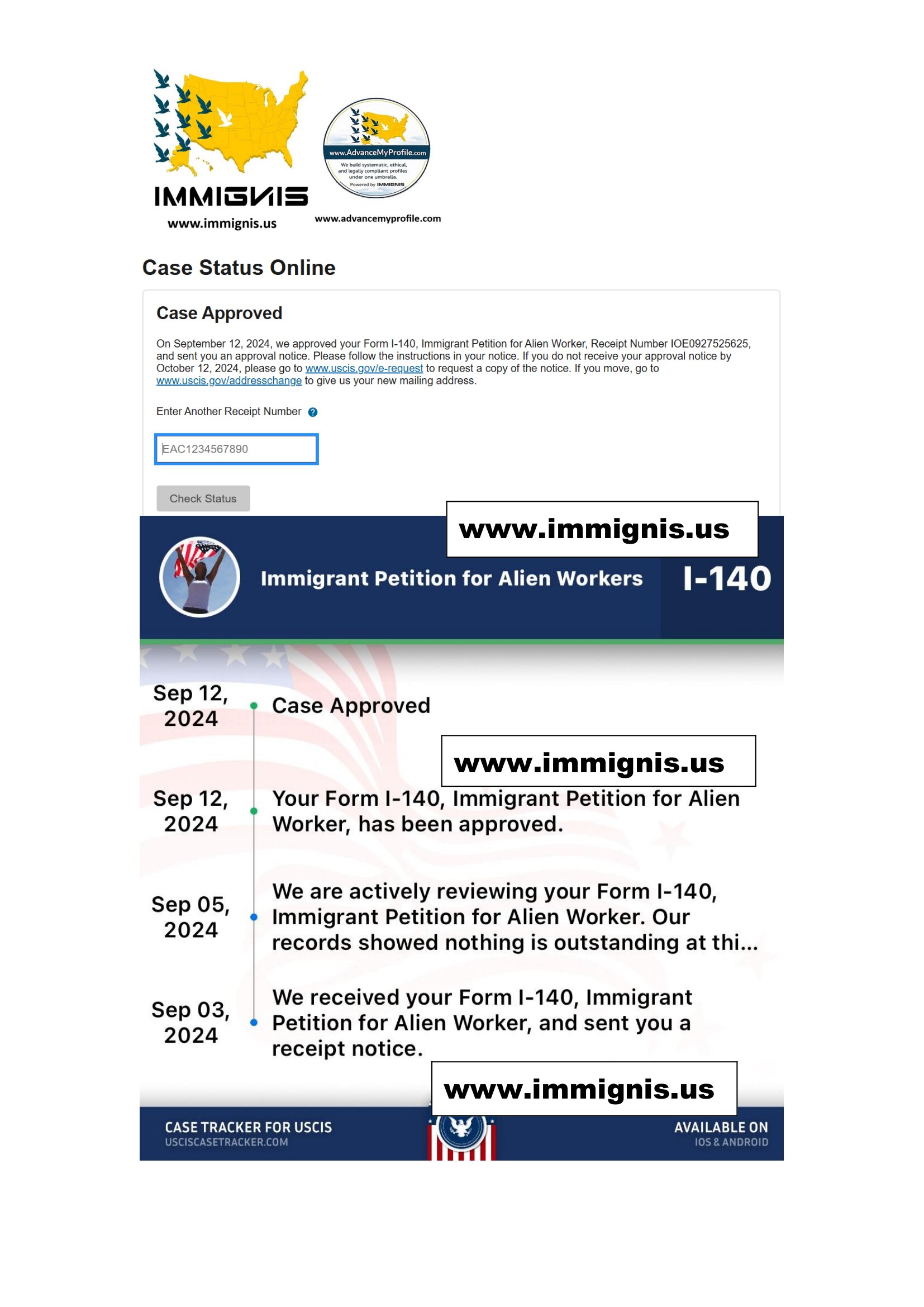
EB-2 NIW healthcare IT software developer: A Microsoft Certified Architect with 14+ years of software development experience, currently building Azure AI solutions and hospital management systems at a major healthcare institution – approved for an EB-2 NIW to apply that same work to the documented gaps in U.S. healthcare IT.
In short: A Microsoft Certified Architect, Expert, and Specialist holding a Bachelor of Science in Electronic
Engineering, with 14+ years of progressive experience in software development and IT consulting including
current senior roles building Azure AI, cloud infrastructure, and clinical management systems at healthcare
institutions in Saudi Arabia was approved for an EB-2 National Interest Waiver as a self-petitioner. Pakistani citizen.
Proposed endeavor: advance scalable healthcare solutions through Azure AI and cloud computing, including AI-
powered analytical dashboards with predictive modeling for patient care and digital transformation of hospital
operations. Approved under Matter of Dhanasar.
The petitioner’s name and employer details have been withheld for privacy. Career record, credentials, and outcome are real.
The Software Behind the Diagnosis
Most people think of a hospital as doctors and nurses and equipment. What they don’t see is the software layer underneath all of it. The system that schedules the appointment. The platform that routes a lab result to the right clinician. The dashboard a hospital administrator watches to track bed occupancy and wait times. The AI model that flags a patient as high risk before the emergency happens.
When that software is well-built, care is faster and more accurate. When it is fragmented, outdated, or missing, clinicians spend time on administrative workarounds instead of patients. The U.S. healthcare system spends 18% of GDP on healthcare and still has documented gaps in IT infrastructure, interoperability, and AI adoption. A large part of that gap lives in the software layer.
He builds that software. He has been doing it for 14+ years, and his most recent work is specifically inside a healthcare institution.
What He Actually Does, Right Now
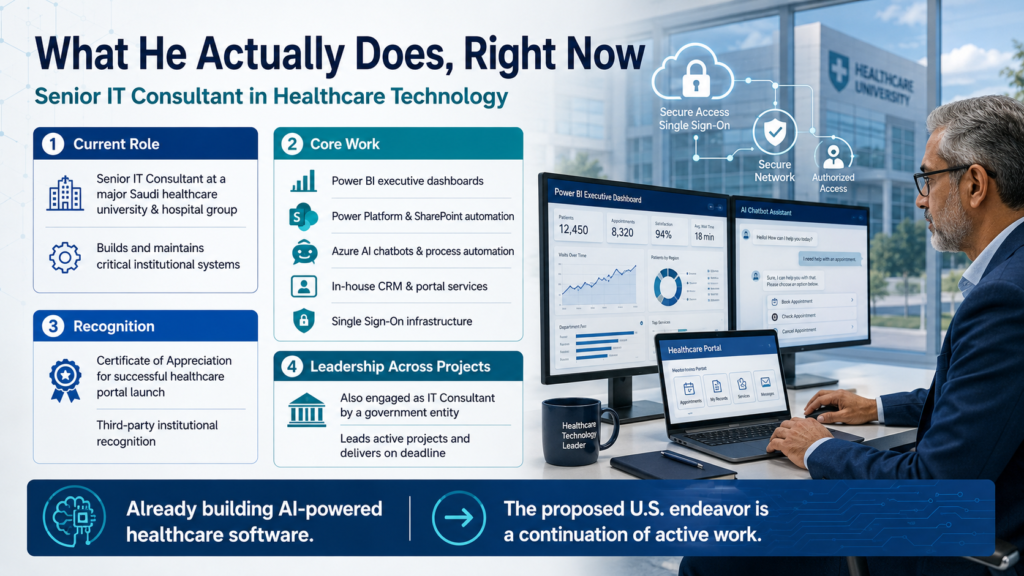
His current role is as a Senior IT Consultant at a major Saudi healthcare university and hospital group. His work there is not generic IT support. He builds and maintains the systems the institution depends on: executive-level Power BI dashboards that give senior management real-time visibility into key metrics, workflow automation using Power Platform and SharePoint, Azure AI integration for chatbots and process automation, CRM and portal services developed entirely in-house, and Single Sign-On infrastructure connecting the institution’s platforms securely.
He also received a formal Certificate of Appreciation from a government healthcare authority for his work leading the successful launch of a new healthcare portal. That is third-party institutional recognition, not a self-reported achievement.Alongside his main role, he is engaged as an IT Consultant by a government entity to lead their active projects and deliver them on deadline. Two substantive engagements simultaneously, both requiring senior-level technical leadership
The well-positioned argument for this case is not hypothetical. He is already building AI-powered healthcare software
at a hospital. The proposed U.S. endeavor is a continuation of active work, applied to a documented national need.
The Career That Built to This Point
His career began as a software engineer, writing ASP.NET applications and building web systems. Over the following 14 years, the scope of his work expanded through every stage: software engineer, senior software engineer, technical consultant, senior specialist consultant, senior technical consultant, and senior IT consultant. Not lateral moves each step added architectural responsibility, team leadership, and client-facing project ownership.
The specific project that demonstrates most directly his fitness for the proposed endeavor is the Hospital Management System he built and led. The system covers Patient Management, Appointment Scheduling, Billing and Invoicing, Doctor and Staff Management, Laboratory and Radiology Integration, and Reporting and Analytics using Power BI. He also integrated Azure AI for chatbots, predictive analytics for patient outcomes, and appointment scheduling optimization. This was not a proof-of-concept. It was a delivered, operational system for a real healthcare client.
Other projects demonstrate breadth: cloud migration for OCR using Azure AI document processing, an Educational Information System built entirely on Azure Cloud with cybersecurity-hardened APIs, and a Robotic Process Automation engagement for a bank. Each shows a different dimension of the same core capability – building cloud-based, AI-integrated systems that automate and improve complex institutional workflows.
His technical credentials are specifically in the Microsoft ecosystem: Microsoft Certified Architect, Expert, and Specialist designations, covering Azure Data Scientist Associate, Azure AI, Power Platform, ASP.NET MVC, C#, and others. He is registered with both the Pakistan Engineering Council and the Saudi Engineering Council.
He has been recognized as Employee of the Month at multiple different employers, and received a formal Certificate for Creative Expertise and Skills in Various Projects from an earlier engagement. These are consistent markers of above-average performance across different organizations over time.
The U.S. Healthcare IT Gap
The U.S. healthcare system spends 18.3% of GDP on healthcare ($4.3 trillion in 2021) and still trails high-income peer countries on affordability, efficiency, equity, and outcomes. The Institute of Medicine has estimated $750 billion in annual waste from unnecessary services and poor-quality care. Nearly 84 million people live in Primary Care Health Professional Shortage Areas. The workforce problem is structural, but technology adoption is a significant part of the gap: only a fraction of U.S. healthcare providers have deployed the AI tools that the GAO has confirmed “have shown promise” for improving clinical outcomes and reducing administrative burden.
The ONC’s 2020-2025 Federal Health IT Strategic Plan, multiple White House executive orders on healthcare access and AI governance, HHS’s funding of $55 million for virtual healthcare tools, and the GSA’s Applied AI Healthcare Challenge all document this need explicitly. The federal government has said clearly what it wants: more AI, more cloud infrastructure, more patient-centric digital systems, deployed across both large hospitals and underserved community health centers.
His proposed endeavor is to provide exactly that starting with AI-powered analytical dashboards and scalable cloud solutions, then building toward fully integrated, patient-centric hospital management systems that small and community health centers can afford and operate.
The Proposed Endeavor in Practice
The four components of the proposed endeavor are not abstract ambitions. Each one maps to work he has already delivered.
Scalable healthcare solutions: he has built cloud-based systems for hospitals using Azure that handle patient data securely, scale across departments, and integrate with existing infrastructure. The Educational Information System he built on Azure is a comparable architecture applied to a comparable institutional environment.
Digital transformation of hospital operations: the Hospital Management System he delivered did exactly this moving from manual processes to automated workflows for scheduling, billing, lab integration, and management reporting.
AI-powered analytical dashboard: he has built executive dashboards using Power BI integrated with Azure AI, providing real-time KPIs to senior management. The healthcare version is a clinical extension of the same architecture.
Predictive modeling for patient outcomes: Azure AI predictive analytics for patient outcomes was a specific component of the Hospital Management System he built. This is not proposed future work. It was delivered.
How the Petition Was Built
This was a direct petition. His career record was already there.
– National importance sourcing: ONC 2020-2025 Federal Health IT Strategic Plan, White House Executive Orders on healthcare access and AI governance, HHS virtual healthcare funding, GAO AI in Healthcare report, GSA Applied AI Healthcare Challenge, White House OSTP STEMM priorities, HHS FY 2022-2026 strategic goals, multiple healthcare access and equity statistics.
– Well-positioned evidence: current senior IT consultant role at a major healthcare institution, Hospital Management System with Azure AI delivered for a healthcare client, formal Certificate of Appreciation from a government healthcare authority, Microsoft Certified Architect and Azure AI credentials, 14+ years of progressive experience through every stage of the software development and IT consulting career ladder.
– Proposed endeavor precision: four components each tied to documented U.S. healthcare IT gaps and directly supported by delivered work in the petitioner’s existing career.
The I-140 was filed as a self-petition without a U.S. employer.
The Outcome |EB-2 NIW healthcare IT software developer
Approved.A self-petitioned EB-2 NIW for a Microsoft Certified Architect and healthcare IT specialist, filed from Saudi Arabia, with no U.S. employer. Approved on the strength of a career spent building the software systems hospitals run on, specific delivered projects in healthcare AI, formal institutional recognition for that work, and a proposed endeavor that addressed documented national healthcare IT priorities.
Every healthcare story in this series has focused on a different layer: the equipment, the building, the biomedical
engineer maintaining the machines. This one is the software. When the software works, everything else works better.
For Healthcare IT and Software Development Professionals
If your career is in healthcare software, clinical IT systems, electronic health records, hospital management platforms, or AI integration for healthcare and your work touches areas the U.S. government has identified as priorities (AI in healthcare, digital transformation of hospital operations, patient-centric systems, telehealth infrastructure), the NIW is worth a serious assessment. The Dhanasar test evaluates the national importance of your proposed endeavor and whether you are positioned to advance it. Delivered hospital management systems, Azure AI integrations, and a career inside healthcare institutions are strong answers to that question.
Questions Healthcare IT Professionals Ask Us
Can a software developer or IT consultant working in healthcare qualify for an EB-2 NIW?
Yes. The EB-2 NIW evaluates whether the proposed endeavor has substantial merit and national importance, and whether the petitioner is positioned to advance it. The U.S. government has explicitly identified healthcare AI, cloud-based health IT, and digital transformation of hospital operations as national priorities through ONC strategic plans, White House executive orders, and HHS funding programs. A software developer who has built and delivered healthcare management systems, AI-powered dashboards, and clinical analytics tools has a specific, demonstrable track record directly relevant to those documented national needs.
Does working for healthcare institutions in Saudi Arabia count toward a U.S. national interest argument?
It can count substantially. The technologies involved (Azure AI, Microsoft Power Platform, cloud-based EHR systems, predictive analytics) are the same platforms used in U.S. healthcare institutions. The workflow challenges of hospital management, appointment scheduling, lab integration, and clinical reporting are structurally similar across healthcare systems. Experience delivering these systems at a senior level for a major healthcare institution demonstrates execution capability that transfers directly to the proposed U.S. endeavor.
How do Microsoft certifications like Azure AI or Azure Data Scientist Associate help an NIW case?
Vendor-specific certifications from major technology platforms serve a specific function in the well-positioned argument: they provide independent, verified evidence of technical competence in the exact tools the proposed endeavor will use. The Microsoft Certified Architect and Expert designations go further they reflect not just product knowledge but the architectural and strategic depth needed to design and implement enterprise-scale systems. Combined with delivered healthcare projects, they support the argument that the petitioner can actually execute what the proposed endeavor describes.
Does having a hospital management system already delivered strengthen the well-positioned argument?
It is among the strongest forms of evidence available. USCIS is evaluating whether the petitioner can advance the proposed endeavor. A delivered, operational hospital management system with Azure AI integration for predictive patient analytics, appointment optimization, and clinical dashboards is direct proof of that capability not a description of future aspirations but documented past execution. When the proposed endeavor closely mirrors work already done, the well-positioned prong is easier to satisfy.
Does a Certificate of Appreciation from a government healthcare authority help?
Yes. Third-party recognition from institutional clients particularly government institutions provides independent verification that the petitioner’s work met or exceeded the expectations of a sophisticated client. It is not self-reported performance. It is an external organization formally documenting that the petitioner made a meaningful contribution to a significant project. In a well-positioned argument, this kind of independent recognition carries weight that job descriptions alone do not.
Delivered hospital management systems with AI integration are proof, not promises, see how Immignis builds NIW cases around software developers already solving healthcare’s documented gaps.