
A senior network engineer who has spent 11 years watching how routing decisions play out at national scale and who is now developing the machine learning algorithms to improve them approved for an EB-2 NIW from Malaysia.
In short: An EB-2 NIW senior network engineer and Consultant holding a Master of Engineering Management and a Bachelor of Telecommunications Engineering, with 11+ years of progressive experience designing and implementing carrier-grade IP/MPLS/VPN networks across Pakistan and Malaysia, was approved for an EB-2 National Interest Waiver as a self-petitioner. Pakistani citizen, Malaysia-based. Proposed endeavor: develop algorithms for Machine Learning-Driven Routing and Dynamic Bandwidth Allocation that improve the efficiency, adaptability, and security of U.S. communications networks. Approved under Matter of Dhanasar, supported by 5 consecutive years of formal employer recognition, first-of-kind network deployments for a major mobile operator, and CCNP/Cisco specialist certifications.
The petitioner’s name and employer details have been withheld for privacy. Career record, awards, and outcome are real.
The Problem With How Networks Route Data Today
When you send a message or stream a video, that data travels across the internet in packets. At each junction in the network, a routing decision is made: which path does this packet take to reach its destination? Those decisions happen billions of times per second, across the entire internet, simultaneously, making this directly relevant to an EB-2 NIW senior network engineer.
Most of those decisions are made by algorithms designed in the 1980s and 1990s. OSPF, BGP, MPLS the protocols that route traffic across carrier networks were built for a world where data volumes were predictable, network topologies were relatively stable, and the performance requirements of applications were modest. The internet today is none of those things.
5G networks, autonomous vehicles, real-time video, and IoT devices generate traffic with wildly different demands: some need minimal latency, some need massive throughput, and some need to keep moving even during a partial network failure. The routing protocols that exist cannot adapt to those conditions in real time. They were not built to. Machine learning can change that, strengthening the EB-2 NIW senior network engineer case.
His proposed endeavor is to develop two specific algorithm families: machine learning-driven routing that analyzes real-time traffic patterns to dynamically optimize how data flows, and dynamic bandwidth allocation that adjusts how bandwidth is distributed based on what the network is actually carrying at any given moment. Both draw directly on what he has spent 11 years learning about how networks behave under real pressure as an EB-2 NIW senior network engineer.
What 11 Years Looks Like
He started in Pakistan, supporting microwave backbone networks and ATM infrastructure for national telecom projects, building the foundation for an EB-2 NIW senior network engineer profile. He moved to Malaysia in 2015 and has been there since, advancing from MW and IPRAN team lead to Senior Network Consultant at a major global telecom infrastructure company, where he has been responsible for designing and implementing the IP transport networks that carry mobile traffic for a leading Malaysian mobile operator.
The specific achievements in his career are measurable and verified.
He led the establishment of the mobile operator’s first-ever broadband network – a full deployment of spine-and-leaf network architecture, AAA server configuration, and integration with a broadband provider, enabling authentication of one million connected broadband subscribers. He received a formal Certificate of Appreciation from the operator for this, strengthening the EB-2 NIW senior network engineer case.
He assisted in the east coast swap project that contributed to the operator being recognized as Malaysia’s Best Mobile Service Provider of the Year in 2020. He supported the integration of 5G services into the operator’s network during a national 5G pilot project in 2020, using next-generation routers to handle 5G traffic from the outset. He led hardware and core link upgrades for Malaysia’s national broadband coverage initiative – a government-funded program to expand coverage and improve broadband quality for citizens nationwide – overseeing the planning, deployment, expansion, and migration of the operator’s L2 MPLS-TP network.
His employer formally recognized his performance every single year from 2019 through 2023 – five consecutive years as Star Employee of the Month. Across COVID disruptions, project deliveries under pressure, and a rapidly changing technology landscape, the recognition was consistent. He also received two additional ZTE corporate awards for handling special assignments and overall professional performance as an EB-2 NIW senior network engineer.
Five consecutive years of formal performance recognition, across five different calendar years and multiple network
generations, is the kind of track record that the well-positioned argument is built on.
Why an Engineer Builds Better Algorithms Than a Researcher
Machine learning-driven routing and dynamic bandwidth allocation are active areas of academic research for an EB-2 NIW senior network engineer. There are papers published on these topics every year, and most of them are written by researchers who simulate network behavior in controlled environments.
What those papers cannot replicate is 11 years of experience watching how routing decisions actually behave when a nationwide network carries real subscriber traffic. Where do congestion points actually appear? What does a sudden spike in traffic from a live event look like at the protocol level? How does a link failure in one part of the network cascade through the rest? What does it cost, in latency and throughput, when a routing algorithm makes the wrong decision during a high-demand period? This practical foundation strengthens the EB-2 NIW senior network engineer case.
He knows the answers to those questions from direct experience, across multiple countries, across multiple network generations, at the level of someone who runs quarterly network audits and provides escalation support when things go wrong. The proposed algorithms are not designed from a theoretical model of how networks behave. They are designed from knowledge of how networks actually behave.
His technical certifications reflect the same depth: CCNP Enterprise, Cisco Certified Specialist in Security Core, CCNA Routing and Switching. These are not general IT credentials. They are the specific certifications that validate competence in the exact network layer his proposed algorithms target as an EB-2 NIW senior network engineer.
Where U.S. Policy Points
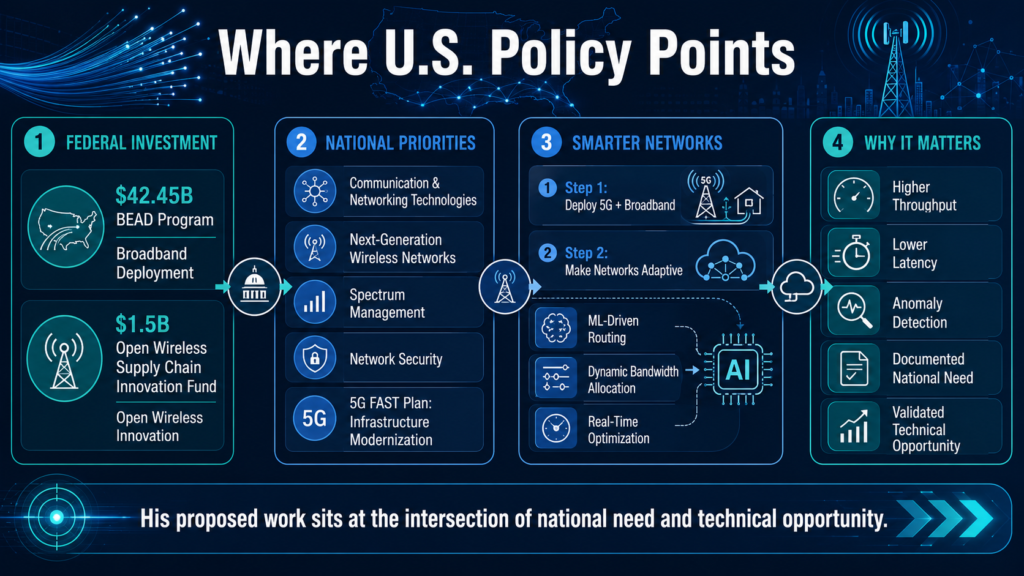
The U.S. government has committed $42.45 billion through the BEAD program for broadband deployment, making this directly relevant to an EB-2 NIW senior network engineer. The NTIA launched a $1.5 billion Open Wireless Supply Chain Innovation Fund. The White House Critical and Emerging Technologies List explicitly names Communication and Networking Technologies including next-generation wireless networks, spectrum management, and network security, as national priorities. The FCC’s 5G FAST Plan targets infrastructure modernization and regulatory reform to keep U.S. networks competitive.
Deploying 5G and broadband infrastructure is step one. Making those networks perform efficiently adapting in real time to the traffic they carry is step two. Machine learning-driven routing and dynamic bandwidth allocation are a core part of that second step for an EB-2 NIW senior network engineer. The National Science Foundation, NIST, and FCC have each published documentation specifically calling for development and deployment of these techniques. The research community has confirmed through peer-reviewed publications that they can significantly improve throughput, reduce latency, and detect network anomalies. His proposed work sits at the intersection of documented national need and validated technical opportunity, strengthening the EB-2 NIW senior network engineer case.
How the Petition Was Built
This was a direct petition. The career record and the technical expertise were already there.
– National importance sourcing: BEAD program ($42.45B), NTIA Open Wireless Supply Chain Innovation Fund ($1.5B), Critical and Emerging Technologies List (Communication and Networking Technologies), NTIA/DoD 5G Challenge, White House Spectrum Strategy, FCC 5G FAST Plan, CISA critical infrastructure designation, NSF and NIST documentation on ML-driven routing.
– Proposed endeavor precision: two specific algorithm families – ML-Driven Routing and Dynamic Bandwidth Allocation – with technical rationale for each, supported by multiple peer-reviewed publications confirming their value in 5G, optical, satellite, and mesh network contexts.
– Well-positioned evidence: 11 years of progressive carrier-grade network engineering, first-ever broadband network deployment for a major mobile operator, 5 consecutive years of Star Employee recognition, CCNP Enterprise and Cisco Security certifications, active 5G project experience, Malaysia national broadband initiative work, quarterly network audit responsibility.
The I-140 was filed as a self-petition without a U.S. employer.
The Outcome
Approved.
A Senior Network Engineer and Consultant, Pakistani citizen, Malaysia-based, with no U.S. employer, approved for an EB-2 National Interest Waiver on the strength of 11 years of documented, recognized, carrier-grade network engineering experience and a proposed endeavor to develop ML algorithms that address a specific, documented gap in how U.S. communications networks manage traffic.
The researchers write the papers. The field engineers know which problems are real. At his level of experience, those
two perspectives are starting to combine and that combination is what makes the proposed work worth doing.
For Senior Network Engineers Considering an NIW
If your career is in IP networking, routing, switching, MPLS, or related transport technologies and you have reached a level of seniority where you have both deep hands-on expertise and insight into where the field needs to go next the NIW is worth considering. A proposed endeavor focused on improving how networks manage traffic, with documented national importance in U.S. federal programs and communications infrastructure priorities, and a career demonstrating the specific technical depth needed to advance it, satisfies the Dhanasar test.
Questions Senior Network Engineers Ask Us
Can a senior network engineer working on IP routing and transport qualify for an EB-2 NIW?
Yes. Communication and Networking Technologies are explicitly listed as critical and emerging technologies by the U.S. government. A proposed endeavor focused on machine learning-driven routing and dynamic bandwidth allocation addresses documented gaps in how U.S. networks manage the growing complexity of 5G, IoT, and high-bandwidth traffic. CCNP and Cisco Specialist certifications, combined with 11 years of carrier-grade network implementation experience, provide the technical foundation for a strong well-positioned argument.
How does field engineering experience support an algorithm development proposed endeavor?
It provides the most valuable input available: knowledge of where the real problems are. ML routing algorithms are more useful when designed by someone who has watched how routing decisions fail under real traffic conditions than by someone who has only modeled them in simulations. 11 years of quarterly network audits, escalation support, nationwide rollout projects, and live 5G deployments means the proposed algorithms will be designed to solve problems that actually exist in production networks, not just in theoretical scenarios. USCIS evaluates whether the petitioner is positioned to advance the proposed endeavor, and that kind of practical foundation is a strong answer.
Do formal performance awards from employers like Employee of the Month matter in an NIW case?
They can, particularly when they are consistent and span multiple years and recognitions. Five consecutive years of Star Employee recognition from the same employer, across different project cycles and technology generations, provides independent, employer-confirmed evidence that the petitioner’s performance exceeded peers over a sustained period. Additional formal awards from the employer and Appreciation Certificates from client organizations (like the certificate for building a mobile operator’s first broadband network) compound that evidence. Together they support the well-positioned argument in a way that self-reported job descriptions cannot.
Does working on national broadband or 5G projects in another country transfer to a U.S. NIW case?
It can transfer directly. The technical skills involved in deploying MPLS, L3VPN, IPRAN, and 5G transport networks are the same whether the deployment is in Malaysia or the United States. The routing protocols, the hardware platforms, and the design principles are standardized globally. Leading a national broadband expansion initiative and supporting a 5G pilot project in Malaysia demonstrates the same type of capability the U.S. needs to deploy its $42.45 billion broadband investment efficiently.
Does a Master of Engineering Management help an NIW case differently from a technical master’s degree?
It contributes specifically to the strategic and managerial dimensions of a proposed endeavor. For an endeavor that involves not just developing algorithms but implementing them across complex network environments with multiple stakeholders, the Engineering Management credential demonstrates the ability to manage the execution side as well as the technical side. Combined with CCNP and specialist certifications that validate the technical depth, the two credentials together cover both dimensions that a complex network engineering endeavor requires.If you are a senior network engineer and your proposed work targets documented U.S. communications infrastructure priorities, an NIW assessment is worth your time. Free assessment: immignis