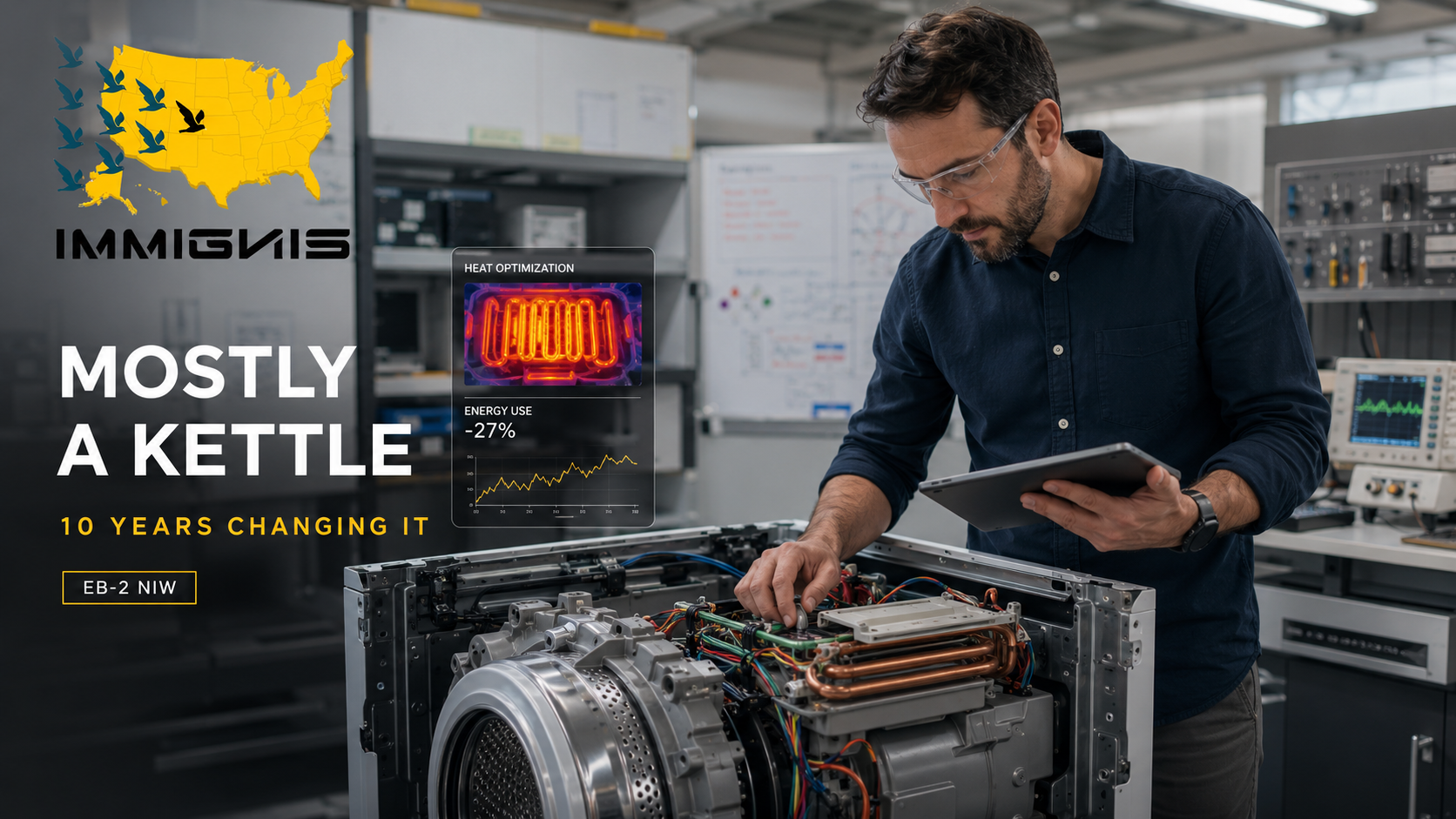
A polymer engineer and R&D project lead who brought a breakthrough cold-wash laundry technology from lab to global markets – approved for an EB-2 NIW to bring the same work to the United States, where 85% of laundry energy still goes toward heating water.
In short: An EB-2 NIW polymer engineer holding a Bachelor of Engineering and an MBA in Logistics and Supply Chain Management, with nearly ten years of progressive leadership at one of the world’s largest consumer goods companies, was approved for an EB-2 National Interest Waiver as a self-petitioner. UK-based, Pakistani national. He led the development and global scaling of a breakthrough cold-wash, short-cycle laundry technology – publicly documented and commercially launched across international markets. Proposed endeavor: develop and deploy next-generation, ultra-low-energy cold-wash detergent systems in the United States, advance circular economy packaging solutions for flexible plastics, and build domestically anchored supply chains to reduce dependence on imported petrochemicals. Approved under Matter of Dhanasar.
The petitioner’s name and employer details have been withheld for privacy. Career record, innovations, and outcome are real.
The Kettle Inside Every Washing Machine
Most people assume that the energy their washing machine uses goes toward running the motor or spinning the drum. In fact, around 85-90% of the energy a washing machine consumes goes toward one thing: heating the water. The drum, the pump, the controls relatively cheap to run. The heater, even for a single warm wash, consumes most of the cycle’s electricity, making this directly relevant to an EB-2 NIW polymer engineer.
American households do approximately 35 billion loads of laundry per year. Most of those loads are done at warm or hot temperatures – habit, assumption about cleanliness, and the fact that most conventional detergents were formulated to activate in warm water. The Department of Energy has estimated that laundry accounts for roughly 10% of total residential energy demand. Over 34 million U.S. households report difficulty paying energy bills. If cold-wash detergents performed as well as hot-water ones and people trusted them household utility bills could drop by around $150 per year per family, strengthening the EB-2 NIW polymer engineer case.
The engineering problem is the chemistry. Conventional detergents are built around surfactants and enzymes that activate at higher temperatures. Getting them to work in cold, short cycles requires a fundamentally different approach to formulation design. That is what he has been working on for nearly ten years as an EB-2 NIW polymer engineer.
The Innovation He Led to Market
His most significant project as an EB-2 NIW polymer engineer was a cold-wash laundry innovation, a detergent engineered specifically for short, 15-minute cycles in cold water, delivering cleaning performance equal to or better than conventional detergents in long hot-water cycles. The project was designed as part of a global company’s Clean Future sustainability roadmap and was scaled across multiple international markets, where it has been publicly recognized as a breakthrough in sustainable laundry technology. The goal was to enable an 80-90% reduction in energy use per wash cycle through chemistry rather than appliance upgrades.
He served as Technical Project Lead, moving the innovation from laboratory formulation and pilot plant validation through commercial-scale launch, coordinating the global brand team, managing the supply chain framework, and ensuring that the formulation performed consistently across diverse consumer markets and water conditions, strengthening the EB-2 NIW polymer engineer case.
Before that, he led a separate initiative replacing petroleum-based synthetic ingredients in laundry formulations with natural raw materials, a reformulation that reduced fossil feedstock dependency while maintaining performance at scale. He also led the launch of a quick-wash care variant in South Asian markets, a product designed for short cycles in water-scarce and price-sensitive contexts. Each project involved a different dimension of the same core problem: how do you get clothes clean efficiently, affordably, and with minimal resource use? Across these and other projects, he launched five sustainable laundry products using patented technologies, strengthened the intellectual property portfolio, and earned formal employer recognitions and consistently strong performance ratings across his tenure as an EB-2 NIW polymer engineer.
The well-positioned argument here does not rest on what he could do. It rests on what he already did: led a
breakthrough cold-wash technology from laboratory development to global commercial launch, exactly the kind of
work his proposed U.S. endeavor requires.
The Career Behind It
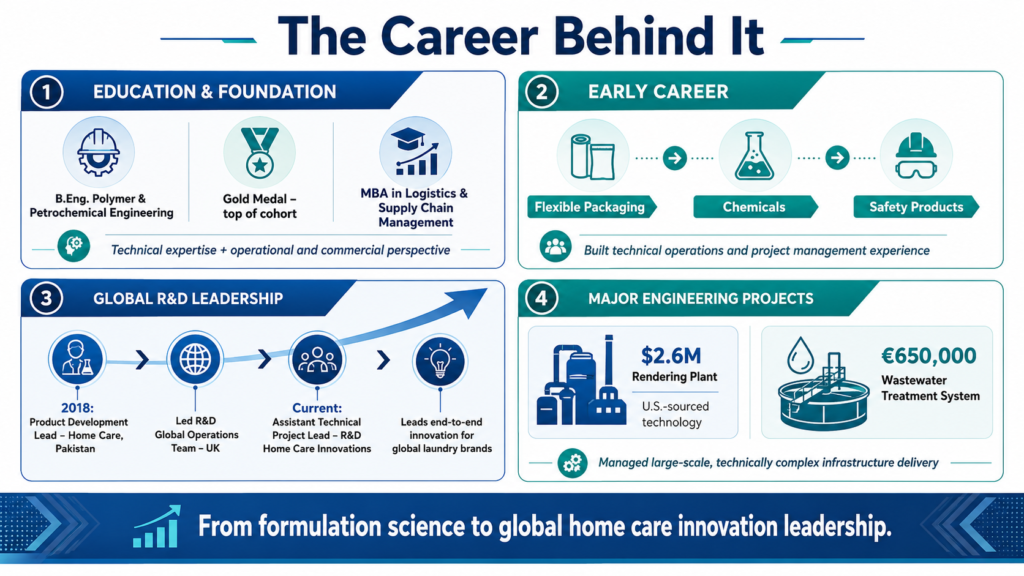
He holds a Bachelor of Engineering in Polymer and Petrochemical Engineering, the specific technical discipline that covers formulation science, material properties, and the chemistry of surfactants and polymers used in detergents and packaging, making his background directly relevant as an EB-2 NIW polymer engineer. His Gold Medal from a leading Pakistani engineering university reflects finishing at the top of his cohort. His MBA in Logistics and Supply Chain Management was a deliberate addition to that technical foundation, giving him the operational and commercial lens needed to bring innovations from the lab into the market at scale.
His early career ran through a flexible packaging manufacturer, a national chemicals company, and a safety products manufacturer in Pakistan, building technical operations and project management experience across different industrial environments. He joined the consumer goods company in 2018 as Product Development Lead for Home Care in Pakistan, led the R&D Global Operations team from the UK, and was promoted to his current role as Assistant Technical Project Lead for R&D Home Care Innovations, where he leads the end-to-end innovation program for global laundry brands, strengthening the EB-2 NIW polymer engineer case.
Alongside his laboratory and R&D work, he also oversaw the installation of a USD 2.6 million rendering plant using U.S.-sourced technology from a company in the American Southeast, and a EURO 650,000 industrial wastewater treatment system, both large-scale, technically complex engineering projects that demonstrated his ability to manage infrastructure delivery, not just product formulation, as an EB-2 NIW polymer engineer.
The Five-Part Proposed Endeavor
His proposed U.S. endeavor as an EB-2 NIW polymer engineer is not a single technology. It is five interdependent components designed to address connected gaps in the U.S. home care sector.
The core is ultra-low-energy cold-wash detergent formulations – proprietary systems using cold-active enzymes and bio-based surfactants that deliver equal or superior cleaning in short, cold cycles. These are not incremental improvements to existing detergents. They are formulations designed from the ground up for a different set of performance conditions, a capability he has already demonstrated in a commercial product now selling internationally.
The second component is circular economy packaging. The U.S. generates approximately 96 million tons of packaging waste annually. Flexible plastics (the kind used in detergent pouches and refill packs) have a recycling rate of 2-6%. His polymer engineering background is directly applicable here: designing packaging with recyclable laminates, developing upcycling pathways using compatibilizer technologies, and integrating closed-loop collection systems that create secondary material streams for U.S. manufacturers, strengthening the EB-2 NIW polymer engineer case.
The third is supply chain localization. U.S. detergent manufacturers depend heavily on imported petrochemical ingredients. Replacing those with domestically sourced, plant-based alternatives reduces exposure to oil price volatility and global disruptions while creating new opportunities for U.S. bio-based chemical producers and small manufacturers.
The fourth is an AI-powered lifecycle analytics platform – a tool that quantifies energy savings and environmental impact at the household level in real time, making the case for cold washing visible and measurable to consumers, utilities, and retailers. The platform addresses a persistent adoption barrier: consumers do not switch to cold water because they cannot see the proof.
The fifth is national deployment through appliance, utility, and retail partnerships – the model that ensures the formulation technology reaches households at scale rather than remaining a niche product for an EB-2 NIW polymer engineer.
Why This Is Nationally Important
If 75% of U.S. laundry loads switched to cold water, Procter & Gamble estimates the annual CO₂ reduction would exceed 27 million metric tons, making this directly relevant to an EB-2 NIW polymer engineer. That is equivalent to removing millions of cars from U.S. roads. The DOE’s 2025 Final Rule on residential clothes washer test procedures establishes the federal measurement framework that cold-wash technologies need to be validated against. The EPA’s National Strategy to Prevent Plastic Pollution calls for precisely the kind of flexible plastic circular economy solutions he proposes. NIST has published design-for-circularity principles that his packaging approach incorporates directly.
His proposed endeavor aligns with these documented federal priorities not as a secondary benefit but as its central purpose. Cold-wash detergents reduce residential energy demand without requiring appliance replacement – the cheapest infrastructure upgrade a household can make. Circular packaging reduces plastic waste and creates domestic manufacturing inputs. Localized supply chains reduce import dependence. Each component addresses a named federal gap, strengthening the EB-2 NIW polymer engineer case.
This alignment shows why the proposed work is not only a consumer-goods innovation, but a national-interest contribution by an EB-2 NIW polymer engineer.
How the Petition Was Built
This was a direct petition for an EB-2 NIW polymer engineer. The technical expertise, the commercial project track record, and the proposed endeavor were already in place.
- National importance sourcing: DOE 2025 Final Rule on clothes washer efficiency test procedures, EPA National Strategy to Prevent Plastic Pollution, EPA National Recycling Goal (50% by 2030), NIST circular economy design principles and circularity metrics, DOE Energy Saver laundry data, ACEEE energy burden research, Recycling Partnership flexible films data, Critical and Emerging Technologies List (2024).
- Well-positioned evidence: cold-wash breakthrough innovation from lab to global commercial launch, a natural reformulation project replacing synthetic petrochemical ingredients with plant-based alternatives, five sustainable products launched with patented technologies, polymer engineering degree directly applicable to both formulation and packaging components, MBA supply chain degree directly applicable to resilient sourcing and deployment strategy, formal employer recognitions and Gold Medal academic achievement, strengthening the EB-2 NIW polymer engineer case.
- Proposed endeavor: five interdependent components (cold-wash formulations, circular packaging, localized supply chains, AI lifecycle analytics, national deployment) each tied to a named federal program or documented national gap, and each grounded in work already done commercially.
The I-140 was filed as a self-petition without a U.S. employer. Personal commitment of $100,000 was documented across the five components for an EB-2 NIW polymer engineer.
The Outcome
Approved.A self-petitioned EB-2 NIW from the United Kingdom, filed by a polymer engineer who had already brought a globally scaling cold-wash innovation from laboratory concept to commercial launch. The case rested on a technically specific proposed endeavor, a directly relevant project track record, and alignment with documented U.S. priorities in household energy efficiency, circular economy packaging, and supply chain resilience.
Every load of laundry done cold instead of warm saves energy, saves money, and cuts emissions. The technology to
make that possible already exists. What is needed is someone who knows how to get households to trust it – and who
has already done that in other markets.
For Materials Scientists and Consumer Goods R&D Leaders
If your career is in polymer science, formulation chemistry, sustainable materials, or consumer goods R&D and your work addresses documented national challenges in energy efficiency, circular economy, or supply chain resilience, the NIW is worth serious consideration. The Dhanasar test evaluates national importance and positioning, not field prestige or publication count. A decade of delivering commercially scaled sustainable innovations for a leading global company, with specific products in global markets, is a strong answer to both.
Questions Materials Scientists and Consumer Goods Professionals Ask Us
Can a polymer engineer or formulation scientist in consumer goods qualify for an EB-2 NIW?
Yes. The EB-2 NIW evaluates whether the proposed endeavor has substantial merit and national importance, and whether the petitioner is positioned to advance it. A proposed endeavor focused on household energy efficiency, circular economy packaging, and domestic supply chain resilience addresses documented federal priorities from DOE efficiency standards and EPA recycling strategy to NIST circularity frameworks. A polymer engineer with a track record of delivering commercial sustainable innovations has both the technical and operational credentials to support that case.
Does leading a product from laboratory development to global commercial launch strengthen the well-positioned argument?
It is one of the strongest possible forms of evidence. USCIS is evaluating whether the petitioner can advance the proposed endeavor not whether they have the qualifications to work in the field. A petitioner who led a cold-wash breakthrough technology from lab through pilot plant validation to international commercial launch has already demonstrated precisely the capability the proposed U.S. endeavor requires. The gap between “qualified to develop cold-wash detergents” and “has delivered a globally scaling cold-wash detergent to market” is decisive.
Does a supply chain MBA complement a technical engineering degree in an NIW case?
In the right circumstances, yes. The Dhanasar well-positioned analysis looks at the full picture of whether the petitioner can advance a multi-dimensional proposed endeavor. An endeavor that covers formulation science, packaging circular economy, localized sourcing, AI analytics, and national deployment is not purely technical, it also requires strategic, operational, and commercial execution. An MBA in logistics and supply chain management directly supports those dimensions. The combination of technical and commercial credentials is genuinely stronger than either alone for an endeavor of this scope.
How specific does the proposed endeavor need to be to qualify for national importance?
Quite specific. A vague proposal to “improve household sustainability” gives USCIS nothing to evaluate. A proposed endeavor with five named, technically described components each connected to a specific federal policy, a documented national gap, and the petitioner’s actual prior work is what USCIS can assess. In this case, each component was tied to a named DOE rule, EPA strategy, NIST framework, or documented recycling or energy statistic. That specificity is what allows the national importance argument to hold.
Is household energy and consumer goods a recognized area of national importance for NIW purposes?
Yes. Residential energy efficiency is explicitly addressed in DOE federal programs, executive orders on affordability, and the White House energy analysis. The EPA has a National Strategy to Prevent Plastic Pollution. NIST has published circularity design principles. The Critical and Emerging Technologies List includes AI and sustainable materials. Each of these corresponds to a component of the proposed endeavor. The NIW does not require a field to be classified as STEM in the traditional sense, it requires that the proposed work address a documented national need.If your work in materials science, sustainable formulation, or consumer goods innovation addresses documented national priorities and you want to understand whether your background supports an NIW, start with an honest assessment. Free assessment: immignis