A mechanical reliability engineer with 17 years inside large-scale oil and gas production facilities – approved for an EB-2 NIW to address one of the most persistent and costly gaps in U.S. upstream operations at the moment of record domestic production.
In short: An EB-2 NIW mechanical reliability engineer holding an MS and BS in Mechanical Engineering, with 17 years of progressive experience in rotating equipment reliability, maintenance strategy, and production facility operations at two multinational oil and gas companies, was approved for an EB-2 National Interest Waiver as a self-petitioner. Pakistani national, Pakistan-based. He holds the CMRP (Certified Maintenance and Reliability Professional) from SMRP, USA, and the Machinery Lubricant Analyst Level II from ICML, USA, has completed Factory Acceptance Testing for critical equipment in the United States, and has published both a research paper and a book on oil and gas production systems. Proposed endeavor: design and execute integrity-driven maintenance and reliability interventions in U.S. upstream oil and gas facilities by integrating condition data, engineering diagnostics, and execution-ready corrective actions into a unified operational framework. Approved under Matter of Dhanasar.
The petitioner’s name and employer details have been withheld for privacy. Career record, certifications, projects, and outcome are real.
The Gap Between Data and Action
Most compressor failures are not sudden. They announce themselves weeks in advance. Vibration signatures drift outside normal bands. Lubrication samples start showing elevated wear metals. Thermal readings creep upward. Inspection findings document progression. The data is there, making this directly relevant to an EB-2 NIW mechanical reliability engineer.
In many U.S. upstream oil and gas facilities, that data sits in separate systems. Condition monitoring reports are reviewed by one team. Inspection findings go to another. Maintenance planning runs on fixed schedules. None of it gets integrated into a single, prioritized decision about what to fix and when, until something stops working. And when something stops working in a production facility operating at full capacity, even 3-4 days of downtime can cost approximately $5 million in production losses and emergency repair costs, strengthening the EB-2 NIW mechanical reliability engineer case.
The United States is currently producing natural gas at record levels – 118.5 billion cubic feet per day in 2025, with projections rising further. Crude oil production sits near 13.6 million barrels per day. In January 2025, the White House declared a National Energy Emergency. Production at this scale makes the tolerance for preventable failures close to zero. A system that was adequate for lower output is no longer adequate for these volumes.
His proposed endeavor is to close the gap between data and action in U.S. upstream facilities turning what facilities already have into decisions they consistently make in time as an EB-2 NIW mechanical reliability engineer.
Seventeen Years, Two Countries, Two World-Class Operations
He started as a graduate trainee at a Fortune 500 international oil and gas company’s production facilities in Pakistan, building the foundation for an EB-2 NIW mechanical reliability engineer profile. He stayed for 14 years, advancing through six progressive roles from trainee to Senior Rotating Equipment Engineer and Team Lead, managing a team of eight engineers and 24 technicians across large-scale gas processing facilities with combined production capacity of 450 million standard cubic feet of gas per day and significant condensate and LPG output.
During that period, he was the person responsible for the rotating equipment that large-scale production depends on: Ariel, Ajax, and Superior reciprocating compressors; Caterpillar, Waukesha, and Superior gas engines; centrifugal and plunger pumps; nitrogen generation units; heat exchangers and pressure systems. He planned overhauls. He executed root cause failure analyses. He led annual turnarounds. He coordinated with OEMs to resolve chronic issues. He commissioned what became one of the largest LPG processing facilities in Pakistan (300 million standard cubic feet of gas per day) a project reported in major national news outlets, strengthening the EB-2 NIW mechanical reliability engineer case.
He then moved to his current role as Manager Maintenance (Mechanical) at a multinational upstream E&P company’s gas field, where he was promoted twice within two years of joining. He reports to the General Manager of Site Operations. He received formal appreciation from the company’s president for maintaining operational continuity under challenging conditions, a recognition that reflects not just technical performance but the kind of operational judgement that keeps production running when circumstances change without warning.
His international exposure went beyond management. He represented his companies at Factory Acceptance Testing for reciprocating compressors and engines in the United States, high-pressure injection pumps in Germany, and nitrogen generation equipment in the Netherlands. These trips gave him direct familiarity with U.S. manufacturing standards, testing protocols, and engineering expectations from the equipment side before it enters the field as an EB-2 NIW mechanical reliability engineer.
The value of 17 years in this field is not the number. It is knowing which vibration pattern on a Waukesha engine
predicts which failure six weeks out, and what to do about it before the engine trips.
The Credentials That Back It Up
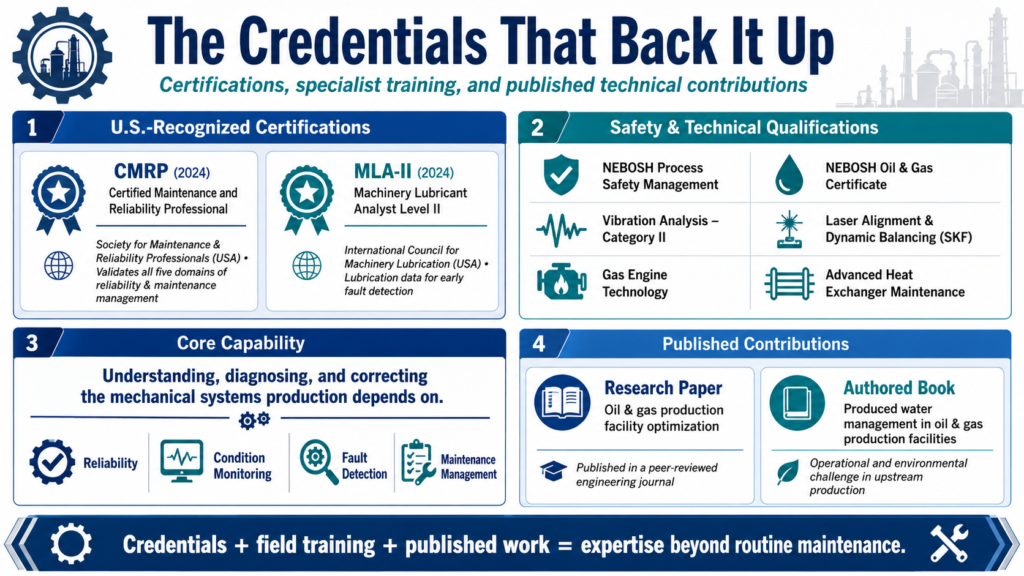
In 2024, he earned the Certified Maintenance and Reliability Professional (CMRP) from the Society for Maintenance and Reliability Professionals in the United States one of the most rigorously evaluated credentials in the reliability engineering field globally, and one that validates competency across all five domains of reliability and maintenance management for an EB-2 NIW mechanical reliability engineer. The same year, he earned Machinery Lubricant Analyst Level II (MLA-II) from the International Council for Machinery Lubrication, a U.S.-based body, validating his ability to use lubrication condition data as a diagnostic tool for early fault detection in rotating equipment.
He also holds NEBOSH Process Safety Management from the UK, an NEBOSH Oil and Gas Certificate, and specialist trainings in vibration analysis (Category II), laser alignment and dynamic balancing (SKF), gas engine technology, and advanced heat exchanger maintenance. Each of these speaks to a different dimension of the same core capability: understanding, diagnosing, and correcting the behavior of the mechanical systems that production depends on, strengthening the EB-2 NIW mechanical reliability engineer case.
He has published a research paper on oil and gas production facility optimization in a peer-reviewed engineering journal, and authored a book on produced water management in oil and gas production facilities – a significant operational and environmental challenge in upstream production. Both contributions demonstrate technical knowledge that extends beyond the work orders in his CMMS and into the broader literature of the field for an EB-2 NIW mechanical reliability engineer.
The Three-Part Proposed Endeavor
His proposed work in U.S. upstream facilities is built on three integrated components for an EB-2 NIW mechanical reliability engineer.
The first is integrating condition data into execution-ready maintenance decisions. In most facilities, vibration monitoring, lubrication analysis, inspection findings, and failure histories are reviewed separately and acted on too slowly. His approach will connect those inputs into structured mechanical risk categories that translate into specific, prioritized corrective actions before degradation escalates into failure. The innovation is in the connection, not the data collection. The data is already there.
The second is cross-OEM diagnostic transferability. In current practice, maintenance strategies are typically developed for each equipment type separately. A solution learned on an Ariel compressor doesn’t automatically apply to a Superior compressor, even when the failure mechanism is identical. His approach identifies degradation patterns that repeat across manufacturers and applies proven corrective solutions system-wide. This reduces the repetition of failures that cost facilities their most expensive maintenance hours, strengthening the EB-2 NIW mechanical reliability engineer case.
The third is production-critical risk prioritization with low-disruption intervention. Instead of fixed maintenance intervals or reactive responses, corrective actions are sequenced by operational impact – the most critical risks addressed first, within existing operating windows, using precision interventions like alignment correction, dynamic balancing, lubrication optimization, and targeted component replacement. No large-scale shutdowns required if they can be avoided for an EB-2 NIW mechanical reliability engineer.
Why This Matters Right Now
The federal policy alignment for this proposed endeavor is unusually direct and recent for an EB-2 NIW mechanical reliability engineer. In January 2025, the President declared a National Energy Emergency and issued an Executive Order titled Unleashing American Energy, establishing expanded domestic production as an immediate national priority. A second order created the National Energy Dominance Council to coordinate cross-agency action. The Department of the Interior launched the 11th National Offshore Leasing Program. The Department of Energy released National Petroleum Council recommendations to accelerate infrastructure development. These are not aspirational policies. They are active federal actions directing the U.S. energy sector toward maximum output.
CISA designates the Energy Sector as critical infrastructure – one of 16 sectors whose disruption would have national security implications. EPA data show that the oil and gas production segment is the largest industrial source of methane emissions, with compressors, gas engines, and equipment leaks as primary contributors. Equipment failures are documented causes. PHMSA data show that corrosion, material failure, and equipment failure together account for approximately 61% of pipeline incidents, strengthening the EB-2 NIW mechanical reliability engineer case.
Running at record production with aging infrastructure, reactive maintenance practices in significant portions of the sector, and federal policy demanding not just more output but stable and efficient output, the gap between available diagnostic data and timely corrective action is a national reliability problem. His proposed endeavor addresses exactly that gap as an EB-2 NIW mechanical reliability engineer.
Projects That Show the Track Record
Several of his specific contributions demonstrate the kind of practical, scalable impact the proposed endeavor is built to replicate in U.S. facilities.
– At the large-scale gas processing facility, he identified chronic seal failures in critical hot oil circulation pumps and engineered a solution: replacing conventional mechanical seals with cartridge-type seals. The chronic failures stopped. The same principle applies to similar pumps across other facilities.
– He led the process optimization that achieved enhanced LPG recovery through flash gas diversion – a production improvement that earned a formal award and contributed to the facility reaching a 500 metric ton per day LPG production milestone, itself nationally recognized.
– He led an in-house repair of a sewerage treatment plant that would otherwise have required expensive external contracting – an OPEX optimization initiative published in the company’s own technical magazine and recognized with a spot award.
– He executed top-end overhauls of gas engines on-site, ahead of schedule, with cost savings and production continuity maintained. Published in the company’s technical magazine. Recognized with a spot award.
– He executed the safe dismantling of two 100-foot guyed-wire telecommunications towers – a technically complex, high-risk activity that required meticulous planning and safety management. Also published and recognized.
Multiple projects from his career were reported in major Pakistani national media outlets, including the commissioning of two 300 MMSCFD gas processing facilities and the tie-in of newly discovered wells into existing production systems. These are not internal project records. They are publicly documented national-scale energy infrastructure achievements.
How the Petition Was Built
This was a direct petition. The career record, certifications, publications, and project history were already in place.
– National importance sourcing: White House National Energy Emergency Declaration (2025), Unleashing American Energy EO, National Energy Dominance Council EO, DOI National Offshore Leasing Program, DOE National Petroleum Council recommendations, CISA Energy Sector critical infrastructure designation, EIA record production data, EPA methane emissions data from oil and gas production, PHMSA pipeline incident data, BLS sector safety data, industry downtime cost analyses.
– Well-positioned evidence: 17 years of progressive experience including leadership of teams of up to 32 engineers and technicians, commissioning of large-scale gas processing facilities, CMRP and MLA-II certifications from U.S.-based bodies, Factory Acceptance Testing in the United States, published research paper and book, multiple formal performance awards from two multinational employers including a presidential appreciation, two confirmed U.S.-based engineering collaborators.
– Proposed endeavor precision: three integrated technical components, each tied to a documented operational gap in U.S. upstream production and each supported by peer-reviewed scholarly literature including recent publications from U.S. universities and national laboratories.
$150,000 in personal investment committed, with a phased execution plan from pilot engagements in the Permian, Haynesville, and Appalachian basins through national scaling. I-140 filed as a self-petition without a U.S. employer.
The Outcome
Approved.A self-petitioned EB-2 NIW, filed from Pakistan, for a mechanical reliability engineer with 17 years of upstream oil and gas experience, CMRP and MLA-II certifications from U.S. professional bodies, a published book and research paper, Factory Acceptance Testing completed in the United States, and a proposed endeavor that addresses a documented operational gap in the sector the federal government has declared an emergency priority.
Record production levels mean record consequences when something fails. The case for improving how U.S. facilities
manage reliability decisions has never been more urgent and the person who makes that case strongest is someone
who has been doing the work at large scale for 17 years.
For Mechanical Engineers and Reliability Specialists in Oil and Gas
If your career is in upstream oil and gas mechanical systems – rotating equipment, maintenance management, reliability engineering, integrity-driven operations – and you have a track record of delivering measurable improvements at production scale, the NIW is worth a serious look. The proposed endeavor does not need to be a technology product. A structured, documented approach to improving how existing systems are maintained and how failures are prevented can satisfy the Dhanasar test when it addresses a documented national gap and is backed by a career demonstrating the capability to execute it.
Questions Oil and Gas Engineers Ask Us
Can a mechanical maintenance engineer in oil and gas qualify for an EB-2 NIW?
Yes. The proposed endeavor needs substantial merit and national importance, and the petitioner needs to be positioned to advance it. Upstream oil and gas production is explicitly designated as critical infrastructure by CISA, and the White House has declared it a national emergency priority. A proposed endeavor that improves the reliability and operational continuity of U.S. upstream facilities addresses a documented national need. An engineer with 17 years of demonstrated, award-recognized results in this domain, CMRP certification from a U.S. professional body, and Factory Acceptance Testing completed in the United States is well-positioned to advance it.
What is the CMRP and why does it matter for an NIW petition?
The Certified Maintenance and Reliability Professional designation is awarded by the Society for Maintenance and Reliability Professionals, a U.S.-based professional organization, after a rigorous examination covering five domains of reliability and maintenance management. It is widely regarded as the most credible professional certification in reliability engineering globally. In an NIW context, it provides independent, U.S.-body-issued evidence that the petitioner’s expertise meets a high professional standard in the specific discipline of the proposed endeavor. For a case built on maintenance and reliability engineering, it directly supports the well-positioned argument.
Does experience at a Fortune 500 international company matter for an NIW?
It contributes to the well-positioned argument, particularly when combined with progressive advancement, team leadership, and documented project achievements. A career that started as a graduate trainee and advanced through six successive roles over 14 years at a multinational Fortune 500 organization – with team leadership responsibilities, formal performance recognitions, and nationally significant project contributions – reflects a professional standing that goes beyond routine employment. That pattern of recognized advancement and measurable contribution is relevant to how USCIS evaluates whether someone can advance a nationally important proposed endeavor.
How does Factory Acceptance Testing in the United States help an NIW case?
It demonstrates direct, in-person exposure to U.S. manufacturing standards, technical specifications, and engineering practices. For a proposed endeavor focused on improving maintenance and reliability in U.S. upstream facilities, this matters because it shows that the petitioner’s technical knowledge is not limited to a non-U.S. context. He has engaged with U.S. vendors, engineers, and testing protocols. He understands how U.S.-manufactured equipment is designed, validated, and expected to perform. That prior engagement with U.S. systems supports the well-positioned argument that his expertise is applicable and transferable to U.S. field operations.
Does having a published book and research paper help an NIW case for a practitioner rather than an academic?
Yes. For practitioners, publications demonstrate technical knowledge that extends beyond operational execution into the broader knowledge base of the field. A research paper on production facility optimization and a book on produced water management in oil and gas production show that the petitioner has engaged with technical challenges at a level of depth and analysis that goes beyond day-to-day engineering duties. In the well-positioned argument, these contributions reflect expertise that is codified, shared with the professional community, and recognized beyond a single employer context.
If your career is in oil and gas mechanical systems or reliability engineering and you want to understand whether your background supports an EB-2 NIW, start with an honest assessment. Free assessment: immignis