
EB-2 NIW CFA financial analyst: A Chartered Financial Analyst with 12 years of experience across investment banking, venture capital, and startup financial management, currently managing end-to-end budgets for 5 U.S. tech startups from a remote role at a U.S. VC firm, approved for an EB-2 NIW to bring accessible, affordable financial planning to the U.S. small business and startup ecosystem.
In short: A finance professional holding the Chartered Financial Analyst (CFA) charter from CFA Institute (USA) and a
Bachelor of Science in Banking and Finance, with 12 years of progressive experience across equity research, investment
analysis, venture capital, and startup financial planning and analysis, was approved for an EB-2 National Interest Waiver
as a self-petitioner. Pakistani national.
He currently works remotely as a Financial Analyst for a U.S. venture capital firm, managing end-to-end budget execution for 5 portfolio tech startups and conducting M&A due diligence and investment valuation. Proposed endeavor: provide accessible and affordable Financial Planning and Analysis (FP&A) services to U.S. small businesses and startups through a Financial Business Process Outsourcing (BPO) model, scaling from independent consultant to a subscription-based digital platform serving small businesses nationally. Approved
under Matter of Dhanasar.
The petitioner’s name and employer names have been withheld for privacy. Career record, credentials, and outcome are real.
The Gap No One Talks About
There are 33 million small businesses in the United States. They employ 46% of the private-sector workforce and have created 12.9 million jobs over the past 25 years. They are the backbone of the American economy by almost any measure. And yet according to the National Federation of Independent Business, only 6% of small businesses allocate dedicated resources for financial planning. The U.S. Bureau of Labor Statistics reports that 20.8% of private-sector businesses fail within their first year and 48.4% within five years. Research consistently shows that financial mismanagement and inadequate planning are among the top causes.
The reason most small businesses don’t have dedicated financial planning is not indifference. It’s cost. A full-time financial analyst costs around$50,000 per yearfor a small business – more than many can afford. The Financial Business Process Outsourcing model changes that calculus: instead of hiring a full-time analyst, a business accesses the same expertise on a fractional or subscription basis, at a fraction of the cost. It is a well-established model in IT, legal, and accounting services. It has not yet been systematically applied to financial planning and analysis at the small business scale.
His proposed endeavor is to close that gap.
He Is Already Doing It
His current role is Financial Analyst at a U.S. venture capital firm, working remotely. His mandate: end-to-end budget execution for 5 portfolio tech startups, along with due diligence and investment valuation for M&A activity. He formulates and maintains monthly budget forecasting for all operational entities, manages a zero-based budgeting initiative to identify cost-saving opportunities across the portfolio, generates board-level presentations analyzing subscription revenue metrics (MRR, ARR, NDRR, cohort analysis), budget execution, and financial summaries, and executes discounted cash flow and comparative analysis valuations on acquisition targets.
Five startups. End-to-end. For a U.S. company. Remotely. This is not a description of someone proposing to do something new. It is a description of someone who is already doing it, at scale, for a U.S. employer, with real U.S. businesses depending on the quality of his work.
The proposed endeavor is an expansion of this model: offering the same quality of financial planning and analysis to the 33 million small businesses that cannot afford to hire someone like him full-time, through a BPO structure that makes it accessible.
The most credible well-positioned argument for an NIW is active execution. He is not proposing to provide FP&A services
to U.S. startups. He already does.
The CFA and the Career Behind It
The Chartered Financial Analyst charter is administered by the CFA Institute in the United States. It is widely regarded as the gold standard credential in investment management and financial analysis globally, with more than 160,000 charter holders across 164 countries. The program requires demonstrated professional experience and the successful passage of three progressively demanding examinations covering investment analysis, portfolio management, ethics, and financial reporting. Fewer than 40% of candidates who begin the program complete it. Holding the CFA charter is not a credential one acquires casually.
His 12-year career began in commodity trading and equity research at Pakistani financial services firms, where he built the analytical foundation: financial modeling, equities valuation, sector analysis, budget reports, strategy reports for the Pakistan Stock Exchange. He advanced through sell-side research, buy-side equity analysis, family office investment management, management consulting across Pakistan, Qatar, and the UAE, and corporate finance advisory. He then moved into investment lead and VC roles managing actual capital allocations and startup portfolios before arriving at his current role.
His project portfolio includes feasibility studies for government infrastructure projects in Saudi Arabia, white paper research on Born Global firms in Qatar, credit accreditation for a healthcare sector in Qatar, business valuation of listed telecom and media companies in Pakistan, and investment portfolio valuations of private and public firms across Saudi Arabia, Egypt, England, Switzerland, and Yemen. The geographic breadth of that experience reflects a financial analyst who has operated in multiple regulatory and economic environments – relevant to serving a diverse national U.S. small business client base.
The Three-Stage Proposed Endeavor |EB-2 NIW CFA financial analyst
His proposed execution plan moves through three stages, each building on the previous.
Near-term: independent financial consultant, leveraging existing U.S. connections and the proven BPO model he already uses at his current role. Joining multiple U.S. CFA Society chapters for network access. Direct client acquisition from the small business and startup community. No large capital commitment required at this stage – the service is the expertise.
Medium-term: legal entity formation and team expansion, hiring local U.S. resources including budget analysts, sales staff, and administrative support. Formalization of the service model into a consultancy structure capable of onboarding larger volumes of clients across multiple industries.
Long-term: technology platform development – an online subscription-based FP&A tool for small businesses. Integrating raw financial data sources, automated budget execution, scenario modeling, Power BI and Tableau visualization, and assumptions-driven financial summary modules. This converts the FP&A service from a consulting engagement into a scalable, affordable product available nationally.
The National Importance Case
The national importance case for this proposed endeavor rests on the scale and documented vulnerability of the U.S. small business sector. Small businesses constitute 99.9% of all U.S. firms. They account for 50% of private-sector employment and 40% of GDP (NFIB). According to the Federal Reserve Bank of St. Louis, 70% of startups report facing financial challenges in their first 12 months. The BLS data shows that poor cash management is among the leading causes of small business failure. These are persistent, documented, ongoing failures at national scale.
The U.S. Small Business Administration, Treasury Department, and multiple executive branch initiatives have specifically identified access to financial expertise and capital as barriers to small business survival and growth. The SBA’s loan programs, procurement set-asides, and technical assistance programs all address parts of this problem. What they do not address is the financial analysis gap: the absence of structured FP&A for businesses that cannot afford to hire it. His proposed endeavor targets that specific gap directly.
How the Petition Was Built
This was a direct petition. The CFA credential, the current U.S. firm engagement, and the 12-year career were already in place.
– Well-positioned evidence: CFA charterholder (CFA Institute USA), BS Banking and Finance, current remote engagement managing 5 U.S. startup budgets end-to-end for a U.S. VC firm, 12 years progressive experience across equity research, investment analysis, management consulting, and venture capital, investment portfolio management across multiple international markets, published market research reports (business optimism index, consumer confidence index, Pakistan strategy reports), feasibility studies for government infrastructure projects in Saudi Arabia and Qatar.
– National importance sourcing: U.S. Census Bureau / SBA small business statistics (33.2M businesses, 46% employment), NFIB survey data (6% dedicated financial planning), BLS business failure rates, Federal Reserve Bank of St. Louis startup financial challenges data, SBA mission and programs, Forbes small business statistics, financial services market growth projections.
I-140 filed as a self-petition without a U.S. employer.
The Outcome
Approved.
A self-petitioned EB-2 NIW for a CFA charterholder with 12 years of financial analysis experience, currently managing end-to-end budgets for 5 U.S. tech startups in a remote engagement with a U.S. venture capital firm, proposing to scale that same expertise to the documented national gap in affordable financial planning for U.S. small businesses.
The well-positioned argument was unusually direct: he is already doing the work. The proposed endeavor is not a plan for
the future – it is an expansion of his current U.S. engagement to a broader national client base that needs the same
expertise.
For Finance Professionals and CFA Charterholders
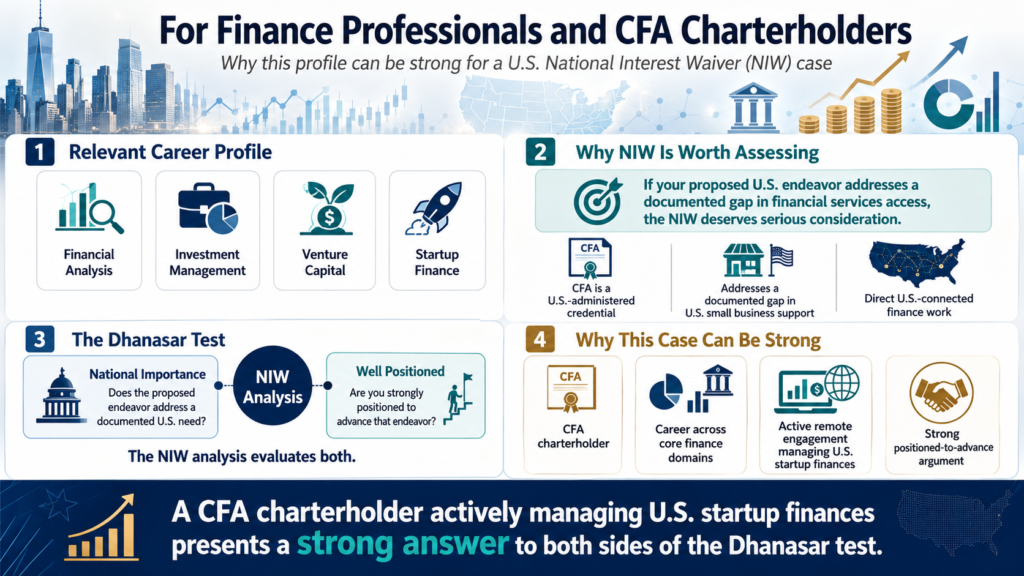
If you hold a CFA charter and your career has spanned financial analysis, investment management, venture capital, or startup finance and your proposed U.S. endeavor addresses a documented national gap in financial services access, the NIW is worth a serious assessment. The CFA is a U.S.-administered credential. The proposed endeavor touches one of the most widely documented gaps in U.S. small business support. The Dhanasar test is satisfied when the proposed work has national importance and the petitioner is positioned to advance it. An active remote engagement managing U.S. startup finances is as direct a ‘positioned’ argument as NIW petitions get.
Questions Finance Professionals Ask Us
Can a CFA charterholder or financial analyst qualify for an EB-2 NIW?
Yes. The EB-2 NIW evaluates the national importance of the proposed endeavor and the petitioner’s positioning to advance it. The CFA is a U.S.-administered credential from the CFA Institute, globally recognized as the gold standard in investment management and financial analysis. A proposed endeavor focused on providing affordable FP&A services to the documented gap in U.S. small business financial planning with 33 million small businesses, 94% of which lack dedicated financial planning and consistent failure rates driven by financial mismanagement satisfies the national importance prong. A CFA charterholder currently managing U.S. startup budgets for a U.S. VC firm is well-positioned to advance it.
Does a remote engagement managing U.S. startup finances help a non-U.S.-resident NIW case?
It is among the most direct forms of well-positioned evidence available in a financial services NIW case. An active engagement where a U.S. company has specifically contracted the petitioner to manage end-to-end budgets for U.S. portfolio companies demonstrates that U.S. institutions have evaluated his expertise, found it superior to available alternatives, and are relying on it for real financial decisions affecting U.S. businesses. Under Dhanasar, this is direct evidence that the petitioner is already positioned to advance the proposed endeavor in the U.S. market, not merely qualified in the abstract.
Does a Financial Business Process Outsourcing model for small businesses constitute a legitimate NIW proposed endeavor?
Yes, when it is supported by documented national need and specific technical expertise. The BPO model for FP&A addresses a specific, documented market failure: small businesses that need financial planning expertise but cannot afford full-time analysts. The SBA, NFIB, Federal Reserve Bank, and BLS have all published data documenting the failure rates and financial management gaps in the U.S. small business sector. A CFA charterholder proposing to deliver expert FP&A through an accessible, affordable structure addresses that specific failure. The endeavor does not need to be a technological innovation; it needs to address national importance and reflect expertise that can advance the proposed work.
How does the CFA credential specifically help the well-positioned argument for an NIW?
The CFA charter from CFA Institute (USA) provides several distinct advantages in an NIW well-positioned argument. First, it is issued by a U.S.-based professional body and is explicitly described by the Institute as the global gold standard in investment management and financial analysis. Second, it requires demonstrated professional experience (not just examinations), so it serves as independent third-party validation that the petitioner’s financial expertise meets a high professional standard as evaluated by a U.S. institution. Third, fewer than 40% of candidates who begin the program complete it, making charter-holder status itself a marker of distinction above peers. These elements collectively support the Dhanasar well-positioned analysis.
Managing real budgets for 5 U.S. startups right now is the strongest kind of well-positioned evidence. already doing the work, not proposing to. See how Immignis builds NIW cases around active U.S. engagement.