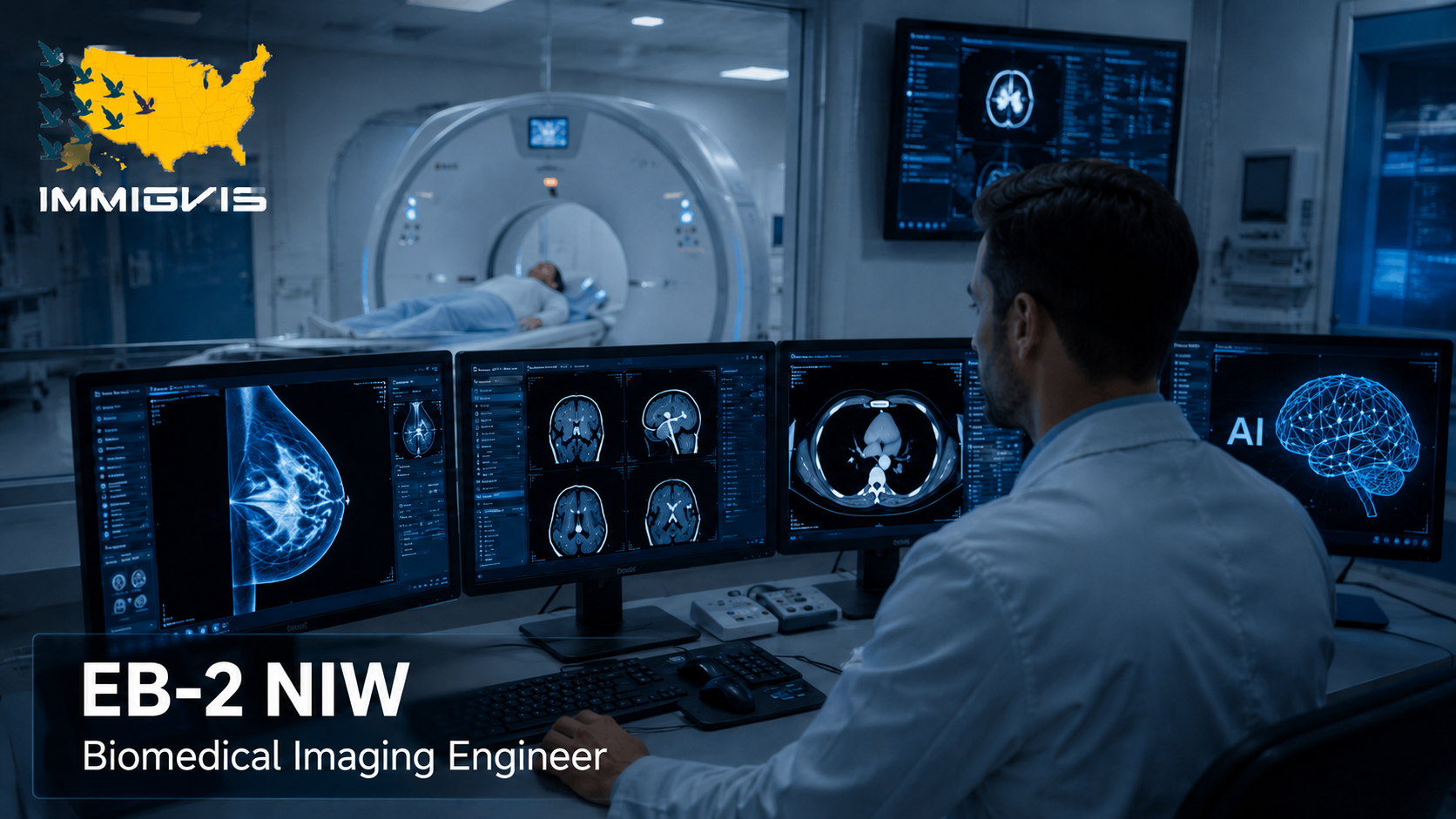
EB-2 NIW biomedical imaging engineer: A biomedical engineer who had spent 14 years installing and maintaining CT scanners, mammography systems, and AI-integrated imaging platforms at some of the UAE’s most prestigious hospitals filed a petition that received an RFE. Not because the career wasn’t strong enough. Because the first submission didn’t explain it well enough. The response fixed that, and the petition was approved.
In short: A biomedical engineer with 14 years of progressive experience specializing in the installation, commissioning,
servicing, and AI integration of medical imaging equipment – CT scanners, Digital Mammography, Digital X-ray, Computed
Radiography, C-Arms, PACS, and RIS was approved for an EB-2 National Interest Waiver as a self-petitioner after
responding to a Request for Evidence.
UAE-based Pakistani national. His career includes 15 major hospital installations across the UAE, including AI server and workstation integration for mammography diagnosis at a world-renowned Abu Dhabi hospital system. He holds advanced certifications from Fujifilm Medical Systems across every major equipment category. Proposed endeavor: serve U.S. healthcare facilities as a specialized biomedical engineer and consultant, advancing from employee to independent consultant, addressing the documented U.S. shortage of specialized biomedical
imaging engineers. Approved under Matter of Dhanasar.
The petitioner’s name and employer details have been withheld for privacy. Career record, project list, certifications, and outcome are real.
When the RFE Is About Explanation, Not Evidence
Most NIW petitions receive RFEs because USCIS challenges something substantive – the scope of national importance, the strength of the well-positioned argument, the clarity of the proposed endeavor. That is the most common pattern.
This case was different. The petitioner opened his RFE response with a candid acknowledgment: the first submission failed because of inadequate explanation, not inadequate experience. Fourteen years of hospital installations, advanced manufacturer certifications, AI integration work at world-class facilities, and a documented U.S. workforce shortage were all there in the supporting documents. What was missing was a clear, structured explanation of how those facts satisfied the Dhanasar test.
The core RFE situation: The underlying career was strong. The supporting documents were substantial. The petition cover letter as per USCIS did not connect them to the legal standards clearly enough. The RFE response rebuilt that connection – same facts, same documents, much clearer explanation.
The petition was approved.
An RFE is not a finding that the petitioner is unqualified. It is a request for more or better explanation. When the underlying career is genuine, the RFE response is the opportunity to show it properly.
Fourteen Years at the Same Employer, Every Major Equipment Platform
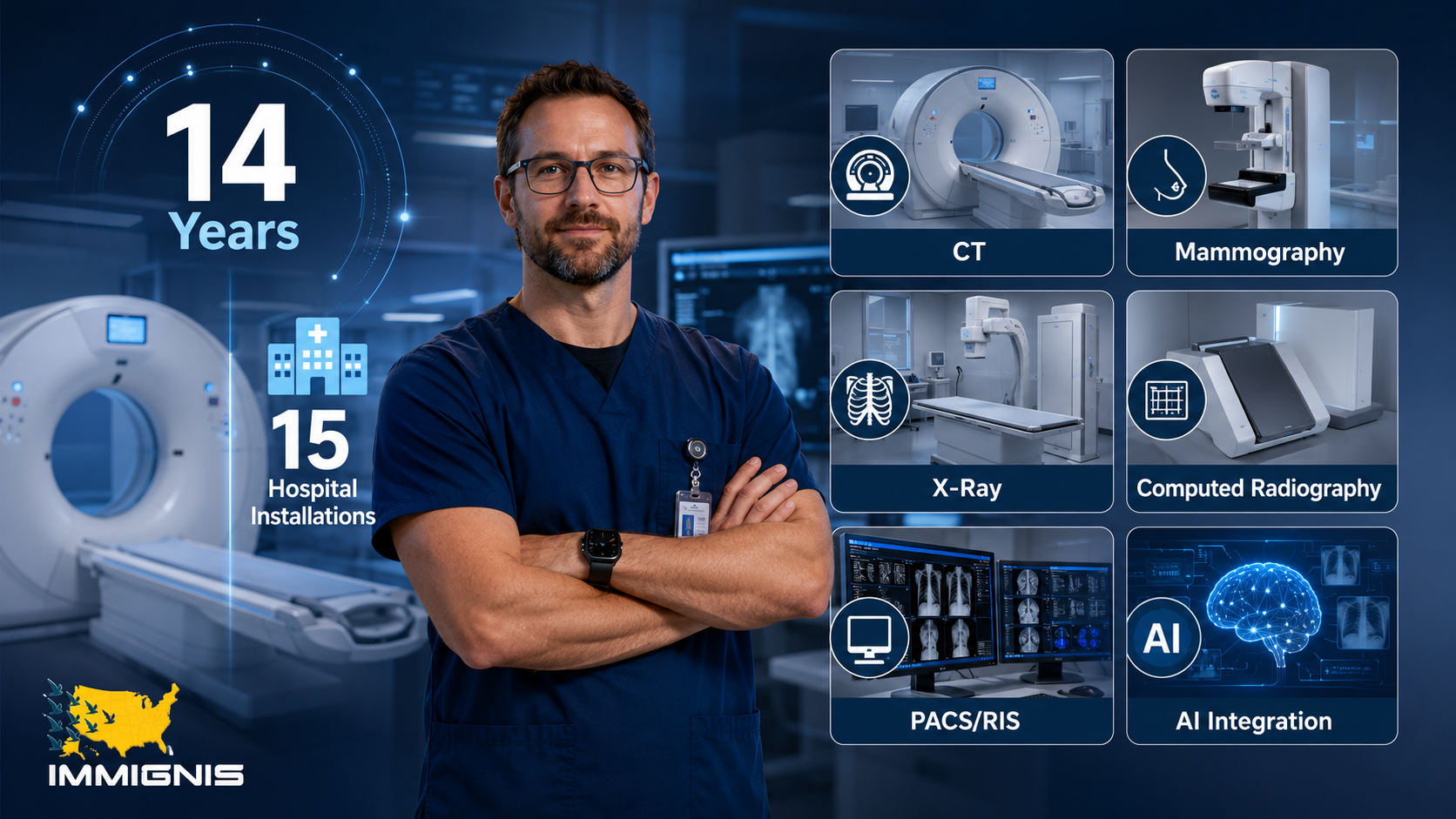
Since 2014 he has worked for the same UAE-based biomedical equipment supplier and service company. Over 14 years there, he has advanced to the highest position available within his specialization. His role involves leading multidisciplinary teams (CT technologists, mammography technologists, X-ray technologists, medical physicists) on the full lifecycle of imaging equipment: site preparation, delivery, installation, electrical connection, mechanical assembly, cooling systems, networking, calibration, testing, safety verification, and staff training.
He has accumulated advanced training certifications from Fujifilm Medical Systems (formerly Hitachi Medical Systems) across every major equipment category: CT scanners from 16-slice to 128-slice, Digital Mammography (Amulet F/S and Innovality), Digital Radiography (FDR Acselerate, FDR Smart, FDR DEVO), Computed Radiography (FCR Capsula XL II, Prima T, and XG5000), PACS (Synapse), and RIS (Synapse CWM). These are not introductory certifications. They are advanced, manufacturer-issued credentials that verify competency in the specific platforms he services.
Fujifilm Healthcare Americas Corporation – the result of a merger between Fujifilm and the former Hitachi Medical Systems U.S. operations – is an active and significant participant in the U.S. medical imaging market. His certifications in Fujifilm equipment platforms are directly applicable to U.S. hospital environments without a technology transition gap.
The AI Integration That Defines the Frontier
His most technically advanced project and the one that best reflects where the field is going was the installation and integration at a world-renowned Abu Dhabi hospital system. The project scope included two Digital Mammography systems with Tomosynthesis (3D mammography), Stereotactic Biopsy capability with both vertical and lateral approaches, and the key advancement dedicated AI servers and AI-powered diagnostic workstations designed to assist radiologists in interpreting mammograms.
The AI system works like this: Tomosynthesis combines multiple X-rays to construct a detailed 3D image of breast tissue. The AI algorithms running on the dedicated servers analyze that 3D image, flag suspicious areas for radiologist attention, and assist in distinguishing between benign and malignant lesions. The radiologist still makes the diagnosis. The AI reduces the probability that a suspicious feature is missed.
His role was the integration challenge: ensuring seamless connectivity between the Fujifilm Digital Mammography hardware, the AI workstations, and the PACS/RIS infrastructure – resolving every hardware and software compatibility issue that arose during implementation. This is not the work of a standard field service engineer. It requires understanding both the imaging hardware and the AI software layer, and the network architecture that connects them. He was also responsible for the PACS and RIS implementation at the same institution, meaning the complete radiology information infrastructure for that department.
Installing a CT scanner requires technical precision. Integrating AI diagnostic systems into a mammography workflow at a world-class hospital requires a different tier of expertise: hardware, software, clinical workflow, and network architecture, all simultaneously.
The Project Portfolio
Across 14 years, his documented installations include the full spectrum of imaging specialization, across 15 major hospital engagements in the UAE:
– A major Abu Dhabi hospital (part of a global health network) – CT scanner with AI workstation (64 slice)
– Three Abu Dhabi and Sharjah hospitals – Digital Mammography systems with Tomosynthesis, Stereotactic Biopsy, PACS/RIS implementation
– A major Dubai hospital – high-end ceiling-mounted Digital Radiography with PACS
– Multiple healthcare centers across Abu Dhabi, Sharjah, and Dubai – CT scanners (16 and 64 slice)
– Four medical centers at a major energy company – floor-mounted Digital Radiography systems and laser imagers (four simultaneous deployments)
– A college health center (two locations) – ceiling-mounted Digital Radiography with auto-tracking
– Several clinics and polyclinics – dental CBCT, Computed Radiography, Digital Mammography with mini PACS
He also consults on diagnostic center design, a higher-level engagement that covers site selection, compliance with JCI and ISO standards, IT infrastructure design, vendor selection, staff training, and financial projections. This consultancy function is the direct predecessor to his proposed U.S. independent consultant role.
The U.S. Workforce Gap
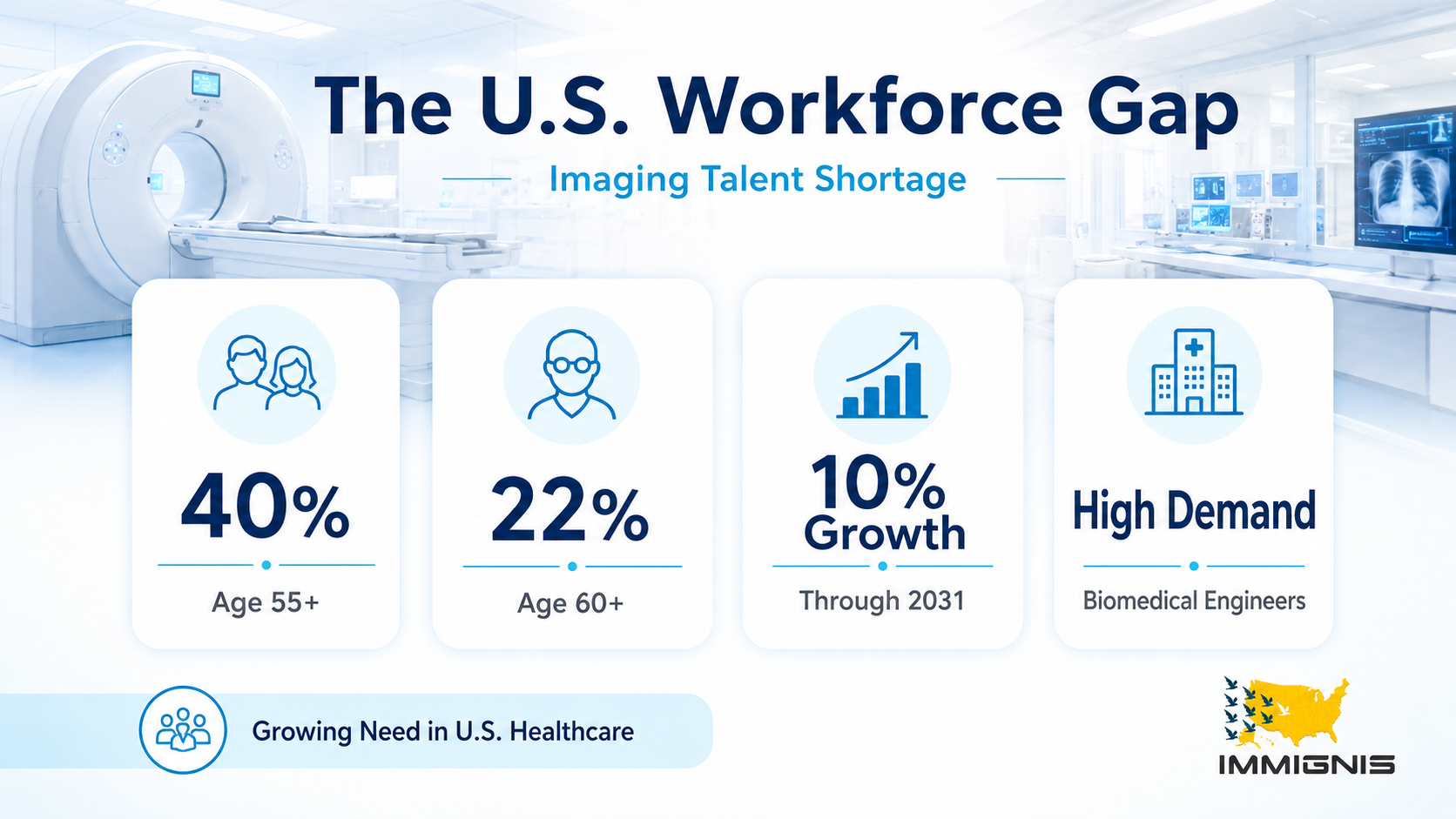
The Association for the Advancement of Medical Instrumentation (AAMI) has documented a significant and worsening shortage of biomedical engineers in U.S. healthcare: 40% of currently employed biomedical engineers are aged 55 or above, with 22% exceeding 60 years and approaching retirement. The profession faces documented challenges in attracting and retaining younger talent, and AAMI has specifically identified patient safety implications from the shortage.
The Bureau of Labor Statistics projects 10% employment growth for biomedical engineers through 2031, faster than average for all occupations. The O*NET Online database designates Biomedical Engineering (code 17-2031.00) as a Bright Outlook occupation, meeting criteria for both above-average projected growth and significant projected job openings.
His Texas focus is grounded in demographic data: Texas is projected to have a growing elderly population of 5.9 million individuals, approximately 19.4% of the state’s total population, by 2030. An aging population means more imaging procedures, more equipment utilization, and more specialized biomedical engineers needed to maintain and operate the machines that support diagnosis. His personal experience of living in Texas provides an additional foundation for that geographic choice.
Beyond the workforce gap, the medical imaging equipment market itself is growing substantially. The U.S. medical imaging market was valued at USD 48.75 billion in 2021 and is projected to reach USD 84.08 billion by 2030 (Fortune Business Insights). The CT scan market alone is projected to grow from USD 8.14 billion to USD 10.95 billion by 2028 (Mordor Intelligence). Growth at this rate in a sector that already has documented workforce shortages intensifies the need for the exact specialization he provides.
The Proposed Execution Plan |EB-2 NIW biomedical imaging engineer
His proposed U.S. plan moves through three stages, each building naturally on the previous.
Short term (initial): employee at a U.S. healthcare facility or biomedical equipment company. The documented U.S. shortage of specialized biomedical imaging engineers means this step is highly feasible – his credentials, certifications, and 15-project portfolio of U.S.-active equipment brands provide immediate value to U.S. employers.
Medium term (12-18 months): transition to independent consultant/service provider, expanding reach to more healthcare facilities and more patients. The distinction between the employee role and the consultant role is not a change in what he does — it is an expansion of scope. He is already doing this work; the independent consultant model removes the limitation of serving only one employer.
Long term (18-30 months): formation of a company supplying, installing, maintaining, and repairing biomedical imaging equipment – creating employment, providing internships for emerging biomedical engineers, and expanding service capacity across multiple healthcare facilities. This stage also includes his knowledge transfer goal: training the next generation of biomedical imaging specialists.
How the Petition and RFE Response Were Built
The underlying evidence was strong from the initial filing. The RFE response structured and explained it properly.
– National importance sourcing: AAMI workforce shortage data (40% aged 55+, 22% near retirement), BLS 10% growth projection, O*NET Bright Outlook designation, NIBIB mission, OSTP STEMM priorities, ARPA-H establishment, HHS FY2022-2026 strategic goals, Mordor Intelligence/Fortune Business Insights market projections ($48.75B to $84.08B by 2030), U.S. Census Bureau aging population data, CDC disease burden statistics (cancer, cardiovascular disease, COPD, stroke), Critical and Emerging Technologies List (AI).
– Well-positioned evidence: 14 years at same employer reaching highest available position, 15 documented hospital installation projects across UAE, AI server and workstation integration at a world-renowned hospital system, advanced Fujifilm Medical Systems certifications across all major imaging modalities (CT, mammography, radiography, CR, PACS, RIS), diagnostic center design consultancy experience (JCI/ISO compliance), diagnostic filmless transition projects leveraging AI and machine learning.
I-140 filed as a self-petition without a U.S. employer.
The Outcome
Approved after RFE.
A self-petitioned EB-2 NIW for a biomedical imaging specialist who installed CT scanners and mammography systems at prestigious UAE hospitals for 14 years, integrated AI diagnostic systems at a world-renowned hospital, and held advanced certifications in the exact platforms used by U.S. healthcare facilities – approved after a clear, well-structured RFE response that explained what the first petition had left implicit.
The career was always there. The AI integration work, the 15 hospital installations, the Fujifilm certifications, the PACS/RIS implementations – all in the supporting documents from the start. The RFE was the signal to explain it better, and the response did.
For Biomedical Engineers in Medical Imaging
If your career is in medical imaging equipment (installation, service, commissioning, AI integration, or diagnostic center design) and you have a documented track record at major healthcare institutions, the NIW is worth a serious assessment. The U.S. biomedical engineering workforce shortage is documented and worsening. The equipment market is growing. And if your first petition is unclear rather than insufficient, an RFE is not a denial. It is an opportunity to explain what was always there.
Questions Biomedical Imaging Engineers Ask Us
Can a biomedical engineer who has spent their entire career outside the United States qualify for an NIW?
Yes. The Dhanasar test evaluates the national importance of the proposed endeavor and whether the petitioner is positioned to advance it – not where the career took place. A specialized biomedical imaging engineer with advanced manufacturer certifications in equipment actively used by U.S. hospitals, 14 years of documented hospital installations, and a demonstrated ability to integrate AI-based diagnostic systems is positioned to serve the U.S. healthcare market regardless of where that expertise was developed. The U.S. workforce shortage further strengthens the national importance case.
What does an RFE about petition explanation (rather than substantive challenges) mean for the outcome?
An RFE about petition clarity is an invitation to restructure the same evidence more effectively – not to develop new evidence that didn’t exist before. When the underlying career is genuinely strong, a well-prepared RFE response that connects that career to the Dhanasar test clearly and specifically has a good probability of approval. The key is treating the RFE response as the opportunity it is rather than treating it as a near-denial. In this case, the same 14-year career that was in the initial submission was approved after the response explained it properly.
Does integrating AI into medical imaging systems help an NIW case?
Yes, directly. The U.S. government’s Critical and Emerging Technologies List designates Artificial Intelligence as a priority domain. A biomedical engineer whose work involves integrating AI diagnostic servers and workstations into mammography systems – enabling radiologists to detect breast cancer earlier and more accurately – is contributing to the intersection of AI, healthcare technology, and patient outcomes. This AI dimension is documented, institutional (completed at a world-renowned hospital), and directly relevant to both the national importance and the well-positioned arguments.
Do manufacturer-specific certifications in medical imaging equipment (like Fujifilm Medical Systems) help the NIW case?
They contribute specifically to the well-positioned argument. Manufacturer-issued certifications in specific imaging platforms (CT scanners, mammography systems, PACS, RIS) are independent validations of technical competency in the exact systems U.S. hospitals use. Fujifilm Healthcare Americas Corporation is an active participant in the U.S. medical imaging market; certifications in their equipment platforms are directly applicable to U.S. healthcare environments. Combined with 15 documented hospital deployments of those same systems, the certifications provide the credentials-plus-track-record combination that the well-positioned prong requires.
IAn RFE doesn’t mean your case is weak, it means the explanation needs work. See how Immignis turns RFE responses into approvals for biomedical and imaging professionals.