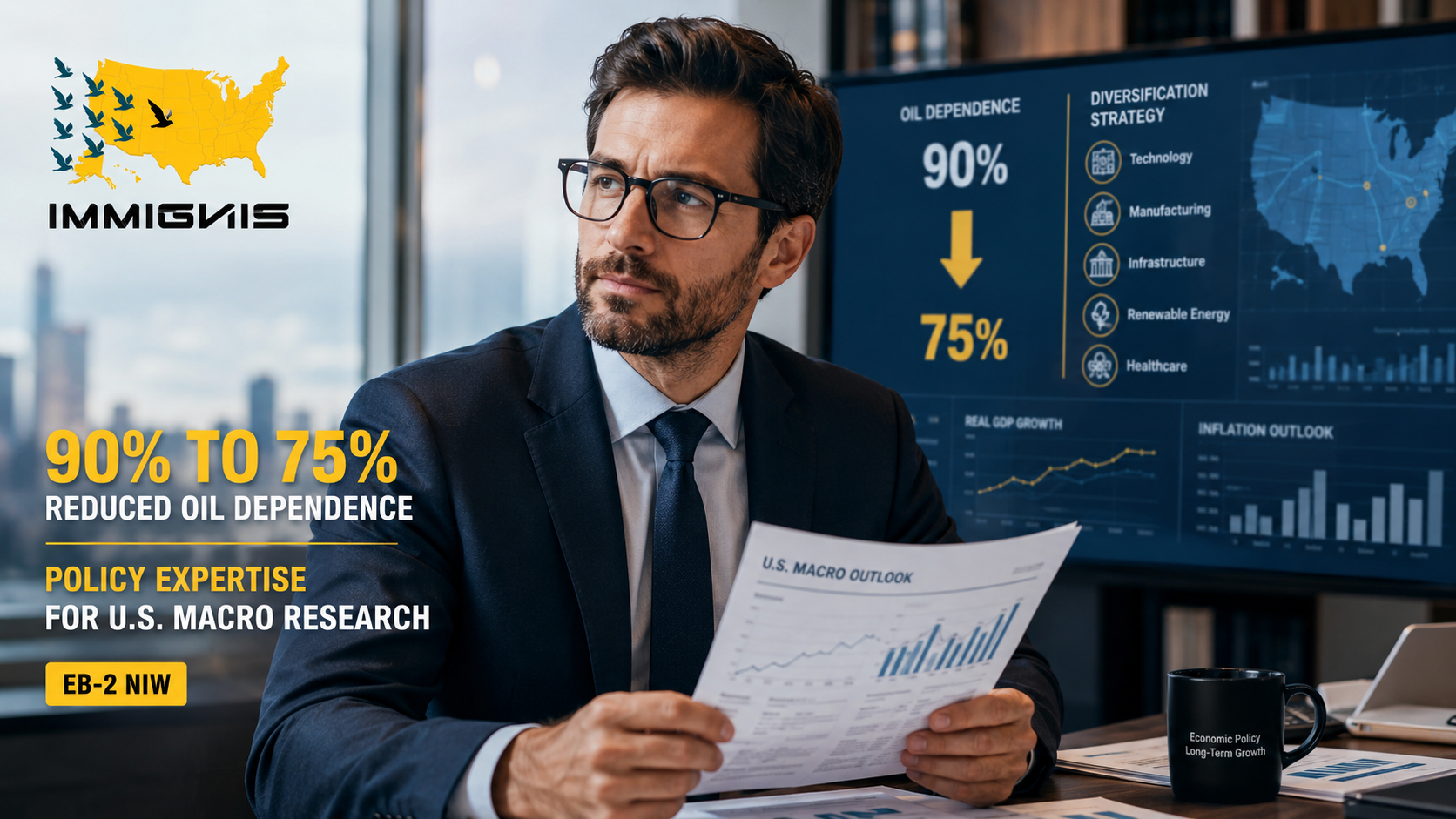
EB-2 NIW economist: An Iraqi economist whose tax reform model moved Kurdistan’s non-oil revenue from 10% to 25% of total government income – recruited by Germany’s development agency (the equivalent of USAID) and recognized with 200+ television appearances as a leading economic analyst – approved for an EB-2 NIW to conduct advanced macroeconomic research and foster international financial collaboration in the United States.
In short: An economist holding a Doctor of Philosophy in Economics from a UK university and a Master of Science in Economics and Finance from the same institution, with progressive experience spanning government tax reform, macroeconomic policy advisory, academic research, and financial markets consulting, was approved for an EB-2 National Interest Waiver as a self-petitioner. Iraqi national, based in Iraq’s Kurdistan Region.
He serves as Associate Professor at a leading technical university in the Kurdistan Region and as Economic and Finance Consultant at a financial consulting firm. He previously served as Top Economic Adviser in the Deputy Prime Minister’s office of the Kurdistan Regional Government. His tax reform model, developed for the KRG, raised non-oil government revenues from 10% to 25% of total revenue, creating a new directorate for major taxpayers and marking a significant step toward economic diversification. Germany’s development cooperation agency specifically recruited him for economic reform expertise.
He has presented at an international conference at Oxford University. Proposed endeavor: advanced macroeconomic research on U.S. monetary policy, inflation, and the USD Index, and international financial collaboration to connect foreign brokers with U.S. financial institutions. Approved under Matter of Dhanasar.
The petitioner’s name and employer names have been withheld for privacy. Career record, projects, and outcome are real.
When an Entire Government Economy Depends on One Commodity
Economists have a term for what happens when a government becomes overwhelmingly dependent on revenue from a single natural resource: Dutch Disease. When oil prices are high, everything is fine. When they fall, the entire government budget collapses. Healthcare, salaries, infrastructure, education – all of it runs on the oil price. And the government has little incentive to build any other revenue source because the oil money is so much easier.
This was the fiscal reality of Iraq’s Kurdistan Region. The KRG was generating approximately 10% of its total revenue from non-oil sources. Oil dominated everything. The risks of that dependency (price volatility, geopolitical disruptions, long-term depletion) were well understood but structurally unaddressed.He developed an economic model for tax system reform and submitted it as a comprehensive policy report to the Deputy Prime Minister’s office.
The model was implemented. The result: non-oil revenue rose from 10% to 25% of total KRG government revenue. A new directorate was created (the General Directorate of Big Taxpayers) to administer the expanded tax system. This is documented in KRG government press releases and covered in regional news. It is not a self-reported achievement. It is a publicly verified policy outcome.
A 15-percentage-point increase in non-oil government revenue, from 10% to 25%, is not an incremental improvement. It is a structural change in how an economy finances itself. He built the model. It was implemented. The directorate still exists.
When Germany’s USAID Comes Looking
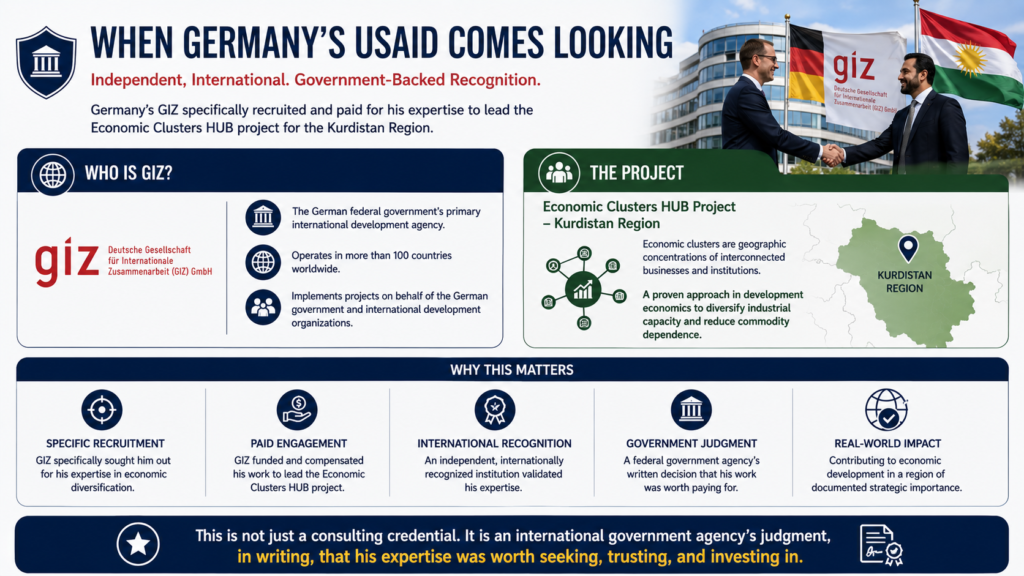
Germany’s Deutsche Gesellschaft für Internationale Zusammenarbeit (GIZ) is the German federal government’s primary international development agency – equivalent in function and scale to USAID. GIZ operates in more than 100 countries and delivers projects on behalf of the German government as well as international development organizations.
GIZ specifically recruited him and paid for his expertise to lead the Economic Clusters HUB project for the Kurdistan Region. Economic clusters are geographic concentrations of interconnected businesses and institutions – the approach used in development economics to diversify industrial capacity and reduce commodity dependence. The GIZ engagement represents an independent, internationally recognized institutional decision that his expertise in economic diversification was worth seeking out and compensating.
Being recruited by GIZ for policy work in a region of documented economic development importance is not the same as listing a consulting credential. It is an international government agency’s judgment, in writing, that this economist’s work was worth paying for.
The Academic Career and the Media Presence
He has served as Associate Professor at a leading technical university in Iraq’s Kurdistan Region since 2011, making him a permanent institutional member with over a decade of teaching and research in economics and finance. His courses span Principles of Economics, Financial Mathematics, International Economics, and related areas. He has supervised five PhD students and two MSc students.
He presented at a conference at Oxford University in December 2022 – a peer-reviewed international venue in one of the world’s most recognized academic settings. His research encompasses oil revenue volatility, exchange rate regimes, macroeconomic impacts on gold prices, and (directly relevant to the proposed U.S. endeavor) published and in-progress work on U.S. monetary policy and the Dow Jones Industrial Average, and U.S. macroeconomic conditions and the USD Index.
His public profile in Kurdistan and Iraq is substantial. He has made more than 200 television appearances as an economic analyst on national channels, and maintains a YouTube channel with approximately 60 uploaded interviews. This media presence reflects what his academic and policy career has built: recognized authority in economic analysis in a region where economic questions about oil, diversification, government finance, and development are actively debated in the public sphere.
The Two-Track Proposed Endeavor |EB-2 NIW economist
His proposed U.S. work has two interconnected tracks, each drawing on a different dimension of his career.
The first is advanced macroeconomic research – analyzing the effects of U.S. monetary policy on inflation rates and the USD Index. The U.S. Dollar Index ranged between 102 and 110 in 2023; small changes in the dollar’s global value have substantial effects on trade, debt service, and purchasing power. The Federal Reserve has published that understanding the relationship between monetary policy decisions and macroeconomic outcomes is essential for effective policymaking.
His research on U.S. monetary policy and the Dow Jones (accepted for publication) and the in-progress work on U.S. conditions and the USD Index are the direct academic predecessors of this proposed research track. The research will be directed toward Federal Reserve datasets, submitted to U.S. journals, and presented to policy institutions.
The second is international financial collaboration – using his connections in Iraq’s financial sector to facilitate the entry of Iraqi brokers into U.S. financial markets. Iraqi financial actors face documented barriers to accessing U.S. private banks and financial institutions. By bridging that gap, his work would channel additional foreign capital into the U.S. economy, diversify investment sources, and strengthen U.S. financial market participation from the Middle East. He has already applied this knowledge at the institutional level: his university’s internship program taught approximately 50 students Forex market practice. His consulting work in the Forex and gold markets gives him operational familiarity with the trading environment his proposed collaboration work will navigate.
The National Importance Case
The national importance case for an economist proposing macroeconomic research on U.S. monetary policy and inflation is grounded in well-documented federal priorities.
– Federal Reserve’s Monetary Policy Reports consistently emphasize that data-driven macroeconomic research is essential for sound policy decisions, particularly on inflation management and exchange rate stability.
– The Council of Economic Advisers advocates for rigorous academic research as foundational to effective monetary policy, with annual Economic Reports of the President documenting the ongoing need for evidence-based policy guidance.
– U.S. Department of Commerce SelectUSA program: FDI totaling $148.8 billion was recorded in 2023; the program explicitly targets expansion of foreign direct investment and financial market participation as national priorities.
– OECD U.S. Economic Snapshots provide benchmarks against which macroeconomic research and policy analysis are measured; his proposed research contributes to this analysis layer.
– Office of International Affairs, U.S. Treasury: explicitly focuses on global financial collaboration and the importance of international partnerships for financial stability.
– Strengthening the Economy was rated the top U.S. policy priority by 73% of Americans in 2024 survey data.
How the Petition Was Built
This was a direct petition. The government policy impact, GIZ recruitment, academic record, and published/in-progress research were already in place.
– Well-positioned evidence: Associate Professor at a leading Iraqi technical university, PhD Economics from a UK university, tax reform model that raised KRG non-oil revenue from 10% to 25% (publicly documented), General Directorate of Big Taxpayers created as result of his model, GIZ-recruited for Economic Clusters HUB project, Top Economic Adviser at KRG Deputy Prime Minister’s office, published research on gold prices/exchange rates/macroeconomic indicators, accepted paper on U.S. monetary policy and Dow Jones, in-progress paper on U.S. macroeconomic conditions and USD Index, Oxford University conference presentation (December 2022), 200+ television appearances, 5 PhD students supervised, 2 MSc students supervised, 50 students taught Forex market through university internship.
– National importance sourcing: Federal Reserve Monetary Policy Reports, Council of Economic Advisers, OECD U.S. Economic Snapshots, U.S. Bureau of Labor Statistics inflation data, BEA FDI statistics ($148.8B, 2023), SelectUSA program outcomes, Office of International Affairs U.S. Treasury, FSB Global Monitoring Report, BIS Annual Economic Report, World Bank international investment data.
I-140 filed as a self-petition without a U.S. employer.
The Outcome
Approved.A self-petitioned EB-2 NIW for an Iraqi economist whose tax reform model produced a publicly documented 15-percentage-point increase in KRG non-oil government revenue, was specifically recruited by Germany’s development cooperation agency for economic reform expertise, holds a PhD Economics from a UK university, presented at Oxford University, and proposes to conduct advanced macroeconomic research on U.S. monetary policy and foster international financial collaboration between Iraq and the United States.
GIZ – Germany’s equivalent of USAID – does not recruit economists at random. Being specifically sought out and paid by an international development agency for policy expertise is an institutional judgment about the quality and relevance of that expertise. It is one of the most direct forms of external validation available to an applied economist.
For Economists and Economic Policy Researchers
If your career is in economics, macroeconomic research, financial markets, or economic policy advisory – particularly with documented real-world policy outcomes, institutional research grants, or applied work with governments or international development organizations – the NIW is worth a serious assessment. The Dhanasar test is satisfied when the proposed endeavor has national importance and you are positioned to advance it. An economist who has built a tax reform model with publicly documented government-level impact, been recruited by an international development agency for policy expertise, and is conducting active research on U.S. monetary policy and macroeconomic indicators has a direct answer to both.
Questions Economists and Policy Researchers Ask Us
Can an economist or macroeconomic policy researcher qualify for an EB-2 NIW?
Yes. The Dhanasar test evaluates whether the proposed endeavor has substantial merit and national importance, and whether the petitioner is positioned to advance it. A proposed endeavor focused on advanced macroeconomic research into U.S. monetary policy, inflation dynamics, and the USD Index addresses documented federal priorities articulated by the Federal Reserve, Council of Economic Advisers, and Treasury. An economist with a PhD from an accredited UK university, peer-reviewed publications on related topics, documented policy impact at government level, and active in-progress research directly relevant to the proposed U.S. work is well-positioned to advance it.
How does documented government policy impact help an NIW case for an economist?
It provides a form of well-positioned evidence that published papers alone cannot: demonstrated real-world application of economic expertise at the level where policy actually gets made. A tax reform model that raised a government’s non-oil revenue from 10% to 25% of total income, resulting in the creation of a new government directorate, is a publicly verifiable policy outcome. This type of applied impact demonstrates not only theoretical knowledge but the ability to translate economic analysis into institutional change – exactly the capability the proposed U.S. macroeconomic research endeavor requires.
How does being recruited by an international development agency (like GIZ) help an NIW case?
Being specifically recruited and paid by GIZ (Germany’s federal development cooperation agency, equivalent to USAID) for economic reform expertise is an independent, internationally recognized institutional judgment about the petitioner’s qualifications. GIZ operates under competitive selection criteria and hires specialists based on documented professional standing. This form of recognition is different from employment: it reflects an external assessment that the petitioner’s expertise is valuable enough to seek out specifically. In the Dhanasar well-positioned analysis, it functions as independent institutional validation of the specific expertise the proposed endeavor requires.
Does macroeconomic research with a U.S. focus (on Fed policy, Dow Jones, USD Index) help the NIW case for a non-U.S.-based researcher?
Substantially. Under Dhanasar, the well-positioned prong evaluates whether the petitioner can advance the proposed endeavor – not where their career has been located. An economist whose published research is directly on U.S. monetary policy and its effects on U.S. financial indicators (the Dow Jones, USD Index, inflation) has already been doing the proposed U.S. work from abroad. The publication record demonstrates both the analytical capability and the specific subject-matter engagement with U.S. macroeconomic questions, making the connection between existing expertise and proposed U.S. contribution direct and concrete.
A tax reform model that moved a government’s revenue structure and got Germany’s development agency to recruit him, that’s the kind of documented impact USCIS can verify. See how Immignis builds NIW cases around real policy outcomes.