EB-2 NIW 6G wireless researcher: A PhD researcher and Associate Professor with 537 citations, 25 journal publications in top IEEE venues, and EPSRC-funded post-doctoral research in the UK – specializing in the enabling technologies for Beyond 5G and 6G wireless communications – approved for an EB-2 NIW at a moment when the White House has declared winning the 6G race a national security priority.
In short: An electronic engineering researcher holding a Doctor of Philosophy in Electronic Engineering from a New Zealand university and post-doctoral research training from a UK institution under EPSRC (Engineering and Physical Sciences Research Council) funding, with 15 years of experience in wireless communications research and academia, was approved for an EB-2 National Interest Waiver as a self-petitioner. Pakistani national. He serves as Associate Professor and In-charge Graduate Program at a leading Pakistani technical university, where he has published 25 peer-reviewed journal papers and 6 conference papers in top IEEE and international venues, accumulated 537 Google Scholar citations (including citations in 5 patents), and supervised 4 completed Master’s theses.
He is an IEEE Senior Member since 2018. His research focuses on Intelligent Reflecting Surfaces, full-duplex MIMO, terahertz frequencies, Device-to-Device communications, and physical-layer security – the enabling technologies for Beyond 5G and 6G wireless systems. He has been engaged by the Navajo Tribal Utility Authority (USA) and has three U.S.-based academic and industry supporters. Proposed endeavor: conduct cutting-edge research to develop enabling technologies, signal processing algorithms, and protocols for next-generation B5G and 6G wireless communication systems in the United States. Approved under Matter of Dhanasar.
The petitioner’s name and employer names have been withheld for privacy. Publication record, citation count, grants, and outcome are real.
The Papers That Come Before the Network
6G networks do not exist yet. They are being imagined, specified, and mathematically characterized right now, in research papers published in IEEE journals, at international conferences, and in funding proposals submitted to the NSF, DOD, and NTIA. The algorithms those networks will run on, the protocols that will govern how devices communicate, the signal processing techniques that will make terahertz frequencies and intelligent reflecting surfaces practical — all of this is being worked out now. It will take a decade before commercial networks exist. The research that determines what is possible is happening today.
He has been doing that research for 15 years. His Google Scholar record shows 537 total citations, with 462 since 2019. His most-cited paper (on Intelligent Reflecting Surfaces, published in 2021) has been cited 97 times by researchers around the world. Five patents have cited his work, meaning engineers building commercial systems have recognized his theoretical contributions as foundational to what they are building. He has published in IEEE Transactions on Communications, IEEE Transactions on Vehicular Technology, IEEE Transactions on Industrial Informatics, and more than a dozen other top-tier IEEE journals.
The White House issued a National Security Presidential Memorandum on winning the 6G race in December 2025. The research being published in 2021, 2022, 2023, 2024 is the research that will determine whether the United States wins it.
The Enabling Technologies He Works On
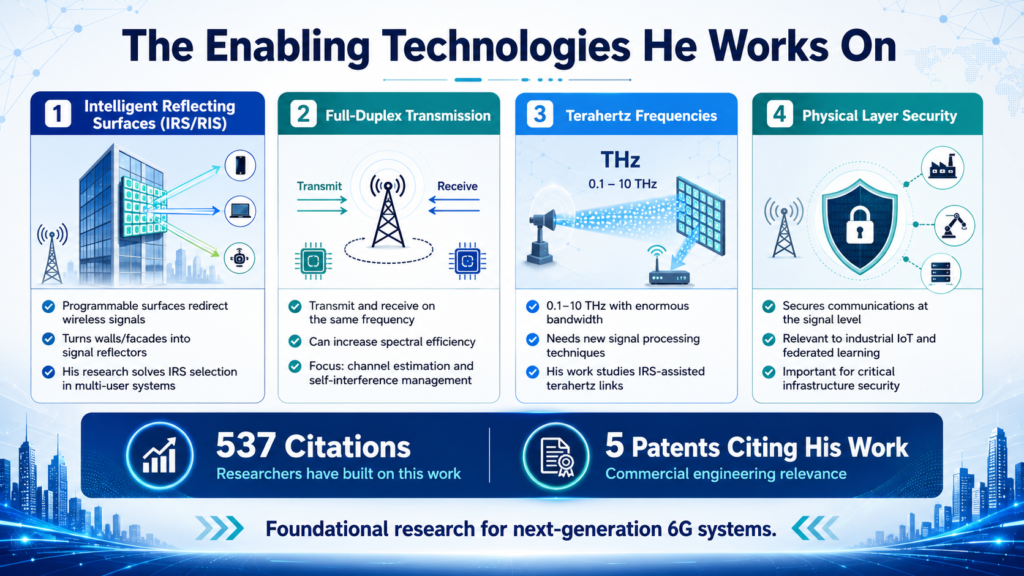
His research focuses on several technologies that are central to how 6G will work differently from 5G. A brief explanation of each makes the well-positioned argument concrete.
Intelligent Reflecting Surfaces (IRS/RIS) – surfaces embedded with thousands of tiny passive elements that can be electronically configured to redirect wireless signals. Rather than relying entirely on base stations to reach devices, a room wall or building facade becomes a programmable signal reflector. His most-cited paper demonstrates the algorithm for selecting which IRS to use in a multi-user system – a fundamental design question that needs to be solved before these surfaces can be deployed commercially.
Full-Duplex Transmission – a system where a device transmits and receives on the same frequency simultaneously, effectively doubling spectral efficiency. His papers address the channel estimation challenge in full-duplex MIMO systems, a critical problem because self-interference (the device’s own transmission interfering with what it is trying to receive) must be managed mathematically.
Terahertz Frequencies – frequencies between 0.1 and 10 terahertz that offer enormous bandwidth but require new signal processing techniques because of their different propagation characteristics. His work on IRS-assisted terahertz systems addresses the fundamental question of how to maintain a usable signal at these frequencies.
Physical Layer Security – techniques that secure wireless communications at the signal level rather than relying entirely on encryption. His papers address this for industrial IoT systems and federated learning networks – both of which are critical security domains for U.S. critical infrastructure.
537 citations means 537 instances of other researchers saying: this is foundational to the work I am doing. Five patents citing his work means engineers building commercial wireless systems have recognized his theoretical contributions as necessary to what they are building.
The Career That Produced the Research |EB-2 NIW 6G wireless researcher
He completed his PhD in Electronic Engineering from a New Zealand university, with research on limited feedback techniques in multiple-antenna wireless communication systems. He then received post-doctoral funding from the EPSRC (Engineering and Physical Sciences Research Council) – the UK’s premier government research funding body, equivalent to the NSF in the U.S. – for the UPFRONT project: Unlocking Potentials of MIMO Full-Duplex Radios for Heterogeneous Networks. EPSRC awards are internationally competitive; post-doctoral positions are not guaranteed to any PhD graduate but are awarded on research quality and potential.
He returned to academia at a leading Pakistani technical university, initially as Assistant Professor and subsequently promoted to Associate Professor based on research and teaching performance. He has served as In-charge of the Graduate Program since 2020, and previously as In-charge of the BS Telecommunications Engineering Program. He has supervised 4 completed Master’s research theses and is currently supervising 1 PhD student.
His research grants as Principal Investigator or Co-Investigator span six funded projects, including industry grants from Spark NZ and Sky Communications in New Zealand, a faculty research grant from Victoria University, and, notably, a project funded by the Navajo Tribal Utility Authority (NTUA) and NI solutions in the United States – a fact sheet on the deployment of small cells for broadband service in Tuba City, Arizona. The NTUA specifically sought him out because of his expertise. Two more recent projects are funded by a Pakistani defense research organization, including an active 2024 project on passive drone detection.
IEEE Senior Member
He was elevated to IEEE Senior Member in 2018. IEEE Senior Member is not a membership tier that comes with a subscription. It requires that candidates have been in professional practice for at least ten years, and must demonstrate significant performance over a period of at least five of those years. Fewer than 10% of IEEE members hold Senior Member grade. The elevation is by nomination and review, reflecting a formal institutional judgment that the candidate has made substantive contributions to the field.
Senior Member status is one of the strongest academic credentials available in electrical and electronic engineering for demonstrating the Dhanasar well-positioned argument: it is an independent, third-party, expert-body confirmation that this person’s contributions are above ordinary professional practice in the field.
Three U.S.-Based Supporters
His petition includes support from three U.S.-based professionals in the wireless communications field.
The first is an IEEE Fellow and Professor at a U.S. midwestern engineering university – a recipient of the NSF CAREER Award, a former department chair at two U.S. universities, and a recognized authority in electrical and computer engineering. IEEE Fellow is the highest grade of IEEE membership, awarded to fewer than 0.1% of members for extraordinary accomplishment.
The second is a Principal Engineer at a major U.S. semiconductor and wireless technology company, who served as a foreign evaluator of his PhD thesis and is an active researcher in MIMO, millimeter-wave, and reconfigurable intelligent surface communications.
The third is a researcher at a major U.S. technology company, with expertise in wireless communications, patents, and published research.
Having an IEEE Fellow at a U.S. research university, a Principal Engineer at a major U.S. wireless technology company, and a researcher at a major U.S. technology company all independently supporting the petition demonstrates that the U.S. technical community in his specific field recognizes and values his contributions.
The National Importance Case
– White House National Security Presidential Memorandum on 6G (December 2025): Formally declared that winning the 6G race is a U.S. national security priority, naming open and resilient-by-design architecture as the national objective.
– White House Joint Statement Endorsing Principles for 6G (February 2024): White House formally endorsed collaborative 6G development as a national priority.
– Critical and Emerging Technologies List (2022, updated 2024): Both versions explicitly list Next-Generation Wireless Networks (5G, 6G, and beyond) as a national priority domain.
– NIST NextG Wireless R&D Gap Analysis (December 2023): NIST and NSF jointly identified major technology gaps in next-generation communications, specifying the research areas most urgently needed.
– DoD Innovate Beyond 5G (IB5G) Program: The Department of Defense launched formal projects to advance collaborative academic and industry partnerships for 5G-to-NextG wireless technologies.
– NTIA $1.5B Public Wireless Supply Chain Innovation Fund: The largest single federal investment in open and interoperable wireless network development.
– FCC TAC AI Working Group Report (August 5, 2025): Called for AI-driven network automation and intelligent network management – precisely the direction his signal processing research enables.
- NSF 6G Research Centers: The National Science Foundation has specifically funded research centers focused on future wireless networks, recognizing 6G as a foundational national science priority.
The United States has officially acknowledged that it does not currently lead in wireless communications – a recognition included in the White House’s own policy documentation. His proposed endeavor is a direct response to that acknowledged gap: developing the signal processing algorithms and enabling technologies through which U.S. leadership in 6G can be established.
How the Petition Was Built
This was a direct petition. The 15-year academic career, the publication record, the citation count, the IEEE Senior Member credential, and the U.S.-based supporter letters were already in place.
– Well-positioned evidence: PhD (New Zealand), EPSRC post-doctoral research (UK), Associate Professor and Graduate Program Director, 25 journal papers + 6 conference papers in top IEEE venues, 537 Google Scholar citations (462 since 2019), 5 patents citing his work, most-cited paper (97 citations on IRS), IEEE Senior Member since 2018, peer reviewer for top-tier IEEE journals (IEEE Transactions on Wireless Communications, IEEE Transactions on Communications, IEEE Journal on Selected Areas in Communications), 4 supervised Master’s theses, funded research from EPSRC/UK, Spark NZ, NTUA USA, and others, three U.S.-based supporters including IEEE Fellow professor and Principal Engineer at major wireless technology company.
– National importance sourcing: White House NSPD on 6G (December 2025), White House Joint Statement on 6G (February 2024), Critical and Emerging Technologies List (2022, 2024), NIST NextG Gap Analysis (December 2023), DoD IB5G Program, NTIA $1.5B Wireless Innovation Fund, FCC TAC AI Working Group Report (August 2025), FCC 5G FAST Plan, NSF 6G research centers.
I-140 filed as a self-petition without a U.S. employer.
The Outcome
Approved.
A self-petitioned EB-2 NIW for an electronic engineering researcher and Associate Professor who has published 25 journal papers in top IEEE venues, accumulated 537 citations including in 5 patents, holds IEEE Senior Member status, was funded by EPSRC in the UK, and was engaged by a U.S. entity for technical expertise – proposing to develop the signal processing algorithms and enabling technologies for 6G wireless systems at a moment when the White House has formally declared 6G leadership a national security priority.
The U.S. government has officially stated that it does not currently lead in wireless communications and that winning the 6G race is a national security priority. The research being done right now, in papers being published right now, will determine whether the U.S. wins it. He has been doing that research for 15 years.
For Academic Researchers and Engineering Professors
If your career is in academic research and you work in a field identified as a national priority – particularly wireless communications, 6G, AI, cybersecurity, quantum technologies, or other areas on the Critical and Emerging Technologies List – the NIW is worth a serious assessment. The Dhanasar test evaluates the national importance of the proposed endeavor and whether you are positioned to advance it. For a researcher with a strong publication record, substantial citations, and support from recognized U.S. experts in the field, the well-positioned argument can be among the clearest available.
Questions Academic Researchers Ask Us
Can an academic researcher or university professor qualify for an EB-2 NIW?
Yes. The Dhanasar test evaluates the national importance of the proposed endeavor and the petitioner’s positioning to advance it – not whether the petitioner is an industry professional or an academic. A researcher whose work contributes to a field explicitly identified in the Critical and Emerging Technologies List, whose publications are cited by hundreds of other researchers and by commercial patents, whose EPSRC post-doctoral funding reflects international competitive selection, and who has three U.S.-based academic and industry experts supporting the petition satisfies both the national importance and well-positioned prongs directly.
Does citation count matter in an NIW case for a researcher?
It is one of the most relevant forms of well-positioned evidence for a researcher. Citations in the academic literature are the formal mechanism by which researchers acknowledge that a prior work is foundational to their own. 537 citations means 537 instances of peer-reviewed recognition that this researcher’s work is necessary to the field. Citations in five commercial patents extend that recognition into practical engineering: engineers building commercial systems have identified this researcher’s theoretical contributions as foundational to what they are implementing. For Dhanasar’s well-positioned prong, a citation count of this scale from a researcher with 15 years in the field is evidence that the petitioner already influences the endeavor they are proposing to advance.
What does IEEE Senior Member status mean for a NIW case?
IEEE Senior Member is the most meaningful non-Fellow grade of IEEE membership for NIW purposes. It requires formal nomination, a minimum of ten years in the profession, and demonstrated significant performance over at least five of those years. Fewer than 10% of IEEE members hold it. Unlike a basic membership that any dues-paying member can hold, Senior Member is awarded through a review process that independently evaluates the candidate’s professional accomplishments. For the Dhanasar well-positioned analysis, it is an independent, third-party, expert-body formal statement that the petitioner has achieved above-peer performance in the field of electrical and electronic engineering.
How does EPSRC post-doctoral funding help an NIW case?
EPSRC (Engineering and Physical Sciences Research Council) is the UK government’s primary research council for engineering and physical sciences, equivalent in structure and prestige to the NSF in the U.S. Post-doctoral positions are not guaranteed to PhD graduates; they are awarded competitively to researchers identified as having exceptional potential and research quality. Having been funded by EPSRC for a post-doctoral project is an independent national-government-level recognition of research quality from a third country, which strongly supports the Dhanasar well-positioned analysis. It demonstrates that the petitioner’s research contributions were evaluated by an independent expert government body and found worthy of competitive government funding.
How is this case different from Stories 25 and 41, which also involve 5G and wireless networks?
Stories 25 and 41 both involve industry engineers implementing and managing 5G networks in the field. Story 25 is an Open RAN operations specialist at a cloud-native U.S. wireless carrier. Story 41 is an RF Engineering Manager supporting nationwide fiber/5G/CBRS programs. Both are practitioners whose work involves deploying, operating, and optimizing networks that already exist or are being deployed now. This case is fundamentally different: the petitioner is an academic researcher and professor who develops the signal processing algorithms, theoretical frameworks, and enabling technologies that define what future 6G networks will be capable of. The distinction is between building and running existing networks versus discovering and demonstrating what future networks can mathematically achieve. These are different professional activities, different well-positioned evidence types, and different national importance arguments that serve different reader audiences.
537 citations and five patents citing his work are the kind of independent validation that makes a well-positioned argument hard to dispute. See how Immignis builds NIW cases around deep research records.