A Vietnamese medical-device engineer built an approval-ready NIW around affordable assistive technology for aging and disabled Americans, without forcing his inventor profile into an academic mold.
Approval summary: The client was a Vietnamese medical-device engineer working in Japan with approximately ten years of experience, a granted patent, a registered trademark, real clinical and care-setting use, and a commercially adopted assistive-technology product. He had never filed before and doubted that EB-2 NIW applied to him because he was not a traditional academic researcher. We built the EB-2 NIW medical device engineer case around his real evidence: invention, commercialization, clinical adoption, accessibility impact, technical publications, independent letters, targeted public visibility, and a clear proposed endeavor focused on affordable assistive devices for aging and disabled Americans. The EB-2 NIW medical device engineer petition was approved without a Request for Evidence.
| Nationality / chargeability | Vietnamese |
| Professional field | Medical-device engineering; affordable assistive technology |
| Starting point | No prior filing; strong inventor record but low confidence in NIW eligibility |
| Profile-building focus | Patent, trademark, clinical adoption, disability-access impact, selective recognition, and independent validation |
| Outcome | EB-2 NIW approved without RFE |
The National Problem: Assistive Technology That Many People Cannot Afford
America is aging, and millions of people live with mobility limitations, sensory impairments, or disability-related needs that affect daily independence, a national context directly relevant to an EB-2 NIW medical device engineer. Assistive medical technology can reduce dependence on institutional care and help people remain active at home and in their communities. The problem is access. Many advanced devices are too expensive, too complex, or poorly adapted for ordinary clinical and home-care environments.
That is why this EB-2 NIW medical device engineer case was not framed as a product story. The national-interest argument was built around a wider healthcare and accessibility issue: affordable assistive devices that can improve quality of life for aging and disabled Americans while reducing pressure on long-term-care systems, strengthening the EB-2 NIW medical device engineer argument.
The Client’s Starting Point: Strong Evidence, Wrong Self-Assessment
When he came to us, he did not think he was a typical NIW candidate or an EB-2 NIW medical device engineer. He was not a university professor. He did not have a large citation record. He had not built his career around academic journals. His strongest evidence came from applied engineering: a granted patent, a registered trademark, a branded assistive device, clinical and care-setting adoption, product demonstrations, commercial use, and feedback from disability-support organizations.
The first step was not to manufacture a new identity for him as an EB-2 NIW medical device engineer. It was to help him understand that these were not ordinary business documents. Properly organized, they were immigration evidence: originality, commercialization, adoption, user impact, and independent professional recognition for an EB-2 NIW medical device engineer.
The Proposed Endeavor
Proposed endeavor: for an EB-2 NIW medical device engineer: To develop and deploy affordable assistive medical devices that improve independence and quality of life for aging and disabled Americans, addressing the national gap in accessible, cost-effective assistive technology, reducing dependence on institutional long-term care, and alleviating the economic burden on the U.S. health system.
This wording was important because it converted the EB-2 NIW medical device engineer case from “I invented a device” into “my engineering work addresses a national accessibility and healthcare-cost problem.” The device remained central, but the national interest became the impact of affordable assistive technology on aging, disability access, independence, and care-system burden for an EB-2 NIW medical device engineer.
What Immignis and Advance My Profile Built
The profile-building strategy was applied, not academic. We did not try to make the client look like a researcher he was not. We built an inventor and product-adoption record around the evidence he already had.
• We rebuilt his public professional identity around assistive medical-device engineering, aging, disability access, and affordable health technology.
• We organized the granted patent as original-contribution evidence and placed it at the center of the well-positioned argument.
• We used the registered trademark to show that the invention had moved from concept to commercial product identity.
• We made clinical and care-setting adoption a central evidence category because real use mattered more than citation volume in this applied field.
• We strengthened the publication record with a limited set of field-aligned rehabilitation-engineering and biomedical-device papers, without overbuilding an artificial academic profile.
• We prepared a targeted white paper on the affordable assistive-technology gap and shared it with relevant disability-access, rehabilitation-technology, aging-care, and assistive-technology stakeholders.
• We secured expert commentary in healthcare-technology, aging-policy, and disability-access contexts to show that his work belonged to a public-interest conversation.
• We pursued selective professional recognition and conference activity only where the evidence matched his genuine experience and technical niche.
How the Evidence Supported the Dhanasar Prongs
For Prong 1, the case connected the proposed endeavor to a national need: aging, disability access, affordability, long-term-care burden, and practical assistive technology. The petition did not rely on the product alone. It explained the public value of the class of technology he was positioned to advance.
For Prong 2, the patent, trademark, product use, clinical adoption, technical publications, professional recognition, and independent letters showed that he was already doing the type of work described in the endeavor. The evidence did not ask USCIS to imagine future capability. It showed existing capability.
For Prong 3, the petition explained why a job-offer and labor-certification process would not fit the nature of the proposed work. His contribution was not limited to a single employer vacancy. It involved an applied technology pathway with potential value across rehabilitation clinics, disability-support organizations, care providers, product partners, and U.S. assistive-technology markets.
The Filing and Approval
The final petition was filed under standard processing. No Request for Evidence was issued. USCIS approved the EB-2 NIW petition after processing, confirming that the evidence had been organized clearly enough to answer the main questions before the officer had to ask them.
The approval was not the result of changing who the client was. It came from reading his record correctly. He was already an inventor with a usable assistive-technology product. The profile-building process turned that real record into a structured national-interest petition.
What the Client Gained Beyond Approval
After the approval, the client approached the U.S. market with stronger professional positioning. A U.S. medical-device distributor entered serious discussions for product adaptation and distribution. A rehabilitation-technology company explored licensing opportunities connected to the patented mechanism. He was later considered for a senior engineering and product-commercialization role involving U.S. market entry, regulatory planning, and clinical-user feedback.
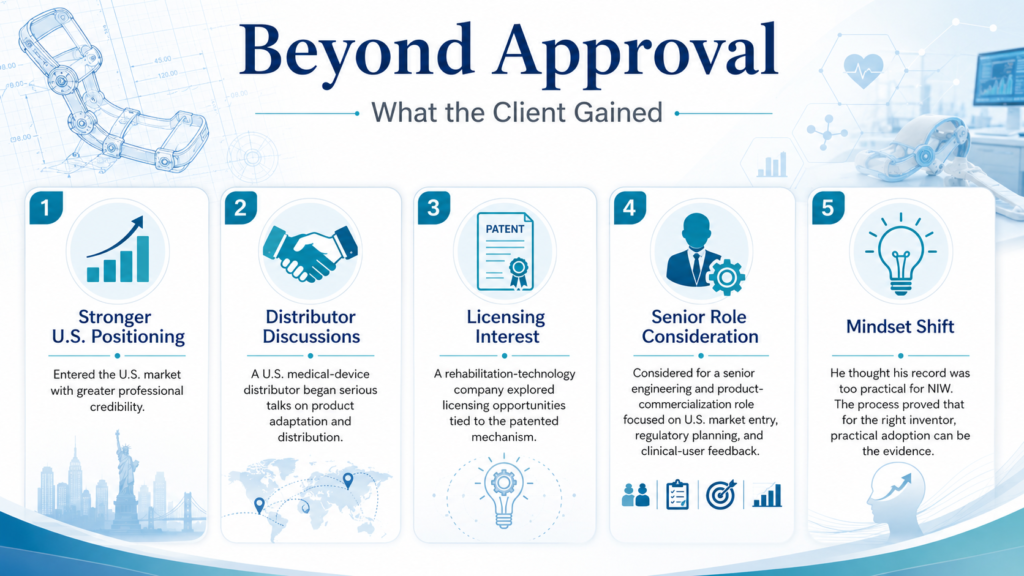
The profile-building work also changed how he saw his own career. He had assumed that his record was too practical for NIW. The process showed the opposite. For the right type of inventor, practical adoption can be the evidence.
Lessons for Engineers, Inventors, and Product Developers
• EB-2 NIW is not only for academic researchers. Inventors and applied engineers can qualify when their work is nationally important, well documented, and connected to a clear proposed endeavor.
• A granted patent, trademark, product use, and clinical adoption can form a strong foundation when they are presented as evidence of originality, commercialization, and practical utility.
• Citation counts must be read in context. In smaller applied fields, adoption evidence may be more persuasive than citation volume.
• The proposed endeavor must translate a product into a national-interest contribution. The national interest here was not simply the device; it was the accessibility and care-system problem the device addressed.
• Ethical profile building does not invent a false profile. It organizes real evidence so that the client’s professional value can be reviewed independently.
Engineers, inventors, and product developers often assume the NIW is only for people with academic careers. That is not always true. Patents, adoption, user impact, clinical use, technical publications, and independent recognition can all matter when they are organized around a credible national-interest strategy.
Start with a free, honest assessment. If the record is not strong enough yet, the right answer is not a rushed filing. The right answer is a clear build plan based on what the professional has actually done, what can be proven, and what USCIS needs to see. immignis