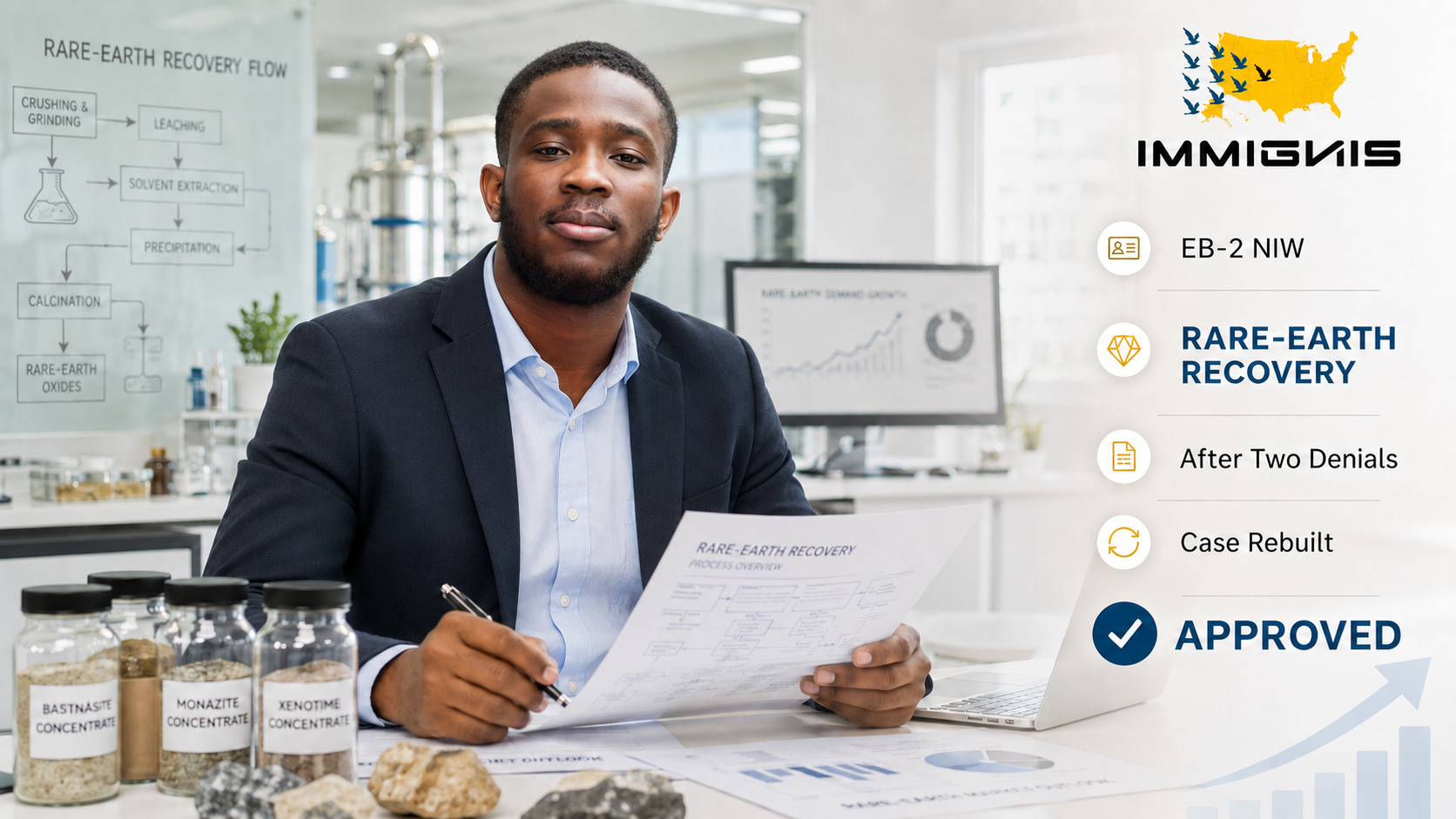
A metallurgist working in Australia had already been denied twice through two low-cost services. The third filing succeeded because the record was rebuilt around the exact national-interest mechanism USCIS had not seen before: rare-earth and critical-mineral recovery from industrial waste streams.
In short: A South African metallurgist and process engineer with approximately twelve years of experience in rare-earth
and critical-mineral recovery came to Advance My Profile after two prior EB-2 NIW denials. The earlier filings were not
fraudulent, but they were broad, thin, and too generic for the national-interest standard. We audited both failed records,
removed distracting material, rebuilt the proposed endeavor, developed focused evidence, sourced independent letters,
and filed a third petition. USCIS approved the rebuilt EB-2 NIW I-140 without issuing a Request for Evidence.
Case Snapshot
| Nationality / chargeability | South African |
| Working location | Australia, in metallurgy and critical-minerals research |
| Profession | Metallurgist and process engineer focused on rare-earth and critical-mineral recovery |
| Career stage | Approximately 12 years; senior researcher and process engineer |
| Pathway | EB-2 National Interest Waiver, consular-processing route after I-140 approval |
| Starting problem | Two prior NIW denials from two different low-cost services |
| Engagement | Approximately 11 months of audit, profile rebuilding, and refile preparation |
| Outcome | Rebuilt I-140 approved without RFE |
The Result Came First: Approval After a True Rebuild
This was not a case where a strong EB-2 NIW petition only needed better wording. USCIS had already seen the applicant twice. The third filing had to be materially different. It had to show a narrower endeavor, stronger independent validation, a clean policy theory, and a record that made the applicant’s exact technical expertise the mechanism of the national benefit.
The rebuilt petition did that. It moved the case away from generic critical-minerals language and toward a specific, technical, and nationally important contribution: recovering rare-earth elements and critical minerals from tailings, slag, and industrial process residues. Once the evidence was reorganized around that narrow specialty, the EB-2 NIW case became easier for USCIS to understand and approve.
The Problem With the First Two Denials
The first service filed quickly with a broad EB-2 NIW national-interest claim about critical minerals and global supply chains. The topic was important, but the petition did not explain how this metallurgist’s specific waste-stream recovery methods addressed a concrete U.S. processing-capacity gap. The second service added more documents, but the structure stayed weak. Some evidence was off-niche, and the letters came largely from dependent or familiar sources.
The issue was not that the client lacked expertise. The issue was that the EB-2 NIW filings asked USCIS to infer too much. They did not make clear why his work in rare-earth recovery from industrial waste streams mattered to U.S. clean-energy, semiconductor, defense, and advanced-manufacturing supply chains.
The Corrected Proposed Endeavor
“To develop and scale recovery and recycling processes for rare-earth elements and critical minerals from industrial waste streams - reducing United States dependence on foreign critical-mineral supply chains, strengthening domestic processing capacity, and advancing the supply-chain security of the clean-energy and defense technology sectors” for an EB-2 NIW proposed endeavor.
This EB-2 NIW framing worked because it tied the petitioner’s exact technical work to a national problem. It did not present him as a general mining professional or a broad supply-chain commentator. It presented him as a process engineer whose recovery and recycling methods could help address a documented U.S. vulnerability: the shortage of reliable, lower-impact, domestically aligned processing routes for strategic materials.
What Advance My Profile Rebuilt
1. A clean record after two failed filings
We first audited both denial notices and both prior filings. Evidence that still helped the case was preserved. Off-niche or distracting material was de-emphasized. The third petition had to look different in substance, not simply longer or more polished.
2. Focused publications in the right technical niche
Working with domain support, the publication strategy was narrowed to rare-earth and critical-mineral recovery from industrial waste streams. The strongest topics included recovery from tailings, extraction efficiency, process optimization, waste-stream characterization, and scalable recycling pathways. The point was depth in the exact specialty, not volume across unrelated metallurgy topics.
3. A policy-facing white paper for credible audiences
Because critical minerals sit at the intersection of clean energy, defense technology, industrial supply chains, and materials security, a white paper made sense. It was shared with relevant materials-engineering networks, critical-minerals stakeholders, supply-chain policy forums, and research groups focused on clean-energy materials and recycling. The audience fit the field, which made the evidence credible.
4. Intellectual-property evidence tied to the same recovery method
A patent filing documented a novel recovery process connected to the same technical work. The petition did not overstate the patent. It used the filing as dated evidence of originality, and it explained that a genuine, relevant patent or process-protection record can support originality even when it is not U.S.-issued, provided it is properly documented and tied to the endeavor.
5. Selective professional recognition
The client secured a Senior Member grade in a recognized metallurgy or materials-engineering professional body through peer nomination and review. This was more useful than a basic pay-to-join membership because it reflected professional standing rather than simple participation.
6. Independent letters rebuilt from scratch
The earlier letters were too dependent on people already close to the petitioner. The new letter panel included independent voices: a U.S. national-laboratory researcher, a materials scientist whose group had built on his methodology, a critical-minerals supply-chain analyst, and an industry engineer familiar with rare-earth processing applications. Each letter explained why his specific recovery methods mattered to the national-interest problem.
How the Evidence Supported Dhanasar
- Substantial merit and national importance: The petition connected rare-earth and critical-mineral recovery to U.S. clean-energy deployment, defense technology, semiconductor manufacturing, and supply-chain security.
- Well-positioned evidence: Focused publications, recovery-process work, IP documentation, professional recognition, and independent letters showed he had the technical capacity to advance the endeavor.
- Waiver justification: The petition explained why waiting for a traditional employer-sponsored labor certification would not serve the public interest when the endeavor addressed a strategic materials problem extending beyond one employer.
The Filing, Approval, and Consular Route
The rebuilt petition was filed with a cover letter that acknowledged the two prior denials, identified the earlier deficiencies, and showed how the new record answered them. USCIS approved the I-140 without issuing an RFE.
Because the petitioner was working in Australia and not physically in the United States, the post-I-140 process would proceed through consular processing. We kept that point clear in the public story. An approved I-140 is a major immigration step, but consular processing still continues through the National Visa Center and the appropriate U.S. consular post.
What Changed Beyond the Approval
The approval gave him a stronger immigration foundation, but the profile-building work also changed how his expertise could be presented professionally. His public record now showed a precise specialty in critical-mineral recovery, not a scattered metallurgy profile. His white paper opened communication with relevant materials-sector stakeholders. His focused publication record made it easier for U.S. employers and collaborators to understand his exact value.
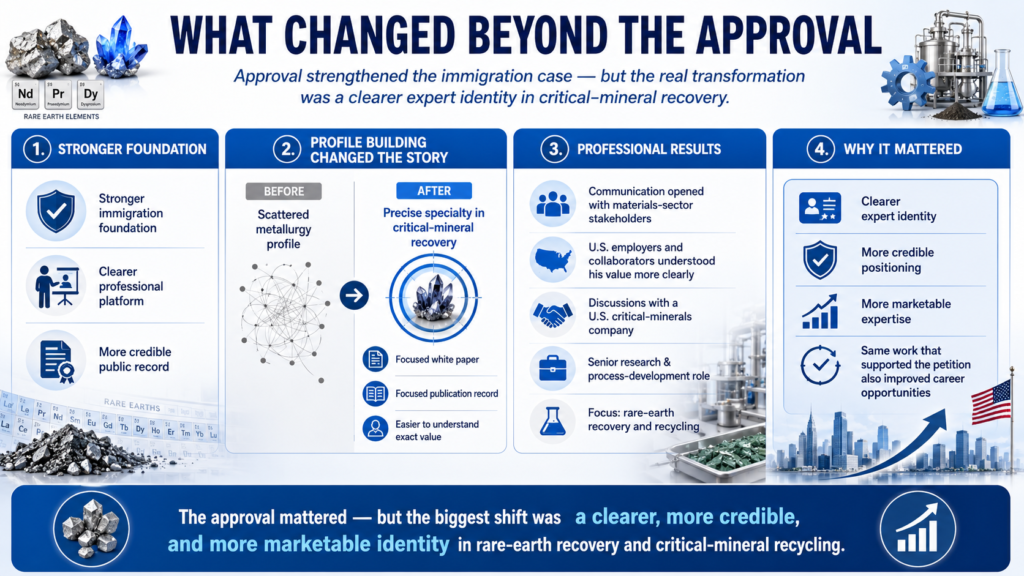
He later entered discussions with a U.S. critical-minerals company about a senior research and process-development role tied directly to rare-earth recovery and recycling. That was the professional result of the same work that supported the petition: a clearer, more credible, and more marketable expert identity.
Lessons for Professionals After One or Two NIW Denials
- A third filing must be qualitatively different. A longer version of the same weak record is not a rebuild.
- Critical minerals can be a strong NIW field, but the technical mechanism must be specific.
- Independent letters become more important after prior denials because USCIS has already rejected familiar or dependent evidence.
- White papers can support the case when they are sent to credible, field-appropriate recipients.
- Patent evidence should be described accurately. A genuine, relevant patent or process-protection record can support originality, but it should not be overstated.
- Consular processing should be explained honestly. I-140 approval is a major step, but it is not the end of the immigrant-visa process.
A denial does not always mean the person is weak. Sometimes it means the record was built around the wrong level of generality. This case succeeded because the third filing did not try to make the old record sound better. It rebuilt the case around the petitioner’s exact technical value and supported that value with focused, independent, and field-aligned evidence.
If you have been denied once or twice, the right first step is not another rushed filing. The right first step is an honest audit of what USCIS already rejected and whether your real expertise can be rebuilt into a different, stronger record. Submit your free assessment request. immignis