NIW aerospace engineer case showing how Advance My Profile helped a senior propulsion engineer in the UAE turn civilian aerospace-efficiency work into an approvable NIW record, answer an RFE, and secure approval while avoiding over-disclosure in an export-sensitive field.
Approval Snapshot
| Client profile | Russian national working in the UAE aerospace and aviation sector |
| Profession | Propulsion engineer focused on commercial-aircraft fuel efficiency and lightweight aerospace materials |
| Career stage | Approximately 11 years of senior engineering experience |
| Initial challenge | Strong civilian aerospace record, but no patent strategy and a field requiring careful export-control-sensitive framing |
| Profile-building period | Approximately 11 months |
| Result | EB-2 NIW RFE answered and petition approved |
In short: A Russian senior propulsion engineer working in commercial aviation had no patent record and could not
safely disclose certain technical know-how. We built the petition around civilian aerospace efficiency, non-controlled
publications, independent expert letters, professional recognition, and a careful technical declaration. USCIS issued an
RFE asking for U.S.-specific positioning and clarification of the civilian scope. The response answered both points and
the NIW was approved.
The National Problem: Cleaner, More Efficient Commercial Aviation
Commercial aviation depends on aircraft that are lighter, more fuel-efficient, and easier to maintain over long service cycles. For the United States, this is not only an airline-cost issue. It affects aerospace manufacturing competitiveness, aviation emissions, fleet efficiency, and the future of sustainable commercial flight, making it directly relevant to a NIW aerospace engineer case.
The client’s work sat directly inside that problem. He had spent more than a decade contributing to lightweight component design, composite-material evaluation, and fuel-management efficiency in civilian aircraft. His work was not weapons-related and was not presented as defense technology. The challenge was to document the national value of his work as a NIW aerospace engineer without disclosing material that should remain protected.
The Starting Point: A Strong Engineer in a Sensitive Field
When he came to us, he already understood that his field required caution. Aerospace propulsion and advanced materials can overlap with export-sensitive or dual-use technology, a concern directly relevant to a NIW aerospace engineer. A careless petition could create unnecessary questions about controlled technology, even where the actual proposed work is entirely civilian.
He had also made the correct decision not to force a patent strategy. A patent requires public disclosure. In his field, some methods and know-how could not be disclosed without regulatory, commercial, or contractual risk. The question was not whether an NIW could be filed without a patent. The question was whether the record could be built from lawful, credible, non-controlled evidence for a NIW aerospace engineer.
The Proposed Endeavor
The proposed endeavor had to be precise from the first page:
“To develop and apply advanced lightweight materials and propulsion-efficiency methods for commercial aerospace applications - reducing fuel consumption in U.S.-manufactured and U.S.-operated aircraft, advancing domestic aerospace industrial capacity, and contributing to aviation emissions-reduction and clean-energy goals established in U.S. federal policy.”
This framing did three things. It named the technical mechanism. It limited the scope to commercial aerospace. It connected the work to fuel reduction, domestic aerospace capacity, and sustainable aviation goals. Just as important, it avoided any ambiguity that the petition relied on controlled defense technology.
What Advance My Profile Built
We built the record around what could be shown clearly and responsibly for a NIW aerospace engineer. The case did not rely on hidden claims, vague prestige, or a forced patent narrative. It used a disciplined evidence architecture:
• A civilian aerospace identity focused on fuel efficiency, lightweight materials, component lifecycle improvement, and sustainable aviation engineering for a NIW aerospace engineer.
• A focused publication record in legitimate aerospace and materials-engineering venues, using only non-controlled topics aligned with the proposed endeavor.
• Citation evidence showing that independent aerospace researchers, including U.S.-based groups, were engaging with his civilian efficiency work.
• A conference presentation and technical-session invitation in sustainable aviation materials.
• Senior Member recognition in a recognized aerospace or aeronautical engineering professional body through peer nomination and review, supporting the NIW aerospace engineer profile.
• A targeted white paper on commercial aviation fuel-efficiency gains from lightweight materials and maintenance-cycle optimization.
• Independent expert letters from arms-length U.S.-connected aerospace, materials, and aviation-efficiency professionals for the NIW aerospace engineer case.
How the Profile-Building Work Supported Dhanasar
Prong 1: Substantial Merit and National Importance
The petition did not argue that aerospace is important in the abstract. It showed how lighter materials and propulsion-efficiency methods reduce fuel consumption in commercial aircraft, support U.S. aerospace manufacturing, and align with aviation emissions-reduction goals. The white paper and expert letters helped translate the engineering work into a national-interest explanation that an officer could evaluate.
Prong 2: Well Positioned to Advance the Endeavor
Because no patent record was used, the well-positioned argument depended on other credible evidence: publications, citations, conference activity, senior professional recognition, technical-session participation, and independent letters. The record showed that he had already contributed to the same civilian aerospace-efficiency problem named in the endeavor.
Prong 3: Why the Waiver Made Sense
The waiver argument focused on the national value of allowing a specialized civilian aerospace-efficiency engineer to continue advancing work tied to U.S. aircraft efficiency, sustainability, and industrial capacity. The petition made clear that a labor-certification process would not capture the broader value of this specialized technical contribution.
The RFE and the Response
USCIS issued an RFE asking for two main clarifications. First, the officer wanted more evidence that a UAE-based engineer was specifically positioned to advance the work in the United States. Second, the officer wanted clearer explanation of the civilian nature of the work and whether any submitted evidence involved export-controlled technology.
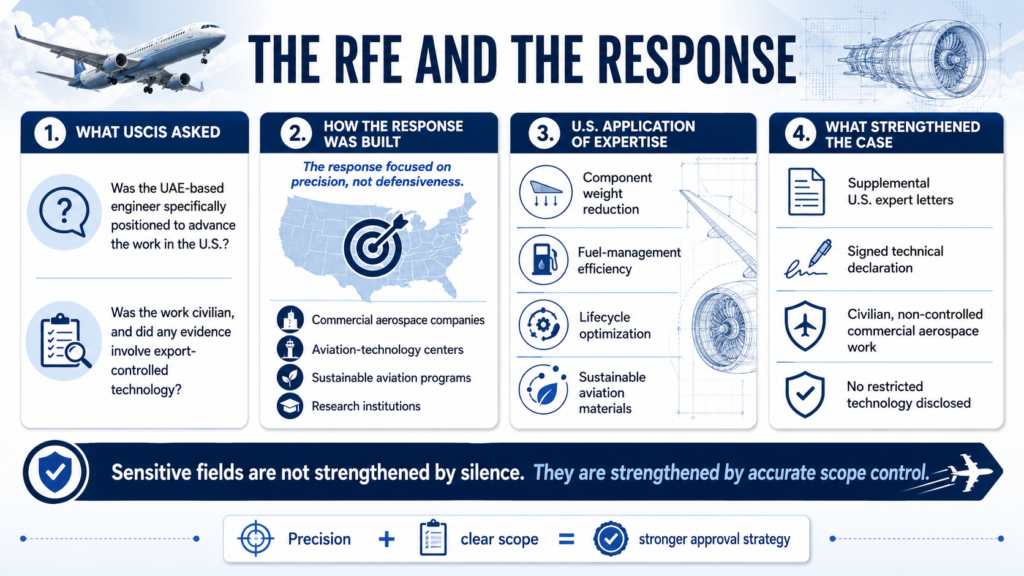
The response was built around precision, not defensiveness. We prepared a U.S.-specific professional plan identifying commercial aerospace companies, aviation-technology centers, sustainable aviation programs, and research institutions where his expertise could be applied. The plan focused on component weight reduction, fuel-management efficiency, lifecycle optimization, and sustainable aviation materials.
We also added supplemental U.S. expert letters and a signed technical declaration explaining that the petition was based on civilian, non-controlled commercial aerospace work and that none of the submitted evidence disclosed restricted technology. This was a key part of the approval strategy: sensitive fields are not strengthened by silence. They are strengthened by accurate scope control.
The Approval Outcome
After the RFE response, USCIS approved the EB-2 NIW petition for a NIW aerospace engineer. Because the client was outside the United States, the approval cleared the I-140 stage and moved the case toward the appropriate consular-processing path. The story remained honest about timing: approval of the I-140 was a major immigration step, while later immigrant-visa processing would still follow through the National Visa Center and the consular interview process.
The profile-building work also changed how he could present himself professionally. He was no longer simply an engineer inside a technical employer. He had a public, civilian aerospace-efficiency profile as a NIW aerospace engineer supported by publications, citations, professional recognition, conference activity, expert letters, and a careful non-controlled evidence record.
What Other Engineers Can Learn From This Case
- Export-sensitive fields require careful framing, not avoidance. A clear civilian and non-controlled scope can make the petition more credible.
- A patent is not always the right evidence. In some aerospace and dual-use areas, patent disclosure can create unnecessary risk.
- Patent-free NIW cases can still be strong when the record includes publications, citations, expert letters, professional recognition, and lawful technical evidence.
- White papers work only when they fit the field and reach credible audiences. Here, the subject was commercial aviation efficiency, not generic technology policy.
- An RFE can improve the case when the response directly answers the officer’s concern with documents, not just argument.
- Ethical profile building does not invent a profile. It organizes and documents the professional value that already exists within the client’s real field.
If you are an engineer in aerospace, propulsion, advanced materials, aviation efficiency, or another export-sensitive field, the question is not whether the NIW is impossible. The question is whether your work can be framed lawfully, credibly, and specifically around the civilian evidence you can show. Start with a free, honest assessment. If your record is not ready, the right answer is not a rushed filing. The right answer is a careful evidence strategy based on what can be documented responsibly. immignis