Key facts at a glance:
| Outcome | EB-1A approval for a Brazilian AI radiology scientist in a U.S based research hospital. |
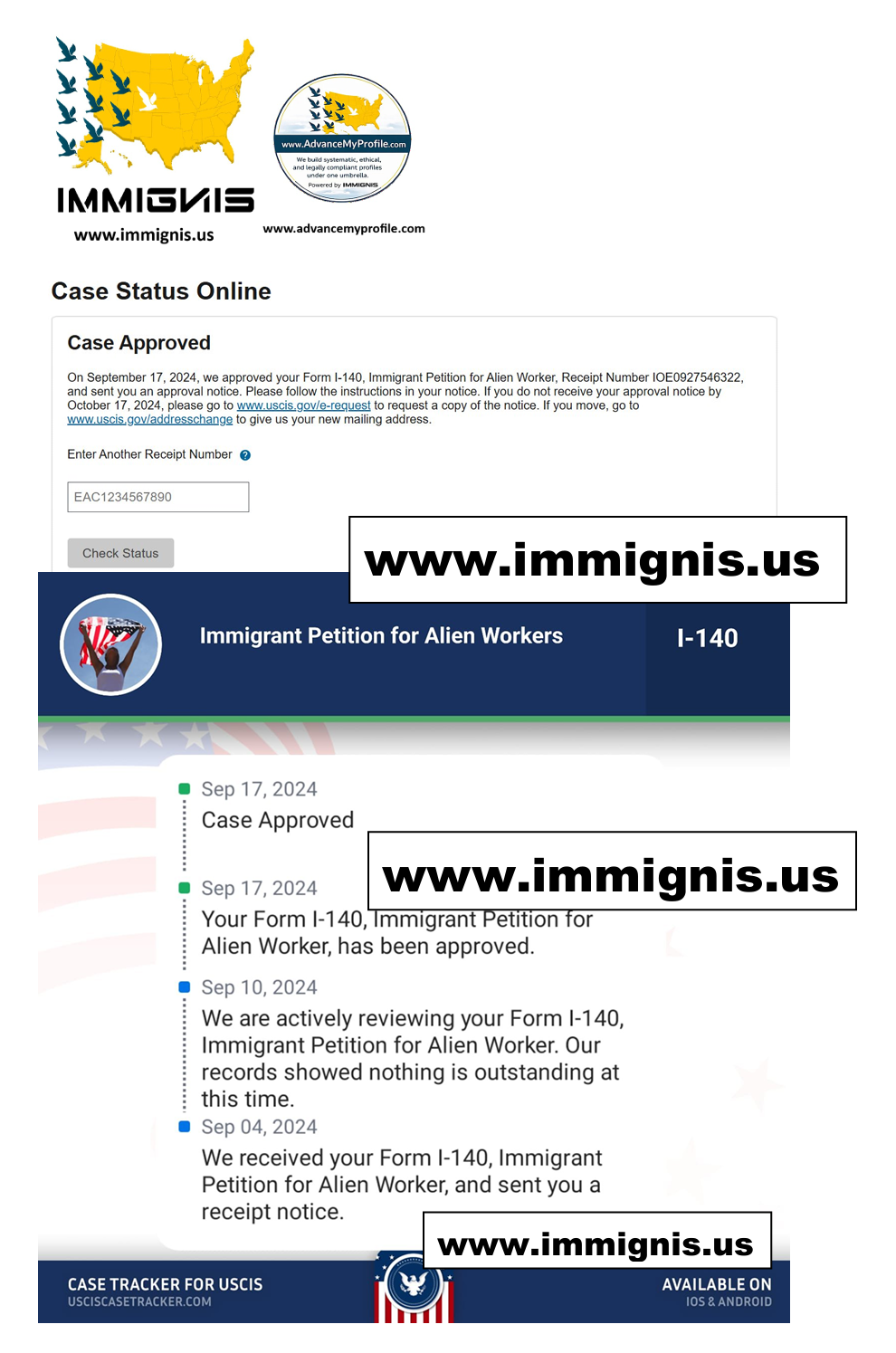
| Approval date | Approved on September 17, 2024. |
| Field niche | AI assisted radiology triage for stroke and pulmonary embolism, with a focus on explainable AI radiology. |
| Starting problem | Her strongest clinical AI work was internal, hospital based, and difficult to see outside her institution. |
| Path used | Ethical EB-1A profile building through focused authorship, validation abstracts, adoption evidence, health tech commentary, selective memberships, peer review, white papers, conference recognition, and independent U.S. imaging expert letters. |
| USCIS EB-1A criteria activated | Scholarly articles, original contributions, judging, published material, leading role, and high remuneration. |
| She was still thinking about scan queues, triage alerts, and the uneasy space between artificial intelligence and clinical judgment. For years, her work had lived inside that space. Emergency teams saw the benefit. Radiologists trusted the workflow. Patients never knew her name. Outside the hospital, almost no one could see it. She worked in a U.S. based research hospital on AI assisted radiology triage for stroke and pulmonary embolism, but her achievements were locked inside internal systems, hospital adoption discussions, and clinical validation work. She had not built a weak career. She had built a hidden one. |
AI radiology EB-1A approval: Why did a strong AI radiology career still look risky?
The risk was visibility. Inside the hospital, her contribution mattered because emergency imaging can be brutally time sensitive. Stroke triage depends on fast escalation. Pulmonary embolism triage depends on clear detection pathways and careful coordination between AI outputs and physician review. Her work helped make AI tools more explainable, usable, and clinically credible.
On paper, the record looked thin. Some work was unpublished. Some evidence belonged to the hospital environment. Some impact was known by teams but not documented in a way an immigration officer could evaluate.
The EB-1A green card is a self-petition immigrant category for people who can show extraordinary ability through sustained national or international acclaim and evidence that they are among the small percentage at the top of their field.
That definition worried her. She did not feel like someone with public acclaim. She felt like someone who had solved hard problems quietly.
Her fear was familiar to many medical AI professionals. The most useful work is often the least visible. The best evidence may sit inside hospital workflows, implementation notes, internal validation meetings, and careful clinical decisions that were never written for USCIS.
A strong EB-1A petition needed to make that work visible without overstating it, exposing confidential information, or turning the case into marketing language.
What did Immignis see that the original record did not show?
Immignis saw a real candidate with an evidence problem. The first review did not treat her as automatically ready. That honesty mattered. A strong career and a strong petition are different things. USCIS does not approve EB-1A because a person is skilled, busy, or respected by a supervisor. The evidence must show recognized standing in a defined field.
The original file could have invited a Request for Evidence. An officer could have asked whether her work was routine hospital implementation, whether the contribution was truly hers, whether any recognition existed outside the employer, and whether the record showed sustained acclaim.
Immignis narrowed the case to one precise field: explainable AI-assisted radiology triage for emergency conditions, especially stroke and pulmonary embolism. That focus changed everything. It gave the profile a center. It allowed publications, expert commentary, memberships, peer review, leading role evidence, and letters to speak the same language.
What would the USCIS officer need to see?
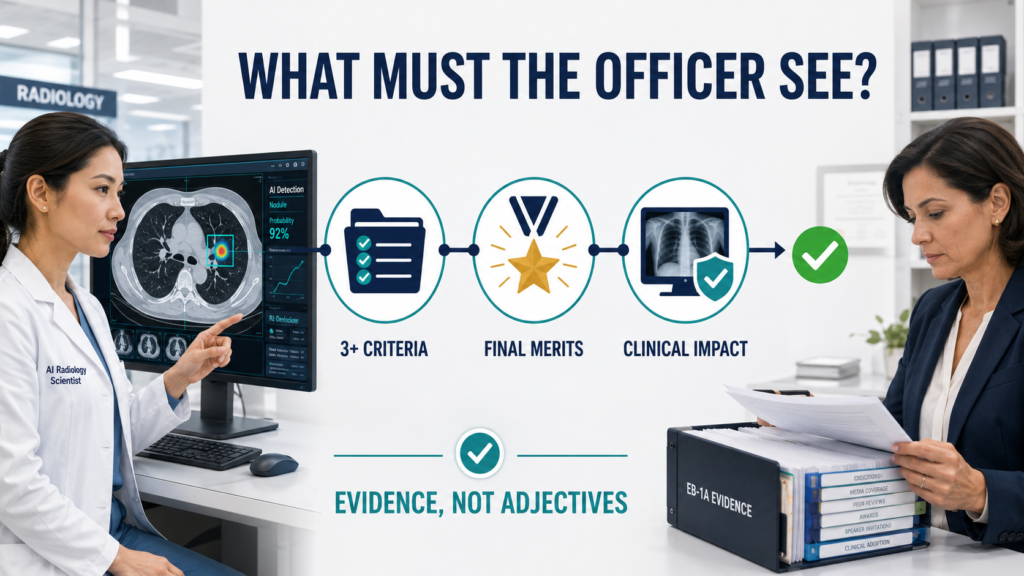
The officer needed more than a list of achievements. In EB-1A adjudication, the initial question is whether the evidence satisfies at least three regulatory criteria or a comparable evidence path. The next question is harder. In the final merits review, the officer weighs the total record to decide whether the applicant has sustained acclaim and stands at the top of the field.
That is why some EB-1A cases fail even when they appear to meet several criteria. The documents may exist, but the story does not prove field level standing.
For this scientist, the petition had to answer a practical medical AI question: did her work contribute to the way urgent radiology AI could be trusted, explained, and adopted in clinical settings?
The answer had to be shown through evidence, not adjectives.
How did Advance My Profile build her authority record ethically?
The build began with a roadmap.
Advance My Profile, powered by Immignis, started with a bespoke assessment. Immigration strategy, medical imaging subject review, content planning, and ethics screening were aligned before any public work began. The team did not try to force her into unrelated research areas. The entire plan stayed inside her true specialism.
First came positioning. Her public identity moved from a broad “AI in healthcare” label to a precise authority niche: explainable AI radiology triage for urgent imaging. That niche made the case easier to understand and harder to dismiss as generic technology work.
Next came authorship. With domain PhD support, we develop a focused set of peer reviewed papers and clinical validation abstracts. These pieces addressed real field problems: how AI triage should support radiologists, how explain ability affects clinical trust, and how stroke and pulmonary embolism workflows can benefit from careful human in the loop design.
The publication strategy was built around five focused papers: three in suitable Q4 journals and two in suitable Q3 journals, each tied to the same narrow niche. Each publication was then supported through print media and press-release coverage explaining the innovative findings and the clinical AI relevance in plain language.
The goal was not volume. The goal was coherence. Then came documented impact. Because hospital work often contains confidential information, Immignis helped prepare a safe hospital adoption brief. It explained the nature of the work, the implementation context, and the clinical value without revealing patient data, protected employer information, or proprietary details.
That document mattered because internal value must be translated. USCIS cannot weigh what it cannot see. Public recognition followed. The client began appearing as an expert voice in reputable health tech and medical AI outlets. This mattered because the profile was no longer speaking only through internal documents. Independent media began presenting her as an expert on explainable AI in radiology, urgent triage workflows, clinical safety, and the limits of automation in emergency imaging.
Selective and fellow grade membership options were pursued where the eligibility rules matched her record. Medical imaging, radiology informatics, and applied AI organizations became part of the authority build. Legitimate professional honors were reviewed, but nothing ornamental was added for decoration.
Conference visibility added another layer. Her work was shaped for a relevant conference submission, and the preparation resulted in a best paper recognition connected to her medical AI niche. That award helped show that independent reviewers saw value in the research, not only her employer.
Peer review became a turning point. As her profile became more visible, she received opportunities to review work/research connected to medical imaging and health AI. That changed the record from “she has been evaluated” to “the field trusts her to evaluate others.”
Independent letters gave the petition its outside voice. Immignis did not depend only on internal supervisors. The client helped arrange qualified referees, while Immignis guided the evidence strategy and drafted detailed letters. U.S. imaging leaders explained how her work fit into larger questions of emergency radiology, AI adoption, and clinical trust.
To show broader field relevance, Immignis also prepared a policy facing white paper and shared it with relevant medical imaging, health-tech, and clinical AI stakeholders. The purpose was not to create noise. It was to place her work in front of the communities that could understand its significance.
The case was built by legal experts, domain PhDs, media professionals, and an evidence team working from one ethical rule: every claim must be real, relevant, and verifiable.
Why did the ethical approach matter in a medical AI case?
In medical AI, credibility is part of the professional record. A scientist in radiology cannot afford a profile filled with weak journals, paid citation schemes, fake awards, or media placements that pretend to be independent recognition. USCIS can question that evidence, and the professional consequences can last longer than the petition.
Immignis treated the EB-1A profile as something the client would carry for life. Publications had to belong to the field. Commentary had to be credible. Memberships had to match her expertise. Letters had to explain real significance. The file had to be something she could show to a hospital leader, a journal editor, a conference organizer, or a future collaborator with pride.
That is the difference between profile building and profile decoration. We build profiles. Profile building creates a record the petitioner can own, present, and claim throughout her career. Profile decoration may look useful for one filing, but it can turn into a nightmare if the evidence is weak, unrelated, or embarrassing when questioned later. A professional should not have to hide the profile built for an immigration case. The record should strengthen the professional name.
Could your own EB-1A profile be stronger than it looks?
If your strongest work is internal, proprietary, clinical, technical, or hidden inside an employer, your issue may be documentation.
Immignis offers a free profile assessment for professionals who want to understand whether their record may support an EB-1A green card, EB-2 NIW, O-1, or another merit-based pathway. The assessment is designed to identify the field niche, evidence gaps, and honest path forward.
Which USCIS EB-1A criteria did the final petition activate?
The final Form I-140 petition activated six USCIS EB-1A criteria and then tied them into a final-merits narrative.
- Scholarly articles: Peer-reviewed papers and clinical validation abstracts showed authorship in explainable AI radiology and AI-assisted emergency imaging.
- Original contributions: The petition showed how her work supported safer, more interpretable radiology triage for stroke and pulmonary embolism. The hospital adoption brief and independent letters helped prove significance beyond ordinary employment.
- Judging the work of others: Peer review invitations showed that journals and professional venues trusted her to evaluate work by others in medical imaging and applied AI.
- Published material: Health tech and medical AI coverage placed her expertise in public view and connected her name with explainable clinical AI.
- Leading or critical role: Her work was documented as part of important AI and imaging functions inside a distinguished hospital environment.
- High remuneration: Comparative compensation evidence showed that her pay reflected senior value in the medical AI and radiology technology market. After the profile building activities, her stronger authority record also supported professional growth, including a promotion and salary increase because decision makers could see her as an authority, not only an internal contributor.
The final merits argument did the heaviest work. It explained that the record was not a pile of disconnected documents. It showed sustained acclaim in a narrow field where clinical accuracy, speed, and trust matter.
For this case, the central message was simple: she was not only using medical AI. She was helping define how explainable AI could be used responsibly in urgent radiology triage.
What did EB-1A approval mean for her?
The EB-1A approval gave her freedom and recognition at the same time. The approval meant she had a self-petition green card path without employer sponsorship and without labor certification. It also meant that her professional story no longer lived only inside hospital walls.
The profile she built continued to matter after approval. She had focused authorship, a clear public niche, expert commentary, peer review activity, selective professional recognition, conference award evidence, leading role documentation, high remuneration support, and independent validation from U.S. imaging leaders. The approval was the immigration result. The authority record was the career asset.
If this sounds like you:
You may be a medical AI scientist whose best work sits inside a hospital system. You may be a radiologist, engineer, researcher, founder, or health informatics specialist whose contribution is real but hard to see from the outside. That does not mean your record is weak. It may mean your record is unfinished.
The safest path is not to invent recognition. The safest path is to build the recognition your real work deserves: focused research, public authority, peer review, selective memberships, independent validation, and a petition narrative that can survive review. Do not build evidence you will need to hide later. Build an EB-1A profile that supports your immigration future and strengthens your professional name.
FAQs:
Can an AI radiology scientist qualify for an EB-1A green card?
Yes. An AI radiology scientist qualify for an EB-1A green card if the record shows extraordinary ability through sustained acclaim and evidence under the USCIS EB-1A criteria. Strong evidence can include peer reviewed medical AI publications, original clinical contributions, peer review, published material, leading role evidence, high remuneration, and independent expert letters.
What if most of my medical AI work is confidential or internal?
Confidential or internal work can still support an EB-1A petition if it is documented lawfully and carefully. The record should separate safe, non-confidential contribution evidence from protected employer data, patient information, and proprietary material. Adoption summaries, independent expert letters, publications, and public recognition can help make internal work visible.
What causes RFE risk in an EB-1A medical AI petition?
RFE risk often increases when the petition shows technical work but does not prove field level significance. In medical AI, USCIS may ask whether the contribution belongs to the applicant, whether it is recognized outside the employer, and whether the total record shows sustained acclaim in a defined field. A strong final merits narrative helps connect the evidence.
Does EB-1A require employer sponsorship or labor certification?
No. EB-1A allows a qualified applicant to self-petition by filing Form I-140 without employer sponsorship and without PERM labor certification. This makes EB-1A different from many employer dependent green card routes. The applicant still must prove extraordinary ability and satisfy the legal standard.
How does Form I-140 approval affect the priority date?
When an EB-1A Form I-140 is properly filed, the filing date generally becomes the priority date for that immigrant petition. After approval, the applicant still follows the visa availability and adjustment of status or consular processing rules that apply to their situation.
Do I need a PhD or U.S. degree for EB-1A?
No specific degree is required for EB-1A by itself. A PhD or U.S degree can help explain expertise, but USCIS focuses on evidence of extraordinary ability, such as original contributions, scholarly authorship, judging, published material, leading roles, awards, memberships, and high remuneration where applicable. Degrees support the story but do not replace acclaim evidence.
Build an EB-1A success story around evidence you can trust
If you work in AI radiology, medical imaging AI, health informatics, clinical AI, or another advanced field, your strongest achievements may already exist. They may be hidden, scattered, or too internal to help without a strategy.
Immignis helps professionals build EB-1A profiles through ethical evidence development, field specific positioning, reputable visibility, independent validation, and petition ready storytelling.