Key facts at a glance:
| Outcome | EB-1A approval for a Peruvian mining safety engineer working with an Australia based mining company. |
| Approval date | Approved on July 29, 2024. |
| Field niche | AI-supported mine safety and tailings-risk monitoring. |
| Starting problem | His strongest safety achievements were proprietary, employer based, and difficult to verify publicly. |
| Path used | Ethical EB-1A profile building through safe non-confidential methodology documentation, technical articles, a mine safety white paper shared with mining associations, safety award recognition, a conference workshop, expert interviews, judging in mining innovation awards, independent mine safety letters, leading-role evidence, and high salary documentation. |
| USCIS EB-1A criteria activated | Awards, original contributions, published material, judging, leading role, and high remuneration. |
He knew the sound of a mine site when the day was going wrong. The radio became sharper. The language became shorter. A sensor reading, a slope condition, a tailings warning, a fatigue pattern, a delayed inspection. Each small signal could point to something larger.
His work was built around those signals. He helped create Mining Safety EB-1A Success through AI-supported mine safety and tailings-risk monitoring methods inside an Australia based mining company, where better warnings could protect workers, assets, and surrounding communities.
The work mattered. It was also difficult to show. Most of his strongest achievements were buried inside proprietary safety systems, operational reports, internal dashboards, and employer controlled methods. Outside the company, his record looked narrower than his impact.
He had built a serious safety career. The file needed to prove it without exposing what had to stay confidential.
Why did a strong mine safety career still look risky for EB-1A?
The risk was that his contribution could be mistaken for ordinary operational safety work.
Mining safety is a field where results are often internal by design. Tailings-risk monitoring, hazard prediction, incident-prevention workflows, and safety analytics are rarely public in full detail. The strongest evidence may sit inside restricted incident reviews, engineering controls, and site-level implementation records.
That creates a hard EB-1A problem. USCIS can only evaluate what the petition can show. If the record stays hidden, even high-impact safety work may look like a job description.
The EB-1A green card is a self-petition immigrant category for people who can show extraordinary ability through sustained national or international acclaim and evidence that they are among the small percentage at the top of their field.
That standard did not scare him because he lacked substance. It worried him because the substance was locked behind the walls of a safety critical industry.
What did Immignis see beneath the confidentiality problem?
Immignis saw a candidate with real field value and a visibility gap. The original record showed high responsibility, technical skill, and safety leadership. It did not yet show enough public recognition, independent validation, or clear separation between the company’s safety program and his individual contribution.
For this case, the strategy could not be generic. A mining safety engineer cannot publish sensitive tailings data, disclose proprietary monitoring logic, or make broad claims about incident prevention without evidence. The record had to be built safely.
Immignis narrowed the case to one field: AI supported mine safety and tailings risk monitoring. That focus gave the petition its center. It connected technical articles, a safety white paper, expert interviews, award evidence, judging, leading role documentation, and independent letters to the same field-level question: did his work help advance how mines identify and manage safety risk before harm occurs?
What did USCIS need to see in this mining safety case?
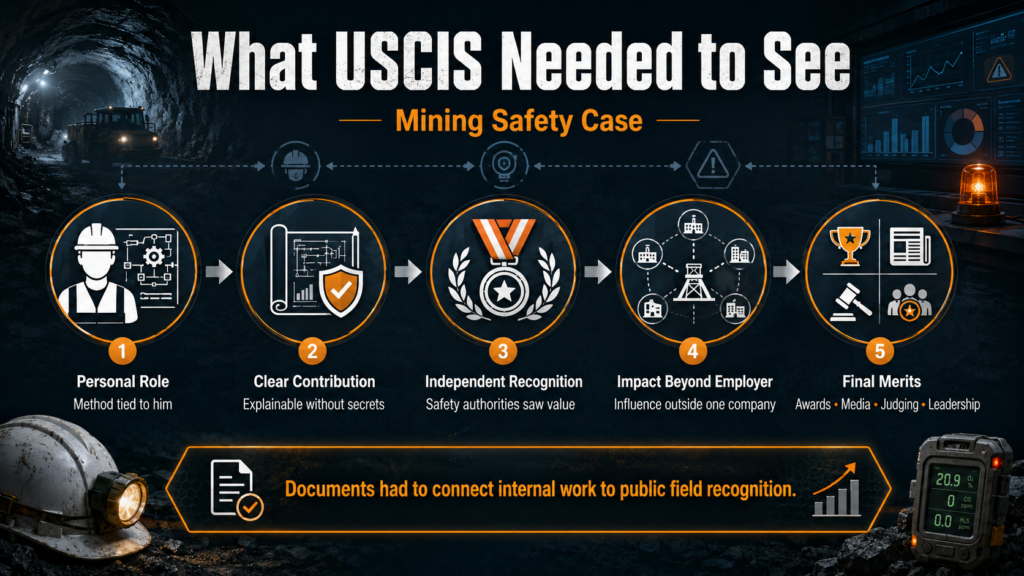
The officer needed to see more than a responsible engineer working for a major mining company. A case like this has several specific adjudication questions. Was the safety monitoring method connected to the applicant personally? Could the contribution be explained without disclosing proprietary systems? Did independent mine safety authorities recognize the value of the work? Did the record show influence beyond one employer? Did his awards, media, judging, and leadership evidence support final merits in the same narrow safety niche?
The petition had to answer each question through documents. It could not rely on dramatic language about dangerous mines or artificial intelligence. It had to show the bridge from internal safety work to public field recognition. That bridge became the heart of the case.
How did Advance My Profile build his authority record ethically?
The build began with a strict evidence boundary. Advance My Profile, powered by Immignis, first identified which parts of his work could be described safely. The legal strategy team, technical reviewers, content team, media team, and evidence team separated confidential mine-site details from non-confidential methodology. That step protected the employer, the client, and the credibility of the petition.
Then the profile was repositioned. Instead of presenting him as a broad mining engineer, the record focused on AI-supported mine safety and tailings-risk monitoring. That niche gave the case a disciplined shape.
Technical articles followed. The articles explained risk-monitoring concepts, predictive safety workflows, responsible use of AI in hazardous environments, and how mine operators can think about early-warning systems without revealing site-specific data. The writing showed expertise in a way the field could read and USCIS could understand.
A mine-safety white paper became one of the strongest public-facing pieces. It was prepared for relevant mining associations and safety stakeholders, with a focus on non-confidential lessons from AI supported hazard detection and tailings risk monitoring. It translated private operational knowledge into a public safety framework.
That mattered because the original work was strong but invisible. The white paper made the thinking visible.
Immignis also developed expert interview opportunities. The client spoke on mine safety analytics, tailings risk awareness, and the role of predictive tools in worker protection. The media work stayed close to his true field. It did not turn him into a general technology commentator.
Conference visibility added another layer. A workshop helped place his safety methods before a relevant professional audience. The goal was to show that his work could be explained, evaluated, and discussed outside the employer environment.
Safety-award evidence was pursued where the eligibility rules matched his record. In a case like this, awards are meaningful only when they come from legitimate industry or professional safety channels. Empty honors would have weakened the story Credible recognition strengthened it.
Judging became important because it showed a shift in standing. He was positioned to evaluate mining innovation and safety-related work by others. That helped show that the field trusted his technical judgment, not only his employer.
Independent letters gave the petition its outside voice. Immignis worked with the client to secure letters from mine safety authorities and experienced professionals who could explain the significance of his contribution in tailings risk monitoring, safety analytics, and hazardous operations.
The record also documented his leading role and high salary. Comparative compensation evidence helped show that his market value matched a senior safety specialist. His leadership documentation showed that his work was tied to important safety functions, not routine site support.
The full build ticked several boxes because the activities were connected. Technical authorship, white paper, safety recognition, expert interviews, workshop visibility, judging, leadership evidence, salary proof, and independent letters all pointed to one field.
Why did the ethical approach matter in a mining safety profile?
In mining safety, credibility can never be cosmetic. A professional who works with tailings risk, worker safety, and hazardous operations cannot afford a profile padded with weak awards, paid media, recycled articles, or claims that cannot survive technical review. That kind of decoration can damage the petition and the professional name behind it.
Immignis treated the EB-1A profile as a record the client could carry for life. The technical articles had to be accurate. The white paper had to be useful. The media interviews had to stay within his expertise. The award evidence had to be legitimate. The letters had to explain real field value.
Profile building should create something a professional can own publicly. It should not create a web trail that later requires explanations, corrections, or embarrassment.
Could your own EB-1A profile be stronger than it looks?
If your most important work is internal, proprietary, or safety-sensitive, your issue may be documentation.
Immignis offers a free profile assessment for professionals who want to understand whether their record may support an EB-1A green card, EB-2 NIW, O-1, or another merit-based pathway. The assessment identifies the field niche, evidence gaps, realistic criteria, and the honest path forward.
Which USCIS EB-1A criteria did the final petition activate?
The final Form I-140 petition activated six USCIS EB-1A criteria and tied them into a final-merits narrative.
- Awards: Legitimate mine safety recognition supported the claim that his work had been evaluated and valued beyond ordinary employment.
- Original contributions: The petition explained how his AI-supported monitoring methods contributed to mine safety, tailings-risk awareness, and proactive hazard management.
- Published material: Expert interviews and public coverage placed his safety expertise before a wider professional audience.
- Judging: Judging in mining innovation and safety related settings showed that he was trusted to evaluate work by others.
- Leading role: Employer and project evidence showed that his role was tied to important safety functions within a distinguished mining environment.
- High remuneration: Comparative salary evidence showed that his compensation reflected senior value in mining safety and risk-monitoring work.
The final-merits argument did the heavy work. It showed that the record was not a collection of unrelated activities. It showed a mining safety specialist whose proprietary work had been carefully translated into public, verifiable, field-level evidence.
The central message was simple: he was not only managing safety tasks. He was helping advance how AI-supported monitoring could identify risk in mining environments where delay can be costly.
What did EB-1A approval mean for him?
Approved on July 29, 2024, the case gave him a self-petition green card path without employer sponsorship and without PERM labor certification.
It also changed how his professional record could be seen. Before the profile build, much of his contribution lived inside proprietary systems and internal safety work. After the build, he had a clear niche, technical articles, a mine-safety white paper, expert interviews, workshop visibility, safety recognition, judging evidence, leading-role documentation, salary proof, and independent validation.
The approval was the immigration result. The authority record was the career asset.
If this sounds like you:
You may be a mining engineer, safety specialist, risk analyst, environmental engineer, or industrial AI professional whose strongest work is confidential by nature.
That does not mean the record is weak. It may mean the record is unfinished.
The safest path is to build recognition around what is real: non-confidential methodology, credible technical writing, industry visibility, safety recognition, judging, independent expert letters, leading-role evidence, and a petition narrative that can survive review. Do not build evidence you will need to hide later.
Build an EB-1A profile that protects your credibility and strengthens your professional name.
Can proprietary mine safety work support an EB-1A green card?
Yes. Proprietary mine-safety work can support an EB-1A petition when it is translated into safe, non-confidential evidence. The record should show the applicant’s individual contribution, field relevance, independent validation, and recognition outside ordinary employment.
How can tailings risk monitoring be documented without exposing confidential mine data?
The evidence can describe methodology, safety principles, adoption context, and expert significance without disclosing site-specific data, restricted dashboards, incident reports, or employer trade secrets. White papers, technical articles, expert letters, and public interviews can make the contribution visible while protecting sensitive information.
What kind of awards matter in a mining safety EB-1A case?
The strongest awards are legitimate safety, engineering, innovation, or mining-sector honors with real eligibility standards and expert evaluation. A weak or decorative award can hurt the story. The award should connect directly to mine safety, risk monitoring, tailings management, or industrial AI.
Can an industry engineer qualify for EB-1A without many academic publications?
Yes, some industry engineers qualify through original contributions, awards, published material, judging, leading role evidence, high remuneration, and independent expert letters. Technical articles and white papers can help when the field impact is practical and industry facing. The petition must still show sustained acclaim and top level standing.
What creates RFE risk in an AI mine safety petition?
RFE risk increases when the petition sounds like a job description or when proprietary achievements are claimed without independent support. USCIS may question whether the contribution belongs to the applicant, whether the work is recognized outside the employer, and whether the evidence proves field level significance.
Do mining safety engineers need a PhD for EB-1A?
No specific degree is required by itself for EB-1A. A PhD can help explain expertise, but USCIS focuses on evidence of extraordinary ability. Industry safety engineers can build strong cases when their records show genuine recognition, contribution, judging, leadership, and credible outside validation.
Build an EB-1A success story around evidence you can trust
If you work in mine safety, tailings-risk monitoring, industrial AI, environmental risk, or another safety critical field, your strongest achievements may already exist. They may be hidden, scattered, or too confidential to help without a strategy.
Immignis helps professionals build EB-1A profiles through ethical evidence development, field specific positioning, reputable visibility, independent validation, and petition ready storytelling.