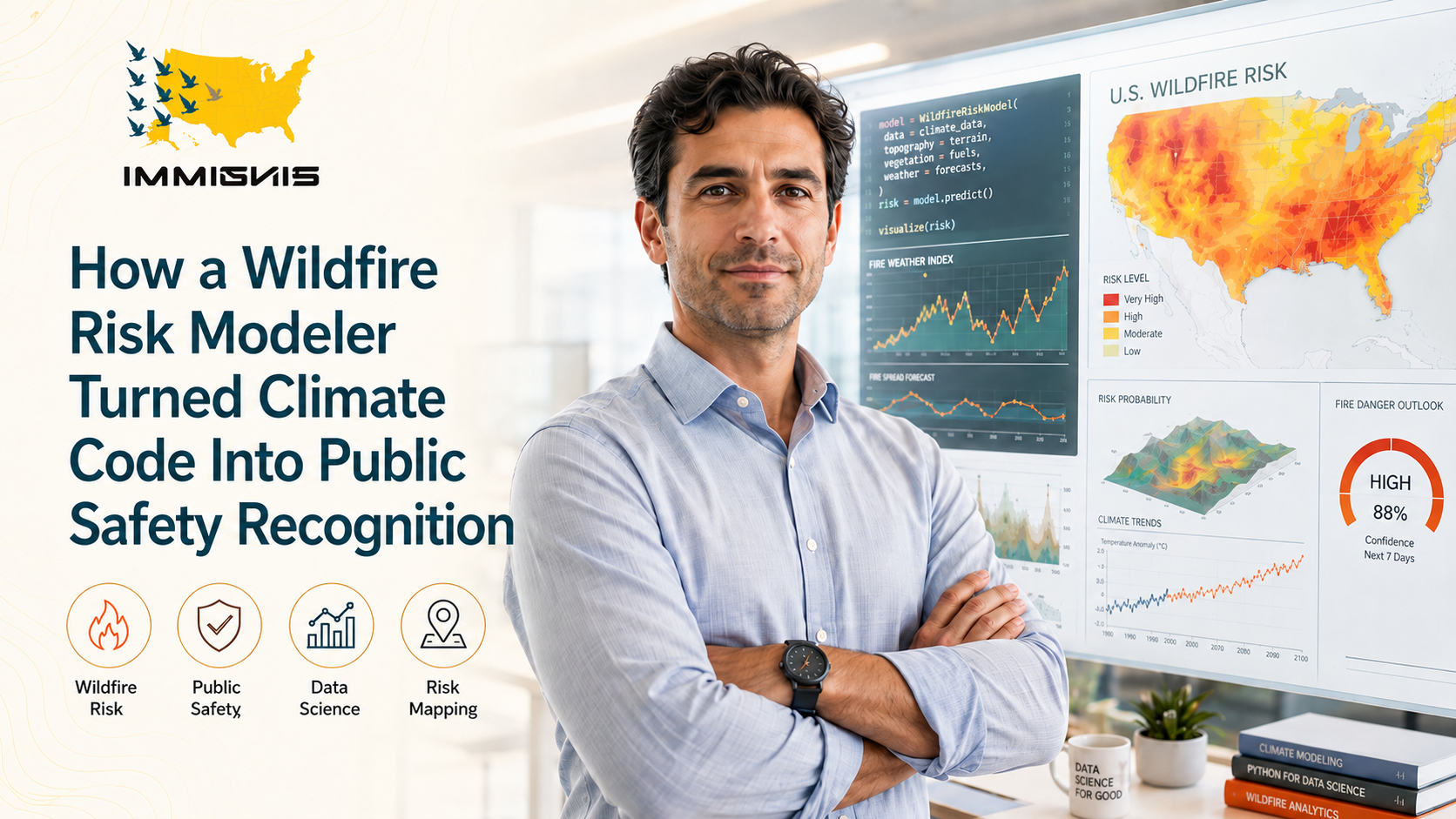
Key facts at a glance:
| Outcome | EB-1A approval for a Greek wildfire risk modeler working through Germany based climate research projects. |
| Approval date | Approved on November 8, 2024. |
| Field niche | AI wildfire spread forecasting for power grid and community protection. |
| Starting problem | He had academic climate work, but no clear EB-1A narrative connecting it to public safety and infrastructure resilience. |
| Path used | Ethical EB-1A profile building through focused publications, a policy brief for emergency management audiences, expert media commentary during fire season, invited talks, peer review, open source model documentation, and independent letters from climate risk and utility experts. |
| USCIS EB-1A criteria activated | Scholarly articles, original contributions, published material, judging, and leading role. |
EB-1A wildfire risk modeler approval arrived on November 8, 2024, but the story had begun much earlier, in the red edges of a wildfire map.
He had spent years looking at heat, wind, fuel, slope, dry vegetation, and power-line exposure. To most people, those variables were weather and terrain. To him, they were signals that could warn a community before a fire became a disaster. His research mattered. His models mattered. The problem was that the EB-1A record did not yet show why they mattered outside an academic climate institute. He had built a serious body of work. The case needed to show a public safety contribution.
Why did a wildfire scientist need a stronger EB-1A story?
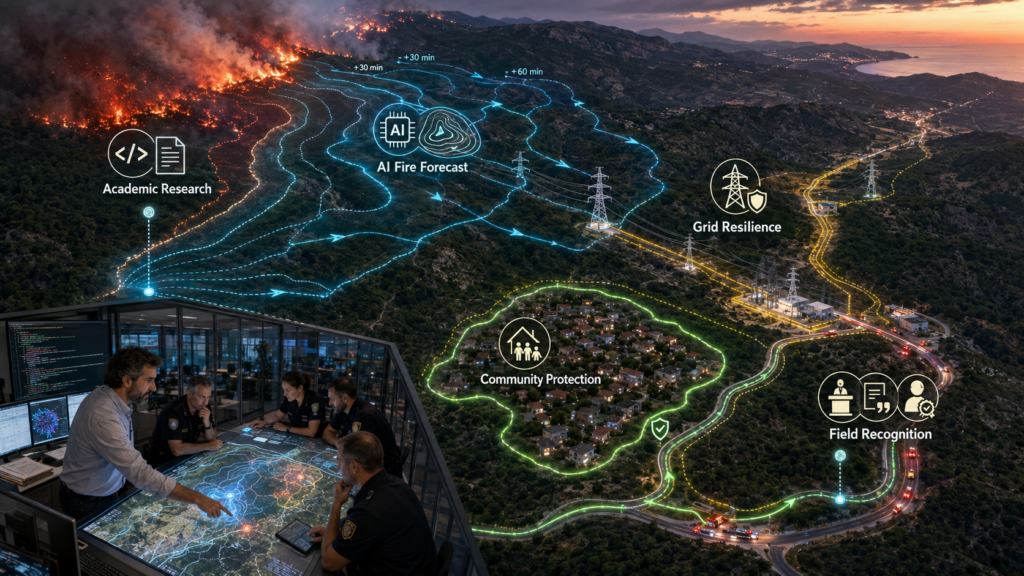
This EB-1A success story began with a gap between academic output and public safety meaning.
The Greek scientist was working from a Germany based climate institute on AI wildfire spread forecasting for power grid and community protection. His models helped explain how fires could move across landscapes, where transmission infrastructure could become vulnerable, and how emergency planners could think about risk before the flames arrived.
But the original record read too much like academic climate modeling. It showed research, but it did not clearly answer the question an immigration officer would care about: why was this work significant beyond the laboratory?
The EB-1A green card is a self petition immigrant category for people who can show extraordinary ability through sustained national or international acclaim and evidence that they are among the small percentage at the top of their field.
That definition can feel distant to scientists whose best work is built through code, datasets, simulations, and technical papers. He did not lack substance. He lacked a clean EB-1A narrative that connected wildfire forecasting to power grid resilience, community protection, and field level recognition.
What did Immignis see in the first review?
Immignis saw a researcher with a strong technical base and an unclear center. His record had academic value. It had publications. It had modeling skill. But the evidence was spread across climate risk, wildfire behavior, environmental data, and infrastructure exposure. That scattering made the file easier to misunderstand.
The case could have invited questions. Was the work mainly ordinary academic modeling? Did his models influence real emergency management or utility risk thinking? Did the field recognize him as a specialist in wildfire spread forecasting, or only as one researcher among many working on climate analytics? The strategy was to narrow the record to one clear field niche: AI wildfire spread forecasting for power grid and community protection.
That single sentence changed the petition. It gave every later activity a reason to exist. Publications, open source documentation, media commentary, invited talks, peer review work, and expert letters all had to point back to wildfire resilience.
What would USCIS need to see in this wildfire AI case?
USCIS needed to see that the work had moved from climate modeling into a recognized public safety contribution. For this case, the officer would need evidence that the models were not just academic exercises. The petition had to show that his forecasting methods could help identify fire spread risk, support power grid planning, inform community protection, and guide the way emergency-management audiences think about wildfire exposure.
The final-merits issue was specific. It was not enough to say that wildfire is important. The record had to show that this scientist had built recognizable expertise in AI wildfire spread forecasting and that other people in the field had begun treating his work as useful. That meant the case needed three layers: a technical layer showing model development, a public safety layer showing why the work mattered, and an independent recognition layer showing that the field could see him.
How did Advance My Profile build the authority record ethically?
The build started by removing noise. My Profile, powered by Immignis, did not present him as a general climate scientist. The team repositioned the profile around wildfire spread forecasting for infrastructure and community resilience. That focus made the record tighter and stronger.
First came the research architecture. His publications were organized around wildfire-risk modeling, AI forecasting, grid exposure, and community warning relevance. Where new writing was needed, the content stayed inside his real expertise. The purpose was not to create volume. The purpose was to build a visible line of thought.
Then came the policy brief. The brief was written for emergency management and resilience audiences, not only for academics. It explained how wildfire spread models can help planners think about evacuations, utility hardening, critical infrastructure exposure, and vulnerable communities. This gave the case a language that public safety experts could understand. Open-source model documentation became another important piece. The documentation did not reveal anything improper or unsupported. It explained the model logic, inputs, limits, and responsible use. In an AI case, this matters because explainability and responsible deployment can be as important as prediction accuracy.
Expert media commentary was developed during fire season. His comments stayed close to his actual field: wildfire spread, power-grid vulnerability, climate driven risk, and practical forecasting. The coverage helped connect his name with a public problem that readers already understood. Invited talks gave the record a different kind of recognition. Instead of appearing only in papers, he began appearing as a voice in conversations where climate-risk, utilities, and emergency planning meet.
Peer review strengthened the judging criterion. Reviewing work in climate modeling, wildfire risk analytics, and AI environmental systems showed that the field trusted him to evaluate other experts. Independent letters completed the outside record. Letters from climate-risk and utility experts explained why the work mattered to power-grid protection, emergency planning, and wildfire resilience. These were not generic praise letters. They were field explanations written for a case where technical value needed to become visible.
Why did the ethical approach matter here?
Wildfire science is too serious for decorative evidence. Communities, utilities, land managers, and emergency officials rely on credible risk information. A profile filled with weak media, fake awards, or unrelated publications would have damaged the story. It would also have created a record the scientist could not proudly carry into future collaborations.
Immignis treated the profile as a long term professional asset. The publications had to match the niche. The policy brief had to be useful. The media commentary had to be accurate. The open-source documentation had to be responsible. The expert letters had to explain real significance. That is the difference between profile building and profile decoration. Decoration makes a file look busy. Profile building turns real work into a record the professional can own for life.
Could your own EB-1A profile be stronger than it looks?
If your strongest work is technical, academic, proprietary, or difficult for non-specialists to understand, your issue may be documentation and framing.
Immignis offers a free profile assessment for professionals who want to understand whether their record may support an EB-1A green card, EB-2 NIW, O-1, or another merit-based pathway. The assessment identifies the field niche, evidence gaps, realistic criteria, and the honest path forward.
Which USCIS EB-1A criteria did the final petition activate?
The final Form I-140 petition activated five USCIS EB-1A criteria and connected them through a wildfire resilience final merits narrative.
Scholarly articles: Publications showed authorship in wildfire spread modeling, AI forecasting, climate risk analytics, and infrastructure exposure.
Original contributions: The petition explained how his modeling work supported better understanding of wildfire spread risk for power-grid and community protection. The open-source documentation, policy brief, and expert letters helped show significance beyond routine academic output.
Published material: Expert commentary and media coverage during fire season placed his expertise in public view and tied his name to wildfire resilience and AI risk forecasting.
Judging the work of others: Peer review assignments showed that journals and technical venues trusted him to evaluate work by other researchers.
Leading role: Institute and project evidence showed that he played an important role in climate risk modeling work connected to wildfire and infrastructure protection.
The final merits argument did the heaviest work. It showed that the record was not just a set of climate publications. It showed sustained recognition in a focused public safety niche where AI, wildfire behavior, utilities, and community protection meet.
The central message was direct he was not only modeling wildfire risk. He was helping make wildfire forecasting more useful for the systems and communities that need it most.
What did EB-1A approval mean for him?
The EB-1A approval gave him recognition, mobility, and a clearer professional identity.
Approved on November 8, 2024, the case showed how a climate scientist with scattered academic evidence could become an EB-1A approved authority in AI wildfire spread forecasting for public safety. It gave him a self petition green card path without employer sponsorship and without PERM labor certification.
The value did not end with approval. After profile building, he had a sharper niche, organized publications, a public safety policy brief, expert commentary, invited talks, peer-review evidence, open-source model documentation, and independent validation from climate risk and utility experts.
The approval was the immigration result. The authority record was the career asset.
If this sounds like you:
You may be a climate scientist whose work is buried in datasets, models, and institutional projects. You may be an AI researcher, utility risk analyst, environmental engineer, or resilience specialist whose work matters but is difficult to explain outside your field.
That does not mean your record is weak. It may mean your record is unfinished.
The safest path is not to invent recognition. The safest path is to build the recognition your real work deserves: focused authorship, responsible public explanation, peer review, open documentation where appropriate, policy facing work, independent expert letters, and a final petition narrative that can survive review.
Do not build evidence you will need to hide later. Build an EB-1A profile that protects your professional name while strengthening your immigration future.
FAQ:
Can a wildfire risk scientist qualify for an EB-1A green card?
Yes. A wildfire risk scientist may qualify for an EB-1A green card if the record shows extraordinary ability through sustained acclaim and evidence under the USCIS EB-1A criteria. Strong evidence can include publications, original modeling contributions, expert media recognition, peer review, policy facing work, leading role documentation, and independent expert letters.
How can climate modeling be shown as more than academic research in EB-1A?
The petition should connect the modeling work to field-level use. In a wildfire AI case, that may include powergrid exposure analysis, emergency management relevance, community protection planning, open-source documentation, and letters explaining why the models help real decision makers.
Can open-source model documentation help an EB-1A petition?
Yes, when it is connected to genuine technical contribution and responsible field use. Open-source documentation can help show transparency, reproducibility, adoption potential, and practical value, especially in AI forecasting, climate risk modeling, and environmental analytics.
What if my research is based outside the United States?
EB-1A does not require all work to be performed in the United States. For a climate or wildfire case, the record should explain why the work has national or international recognition and how the expertise is relevant to U.S. needs, such as wildfire resilience, utility protection, emergency planning, or infrastructure safety.
What creates RFE risk in an EB-1A wildfire modeling petition?
RFE risk increases when the petition lists publications but does not explain significance. USCIS may question whether the work is routine academic output, whether the applicant is individually responsible for the claimed contribution, and whether the evidence shows recognition beyond one institute or research group.
Do I need a U.S. job offer to file EB-1A as a scientist?
No. EB-1A allows a qualified applicant to self-petition by filing Form I-140 without employer sponsorship and without PERM labor certification. The applicant still must prove extraordinary ability and show that the overall record supports final meri
Build an EB-1A success story around evidence you can trust
If you work in wildfire modeling, climate risk analytics, infrastructure resilience, utility protection, emergency management, or another advanced field, your strongest achievements may already exist. They may simply be hidden, scattered, or too technical to help without a strategy.
Immignis helps professionals build EB-1A profiles through ethical evidence development, field specific positioning, reputable visibility, independent validation, and petition ready storytelling.