Key facts at a glance
| Outcome | EB-1A approval for a French aerospace composite scientist working at a France based aerospace research center. |
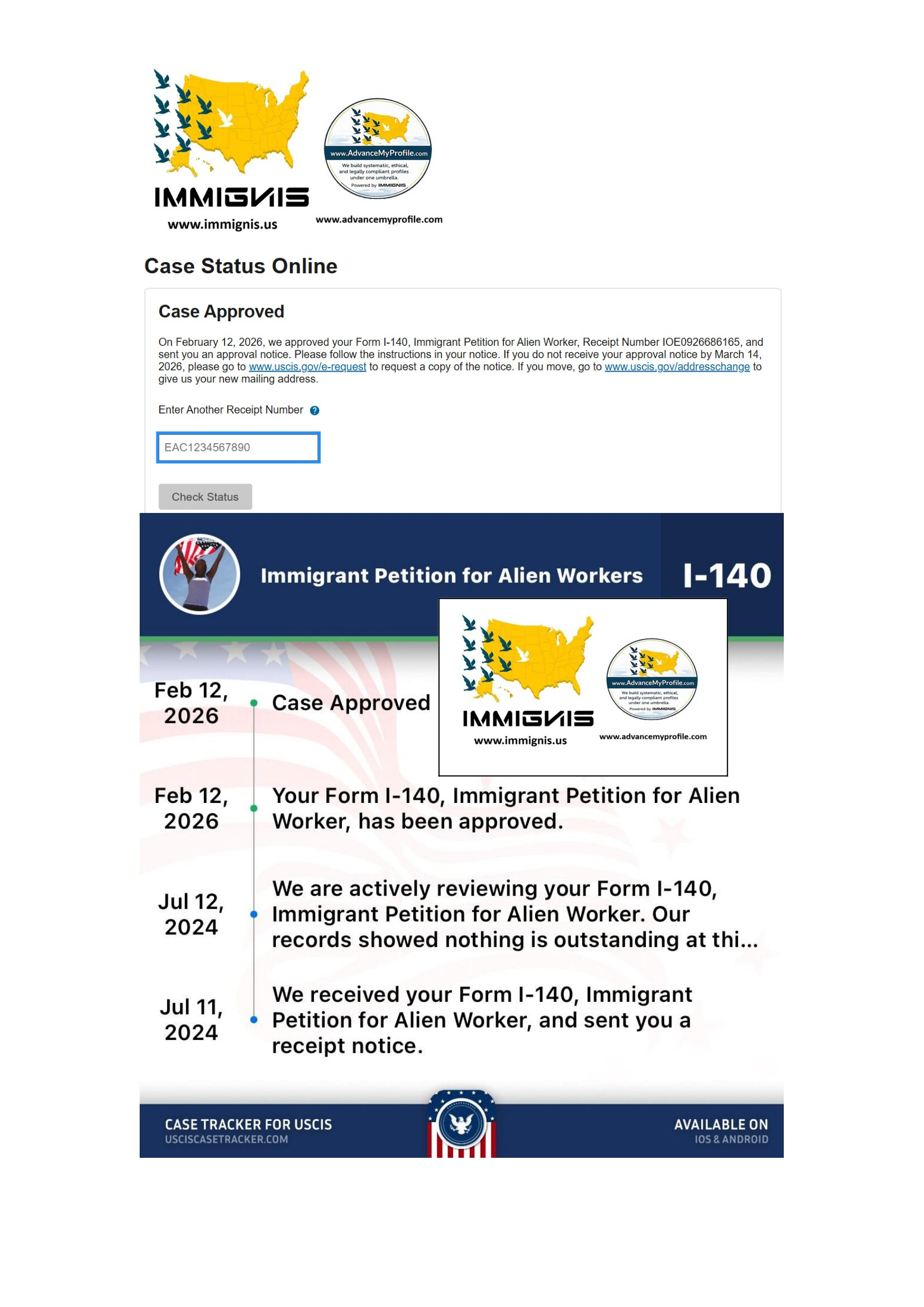
| Approval date | Approved on February 12, 2026. |
| Field niche | Composite repair validation methods for aircraft safety and lifecycle extension. |
| Starting problem | He already had publications, but the record was scattered and did not clearly show the major significance of his repair work. |
| Path used | Ethical EB-1A profile building through focused technical papers, citation visibility, an authored repair validation guide, patent documentation, conference keynote activity, aviation trade coverage, peer review, field relevant award recognition, and independent letters from aerospace materials leaders. |
| USCIS EB-1A criteria activated | Scholarly articles, original contributions, published material, judging, and recognized prizes or awards, with patent evidence strengthening the original-contribution record. |
EB-1A aerospace composite scientist approval. He read the approval date twice: February 12, 2026.
Not because he expected the screen to change. Because for years his work had already been published, tested, discussed, and used, yet his professional record never quite showed the importance of the problem he had chosen to solve.
Aircraft age. Composite damage. Repair decisions. His work focused on a question that sounds narrow until an aircraft must remain safe for years beyond its first delivery: how can a damaged composite structure be repaired, validated, and returned to service with confidence?
He had papers. He had laboratory work. He had technical credibility.
What he did not have was one clear authority story.
That was the weakness behind this EB-1A success story.
Why were existing publications not enough for this aerospace scientist?
His publication record proved that he could do research. It did not yet prove sustained acclaim in one precise field.
The papers moved across composite materials, structural behavior, manufacturing questions, and repair-related topics. None of that work was weak. The problem was that the record asked an immigration officer to do too much interpretation.
An aerospace materials specialist could look at the papers and see the connection. USCIS should not have to reconstruct that connection on its own.
The EB-1A green card is a self-petition immigrant category for people who can demonstrate extraordinary ability through sustained national or international acclaim and evidence placing them among the small percentage at the top of their field.
For him, the phrase sustained acclaim created a practical problem. Recognition existed, but it was spread across topics. Citations existed, but not all of them supported the same professional identity. Technical work existed, but the major significance of composite repair validation was not yet obvious from the record.
His career looked active. It did not yet look concentrated.
The turning point was not ‘publish more.’ It was choosing what the career meant.
Advance My Profile, powered by Immignis, did not begin by adding random activities. The first task was to map his existing research and ask a harder question: what problem did his strongest work repeatedly return to?
The answer was composite repair validation for aircraft lifecycle extension.
That changed the strategy. Instead of presenting him as a broad composites researcher, the profile was rebuilt around the science of deciding whether a repaired aircraft structure can remain safe, durable, and technically defensible over time.
The niche connected damage assessment, bonded and composite repair behavior, validation, structural integrity, and the economic reality of keeping aircraft in service without compromising safety.
This was more than better wording. It determined which papers deserved emphasis, which new research questions belonged in the plan, what type of technical guide would be useful, which industry audiences mattered, and what independent experts needed to explain. For the first time, the record had a center.
What did USCIS need to see in a composite-repair EB-1A case?
USCIS needed to see why this was not ordinary aerospace research or routine materials testing.
For the original-contribution criterion, the petition had to identify his own repair-validation methods, analytical approaches, or technical findings and explain why they mattered to the field. A patent number by itself would not answer that question. The record needed to show what problem the patented or documented work addressed and why other specialists considered the contribution significant.
The repair context also mattered. Composite repair is not simply about fixing visible damage. The case had to explain why validation affects structural integrity, inspection confidence, maintenance decisions, aircraft availability, and lifecycle cost.
For scholarly authorship, USCIS could see publications. The harder final-merits question was whether the publication record showed a recognized specialist or simply a productive researcher with varied interests.
Published material had to be about him or his work, not merely articles he had written. Judging evidence had to show that technical venues trusted him to evaluate the work of other specialists. Any awards evidence had to involve genuine recognition and documented selection standards.
The officer also needed independent context.
Did aerospace materials leaders see his work as relevant to aircraft repair validation? Could they explain why the methods mattered beyond his laboratory? Did his technical record point to safety and lifecycle extension in a way that experts outside his institution could recognize?
That became the evidentiary problem the profile-building plan was designed to solve.
How did Advance My Profile rebuild the record around repair validation?
The first visible change was in the research plan. With support from domain PhDs and technical research professionals, his authorship strategy was narrowed. New papers and technical pieces stayed close to repair validation, structural performance after repair, damage tolerance, and the evidence needed to support longer aircraft service life.
The team also revisited his existing publications. Citation visibility was developed ethically by improving topic coherence, research discoverability, conference exposure, and the connection between newer work and his established findings. No paid citations. No citation exchange. No artificial schemes designed to manufacture numbers.
The aim was to make useful research easier for the right researchers to find and cite.
Then came the technical guide. He authored a focused guide on composite repair validation. It was written for engineers and technical audiences who needed a practical framework for thinking about damage characterization, repair selection, validation evidence, structural performance, and continued-service confidence.
The guide gave the profile something different from a journal article. It showed that he could organize a specialist body of knowledge for others in the field.
Patent documentation added another layer. The team assembled the patent family, inventorship evidence, technical problem statements, and supporting materials needed to show his individual connection to the claimed repair innovations. The petition did not assume that a patent automatically proved major significance. Independent letters and technical context explained why the underlying work mattered.
Conference activity was built around the same niche. Rather than submitting a general presentation on composites, the strategy developed talks around repair validation and aircraft lifecycle extension. That focus supported a keynote opportunity and placed him before an audience that could understand the engineering problem.
The public record began to look different. His name was no longer attached to a collection of unrelated materials topics. It was increasingly attached to composite repair.
How did trade coverage, peer review, and awards add independent recognition?
Aerospace trade coverage translated the significance of the work without turning it into marketing.
The media story was not that he had ‘changed aviation.’ The story was more credible: modern aircraft rely heavily on composite structures, and repair-validation science matters when operators and engineering teams decide how damaged structures can remain safely in service.
Trade features and expert commentary connected his name to aircraft lifecycle extension, structural repair, and composite safety.
Peer-review service strengthened another part of the record. Journals and technical venues invited him to evaluate research by other specialists. In an EB-1A petition, genuine peer review can support the criterion for judging the work of others because the professional is being trusted to assess expert work in the field.
A field relevant awards strategy was also developed. Advance My Profile identified recognition opportunities connected to aerospace materials, structural innovation, maintenance engineering, and research impact. Submissions were prepared only where his real record matched the eligibility rules. The resulting recognition was documented with the award criteria, selection process, and evidence connecting the honor to his repair work.
Nothing was added simply because the word ‘award’ looked useful in a petition. That distinction mattered.
Why did independent aerospace letters change the way the evidence read?
Because a stack of technical documents can show activity without explaining significance.
Immignis developed an independent referee strategy around aerospace materials leaders who could understand repair validation. The strongest letters did not repeat his CV. They explained the engineering problem first.
They described why composite damage can create difficult lifecycle decisions. They discussed the need to validate repaired performance rather than assume it. They placed his methods and publications inside the wider challenge of extending aircraft service life while protecting structural integrity.
Then they explained his contribution. The team guided the client in approaching suitable referees and prepared evidence based letter drafts for expert review. Each expert could revise the language and sign only what was accurate.
The final letters gave USCIS an outside technical lens. That is what a useful expert letter should do.
Why was ethical profile building especially important in aerospace?
Aerospace claims can follow a professional for decades. A paper can be read by a structural engineer years later. A patent can be checked. A keynote can be discussed by people who were in the room. A claimed award can be traced to its selection rules. A technical guide can be challenged line by line.
Building a fake EB-1A record in a safety-critical field is not only an immigration risk. It can become a professional liability.
That is why the strategy avoided weak journals, purchased citations, ornamental awards, and inflated statements about aircraft safety.
The profile was built from work he could defend in front of an aerospace materials review panel. This is the difference between profile decoration and profile building. Profile decoration creates evidence for one submission and hopes no one looks too closely later.
Profile building creates publications, technical guidance, patents, professional recognition, and independent validation that the person can continue to own throughout a career.
The EB-1A petition used the record. The scientist kept the record.
Could a scattered research profile be stronger than it looks?
Yes. Many researchers do not begin with one perfect EB-1A niche. A scientist may have published across several connected topics because projects, funding, supervisors, and laboratory needs changed over time. The key question is whether a genuine area of sustained expertise can be identified from the work already completed and developed honestly through future activities.
Immignis offers a free profile assessment to identify the strongest field niche, evidence gaps, realistic USCIS EB-1A criteria, and the activities that may strengthen the record without inventing a professional identity.
Sometimes the problem is not a lack of achievement. Sometimes the problem is that the achievements have never been made to speak to one another.
Which USCIS EB-1A criteria did the final Form I-140 petition activate?
Scholarly articles: A focused authorship record connected his existing and newer technical papers to composite repair validation, structural performance, and aircraft lifecycle extension.
Original contributions: Patent documentation, repair-validation research, technical guide evidence, citation context, and independent expert letters explained why his methods and findings had significance beyond ordinary laboratory work.
Published material: Aviation trade coverage discussed his work and expertise in composite repair, structural integrity, and lifecycle extension, creating independent public recognition around the defined niche.
Judging the work of others: Peer-review assignments showed that technical journals and research venues trusted him to evaluate work by other aerospace and materials specialists.
Recognized prizes or awards: Field-relevant recognition was supported with evidence of the honor, its selection standards, and the connection between the award and his aerospace materials work.
Patent evidence strengthened the original-contribution argument, but the petition did not mislabel a patent as a separate EB-1A regulatory criterion.
The final merits narrative then addressed the larger question.
Why did these activities belong together? Because the record showed progression in one field. His earlier research established technical depth. Focused papers concentrated the record. The repair-validation guide showed field-facing authorship. Patents documented invention-related work. Trade coverage created public recognition. A keynote placed him before specialist audiences. Peer review showed evaluative trust. Awards evidence and independent letters added outside recognition.
The petition did not ask USCIS to be impressed by the number of documents.
It asked USCIS to see the pattern. He had become a recognized specialist in composite repair validation for aircraft lifecycle extension.
What did the February 2026 EB-1A approval mean for him?
The Form I-140 approval arrived on February 12, 2026. By then, the professional record looked very different from the file that had started the process.
He still had his original papers. But now those papers sat inside a clearer body of work. He had focused repair-validation authorship, stronger citation visibility, a technical guide, documented patent evidence, a keynote, aviation trade coverage, peer-review activity, professional recognition, and independent letters from leaders who understood the field.
The approval gave him an EB-1A self-petition path without employer sponsorship or a labor certification requirement.
Professionally, the build did something else. It made his expertise easier to recognize.
A future collaborator did not need to read every paper he had ever published to understand the center of his work. An aviation journalist could identify his subject. A conference organizer could see a keynote topic. A journal editor could see the reviewing niche. An aerospace materials expert could understand the contribution the letters were describing.
The approval was the immigration result. The concentrated authority record was the career result.
If your research is published but your authority is still unclear
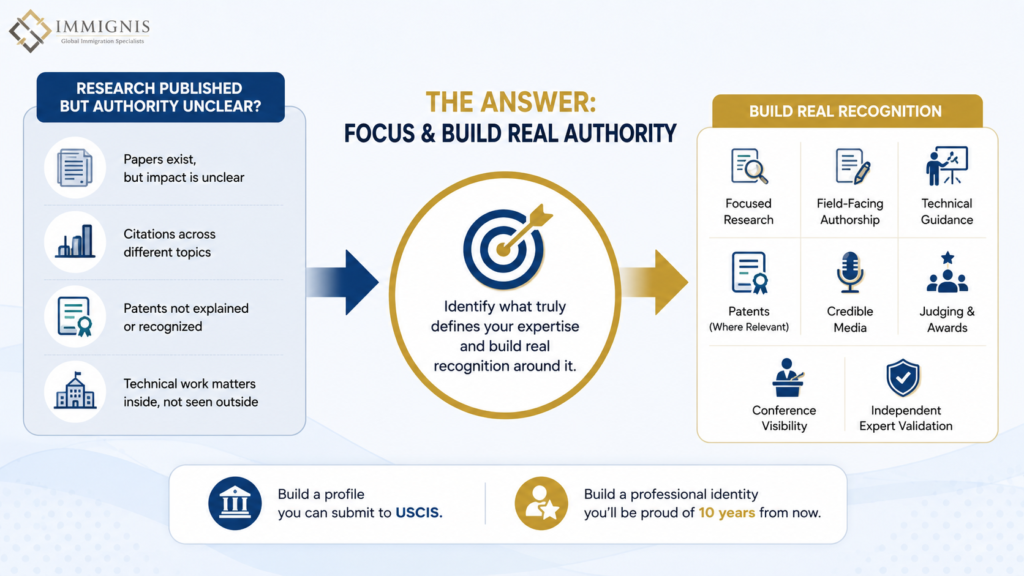
You may already have papers and still feel unready for EB-1A. You may have citations across different topics, patents that no one has explained properly, or technical work that matters inside a research center but has never been translated for the wider field.
That does not automatically mean the record is weak. It may mean the record is scattered.
The answer is not to manufacture acclaim. It is to identify the work that genuinely defines your expertise and build real recognition around it: focused research, field-facing authorship, technical guidance, patents where relevant, credible media, judging, awards, conference visibility, and independent expert validation.
Build a profile you can submit to USCIS. Build a professional identity you will still be proud to use ten years later.
FAQs
Are patents enough for an aerospace scientist to qualify for EB-1A?
No. A patent can help document inventive work, but the key question is the significance of the underlying contribution. In an aerospace composite case, the petition should explain the technical problem, the applicant’s individual role, the repair or validation method involved, and why independent experts consider the contribution important.
Can composite repair research be significant even if the scientist did not design a new aircraft?
Yes. Aircraft lifecycle safety depends on more than original aircraft design. Repair validation, damage assessment, structural integrity, and confidence in continued service can be important technical fields in their own right when the applicant shows original work and recognized significance.
How do you prove individual contribution when aerospace research is team-based?
The evidence should separate the applicant’s own methods, inventorship, authorship, technical responsibilities, and analytical decisions from the broader project. Patent records, contribution statements, project documentation, focused publications, and independent expert letters can help explain individual influence without claiming the work of an entire team.
Can a scattered citation record hurt an EB-1A case?
A scattered citation record does not automatically defeat a case, but it can make the final-merits narrative harder to understand. A focused publication and visibility strategy can help show that the applicant’s recognized work has converged around a defined aerospace specialty rather than relying on unrelated citation totals.
What evidence can show that an aircraft repair method has major significance?
Useful evidence may include independent expert analysis, adoption or validation records, references to the method in later technical work, patent evidence, citation patterns, repair guidance, conference recognition, and documentation showing how the work affects structural integrity, inspection confidence, maintenance decisions, or aircraft lifecycle extension.
Do I need a PhD or a U.S. degree for an EB-1A aerospace case?
No specific degree is required by the EB-1A extraordinary ability category. A PhD can support technical expertise, but USCIS evaluates the extraordinary-ability evidence and the record as a whole. Publications, original contributions, judging, recognized awards, published material, and sustained field recognition remain central to the case.
Build an EB-1A success story around the work that actually defines you
If you work in aerospace composites, aircraft structures, repair engineering, materials science, maintenance technology, or another advanced technical field, a scattered record may be hiding a much stronger professional niche.
Immignis and Advance My Profile help professionals identify that niche, build credible recognition around real expertise, document individual impact, and prepare an EB-1A record that can be explained both to USCIS and to the professional field.
Start with a free EB-1A profile assessment and find out whether your published and technical work can be developed into a clearer authority record.