Key facts at a glance
| Outcome | EB-1A approval for a Norwegian offshore wind integrity engineer working with a Norway based energy company. |
| Approval date | Approved on September 3, 2024. |
| Field niche | Digital inspection and corrosion risk management for offshore wind foundations. |
| Starting problem | His strongest achievements were buried inside offshore energy projects and were difficult to separate from company level results. |
| Path used | Ethical EB-1A profile building through focused corrosion and inspection papers, a digital inspection white paper, technology adoption evidence, a wind energy conference presentation, industry podcast visibility, energy award judging, selective membership, and independent letters from offshore integrity leaders. |
| USCIS EB-1A criteria activated | Original contributions, scholarly articles, published material, judging, memberships, and leading or critical role. |
September 3, 2024 was not the day he learned that salt water punishes steel.
The EB-1A offshore wind engineer had spent years watching offshore structures age under corrosion, marine exposure, repeated loading, and inspection schedules that never felt as generous as engineers wanted them to be.
It was the day USCIS approved the Form I-140 that finally showed why his way of finding integrity risk mattered.
This EB-1A success story did not begin with a laboratory breakthrough or a famous invention. It began with inspection work buried inside offshore energy projects.
Clients could see the value. Project teams could see it. The wider field could barely see him.
He was good at finding problems before they became expensive. On paper, he still looked like one more experienced offshore engineer.
Why did offshore wind integrity work disappear inside big energy projects?
Because offshore projects make individuals look smaller than the assets around them.
That was his starting weakness.
His work addressed corrosion and inspection questions for offshore structures, including how digital inspection evidence could help teams identify deterioration, compare findings, prioritize attention, and make more informed integrity decisions. Yet the professional record outside his employer was thin.
The EB-1A green card is a self-petition immigrant category for people who can demonstrate extraordinary ability through sustained national or international acclaim and evidence placing them among the small percentage at the top of their field.
His career had technical depth. It did not yet show sustained acclaim in a defined field.
The first strategic decision was therefore not to call him an energy expert. It was to make offshore wind integrity visible.
How Did Immignis Build the EB-1A Offshore Wind Engineer’s Technical Niche?
The profile became much stronger when the team stopped describing his work as general offshore engineering.
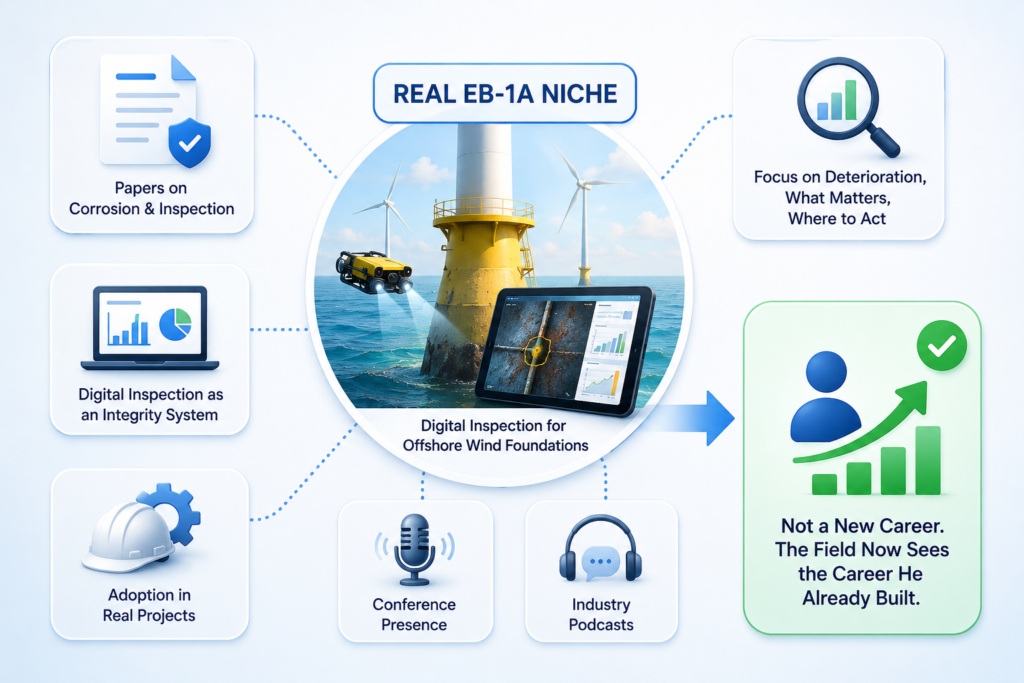
Advance My Profile, powered by Immignis, mapped his project history with legal strategists and offshore integrity specialists. One technical thread repeated across the strongest evidence: digital inspection for offshore wind foundations, with corrosion risk and structural integrity at the center.
Offshore wind assets are expected to operate for years in aggressive marine environments. Inspection is not only about collecting images or writing condition reports. The useful question is whether inspection evidence helps engineers understand where deterioration is developing, which findings matter, and how integrity resources should be directed. His papers could address corrosion and inspection. The white paper could explain digital inspection as an integrity system. Adoption evidence could show use in real projects. Conference and podcast activity could speak to one recognizable subject. The client did not need a new career. He needed the field to see the career he had already built.
What did USCIS need to see in a digital inspection EB-1A case?
USCIS needed to see why his work was more than competent inspection engineering.
For original contributions, the petition had to identify his own inspection methodology, decision framework, or technical influence and explain why it mattered. A claim that he “worked on offshore wind projects” would say almost nothing about extraordinary ability.
The adoption evidence was especially important. If a digital inspection approach had been used, repeated, or relied on in project settings, the record needed to show what was adopted, where the applicant fit, and why the use was meaningful. Company success could not simply be reassigned to one employee.
For a leading or critical role, USCIS needed evidence that distinguished organizations or projects depended on his integrity judgment. A senior title alone would not show whether he shaped inspection priorities, corrosion assessment, or technical decisions that affected offshore reliability.
The final merits review also required outside recognition. Were other offshore professionals engaging with his ideas? Was he invited to present the work? Did industry media seek his expertise? Was he trusted to judge technical innovation or review scholarly work? Did independent experts understand the significance without relying on employer praise?
The petition therefore had to connect three things: his personal contribution, real world use, and independent recognition.
How did Advance My Profile build an offshore integrity authority record?
The build started with technical authorship. With domain support, he developed a focused set of papers around corrosion, inspection reliability, and integrity decision-making for offshore structures. The topics stayed close to the problems he actually understood. There was no attempt to turn him into a broad renewable energy commentator.
Then came the digital inspection white paper. It was written for offshore and wind energy audiences rather than for an immigration file. The paper explained how digital inspection should move beyond data collection and support structured integrity decisions. It addressed the need to organize findings, maintain traceability, compare condition evidence, and connect inspection results with corrosion risk and maintenance priorities.
Technology adoption evidence followed. The evidence team assembled non confidential records showing how elements of his inspection approach were used in offshore work. Adoption summaries, project documentation, role evidence, and independent explanations helped separate his contribution from the wider project team.
How did Advance My Profile build an offshore integrity authority record?
The build started with technical authorship. With domain support, he developed a focused set of papers around corrosion, inspection reliability, and integrity decision making for offshore structures. The topics stayed close to the problems he actually understood. There was no attempt to turn him into a broad renewable energy commentator.
Then came the digital inspection white paper. It was written for offshore and wind energy audiences rather than for an immigration file. The paper explained how digital inspection should move beyond data collection and support structured integrity decisions. It addressed the need to organize findings, maintain traceability, compare condition evidence, and connect inspection results with corrosion risk and maintenance priorities.
Technology adoption evidence followed. The evidence team assembled non confidential records showing how elements of his inspection approach were used in offshore work. Adoption summaries, project documentation, role evidence, and independent explanations helped separate his contribution from the wider project team.
Why did the conference presentation and industry podcast matter?
At a wind energy conference, the presentation was built around inspection and integrity questions that offshore professionals recognized immediately. It did not celebrate digital technology for its own sake. It asked what engineers should do with the evidence once it is collected.
The industry podcast reached a different audience. In conversation, he could explain why a foundation that appears serviceable may still require better inspection history, why isolated findings need context, and why digital records become more useful when engineers can compare condition evidence over time.
How did judging, membership, and independent letters add outside recognition?
Judging in energy innovation awards showed that an external organization trusted him to evaluate the work of other professionals or teams. The evidence documented the event, his judging responsibility, and the type of technical work he assessed.
Selective membership was treated carefully. Advance My Profile reviewed professional organizations and membership grades connected to offshore engineering, corrosion, asset integrity, and renewable energy. Where a membership criterion was claimed, the petition documented the actual admission or advancement standards and how his professional record was evaluated.
Offshore integrity leaders explained why marine corrosion and foundation inspection are central to wind-asset reliability. They described the difficulty of turning inspection data into defensible engineering priorities. Then they explained where his work fit.
Advance My Profile prepared evidence based drafts for expert review. The experts could revise the text and sign only what they considered accurate.
Could your offshore or energy work be stronger than your public profile suggests?
If your best work sits inside inspection reports, client projects, internal engineering systems, or confidential asset programs, the public record may understate your real influence.
It does mean the first question should be whether a genuine area of recognized expertise can be documented without exposing proprietary information or borrowing the achievements of an employer.
Immignis offers a free profile assessment to identify the technical niche, existing evidence, realistic USCIS EB-1A criteria, and the activities that may strengthen the record through real professional development.
Why did ethical profile building matter in offshore wind?
Inspection methods can be questioned. Corrosion conclusions can be challenged. Technology adoption can be checked with project teams. Award judging and membership standards can be verified.
A fake award, paid citation scheme, weak journal, or inflated claim of technology adoption may create a temporary immigration exhibit. It can also create a professional record the engineer must explain to operators, clients, and technical peers later.
The papers stayed inside his real technical competence. The white paper addressed a genuine integrity problem. Adoption evidence was limited to what could be documented. Media and podcast work stayed field-specific. Judging was real. Membership standards were documented. Expert letters were tied to evidence.
Do not build a record you need to hide after approval.
Build one you can still defend on an offshore integrity panel ten years later.
Which USCIS EB-1A criteria did the final Form I-140 petition activate?
Original contributions: The petition connected his digital inspection and corrosion risk work to offshore wind foundation reliability. Adoption evidence, technical documentation, and independent letters explained his individual contribution and its significance beyond routine inspection activity.
Scholarly articles: Focused corrosion and inspection papers built a coherent authorship record around offshore integrity, digital inspection, and foundation reliability.
Published material: Industry media and podcast coverage discussed his work and expertise in offshore wind inspection and integrity, creating independent public recognition around the defined niche.
Judging the work of others: Energy award judging and documented technical evaluation activity showed that external organizations trusted him to assess work by other professionals and innovators.
Memberships: Selective professional membership evidence was supported with admission or advancement standards and documentation showing how his qualifications were evaluated.
Leading or critical role: Project and organizational evidence showed why his integrity judgment mattered to important offshore inspection and reliability work within a recognized energy environment.
The papers established technical depth. The white paper translated the methodology for industry. Adoption evidence showed practice. Conference and podcast activity widened recognition Judging showed evaluative trust. Selective membership and independent letters added outside validation.
What did the September 2024 EB-1A approval mean?
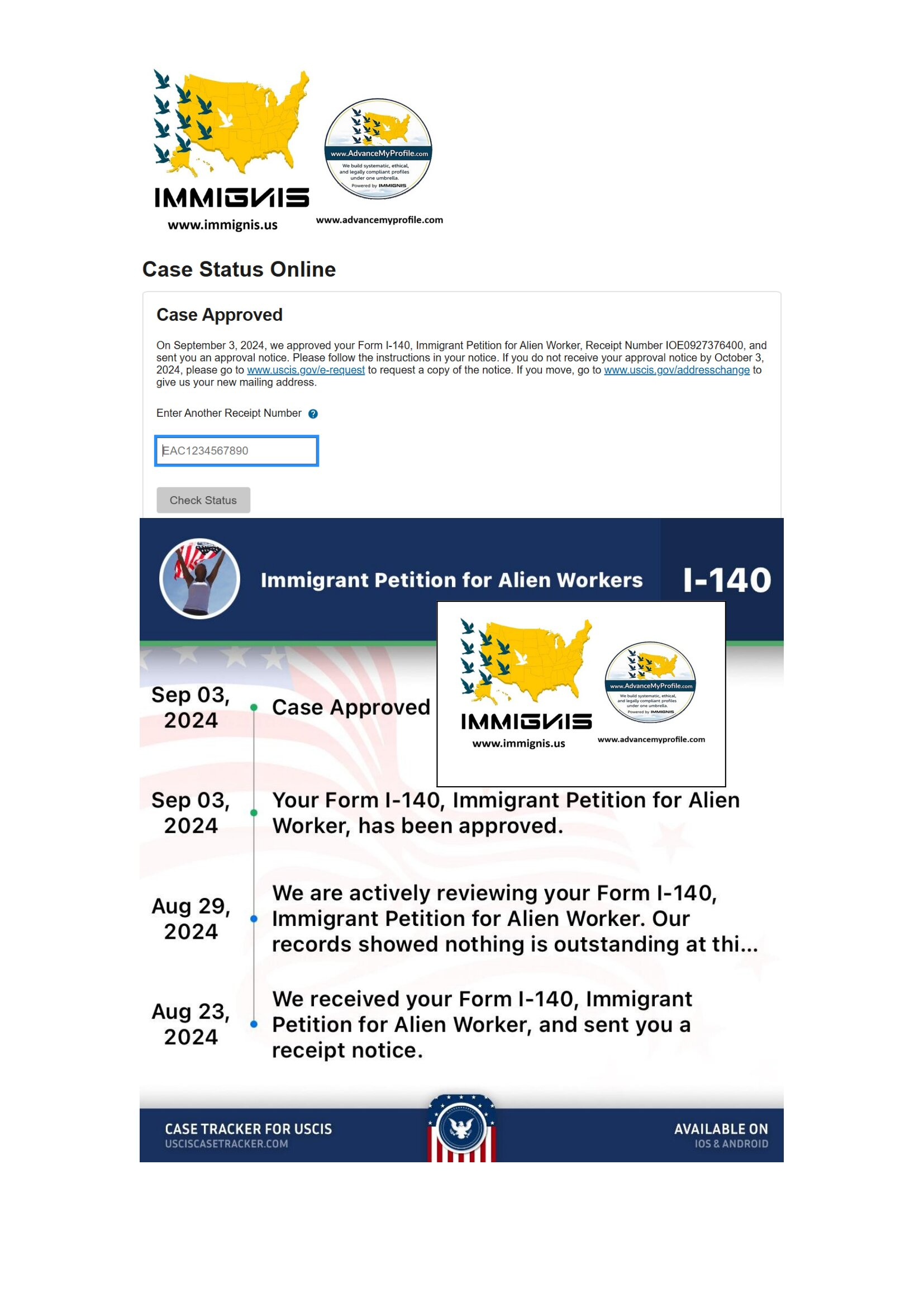
USCIS approved the Form I-140 on September 3, 2024.
The displayed case history shows receipt of the petition on August 23, active review on August 29, and approval on September 3. It does not show a Request for Evidence.
By approval, the professional record no longer depended on private project experience alone.
He had focused papers, a digital inspection white paper, documented technology adoption, conference visibility, an industry podcast, judging activity, selective professional membership, and independent letters from offshore integrity leaders.
The EB-1A classification can be self-petitioned and does not require labor certification. Form I-140 approval establishes the immigrant classification; the later permanent residence step still depends on the applicable process and visa availability, including the priority date.
A wind energy conference could identify his subject. An industry host could invite him to discuss inspection integrity. An expert could evaluate documented adoption. A technical peer could find papers tied to the same niche.
If your achievements are buried inside energy projects:
You may be the engineer clients trust when an inspection result is unclear, a corrosion finding needs context, or a maintenance decision cannot wait for perfect information.
Do not solve that problem with fake visibility.
Build around the expertise you can prove: focused authorship, a useful field-facing white paper, documented adoption, conference contribution, credible media or podcast expertise, genuine judging, selective professional recognition, and independent technical validation.
FAQ:
Can digital inspection methods support an EB-1A original-contribution claim in offshore wind?
Yes, when the applicant can identify an original method, framework, or technical contribution and show recognized significance beyond routine inspection work. Adoption evidence, technical papers, project documentation, and independent expert analysis can help explain why the contribution mattered to offshore integrity or reliability.
How can an offshore engineer prove individual impact when projects belong to an energy company?
The evidence should separate the engineer’s own technical decisions, methods, authorship, and responsibilities from the broader project. Non confidential adoption summaries, role documentation, technical publications, and independent letters can help show personal influence without disclosing protected asset data or claiming the work of an entire team.
Does using drones, sensors, or digital inspection technology automatically make an EB-1A case extraordinary?
No. Technology use alone does not establish extraordinary ability. The case must show what the applicant personally contributed, why the contribution was significant, and how the field independently recognized the work. A sophisticated tool does not replace evidence of individual influence.
Can judging energy or engineering awards count as judging the work of others?
It can when the applicant genuinely evaluates the work of other professionals, teams, or innovators and the activity is properly documented. The petition should show the judging role, the type of work assessed, and the connection to the applicant’s field rather than relying only on an event badge or invitation.
Is EB-1A or EB-2 NIW usually better for an offshore wind integrity engineer?
They address different questions. EB-1A focuses on extraordinary ability and sustained acclaim, while EB-2 NIW focuses on the proposed endeavor, its national importance, and whether the applicant is well positioned to advance it. An engineer with strong technical plans but limited acclaim may be closer to EB-2 NIW, while a developed record of independent recognition may support EB-1A.
Do I need a PhD or a U.S. degree for an EB-1A offshore engineering case?
No specific degree is required for EB-1A extraordinary ability. A PhD can support technical expertise, but USCIS evaluates the extraordinary ability evidence and the record as a whole. For an experienced offshore engineer, original contributions, authorship, judging, qualifying memberships, critical role evidence, and sustained independent recognition may be more important than copying an academic profile.
Build an EB-1A success story around the integrity work that already defines you
If you work in offshore wind, corrosion engineering, structural integrity, digital inspection, asset reliability, or another energy field, your strongest achievements may already exist inside projects the public cannot see.
Immignis and Advance My Profile help professionals identify a defensible niche, develop credible field recognition, document individual impact, and prepare an EB-1A record around real and verifiable professional work.