Key facts at a glance
| Outcome | EB-1A approval for a Ukrainian antimicrobial resistance scientist working at a Poland-based university hospital after USCIS received a response to a request for additional evidence. |
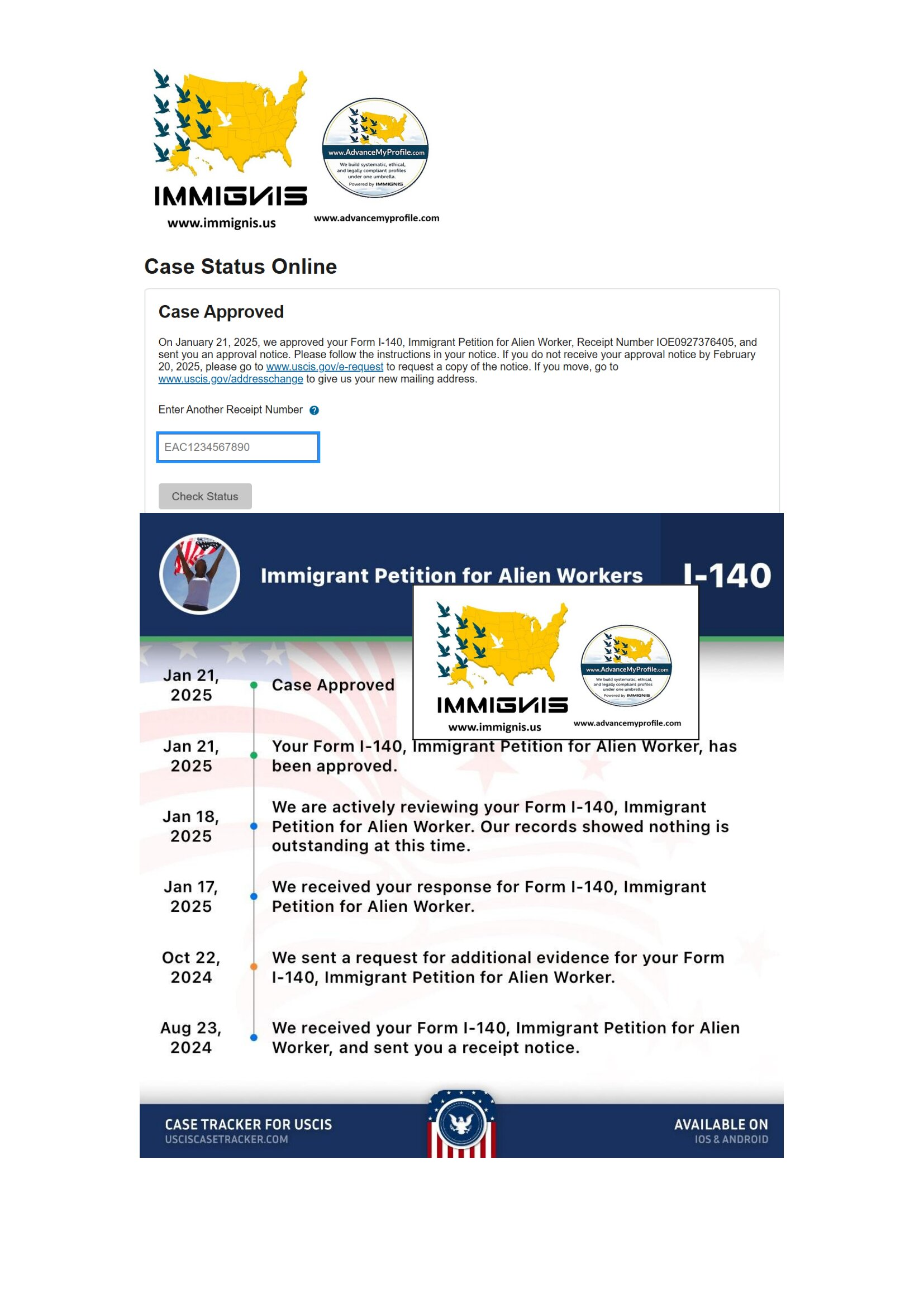
| Approval date | Approved on January 21, 2025. |
| Field niche | Rapid antimicrobial resistance diagnostics for hospital stewardship and earlier treatment decisions. |
| Starting problem | Displacement interrupted the visible research timeline, creating a continuity problem even though the scientist’s AMR expertise and hospital work remained substantial. |
| Path used | Ethical EB-1A profile building through focused AMR publications, hospital protocol-adoption evidence, a public-health white paper, expert commentary, peer review, invited talks, field-relevant award recognition, and independent letters from AMR, microbiology, and stewardship experts. |
| USCIS EB-1A criteria activated | Scholarly articles, original contributions, published material, judging, recognized prizes or awards, and leading or critical role. |
On January 21, 2025, USCIS approved her Form I-140.
Four days earlier, the case history showed that USCIS had received her response to a request for additional evidence.
EB-1A for Scientists requires clear evidence of sustained recognition, extraordinary ability, and continued impact in the scientific field. For this scientist, the hardest part of the case had never been explaining antimicrobial resistance.
It was explaining continuity.
Her research life had been interrupted by displacement. Institutions changed. Projects moved. Professional networks were broken and rebuilt. The clean chronological line that many researchers take for granted no longer existed on paper.
Yet the bacteria did not pause.
Hospitals still needed faster answers about resistance. Stewardship teams still had to decide whether an antimicrobial choice was likely to work. Her expertise in rapid AMR diagnostics remained relevant even when her own career had been forced to change geography.
The question was whether the EB-1A record could show that the field had continued to recognize her.
Why did displacement create a special EB-1A problem?
The EB-1A green card is a self-petition immigrant category for people who can demonstrate extraordinary ability through sustained national or international acclaim and evidence placing them among the small percentage at the top of their field.
For a researcher whose career has been interrupted, the word sustained can feel unforgiving.
Her earlier work showed scientific ability. But a disrupted publication rhythm, changes in institutional affiliation, and gaps in visible professional activity could make the record look as though recognition had faded.
She had continued working in antimicrobial resistance and hospital diagnostics. The evidence simply had to show the bridge between the earlier research record and the work she was now doing in a Poland-based university hospital.
Advance My Profile, powered by Immignis, therefore treated continuity as an evidentiary problem rather than a weakness to hide.
The turning point was narrowing the field to rapid AMR diagnostics for hospital stewardship
Legal strategists and AMR domain specialists identified the strongest recurring thread: rapid antimicrobial resistance diagnostics for hospital stewardship.
Traditional workflows can require time before a resistance picture becomes clear. Rapid diagnostic approaches seek to give clinicians and stewardship teams useful resistance information earlier, so treatment and antimicrobial decisions can be reviewed with better evidence.
The field definition changed the case. Publications could be focused. Protocol adoption evidence became more meaningful. Hospital experts could explain why her work mattered. Public commentary could stay close to resistance testing rather than drift into every infectious-disease topic.
What did USCIS need to see in this AMR diagnostics case?
For original contributions, the petition had to identify her own diagnostic work, analytical approach, protocol input, or other scientific contribution and explain why it mattered to hospital stewardship. General statements about AMR being a global problem would not establish her individual significance.
Hospital adoption evidence required careful treatment. A university hospital may adopt or refine a protocol through teams, committees, laboratories, and stewardship groups. The record needed to show what she personally contributed and why the adopted work reflected her expertise.
For judging, peer-review records needed to show actual evaluation of other specialists’ work.
For published material, expert commentary and media coverage had to be about her or her expertise, not simply articles she authored.
For awards, the evidence needed to document the recognition and its selection standards. An award submission alone would not satisfy the criterion.
Could the record show that a forced interruption changed the location of her career without ending the professional acclaim attached to her AMR expertise?
The publication plan was designed to rebuild a visible scientific line
With support from domain PhDs and research professionals, her newer work was concentrated around rapid AMR diagnostics, resistance detection, hospital stewardship, and the clinical usefulness of earlier diagnostic information.
Earlier research established scientific depth. Newer publications showed that the same expertise had continued to evolve in a different institutional setting.
A reviewer could see a professional trajectory interrupted by circumstance but still centered on the same scientific problem.
Hospital protocol adoption made the contribution practical
Advance My Profile helped assemble non-confidential evidence showing how diagnostic methods, workflow analysis, or protocol recommendations connected to hospital practice. The evidence focused on her individual role, the scientific basis of the work, and the reason stewardship teams needed more useful resistance information earlier.
It showed how diagnostic evidence can support the professionals responsible for reviewing therapy and stewardship decisions.
Protocol documents, role evidence, adoption records, and expert explanations helped move the original-contribution argument beyond publication counts.
The public-health white paper gave the field a bridge between laboratory speed and stewardship
The paper explained why rapid resistance diagnostics should be understood as part of stewardship infrastructure rather than as an isolated laboratory technology.
It explained the narrower and more credible point: when resistance information becomes clinically useful earlier, stewardship teams may have a stronger basis for reviewing antimicrobial choices.
It gave the scientist a field-facing document that other professionals could read without knowing anything about her immigration case.
Expert commentary and invited talks restored visibility around her name
Expert commentary focused on hospital AMR, resistance detection, diagnostic delay, and the challenge stewardship teams face when laboratory information arrives after important treatment decisions have already begun.
Invited talks followed the same focus. Hospital, microbiology, and public-health audiences heard her discuss rapid diagnostics and stewardship evidence.
Peer review, award evidence, and independent letters showed recognition from three different directions
Journals invited her to assess work by other researchers in microbiology, diagnostics, AMR, or closely related areas. The petition documented genuine review activity rather than listing generic editorial invitations.
The award strategy was handled separately. A field relevant recognition was documented with the award record, selection information, and connection to her AMR work. The petition did not rely on the fact that an application had been submitted; it relied on the recognition actually used as evidence.
Immignis developed a referee strategy around AMR scientists, clinical microbiologists, and stewardship professionals who could understand both the diagnostic science and the hospital problem.
Their letters explained why rapid resistance information matters, how her work fit into stewardship workflows, and why the interruption in her geography did not erase the scientific continuity visible in her research and hospital contributions.
Advance My Profile prepared evidence-based drafts for expert review. Referees could revise the language and sign only what they considered accurate.
The request for additional evidence forced the continuity story to become even clearer
The public case history shows that USCIS sent a request for additional evidence on October 22, 2024.
It shows that USCIS received the response on January 17, 2025, resumed active review on January 18, and approved the Form I-140 on January 21, 2025.
The online timeline does not identify the substance of the request, so this story does not invent an RFE issue that the public case history does not disclose.
The response needed to return the officer to the same field narrative: focused AMR publications, hospital protocol adoption, stewardship relevance, public-health analysis, expert commentary, judging, recognition, invited talks, and independent validation. It was not the conclusion of the career.
Why was ethical profile building especially important in an AMR case?
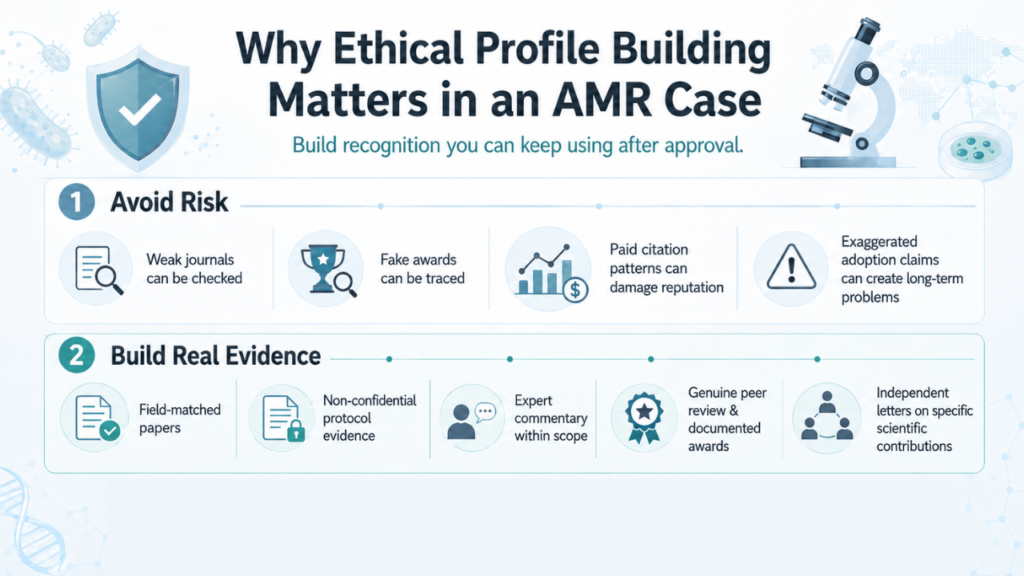
A weak journal can be checked. A fake award can be traced. A paid citation pattern can damage a researcher’s reputation. An exaggerated hospital adoption claim can create problems far beyond USCIS.
The papers matched her field. Protocol evidence was non-confidential and attributable. Commentary stayed within her expertise. Peer review was genuine. Award evidence was documented. Independent letters explained specific scientific contributions.
The aim was a professional record she could continue to use in research, hospital collaboration, speaking, review work, and AMR leadership.
Do not build what you will have to hide after approval. Build the kind of recognition that can travel with you when institutions and countries change.
Which USCIS EB-1A criteria did the final Form I-140 petition activate?
Scholarly articles: Focused AMR publications connected her authorship to rapid resistance diagnostics, hospital stewardship, and the clinical value of earlier resistance information.
Original contributions: Protocol adoption evidence, diagnostic work, public-health analysis, and independent expert letters explained her individual contribution to AMR diagnostic and stewardship practice.
Published material: Expert commentary and independent coverage discussed her work and expertise in antimicrobial resistance diagnostics and hospital stewardship.
Judging the work of others: Peer-review assignments showed that technical and scientific journals trusted her to evaluate research by other specialists in AMR, microbiology, diagnostics, and related fields.
Recognized prizes or awards: Field-relevant recognition was supported with evidence of the award, its selection framework, and the connection between the honor and her AMR work.
Leading or critical role: Hospital and project evidence showed why her diagnostic and scientific judgment mattered to important AMR and stewardship work within a distinguished university-hospital environment.
Her earlier research showed scientific depth. Focused newer publications restored a visible AMR line. Hospital protocol evidence showed practical relevance. The white paper translated the work for public-health and stewardship audiences. Commentary and invited talks rebuilt public authority. Peer review showed evaluative trust. Award evidence and independent letters added outside recognition. It showed that the evidence still met the standard despite disruption.
What did the January 2025 EB-1A approval mean?
USCIS approved the Form I-140 on January 21, 2025.
It showed focused AMR publications, hospital protocol adoption, a public-health white paper, expert commentary, peer review, invited talks, field recognition, and independent letters from people who understood the science and the hospital context.
The approval gave her an EB-1A self-petition path without employer sponsorship or labor certification.
Her authority record was no longer tied to one institution or one country. A hospital could understand the stewardship niche. A journal could recognize her review expertise. A public-health audience could identify the diagnostic question she studied. Independent experts could explain a scientific contribution that had continued across disruption.
The immigration result was approval. The career result was continuity made visible.
If your research career was interrupted by war, displacement, illness, caregiving, or another major disruption
Do not invent publications to fill a gap. Do not buy citations. Do not create artificial awards because your CV looks less continuous than someone else’s.
Build real authorship around it. Document adoption or practical use. Re-enter professional conversations through speaking and commentary. Judge the work of others when legitimate opportunities arise. Ask independent experts to explain the significance they actually understand.
Your authority record can still be honest, coherent, and strong.
FAQs
Can a disrupted research career still support an EB-1A case?
Yes. A gap or disrupted chronology does not automatically prevent EB-1A eligibility. The record still needs to show sustained acclaim and extraordinary ability, so the petition should document continuity through the applicant’s field, publications, contributions, judging, recognition, practical impact, and independent expert evidence rather than trying to hide the disruption.
How can a scientist prove continuity after displacement or changing countries?
Continuity can be shown through a consistent research niche, later publications connected to earlier work, hospital or institutional contributions, invited talks, peer review, professional recognition, and independent letters that explain how the expertise continued across institutional changes. The strongest evidence shows the same scientific problem continuing even when the employer or country changes.
Can hospital protocol adoption support an EB-1A original contribution claim?
It can help when the evidence identifies the applicant’s individual scientific or technical contribution and shows why the adopted work mattered. Protocol documents, role evidence, implementation records, and independent expert analysis can help distinguish a researcher’s contribution from the work of the hospital team as a whole.
Why are rapid AMR diagnostics important to antimicrobial stewardship?
Stewardship teams need useful evidence when antimicrobial choices are reviewed. Rapid resistance diagnostics may provide resistance information earlier than some traditional workflows, which can support better-informed review of treatment and antimicrobial use. The EB-1A case still must prove the applicant’s own recognized contribution to that field.
Does an RFE mean USCIS believed the scientist was not extraordinary?
Not necessarily. A request for evidence means USCIS is asking for additional evidence or clarification before completing adjudication. The public timeline in this case shows a request for additional evidence, receipt of the response, resumed review, and later approval; it does not disclose the specific issue raised.
Do I need uninterrupted publications every year to qualify for EB-1A?
No USCIS rule requires one publication every year. The larger question is whether the record as a whole establishes sustained acclaim and top-level standing in the defined field. A petition involving a disrupted career should explain the chronology carefully and use credible evidence showing that the applicant’s expertise and recognition continued.
Build an EB-1A success story around the work that survived the interruption
If you work in antimicrobial resistance, clinical microbiology, rapid diagnostics, infectious-disease research, stewardship, or another hospital based scientific field, a disrupted timeline may hide a stronger authority record than your CV suggests.
Immignis and Advance My Profile help professionals identify a defensible niche, rebuild credible visibility around real work, document individual impact, and prepare an EB-1A record that explains professional continuity without manufacturing it.
Start with a free EB-1A profile assessment and find out whether your research and field contribution can be developed into a clearer authority record.