Key facts at a glance
| Outcome | EB-1A approval for a Croatian marine robotics engineer and startup founder after his autonomous underwater inspection work was documented as a recognized technical contribution. |
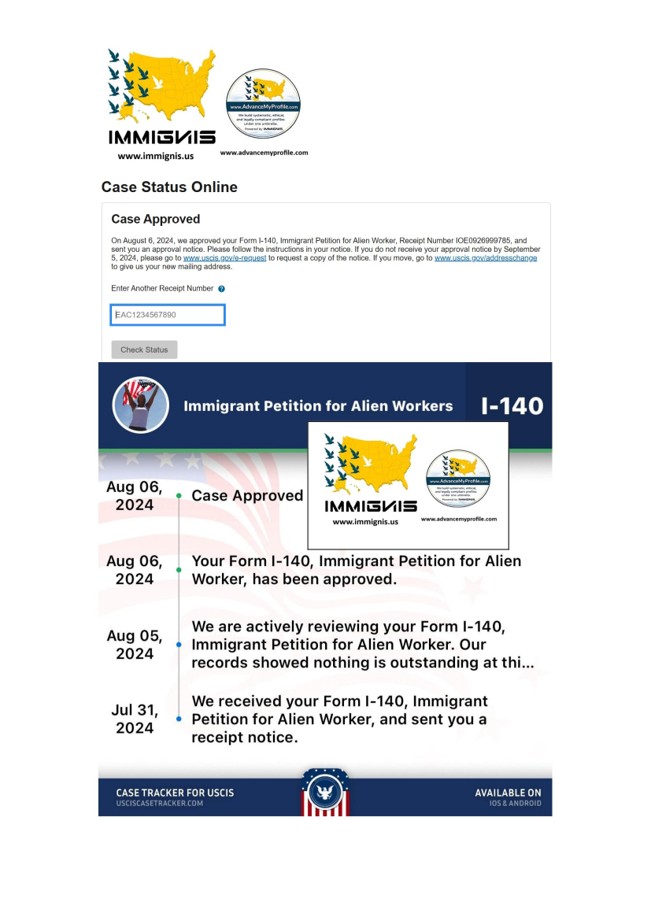
| Approval date | Approved on August 6, 2024. |
| Field niche | Autonomous underwater robots for offshore infrastructure inspection and marine-asset safety. |
| Starting problem | His founder record was heavily tied to the startup, with limited independent evidence separating his individual engineering contribution from the company story. |
| Path used | Ethical EB-1A profile building through technical publications, patent documentation, a maritime inspection white paper, non-confidential demonstration evidence, trade-media coverage, conference judging, standards and professional-community participation, selective membership evidence, industry adoption proof, and independent marine-robotics letters. |
| USCIS EB-1A criteria activated | Original contributions, published material, judging, memberships, and leading or critical role. Patent evidence strengthened the original-contribution record. |
The EB-1A Marine Robotics Founder behind this case received USCIS approval for his Form I-140 on August 6, 2024.
The robot had already been underwater many times. It could move along submerged structures, capture inspection data, and reach places where offshore work becomes slow, expensive, or dangerous for human teams.
But his EB-1A problem was not whether the machine could dive. It was whether the evidence could surface his own contribution. He was a founder. The startup had a name, a product story, investor conversations, demonstration footage, and engineering milestones. USCIS still needed to see the person behind the company.
Why can a successful marine robotics founder still have a weak EB-1A record?
Because startup visibility often belongs to the company before it belongs to the engineer who built the technology. A website may describe an autonomous underwater vehicle. A trade article may mention a robotics startup. A demonstration may show a system inspecting a submerged structure. None of that automatically identifies which technical problems the founder personally solved.
The EB-1A green card is a self-petition immigrant category for people who can demonstrate extraordinary ability through sustained national or international acclaim and evidence placing them among the small percentage at the top of their field.
His original record looked entrepreneurial. It did not yet read as a complete extraordinary-ability record in marine robotics.
Independent evidence was thinner. Judging activity needed development. The public record did not clearly separate his engineering influence from the startup brand. Advance My Profile, powered by Immignis, therefore approached the case as an attribution problem.
The turning point was defining the field around offshore inspection, not “marine robotics”
The strongest part of his work involved autonomous underwater systems used to inspect offshore infrastructure. That meant subsea structures, foundations, corrosion-prone surfaces, difficult visual access, and the need to gather repeatable inspection evidence in environments where human access can be costly and risky.
Legal strategists and robotics domain experts narrowed the authority niche to autonomous underwater robots for offshore infrastructure inspection.
Technical publications could focus on navigation, inspection coverage, sensing, autonomy, and reliable data collection around marine assets. The maritime white paper could address inspection risk. Demonstration evidence could show a real engineering problem instead of a promotional prototype.
The record was built around a more important question: how can autonomous inspection make the condition of offshore infrastructure easier to observe without exposing people to unnecessary underwater risk?
What did USCIS need to see in this marine robotics EB-1A case?
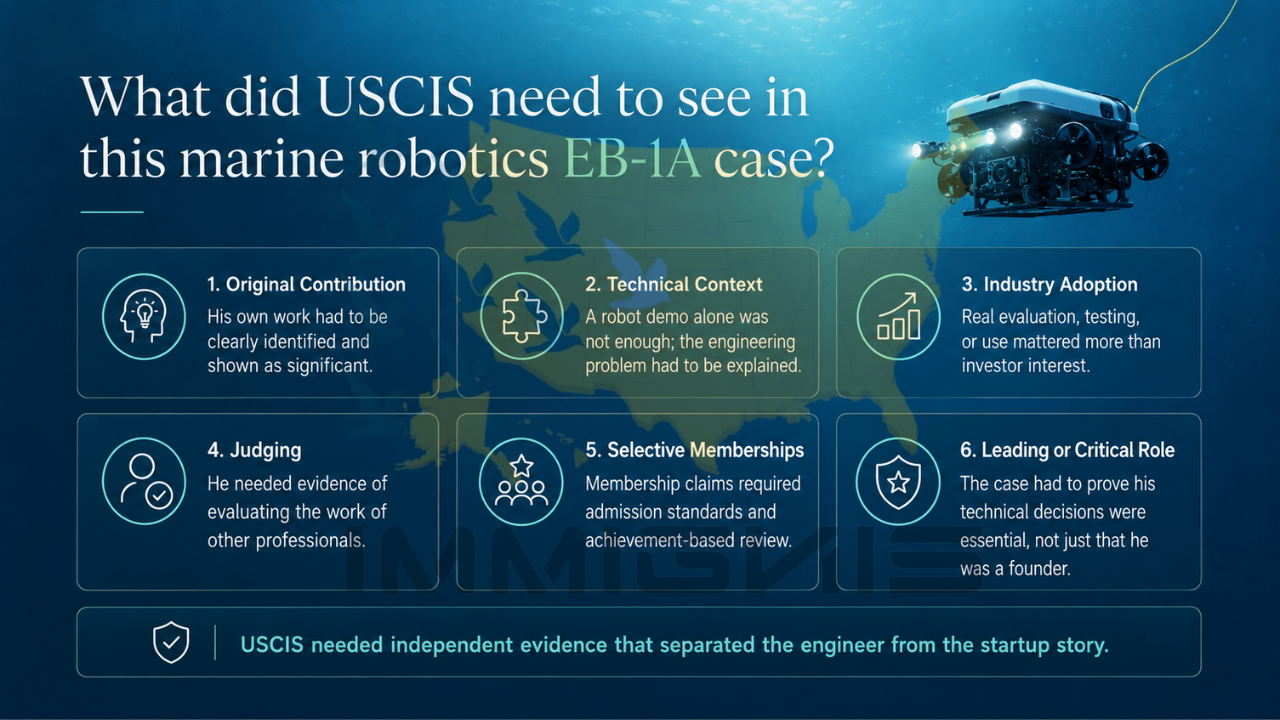
USCIS needed evidence that separated ordinary startup development from an original engineering contribution of recognized significance.
For original contributions, the petition had to identify his own work in autonomy, inspection methods, sensing, data collection, or system integration and explain why the contribution mattered to offshore inspection. A patent filing by itself would not prove major significance.
Demonstration videos also required context. A robot moving underwater can look impressive without proving field impact. The case needed technical descriptions, his personal role, the inspection problem being addressed, and evidence that industry users or experts saw practical value in the approach.
Adoption evidence had to be handled carefully. Investor interest was not the same as technical adoption. The strongest evidence showed how offshore, maritime, or infrastructure stakeholders evaluated, tested, used, or moved toward using the inspection capability.
For judging, the record had to show actual evaluation of other professionals or technologies. Merely attending a robotics conference would not satisfy the criterion.
For memberships, professional-community participation and standards activity could help the final-merits narrative, but a qualifying membership claim required evidence of the organization’s admission standards and expert evaluation of achievement.
For leading or critical role, the petition needed more than the title founder. It had to explain why his technical decisions were essential to the startup’s distinguished robotics and offshore-inspection work.
The final-merits question was case specific: had the evidence made him independently recognizable as a marine-robotics engineer whose work advanced offshore infrastructure inspection?
Technical publications made the engineering problem visible before the product pitch
The publication strategy began with the inspection problem. With robotics and engineering support, technical papers were developed around autonomous underwater inspection, subsea navigation, inspection coverage, sensing constraints, and the reliability of data collected near offshore structures.
The papers did not turn him into a general artificial-intelligence researcher or scatter the record across unrelated robotics subjects. That focus mattered because marine systems operate under constraints that are easy to underestimate from land: limited communications, visibility problems, currents, positioning challenges, sensor noise, and structures that are difficult to inspect consistently.
Patent evidence was useful only after the contribution was explained
The patent filing strengthened the original-contribution record, but it was not treated as its own EB-1A regulatory criterion. Immignis organized the inventorship evidence, technical problem statements, and non-confidential documentation showing his connection to the claimed robotics work. The petition then explained the engineering problem addressed by the invention and why that problem mattered to autonomous offshore inspection.
A patent can show that an invention was claimed. It does not, by itself, show that the underlying contribution became significant in the field. The stronger evidence connected inventorship with demonstrations, industry evaluation, technical publications, and outside expert analysis.
Why did demonstration videos matter more when they were paired with adoption evidence?
A non-confidential demonstration can show navigation near a structure, sensor positioning, inspection movement, or the way a system gathers information underwater. Advance My Profile helped organize demonstration evidence around specific capabilities rather than creating a highlight reel.
The videos were supported by technical explanations and evidence of industry interest, evaluation, pilot activity, or adoption where the record allowed it. Investor documents were used cautiously. Funding interest can show commercial attention, but the petition did not pretend that an investor decision was the same as proof of technical significance.
The maritime white paper translated robotics into infrastructure safety
The paper addressed digital and autonomous inspection for offshore infrastructure, including the challenge of observing submerged assets, documenting condition changes, and deciding when human intervention or more detailed inspection may be needed.
It did not claim that underwater robots eliminate divers, remotely operated vehicles, engineering judgment, or established inspection programs.
Its position was more credible: autonomous systems can add repeatable inspection capability and data where access is difficult, and their value should be evaluated against the real integrity problem.
Trade media and conference judging created two different types of independent recognition
Trade-media coverage made the work visible to maritime, robotics, and offshore readers. The coverage discussed his work and expertise rather than merely reproducing a startup announcement.
He evaluated robotics, maritime technology, or innovation work presented by others. The evidence documented the event, his judging responsibility, and the type of technical work he was asked to assess.
Published material showed that independent outlets considered his work worth discussing. Judging evidence showed that professional organizations trusted his technical judgment when evaluating others.
Standards participation and selective membership were documented without stretching the criteria
Standards and community participation helped show that he was engaging with the technical questions affecting underwater systems and inspection practice. The petition did not automatically call that participation a qualifying EB-1A membership.
Where the membership criterion was used, the evidence addressed the relevant professional grade, the admission requirements, and whether recognized experts evaluated achievement or standing.
Independent marine-robotics letters separated the engineer from the founder title
Immignis developed a referee strategy around marine robotics, autonomous systems, offshore engineering, and infrastructure inspection specialists.
The strongest letters explained why submerged infrastructure is difficult to inspect and why autonomous systems face real navigation, sensing, and data-quality constraints.
They addressed the robotics methods, patent-related work, demonstration evidence, and industry relevance they could independently evaluate.
Advance My Profile prepared evidence-based drafts for expert review. Referees could revise the text and sign only what they considered accurate.
Why was ethical profile building especially important for a robotics founder?
Every startup wants to sound first, fastest, safer, smarter, or disruptive. Those words become dangerous when they are copied into an immigration record without technical evidence.
The profile therefore avoided invented adoption, inflated inspection claims, fake awards, paid citations, weak journals, and exaggerated statements about replacing established offshore safety systems.
The papers had to match his real engineering work. The patent evidence had to show his actual inventorship. Demo material had to remain non-confidential and accurate. Judging had to be genuine. Independent experts had to understand the contribution they described.
Which USCIS EB-1A criteria did the final Form I-140 petition activate?
Original contributions: Technical publications, patent documentation, non-confidential demonstration evidence, industry adoption context, and independent expert letters explained his individual contribution to autonomous underwater inspection and its significance to marine infrastructure work.
Published material: Independent trade-media coverage discussed his work and expertise in marine robotics and offshore inspection, creating public recognition around the defined niche.
Judging the work of others: Conference and innovation judging evidence documented genuine evaluation of robotics, maritime technology, or technical work presented by other professionals and teams.
Memberships: Selective professional membership evidence was supported with the relevant admission requirements and documentation showing how his qualifications or achievements were evaluated.
Leading or critical role: Startup and project evidence showed why his technical judgment was central to distinguished marine-robotics development, demonstration, and offshore-inspection activities.
Patent evidence strengthened the original-contribution argument, but the petition did not mislabel patents as a separate regulatory criterion.
Publications showed engineering depth. Demonstrations made the system inspectable. Adoption evidence connected the technology to industry needs. The white paper explained the infrastructure problem. Trade coverage created public recognition. Judging showed evaluative trust. Membership evidence and independent letters added recognition outside the startup.
What did the August 2024 EB-1A approval mean?
USCIS approved the Form I-140 on August 6, 2024. The displayed case history shows receipt of the petition on July 31, active review on August 5, and approval on August 6. It does not show a request for additional evidence.
He had focused technical publications, patent documentation, a maritime inspection white paper, organized demonstration evidence, trade-media recognition, conference judging, professional-community and membership evidence, industry adoption proof, and independent letters from marine and offshore specialists.
The approval gave him an EB-1A self-petition path without employer sponsorship or labor certification. An offshore engineer could identify the inspection problem he worked on. A journalist could understand the niche. A conference could ask him to evaluate related technology. An independent expert could discuss his contribution without relying on startup marketing. The career result was an engineering identity that could outlast one company.
If you are a founder whose company is more visible than your own expertise
USCIS may still need to understand what you personally invented, designed, led, evaluated, or contributed to the field. Separate your technical work from the company brand. Protect confidential information. Publish around the engineering problem you actually solve. Document real adoption. Accept genuine judging roles. Develop field-facing analysis. Ask independent experts to explain contributions they can evaluate.
FAQ
Can a robotics startup founder qualify for EB-1A based on technical work?
Yes. Founder status does not prevent an EB-1A case, but the petition should identify the applicant’s individual contributions and show recognized significance in the defined field. Patent evidence, technical publications, adoption context, judging, published material, critical-role evidence, and independent experts may help separate the founder’s work from the company story.
Does an underwater robot demonstration prove an original contribution of major significance?
No. A demonstration can help show what a system does, but USCIS still needs evidence explaining the applicant’s individual contribution and why the work is significant. Technical context, adoption or evaluation evidence, patent documentation, publications, and independent expert analysis can help establish the meaning of the demonstration.
How can a marine robotics founder prove industry adoption without revealing confidential client data?
The record can use non-confidential pilot summaries, letters confirming evaluation or use, public procurement or partnership information where available, redacted technical records, adoption descriptions, and independent expert evidence. The goal is to show real industry engagement without disclosing protected offshore or client information.
Do patents count as a separate EB-1A criterion?
Patents are not one of the ten listed EB-1A regulatory criteria. Patent evidence may strengthen an original-contribution claim by documenting inventorship and technical work, but the petition still needs evidence explaining the significance of the underlying contribution.
Can conference judging count as judging the work of others for a marine robotics engineer?
It can when the applicant actually evaluates technical submissions, technologies, research, or other professionals’ work. A conference title or attendance record alone is not enough. The evidence should document the judging responsibility and the type of work evaluated.
Do I need to move my startup to the United States before filing EB-1A?
EB-1A does not require an employer sponsor or labor certification, and a person of extraordinary ability may self-petition through Form I-140. The applicant must still show an intention to continue working in the area of extraordinary ability in the United States. The immigration and business strategy should be evaluated based on the person’s actual circumstances.
Build an EB-1A success story around the engineering work behind the startup
If you work in marine robotics, autonomous underwater vehicles, offshore inspection, subsea sensing, robotics startups, or another deep-technology field, your company may be easier to find than your individual contribution.
Immignis and Advance My Profile help professionals identify a defensible niche, build credible independent recognition around real engineering work, document personal impact, and prepare an EB-1A record that remains meaningful beyond the company brand.