Key facts at a glance
| Outcome | EB-1A approval for a Czech nanomedicine researcher working with a Switzerland-based pharmaceutical research team. |
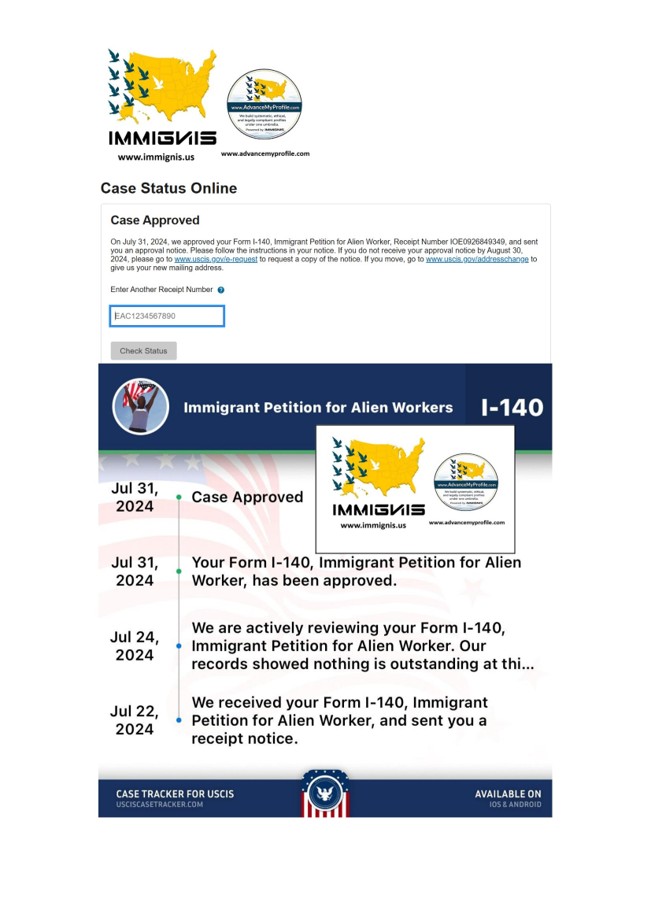
| Approval date | Approved on July 31, 2024. |
| Field niche | Targeted nanoparticle delivery for hard-to-treat tumors, including the biological and formulation barriers that affect delivery to tumor tissue. |
| Starting problem | Her scientific record was strong, but confidentiality rules limited what could be published or described about internal pharmaceutical projects. |
| Path used | Ethical EB-1A profile building through safe publication topics, patent documentation, an oncology white paper, peer review, a focused conference presentation, technical media explanation, selective professional membership, and independent letters from nanomedicine leaders. |
| USCIS EB-1A criteria activated | Scholarly articles, original contributions, published material, judging, and memberships. Patent evidence strengthened the original-contribution record. |
On July 31, 2024, USCIS approved this EB-1A nanomedicine case.
She was a Czech nanomedicine researcher working with a pharmaceutical research team in Switzerland. Her work concerned targeted nanoparticle delivery for tumors that are difficult to treat. Internal projects involved formulations, screening results, development decisions, and technical details that could not simply be copied into a U.S. immigration petition.
That left a practical problem. How do you show an individual scientist’s influence when much of the best work belongs inside a protected research environment?
Confidentiality had protected the research and hidden the researcher
Pharmaceutical research is built around controlled information. A project may be covered by confidentiality agreements, patent strategy, internal review, or commercial development plans. Scientists can spend years on difficult technical problems while the public sees only a company description or a later patent filing.
Her CV showed nanomedicine research and scientific authorship. It did not show the full chain of decisions behind her nanoparticle-delivery work. Some internal project names could not be used. Unpublished formulation details were off limits. The petition also had to avoid statements that could sound like clinical efficacy claims when the evidence concerned preclinical or research-stage delivery work.
The EB-1A extraordinary ability category allows a qualifying person to self-petition for an immigrant classification by showing sustained national or international acclaim and the required evidence of extraordinary ability in the field.
The niche became targeted nanoparticle delivery for hard-to-treat tumors
Advance My Profile, powered by Immignis, reviewed the public research, patent-related material, project history, and non-confidential technical record with legal strategists and nanomedicine domain specialists.
That is a narrower subject than cancer nanotechnology. It deals with the problems that arise when a therapeutic payload has to survive formulation and circulation, reach tumor tissue, move through biological barriers, enter relevant cells, and release its cargo in a useful way.
Different tumors create different delivery problems. Dense tissue, abnormal vasculature, tumor microenvironment, uptake behavior, particle characteristics, and off-target distribution can all affect what a delivery system does in practice.
What could USCIS actually evaluate without seeing the confidential project files?
In pharma research, a project can involve formulation scientists, biologists, analytical teams, pharmacology groups, and company leadership. USCIS still has to evaluate the petitioner’s own work.
For this 2024 case, the file was prepared around the regulatory criteria and the whole-record review USCIS applied to EB-1A petitions at the time. The evidence needed to show which scientific questions she handled, what technical work could be linked to her, and why independent experts considered those contributions important in nanomedicine.
Patent documents helped with inventorship and the description of an original technical concept. They did not automatically prove a contribution of major significance. The record still needed context about the delivery problem, her role, and the scientific value of the work.
The same care applied to publications. Papers could establish authorship, but the case needed a coherent body of work around delivery science. Media evidence had to be about her or her expertise. Peer review had to involve real evaluation of other scientists’ work. Membership evidence depended on the association’s actual admission standards.
Safe publication topics gave her a public scientific record without disclosing the pipeline
With support from domain PhDs and scientific writers, she developed papers and technical topics on nanoparticle delivery barriers, formulation variables, tumor penetration, cellular uptake, and the interpretation of delivery performance. The work stayed within publishable scientific territory and did not reveal protected compound identities or internal development data.
The publications also helped clean up a common problem in industry-based research profiles. A scientist may have excellent internal expertise and a public publication list that looks scattered because each publishable project comes from a different collaboration. Here, the newer authorship was kept close to targeted delivery.
Patent evidence was handled as technical evidence, not a magic EB-1A box
The team reviewed inventorship records, the filing history, the technical problem described in the patent materials, and the parts of the claimed work linked to her. Where the employer or patent counsel had already made information public through a filing, the petition could use that public material within its proper context.
A patent filing is not a separate EB-1A regulatory criterion.
In this case, patent evidence supported the original-contribution analysis. It helped show inventorship and a documented technical concept, while independent letters and the broader scientific record explained why the delivery work mattered.
Scientists in pharma, biotech, and medical-device research often have strong work hidden behind confidentiality rules. Our free EB-1A profile assessment looks at what can be documented safely, which criteria are realistic, and where public recognition can be built without exposing proprietary work.
The oncology white paper explained the delivery problem to a wider audience
The paper focused on targeted nanoparticle delivery in difficult tumor settings and the evidence researchers should examine when discussing delivery performance. It covered biological barriers, formulation considerations, distribution, uptake, and the gap between a promising delivery concept and a result that can be interpreted responsibly.
The paper did not describe an internal drug candidate. It did not claim clinical success. Its value came from explaining a real oncology-delivery problem using knowledge she could share.
Conference presentation, peer review, and media each showed a different kind of recognition
Her conference presentation stayed focused on nanoparticle delivery and research-stage interpretation. The presentation materials used safe technical content and gave a specialist audience an opportunity to engage with her work.
Peer-review activity showed that journals trusted her to assess research by other scientists in nanomedicine, drug delivery, pharmaceutical science, or closely related areas. The file documented genuine invitations and completed reviews where available.
Technical media served another purpose. She explained why ‘targeted’ does not mean a nanoparticle reaches only tumor cells and why delivery claims need careful language. That kind of explanation was useful to health-tech and science audiences because it separated laboratory terminology from public assumptions.
Professional memberships were reviewed separately. Where the EB-1A membership criterion was used, the evidence addressed the association’s admission or advancement standards and the role of expert judgment in assessing applicants.
Independent nanomedicine letters filled the gap an employer letter could not
Immignis developed a referee plan around nanomedicine and drug-delivery researchers who could evaluate her public work, patent-related record, publications, and the scientific issues she studied.
The strongest letters explained why targeted delivery is difficult. A nanoparticle has to be designed around biological conditions that can alter circulation, tissue access, cellular uptake, and payload release. Results can vary with tumor biology and formulation choices.
The referees then described her contribution using evidence they could review. They did not claim knowledge of confidential projects they had never seen.
Advance My Profile prepared evidence-based drafts for expert review. Each referee could revise the language and sign only what the expert considered accurate.
How the USCIS EB-1A criteria came together in this nanomedicine case
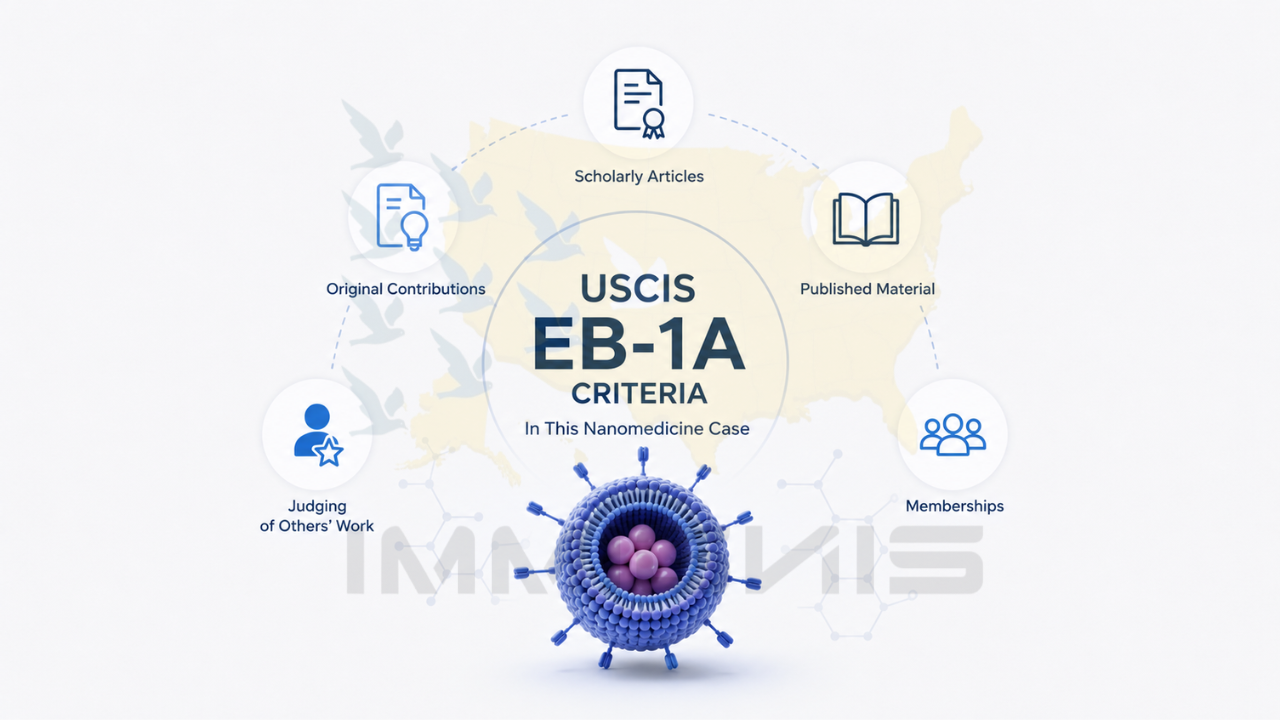
Scholarly articles: Focused publications connected her authorship to nanoparticle delivery barriers, formulation questions, tumor penetration, uptake, and the interpretation of delivery performance.
Original contributions: Patent documentation, non-confidential technical evidence, her research record, and independent nanomedicine letters explained her individual contribution to targeted delivery work and its significance in the field.
Published material: Technical media discussed her work or expertise in targeted nanoparticle delivery and the careful interpretation of cancer nanomedicine claims.
Judging the work of others: Peer-review assignments documented genuine evaluation of scientific work by other researchers in nanomedicine, drug delivery, and related disciplines.
Memberships: Selective professional membership evidence was supported with the relevant admission or advancement standards and the basis on which her qualifications were assessed.
The whole record followed one scientific subject. Public papers showed the research focus. Patent documents helped trace inventorship. The white paper explained the delivery problem for field audiences. Peer review showed evaluative trust. Conference and media activity made her expertise easier to identify. Independent experts explained where her contribution sat in nanomedicine.
Approval arrived nine days after USCIS received the petition
The displayed case history shows that USCIS received the Form I-140 on July 22, 2024, began active review on July 24, and approved the petition on July 31. No Request for Evidence appears in the case history shown above.
The approved EB-1A petition gave her a self-petition immigration path without employer sponsorship or labor certification. Form I-140 approval is one stage of the employment-based immigrant process, and later permanent-residence timing can depend on visa availability and the applicant’s next immigration step.
Her public profile also made more sense after the case. A conference organizer could identify the delivery subject she worked on. Journals had a clear peer-review area for her. Technical media could ask her about nanoparticle delivery without expecting commentary on confidential drug candidates.
If your best biotech work cannot be copied into a petition
Do not disclose protected compound names, unpublished data, internal protocols, or employer material you are not authorized to use. A serious EB-1A profile can be built from public patent records, safe publications, non-confidential role evidence, field-facing analysis, genuine peer review, qualifying memberships, media, and independent expert evaluation where the facts support them.
For a nanomedicine researcher, the public record may be built around delivery barriers, formulation science, tumor microenvironment, uptake, or another problem the scientist has genuinely worked on.
FAQ
Can confidential pharmaceutical research support an EB-1A case?
Yes. The petition still needs verifiable evidence of the applicant’s own work and recognition, but proprietary details do not have to be disclosed carelessly. Public patents, safe publications, non-confidential role documentation, peer review, media, conference activity, and independent expert evidence may help show the applicant’s contribution when each item is supported by the record.
How do you prove an original contribution without revealing a proprietary formulation?
The evidence can identify the technical problem, the applicant’s role, public patent material, non-confidential methods or research topics, and independent context about why the contribution matters. The petition should avoid inventing detail to fill a confidentiality gap and should not include employer-protected information without authorization.
Does a patent filing count as a separate EB-1A criterion?
No. Patents are not listed as a separate criterion in the EB-1A extraordinary ability regulations. Patent evidence may support an original-contribution argument by documenting inventorship and a technical concept, but the record still needs evidence explaining the significance of the contribution.
Can a pharma scientist publish on adjacent safe topics if the core project is confidential?
Yes, when the topics genuinely arise from the scientist’s expertise and do not disclose protected information. Focused publications on delivery barriers, formulation science, tumor biology, analytical methods, or another real part of the person’s work can help create a public research identity. The topics should remain scientifically connected to the applicant’s actual field.
What does targeted nanoparticle delivery mean in cancer research?
Targeted nanoparticle delivery uses engineered particles or delivery systems to improve where and how a therapeutic payload is carried, distributed, taken up, or released. ‘Targeted’ does not mean perfect delivery to tumor cells only. Researchers still study circulation, biological barriers, tumor access, off-target distribution, uptake, and release behavior.
Do I need an approved cancer drug or a clinical trial to pursue EB-1A in nanomedicine?
No specific approved product or clinical trial is required by the EB-1A category. A researcher must meet the applicable extraordinary-ability standard through the evidence in the record. In a research-stage nanomedicine case, original contributions, scholarly authorship, judging, qualifying memberships, published material, and independent recognition may be relevant.
Build an EB-1A success story around the science you can safely prove
Scientists in nanomedicine, oncology research, drug delivery, pharmaceutical development, and biotechnology often have careers that are much stronger than their public CVs suggest.
Immignis and Advance My Profile help identify a defensible field niche, separate public evidence from protected work, build credible recognition around real expertise, and prepare an EB-1A record that respects professional confidentiality.
Start with a free EB-1A profile assessment and find out which parts of your scientific record can support a clearer, verifiable authority profile.