Key facts at a glance
| Outcome | EB-1A approval for a Singaporean AI privacy architect working at a U.S.-based cloud company. |
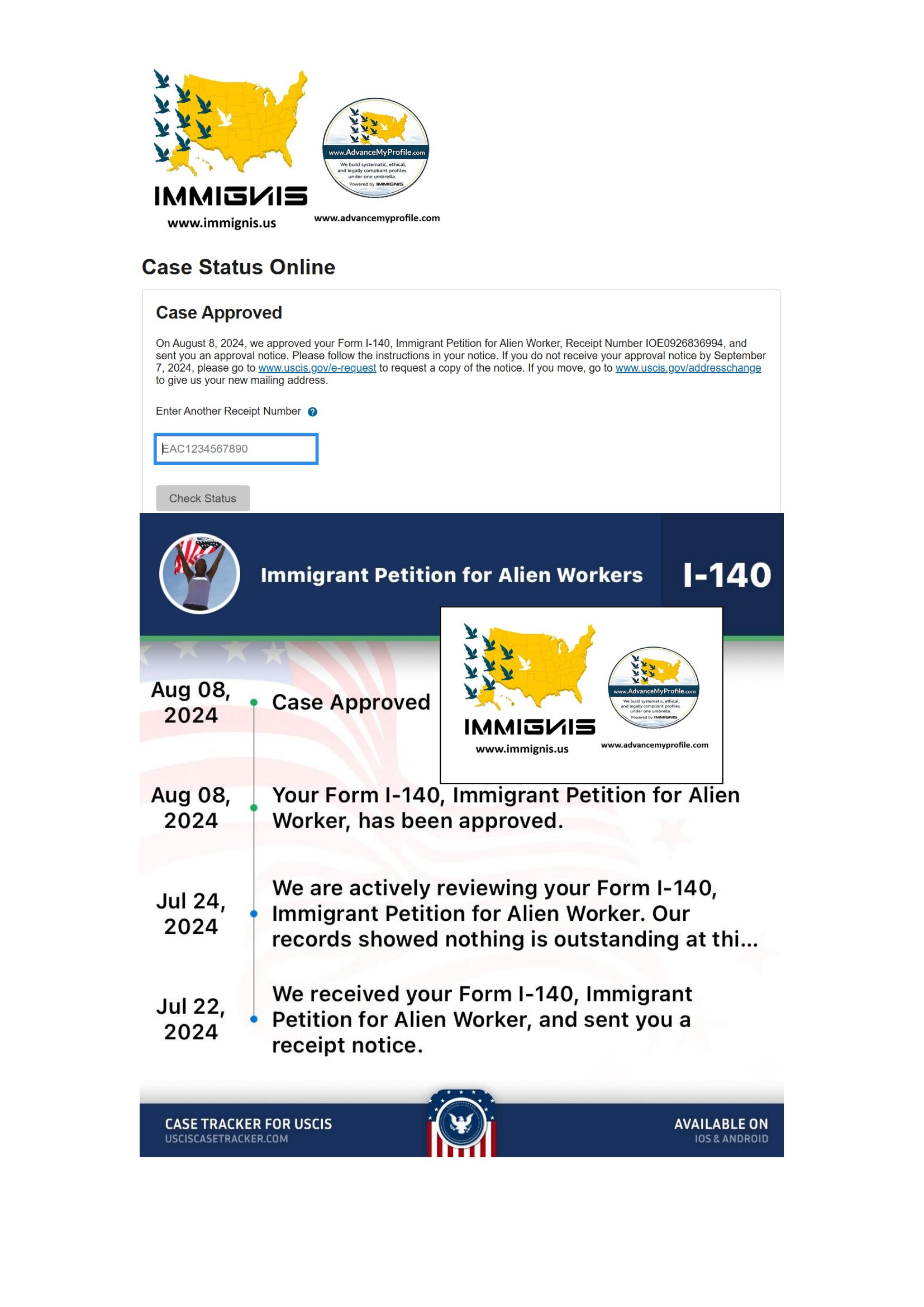
| Approval date | Approved on August 8, 2024. |
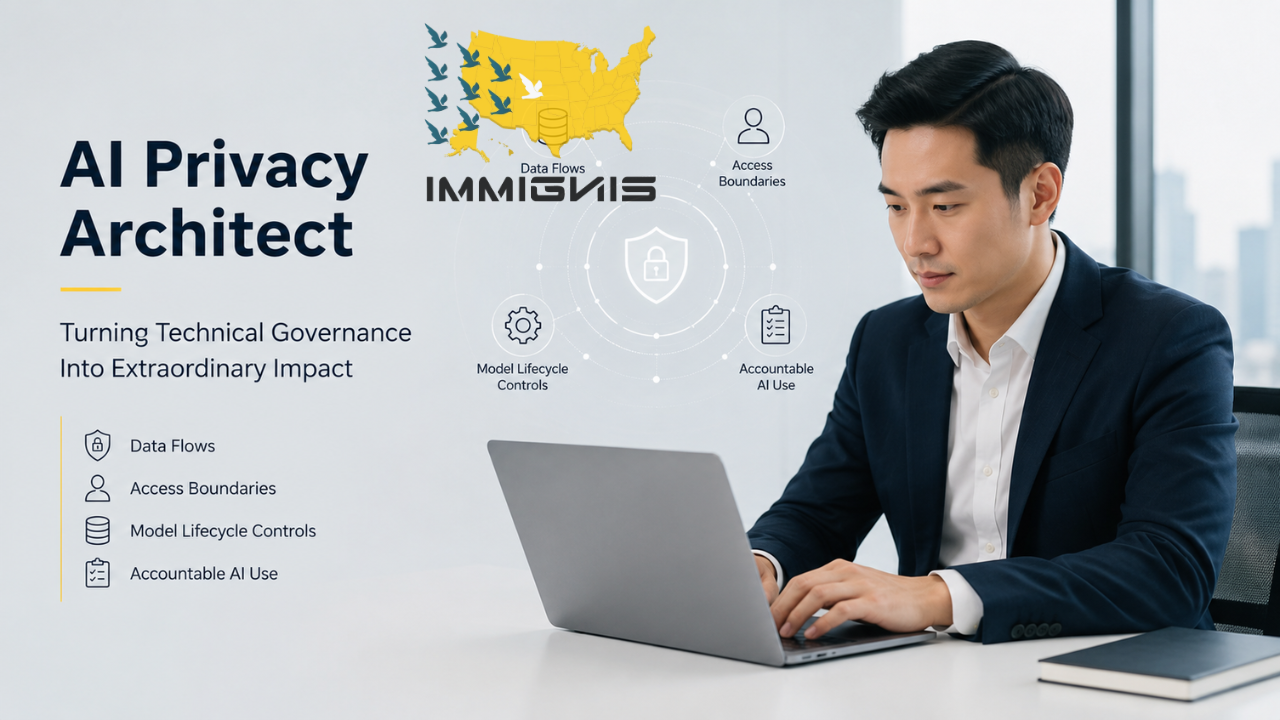
| Field niche | Privacy-preserving AI governance for financial and health data, with a focus on data flows, access boundaries, model lifecycle controls, and accountable AI use. |
| Starting problem | His record sounded corporate and compliance heavy. Internal governance work was visible to company teams, but his individual technical contribution to AI privacy architecture was difficult to identify outside the employer. |
| Path used | Ethical EB-1A profile building through focused papers, a privacy-association white paper, expert commentary, standards participation, peer review, invited talks, selective professional membership, critical-role documentation, and independent letters from AI governance scholars. |
| USCIS EB-1A criteria activated | Original contributions, scholarly articles, published material, judging, memberships, and leading or critical role. |
USCIS approved his Form I-140 on August 8, 2024. It was about a field in a data pipeline. A team wanted to use sensitive information in an AI workflow. The immediate question was technical: which systems needed the field, which people could see it, what would be retained after processing, and what new data might be created as the model was trained, evaluated, logged, and monitored?
He was a Singaporean AI privacy architect working at a U.S. based cloud company. His career had been built around questions like these for financial and health data. Yet his resume made him sound like a compliance professional who attended review meetings.
The word “governance” was hiding the engineering
Policies and review gates were visible. The harder technical questions involved data lineage, purpose boundaries, derived data, model telemetry, access architecture, retention, auditability, and what changed after deployment.
The EB-1A green card is a self-petition immigrant classification for individuals who can demonstrate extraordinary ability through sustained national or international acclaim and recognized achievements in their field.
Advance My Profile, powered by Immignis, reviewed his work with legal strategists and AI governance specialists and defined the field as privacy preserving AI governance for financial and health data.
His field lived across the AI data lifecycle
His work examined how sensitive data moved through collection, feature preparation, model use, evaluation, logging, monitoring, and later review. Financial and health data made access and reuse especially important.
The evidence traced who could access data, how purposes were documented, when information could be minimized or transformed, what was retained, and how controls followed a model into production.
He also worked on accountability around change. A model update, new feature, expanded user group, or new monitoring stream can alter the privacy picture even when the product name stays the same.
What did USCIS need to see in an AI privacy architecture case?
For original contributions, the petition identified his governance architecture, lifecycle controls, and technical decision methods and explained their significance in AI trust and safety. A company privacy policy could not establish his individual contribution.
Scholarly articles addressed privacy preserving AI and model lifecycle controls. Published material required independent coverage about him or his expertise, while peer review supported judging when he evaluated other specialists’ work.
Standards participation was documented according to his real role. Working-group activity and technical comments strengthened the wider record, but participation was not presented as a separate EB-1A criterion.
The memberships criterion required evidence of selective admission or elevation based on achievement and expert assessment. For leading or critical role, the file had to show why significant AI governance work inside the cloud company depended on his technical judgment.
The internal record was reorganized around privacy decisions, not policy titles
Role records, data flow materials, method descriptions, and safe governance examples were grouped around technical decisions.
What data entered the system? Which stage needed it? What new information could be produced? Who required access? What should be logged? How long should information remain available? Which change would trigger another privacy review?
The evidence covered data minimization, access boundaries, model monitoring, logs or derived information, and the point where governance reviews entered design or deployment decisions. Protected financial records, health information, customer names, and internal cloud architecture stayed outside the public story.
The papers moved AI privacy beyond a checklist
With domain support, he developed papers on privacy-preserving AI governance, lifecycle controls, access boundaries, model monitoring, and sensitive financial and health data.
One paper examined new privacy questions created by monitoring logs or derived information after deployment. Another considered data minimization across the model lifecycle.
AI privacy and governance professionals often have their strongest work buried inside internal reviews, control frameworks, and confidential cloud programs. A free EB-1A profile assessment can identify which methods belong to you and where authorship, judging, standards work, speaking, membership, or independent recognition still needs development.
The white paper asked privacy teams to follow the model after launch
The paper organized the issue around inputs, access, transformations, model use, logs, monitoring, retention, and change management, asking teams to document how the data picture evolves after launch. The document stayed with architecture, governance, and the evidence teams need when deciding whether a model change alters privacy risk.
Standards participation put his technical comments into a wider professional process
The record identified the standards-related group, subject, his participation, and verifiable technical comments or working activity. Standards participation showed his technical judgment in discussions beyond one employer. The petition linked relevant comments or work to methods in the original contribution record.
Invited talks made the difficult questions public
His talks asked what happens when a model adds a sensitive feature, how access should change between development and production, and what monitoring should collect when monitoring data may itself be sensitive.
Using non-confidential scenarios, he explained a decision method: trace the data, identify purpose, map access, examine what the model or monitoring process creates, and document controls through change.
Expert commentary focused on privacy risk after the model is deployed
His commentary explained that evaluation records, prompts, logs, monitoring streams, and derived information can create new privacy questions after deployment. He also discussed access boundaries and documentation for financial and health data used across teams and systems.
Peer review showed that other specialists trusted his judgment
Journals and technical venues invited him to review work in AI governance, privacy engineering, responsible AI, data protection, and related fields. The reviewed work required him to assess methods, governance claims, privacy assumptions, and whether conclusions followed from the evidence.
Selective membership evidence was built from the admission standard
Advance My Profile reviewed admission or elevation rules for associations connected to privacy, information governance, and AI. The petition relied on membership evidence only where the relevant grade required recognized achievement and expert assessment.
The leading-role evidence showed where the cloud company relied on his judgment
The petition documented the governance work assigned to him, technical reviews he led or influenced, sensitive-data questions escalated to his level, and how his analysis entered architecture or deployment decisions. The evidence explained why the company’s AI trust work was significant and why his role was critical to it.
Independent AI governance scholars explained why his methods mattered
Independent experts began with the technical problem: AI systems can create new data flows and derived information across evaluation, deployment, logging, and monitoring, making lifecycle decisions important for sensitive financial and health data. They discussed his papers, white paper, standards participation, invited talks, governance methods, and non-confidential professional evidence.
How the USCIS EB-1A criteria came together in this AI privacy case
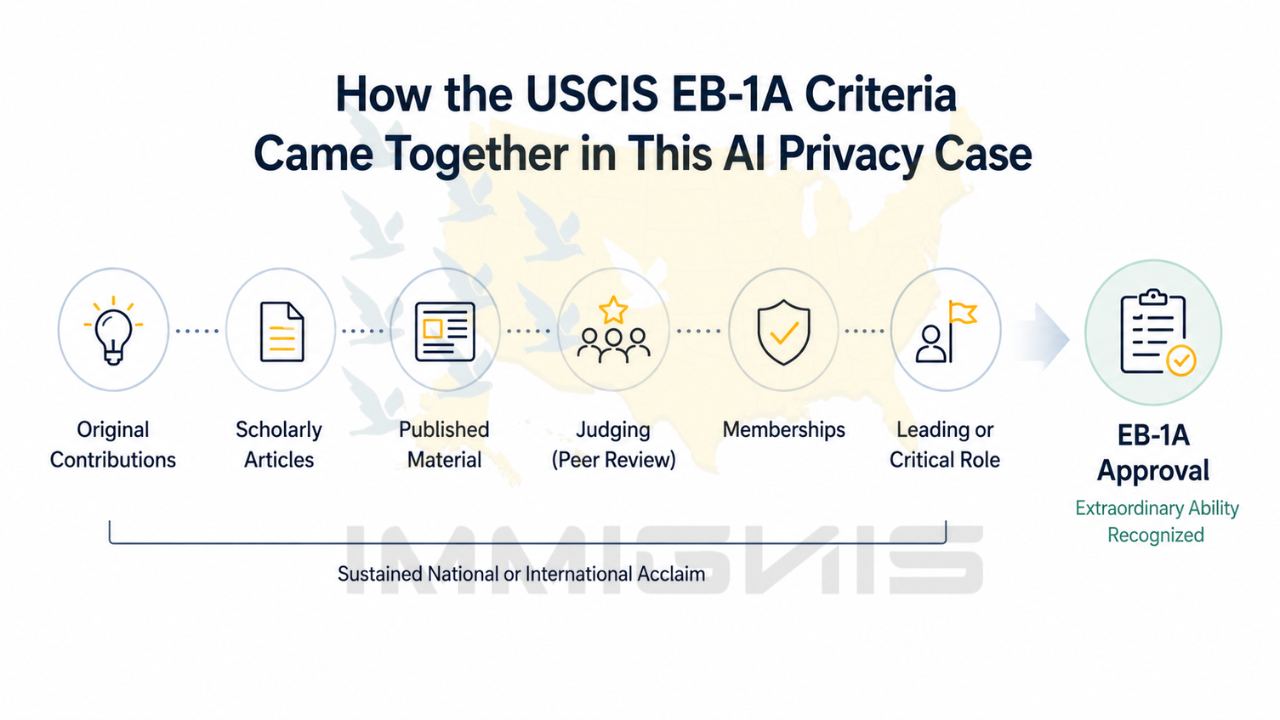
Original contributions: Non-confidential AI governance methods, lifecycle privacy architecture, documented program use, standards-related technical work, and independent expert letters explained his individual contribution and its significance.
Scholarly articles: Focused papers connected his authorship to privacy preserving AI governance, data minimization, access boundaries, model monitoring, and sensitive financial and health data.
Published material: Independent technology and privacy coverage discussed him or his expertise in AI privacy, governance, and trust-and-safety architecture.
Judging the work of others: Peer-review records documented genuine evaluation of research by other specialists in AI governance, privacy engineering, responsible AI, and allied fields.
Memberships: Selective professional membership evidence included the applicable admission or elevation standards and documentation of expert assessment based on achievement.
Leading or critical role: Company and role evidence showed why significant AI privacy and governance work relied on his technical analysis, architecture judgment, and review responsibility.
The papers explained lifecycle privacy problems. The white paper organized the governance method. Standards work, peer review, selective membership, invited talks, media, critical role evidence, and independent letters carried the same specialty beyond the cloud company.
Approval came on August 8, 2024
The approved EB-1A petition gave him a self-petition immigration path without employer sponsorship or labor certification. The filing established a priority date for the immigrant petition, while later permanent-residence timing can depend on visa availability and the applicant’s next immigration step.
If your AI governance career sounds too corporate for EB-1A
Maybe you design data-flow controls, define access boundaries, evaluate model-monitoring privacy, or decide when an AI system needs another review. Those methods matter when they can be traced to your work and supported by evidence.
Build papers around problems you can discuss publicly. Document standards work according to your role. Use peer review for genuine judging evidence, selective membership only when its standard supports the criterion, and independent experts who can evaluate the work.
Do not manufacture authority with fake awards, paid citations, junk journals, or privacy claims you would be uncomfortable defending to another AI governance professional. In a trust-and-safety field, credibility is part of the work.
FAQs
Can internal AI governance work support an EB-1A original-contribution claim?
Yes, when the applicant’s individual method or technical contribution can be identified and the evidence shows major significance in the field. Non-confidential architecture records, governance methods, documented program use, scholarly work, standards activity, and independent expert analysis can help explain the contribution without exposing customer data or protected cloud systems.
What does privacy preserving AI governance mean for financial and health data?
It concerns the technical and organizational controls used to manage sensitive data across an AI system’s lifecycle. That can include data minimization, access boundaries, documented purpose, transformations, model evaluation, logging, monitoring, retention, and review when the system changes. The exact controls depend on the system and data environment.
Does standards participation count as a separate EB-1A criterion?
No. Standards participation is not a separate EB-1A regulatory criterion. It may strengthen the wider record by showing professional engagement, technical contribution, or recognition, and specific work may support another claimed criterion when the evidence fits that criterion.
Can peer review count as judging for an AI privacy professional?
Genuine peer review can support the judging criterion when the applicant actually evaluates research or technical work produced by other specialists in the same or an allied field. The petition should document the invitation and review activity, and the subject should fit the applicant’s expertise.
What is the difference between my own AI privacy white paper and published material for EB-1A?
Your own white paper is authored work and can support the professional record, but it is not independent published material about you. The published material criterion generally concerns qualifying coverage about the applicant and the applicant’s work in professional, major trade, or major media sources, subject to the regulatory requirements.
Do I need a law degree, privacy degree, or PhD to pursue EB-1A as an AI privacy architect?
No specific law degree, privacy degree, or PhD is required for EB-1A extraordinary ability. An AI privacy architect may rely on applicable evidence such as original contributions, scholarly authorship, judging, published material, qualifying memberships, leading or critical roles, and sustained independent recognition. USCIS evaluates the full extraordinary-ability record.
Build an EB-1A success story around the AI privacy method behind your governance work
If you work in AI governance, privacy engineering, responsible AI, cloud trust, financial data controls, or health data architecture, your strongest contribution may still be hidden inside internal review processes. Immignis and Advance My Profile help identify a defensible technical niche, document individual methods, build credible field recognition, and prepare an EB-1A record around evidence you can verify and defend professionally.