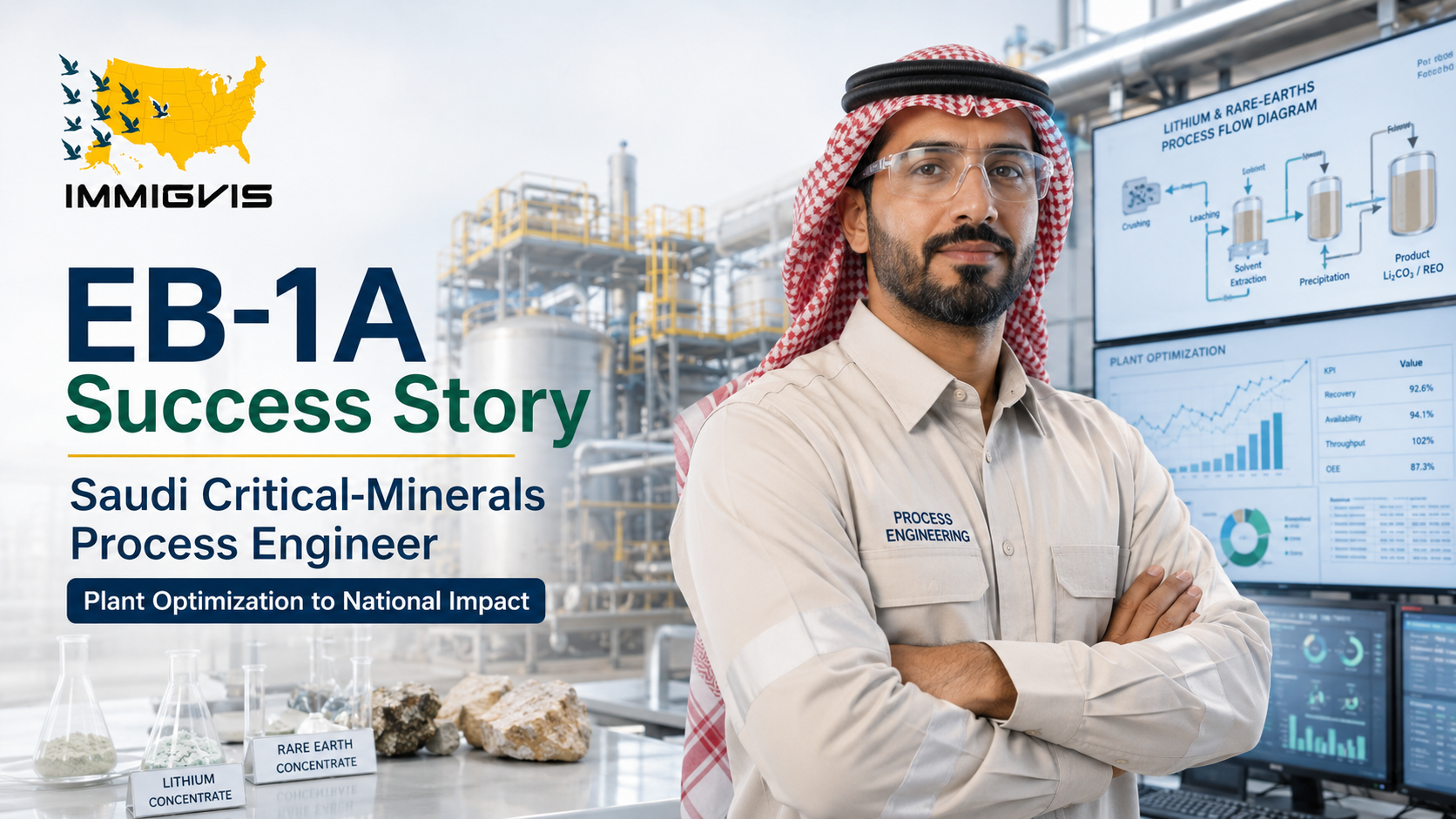
How a lithium and rare-earth process specialist secured EB-1A approval after his technical work was documented as a contribution to critical minerals processing and North American supply-chain security.
Key facts at a glance
| Outcome | EB-1A approval for a Saudi critical-minerals process engineer working at a Canada-based mining technology firm. |
| Approval date | Approved on September 15, 2025. |
| Field niche | Lithium and rare-earth process optimization, with a focus on improving recovery, impurity control, reagent use, energy efficiency, and scale-up reliability in critical minerals processing. |
| Starting problem | The engineer had strong process-development work, but much of the record looked like ordinary plant improvement. Independent recognition and public evidence needed to catch up with the technical value of the work. |
| Evidence-building path | Focused technical publications, a patent application, a critical minerals white paper, conference presentations, trade-media coverage, judging in mining innovation challenges, membership elevation, and independent expert letters. |
| Evidence presented under EB-1A criteria | Original contributions, scholarly articles, published material, judging, and memberships. Patent materials were used to support attribution and original contribution evidence, not as a separate regulatory criterion. |
| Approval focus | The petition connected process optimization to critical-minerals security, showing why his work mattered beyond one employer or one production line. |
Approval came after the record stopped looking like a plant file
On September 15, 2025, USCIS approved the Form I-140 petition of a Saudi critical minerals engineer working with a Canada based mining technology firm.
His approval did not rest on a broad claim that mining is important. It rested on a narrower and more difficult argument: that his work in lithium and rare-earth process optimization represented recognized expertise in a field tied to battery supply chains, clean-energy manufacturing, defense materials, electronics, and industrial resilience.
At the start, that argument was not obvious. His work appeared in process notes, pilot scale reports, plant development records, troubleshooting files, and internal engineering discussions. The results were useful, but the public record did not yet explain why other experts should recognize him as more than a strong process engineer doing assigned work.
The case risk: strong engineering that looked ordinary on paper
Critical minerals processing is full of practical decisions. A lithium brine, hard rock concentrate, or rare earth feed does not become a reliable industrial input by theory alone. Engineers must manage separation behavior, impurities, reagent consumption, energy use, recovery losses, scaling, equipment conditions, and the difference between a promising laboratory result and a repeatable industrial process.
Those details matter. They also create an immigration challenge. USCIS does not approve a case simply because a person worked in a useful industry or participated in a valuable project. EB-1A requires evidence that the individual has extraordinary ability, sustained acclaim, and achievements recognized in the field.
The early record showed technical responsibility. It did not yet present a clear authority profile. The evidence needed to answer a more specific question: what process methods, decisions, or technical concepts could be traced to him, and why did those contributions matter beyond routine production improvement?
His niche was not mining in general
The profile was narrowed to lithium and rare earth process optimization. That choice mattered because it turned a broad mining career into a defined technical subject.
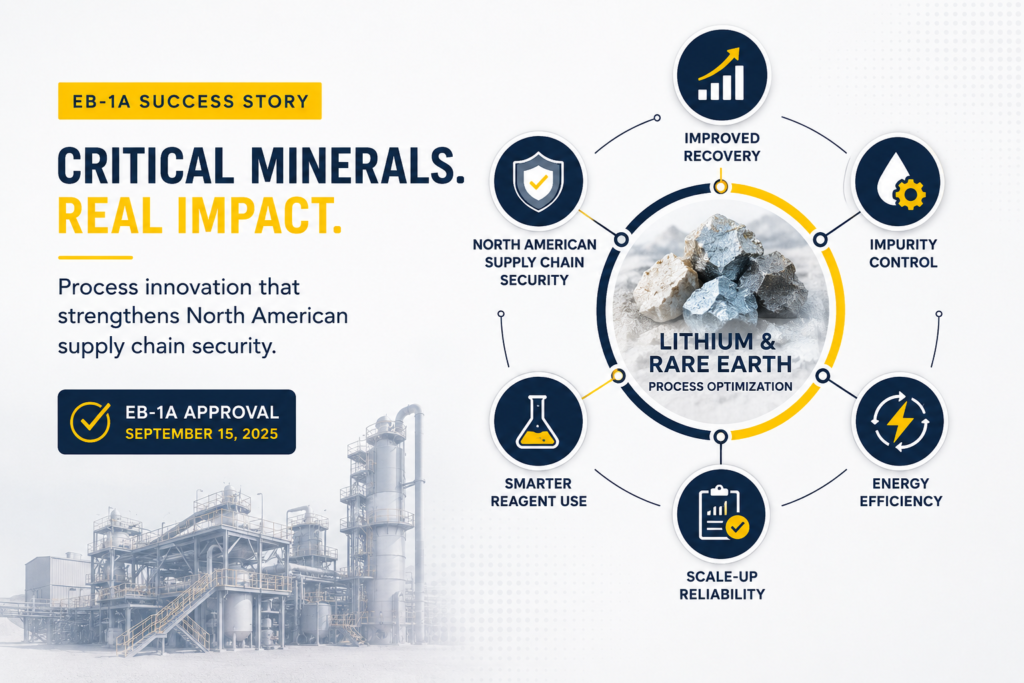
The petition focused on how his work addressed recovery efficiency, impurity removal, reagent strategy, process stability, scale-up constraints, and the economic and operational consequences of small process changes. In critical minerals work, a method that improves recovery or reduces processing uncertainty can affect whether a resource can be developed, qualified, and supplied at useful scale.
The case did not claim that one engineer solved the global critical minerals supply challenge. It made a more defensible point: his methods and documented judgment contributed to the kind of process reliability that lithium and rare-earth projects need before they can support downstream manufacturing.
What USCIS needed to see in a critical-minerals EB-1A case
For original contributions, the petition had to identify his own process engineering work and explain its significance. A statement that a project was commercially important was not enough. The record needed to show what he did, how the method worked, where it was used or evaluated, and why independent experts considered it important in critical-minerals processing.
For scholarly articles, the record needed focused technical authorship connected to lithium, rare earths, mineral processing, separation methods, recovery improvement, scale-up, or allied engineering questions.
For published material, general coverage of mining markets would not be enough. The evidence needed independent coverage discussing him, his expertise, or the technical subject in a way that could support recognition.
For judging, the file had to document actual evaluation of other professionals’ work, such as mining innovation submissions, technical competitions, peer-review assignments, or similar activities. Attending a conference or being listed on a program would not meet the standard by itself.
For memberships, the petition needed evidence that the relevant professional grade required achievement, expert assessment, or a selective advancement process. Open enrollment was treated differently from membership elevation based on professional standing.
Patent evidence helped link him to a technical concept. It supported the original-contribution record, but the petition did not present a patent application as a separate EB-1A criterion.
The internal engineering record was rebuilt around process decisions
The strongest records were not the most polished documents. Some were the practical files engineers rely on when a process refuses to behave as expected.
The evidence was organized around process questions: Which impurity was limiting product quality? Which separation step was losing valuable material? Which reagent strategy created downstream complications? What changed between a bench result and a pilot or plant condition? Which parameter affected recovery without creating another bottleneck?
That structure made the record easier to evaluate. Instead of presenting a stack of projects, the petition showed a sequence of technical judgment: identify the process problem, test the controlling variable, measure recovery or quality behavior, refine the operating window, and document how the decision affected process reliability.
Confidential feed compositions, commercial project names, customer identities, proprietary plant economics, and protected operating data stayed out of the public story. The petition used non-confidential technical descriptions and independent explanation to show the contribution without exposing employer-owned information.
The technical papers gave his process work a public language
With domain support, his authorship record was developed around the technical questions already present in his work. The papers addressed lithium and rare-earth processing, recovery behavior, impurity control, reagent selection, process optimization, and the scale-up problems that appear when a method leaves the laboratory.
One paper examined why a recovery improvement can be misleading if it increases impurity load or creates downstream instability. Another considered the difference between a separation result that works under controlled conditions and a process window that can survive feed variability.
That distinction was important for EB-1A. The publications were not added as decoration. They translated real engineering problems into public technical work that other specialists could read, question, cite, review, or apply.
The patent application helped trace inventorship and technical concepts
The patent application was useful because it connected him to a defined process concept. It helped establish attribution: the petition could point to inventorship and explain the technical problem addressed by the claimed method or system.
The filing did not carry the case by itself. A patent application can show that an idea was formalized, but EB-1A still asks whether the overall record shows major significance, sustained acclaim, and top-level expertise.
The petition therefore placed patent evidence alongside technical publications, process documentation, expert letters, conference activity, and industry recognition. Together, those materials gave USCIS a fuller record than a filing number alone could provide.
The critical minerals white paper connected process engineering to supply security
A public white paper was developed for mining, battery, and industrial-policy audiences. Its purpose was not to promote a specific project. It explained why lithium and rare-earth processing can become a supply-chain constraint even when raw mineral resources exist.
The paper discussed recovery losses, impurity management, process reproducibility, permitting and qualification concerns, reagent and energy intensity, and the importance of scalable processing methods. It also explained why North American critical-minerals security depends not only on exploration or mining, but on the ability to turn mined or extracted material into qualified inputs for batteries, magnets, electronics, and other advanced technologies.
This helped position his work accurately. The petition did not overstate him as a policymaker. It showed that his engineering expertise addressed a technical bottleneck with consequences for supply reliability.
Conference presentations made the process questions visible to other specialists
His conference presentations were built around problems that mining engineers and process teams recognize: recovery that drops during scale-up, impurity behavior that changes with feed conditions, separation strategies that look efficient until downstream steps are considered, and process changes that trade one constraint for another.
The presentations gave other professionals a chance to evaluate the method, ask about assumptions, and understand the technical judgment behind the work. That mattered because EB-1A recognition is not established by private employer praise alone.
The record documented the venues, topics, and professional audience. Where possible, it also connected the presentations to the same technical themes found in the publications and process evidence.
Trade-media coverage turned an engineering topic into a public industry conversation
Trade-media coverage was used carefully. The goal was not to create generic publicity about critical minerals. The useful coverage explained why process optimization is one of the less visible parts of mineral supply security.
He discussed why lithium and rare-earth projects can face difficulties after resource discovery: variable feed materials, complex separations, quality specifications, recovery losses, and the need for reliable process windows before downstream customers can depend on supply.
This coverage helped the published-material evidence and also made the story understandable to readers outside process engineering. It showed a specialist explaining a field problem in public, not just performing confidential work inside a company.
Judging and peer review showed that others relied on his technical assessment
The record also developed evidence that other organizations trusted his judgment. He reviewed technical work and evaluated mining innovation submissions, including projects involving mineral processing, critical minerals recovery, separation methods, or resource-to-product pathways.
For EB-1A, judging evidence is stronger when it is specific. The petition identified what he evaluated, the type of expertise required, and why the activity involved assessment of work by other professionals.
This was different from simply participating in an event. The evidence showed that his technical opinion was being used to assess the work of others in the field.
Membership elevation added professional recognition, but only because the standard mattered
The petition used membership evidence only where the underlying standard could support the EB-1A argument. A basic association membership would not have done much for the case.
The useful evidence came from membership elevation or a professional grade connected to achievement, experience, contribution, or review by qualified members. The petition documented the criteria for admission or elevation and linked the membership to his standing in mining or process engineering.
That approach avoided a common weakness in EB-1A filings: listing memberships without proving that the membership itself says anything meaningful about professional distinction.
Independent expert letters explained why the work mattered beyond the employer
Independent expert letters were essential because much of his strongest work began in product-development and process-improvement environments. The letters did not simply call him talented. They explained the technical value of his process methods, the difficulty of the underlying engineering problem, and the relevance of the work to lithium and rare-earth supply chains.
The strongest letters addressed specific contributions: recovery improvement, impurity control, scale-up reliability, process-window development, or technical concepts reflected in publications and patent materials.
They also helped bridge the gap between internal usefulness and field significance. USCIS needed to understand why the work mattered in the broader critical-minerals field, not only why one company valued the engineer.
How the EB-1A record came together
The final petition did not rely on one dramatic piece of evidence. It worked because the evidence pointed in the same direction.
The technical publications showed focused authorship in lithium and rare-earth processing. The patent application helped trace a process concept to him. The white paper and trade-media coverage made his expertise visible to a broader industry audience. Conference presentations placed his technical methods before other professionals. Judging and peer review showed that outside organizations used his expertise to evaluate work by others. Membership elevation and independent letters reinforced that the field recognized his standing.
Most importantly, the petition did not treat critical-minerals importance as a substitute for individual acclaim. It connected the national and industrial relevance of the field to evidence of his own process-engineering contributions.
Why the approval mattered
USCIS approved the petition on September 15, 2025.
For mining and process engineers, the case offers a useful lesson. A career can involve difficult technical work and still appear ordinary if the evidence is organized only by employer projects, plant records, or product-development milestones.
EB-1A requires a different record. It must show what belongs to the individual, why the contribution matters, and how recognition developed beyond the workplace. In this case, that meant turning process optimization into a public, verifiable, expert supported authority record in lithium and rare-earth processing.
What other critical-minerals professionals can learn from this case
Process engineers often work in the least public part of the supply chain. Their decisions may affect recovery, purity, cost, energy use, waste, yield, or scale-up reliability, but the record may sit inside plant files and confidential development programs.
That does not make EB-1A impossible. It does mean the case must be built with discipline. The professional niche should be narrow. The technical contribution must be attributable. Public evidence should grow from real expertise. Independent experts should explain significance without exaggeration. Metrics should be used only where the records support them.
For lithium, rare-earth, battery materials, mineral-processing, hydrometallurgy, and mining technology professionals, the question is rarely whether the field is important. The harder question is whether the record shows that the individual has earned sustained recognition within that field.
Frequently asked questions
Can process engineering work support an EB-1A petition?
Yes, but the petition must show more than routine engineering responsibility. It should identify the engineer’s own methods, technical decisions, measurable or documented impact, and recognition beyond the employer.
Is working in critical minerals enough to prove national importance or extraordinary ability?
No. Critical minerals may be nationally important, but EB-1A still focuses on the individual. The record must prove sustained acclaim and recognized achievements in the field.
Can confidential plant or product-development work be used?
It can support a petition if handled carefully. The record may use non-confidential summaries, public technical materials, expert letters, patent materials, publications, and safe examples without disclosing protected data.
Does a patent application count as an EB-1A criterion?
A patent application is not a separate EB-1A regulatory criterion. It can help prove attribution, inventorship, and original contribution when supported by evidence explaining the significance of the technical concept.
Why are independent letters important in a process-engineering case?
Independent letters can explain why a technical contribution matters beyond one employer. The best letters discuss specific methods, field relevance, and why the work required unusual expertise.
Build an EB-1A record around the process expertise your industry already depends on
If you work in lithium processing, rare-earth separation, battery materials, hydrometallurgy, critical-minerals recovery, mining technology, or process scale-up, your strongest evidence may still be buried inside confidential engineering records.
Immignis and Advance My Profile help professionals identify a defensible EB-1A niche, document individual contributions, build credible independent recognition, and prepare a record around evidence that can be verified and explained professionally.