A June 2026 approval showed how research, hospital pilot evidence, peer review, and independent recognition can turn service-oriented health-data work into a clear EB-1A record.
Key facts at a glance
| Outcome | EB-1A approval for an Ethiopian maternal-health data scientist connected to a U.S.-based university project. |
| Approval date | Approved on June 12, 2026. |
| Field niche | Risk prediction for maternal morbidity in underserved hospitals, with a focus on early risk detection, clinical triage support, and safer use of limited hospital resources. |
| Starting weakness | The research and service record was valuable, but it was not organized as evidence of extraordinary ability, sustained acclaim, or a clearly identifiable public-health data-science contribution. |
| Profile-building path | Advance My Profile, powered by Immignis, helped document a maternal-health data-science authority record through focused publications, hospital pilot data, a maternal-health white paper, expert commentary, invited panels, peer review, award-nomination evidence, selective membership, and independent letters. |
| EB-1A evidence presented | Scholarly articles, original contributions, published material, judging, leading role, professional recognition, and supporting evidence of selective membership where the record allowed. |
| Approval theme | The petition showed that her data tools helped improve maternal-health risk detection and gave hospital teams a more structured way to identify patients who may need closer review. |
USCIS approved the case, but the harder work came before filing
On June 12, 2026, USCIS approved the Form I-140 petition of an Ethiopian Maternal Health Data Scientist working through a U.S.-based university project.
The approval mattered because her strongest work did not look like a traditional extraordinary-ability profile at first. She was not trying to promote a consumer product, lead a highly visible company, or claim credit for a single headline-making discovery. Her work sat inside a harder space: predicting maternal-health risk in underserved hospitals, where clinical teams often work with limited staff, incomplete data, and little room for delay.
In that setting, a risk tool is not a substitute for a physician, nurse, or midwife. It is a way to make risk easier to see earlier, especially when many patients need attention at the same time. The EB-1A question was whether her contribution could be documented as more than useful research or public-health service.
That became the central task: show that her data-science work had an identifiable method, practical use, outside recognition, and enough field-level significance to support an EB-1A extraordinary-ability petition.
The original record had value, but it did not yet tell a complete EB-1A story
Many researchers in public health make the same mistake. They assume that if the mission is important, the immigration case will understand the importance automatically. Maternal health is unquestionably serious. That alone does not prove extraordinary ability.
Her early record showed research, participation in a university-linked project, and service to hospitals that needed better maternal-risk tools. Those facts were useful. They were not yet enough. USCIS still had to see what she personally contributed, how the work was recognized by others, and why her role rose above a routine research or implementation assignment.
The weakness was not the absence of substance. The weakness was organization. Her research activity, pilot work, commentary, panels, reviewing activity, and professional recognition existed in separate places. The record needed one professional question that connected them.
Advance My Profile, powered by Immignis, reviewed the case with immigration strategists and health-data specialists and narrowed the field to risk prediction for maternal morbidity in underserved hospitals. That frame gave the petition a subject USCIS could evaluate.
Her field was not simply “maternal health analytics”
A broad label such as maternal health analytics would have made the case weaker. It could describe too many roles: dashboard reporting, epidemiology, hospital operations, global-health research, or general data analysis. Her EB-1A record needed a smaller and more defensible professional identity.
The case focused on risk prediction for maternal morbidity in hospitals where resources may be strained. That included work on patient characteristics, warning patterns, hospital context, triage support, and the timing of clinical attention. The point was not to claim that an algorithm could diagnose a complication or replace clinical judgment. The point was that data tools can help hospital teams identify risk patterns earlier and use limited clinical attention more consistently.
That distinction mattered. USCIS does not need a medical lecture, but it does need a clear explanation of what the applicant actually did. The petition showed a data scientist whose work connected maternal-health research to practical hospital decision support.
What did USCIS need to see in this maternal-health data-science case?
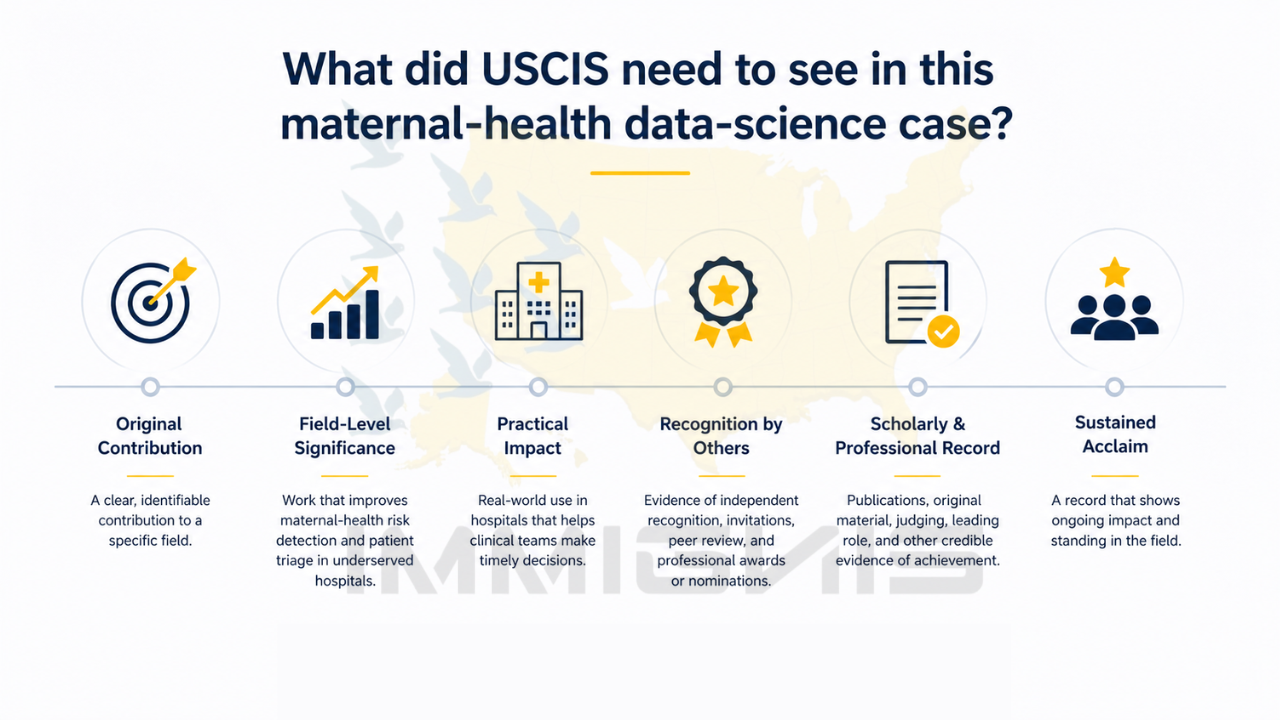
The petition had to do more than show that maternal morbidity is an important public-health issue. It had to show that this applicant had built a record of recognized achievement in a specific field.
For original contributions, the record needed to identify her own risk-prediction methods, modeling decisions, pilot implementation work, or decision-support structure. It also needed independent explanation of why those contributions mattered to maternal-health risk detection, not just to one internal project.
For scholarly articles, the publications had to connect to the same professional theme. A scattered publication list can make a researcher look active but unfocused. Here, the strongest papers were organized around maternal-risk prediction, underserved hospital settings, risk stratification, and responsible use of clinical data.
For published material, the petition needed independent coverage or commentary that helped show public recognition of her expertise. For judging, peer review could count only where she actually evaluated the work of other specialists. For leading role, the evidence had to show that the university project or hospital pilot work relied on her technical judgment, not merely that she was listed on a team.
Professional recognition was handled carefully. Award nominations and submissions can support a broader recognition narrative when documented accurately, but they cannot be presented as award wins unless the award was actually conferred.
The hospital pilot data made the contribution practical
Pilot evidence was important because it moved the case beyond theory. The record showed how maternal-health risk prediction could enter a hospital setting where providers needed earlier signals and better prioritization.
The petition did not claim that a data tool saved a specific number of lives or independently reduced maternal morbidity unless the records supported that claim. It traced what could be documented: the risk problem, the data method, the pilot setting, the applicant’s role, and how the tool supported earlier review or clearer stratification.
That measured approach strengthened credibility. EB-1A petitions are often weakened by exaggerated impact claims. In this case, the stronger argument was simpler: the work gave hospitals a structured way to identify patients who may need closer attention, especially in underserved environments where risk can be missed when systems are overburdened.
The publications gave the work a scientific record
With domain support, her publication record was developed and presented around maternal-health risk prediction rather than general public-health interest. The papers addressed modeling approaches, maternal morbidity risk factors, underserved hospital conditions, clinical-data limitations, and the responsible use of prediction tools in care settings.
One paper examined how risk signals can be missed when hospital data are incomplete or inconsistently captured. Another discussed why models used in underserved settings must be evaluated against local clinical realities instead of assuming that performance in one environment will transfer neatly to another.
The publication strategy was not to inflate the record with unrelated topics. It was to make the applicant’s professional identity easier to see. Each paper helped answer the same EB-1A question: what is this scientist known for, and how does the work fit within a recognized field?
The white paper translated the research for hospital and policy readers
A maternal-health white paper gave the case a public-facing document that explained the problem without turning the article into a technical model report. Its audience included hospital leaders, maternal-health programs, public-health organizations, and institutions trying to improve care in underserved settings.
The paper explained why maternal-risk detection is not only a question of clinical knowledge. It is also a question of workflow, data availability, timing, staffing, documentation, and whether warning patterns are visible before a patient deteriorates.
The white paper also avoided overclaiming. It did not suggest that a prediction tool can remove the need for trained clinicians, emergency readiness, or appropriate obstetric care. It framed data science as decision support: a way to help teams notice risk earlier and organize clinical attention more deliberately.
Expert commentary and panels helped build independent recognition
Public visibility mattered because the early record was too close to research and service activity. Expert commentary allowed her to explain maternal-risk prediction to readers outside a narrow academic circle.
Her commentary addressed the practical problem hospitals face when risk is distributed across many small signals. A single data point may not look urgent. A pattern across patient history, vital signs, laboratory information, prior complications, facility capacity, or follow-up gaps may deserve closer review.
Invited panels gave the record another type of recognition. She discussed how data tools can support maternal-health teams, where model bias can appear, and why risk prediction must be interpreted within the limits of the data available. These appearances helped show that other professionals considered her expertise useful enough to bring into public discussion.
Peer review turned subject-matter judgment into EB-1A judging evidence
The petition documented peer-review activity where journals or professional venues asked her to evaluate work by other researchers. That evidence was not treated as a formality. It mattered because peer review shows that the field trusted her technical judgment.
She reviewed work involving maternal health, clinical prediction, health-data methods, public-health analytics, and related subjects. The review assignments required her to assess study design, data quality, model logic, interpretation, clinical relevance, and whether conclusions followed from the evidence.
For EB-1A, judging evidence is strongest when it shows real evaluation of other specialists’ work. The record therefore separated completed review activity from memberships, conference attendance, or general professional participation.
Selective membership and recognition evidence were evaluated carefully
The petition also addressed professional membership where the record supported it. A membership is useful for EB-1A only if the admission or advancement standard is selective and based on achievement, expert review, or recognized standing. Ordinary open enrollment is not enough.
The file therefore focused on the actual rules, eligibility standards, and evidence of selection or advancement. The same disciplined approach applied to award-related evidence. A nomination, submission, or pending recognition was documented for what it was. It was not described as a prize unless the record showed that the award had been granted.
This may sound cautious, but it is often what makes an EB-1A petition stronger. USCIS can examine whether evidence fits the regulatory criteria and whether the full record supports final merits. Clear evidence usually performs better than inflated labels.
Independent letters explained the significance of the work
Independent expert letters helped connect the technical record to field significance. The strongest letters did not merely praise her as hardworking or promising. They explained the maternal-health problem, the risk-prediction method, the pilot context, and why earlier identification of risk can matter in hospitals that serve underserved populations.
The letters also helped separate her individual contribution from the broader project. That distinction was necessary. A university or hospital project may be important, but EB-1A requires evidence about the applicant’s own achievements.
In this case, independent experts described how her data-science work contributed to risk stratification, decision support, and maternal-health infrastructure. Their explanations gave USCIS a way to understand why the contribution had significance beyond a job description.
How the EB-1A evidence came together
The final petition did not rely on one document. It relied on consistency. The publications, pilot evidence, white paper, commentary, panels, peer review, recognition evidence, membership material, leading-role documentation, and independent letters all pointed to the same professional identity.
Scholarly articles showed authorship in maternal-health data science. Original-contribution evidence connected her methods and pilot work to risk detection in underserved hospitals. Published material and commentary showed that her expertise could be understood by audiences outside the original project. Peer review showed that other specialists trusted her judgment. Leading-role evidence showed that the project depended on her technical work. Independent letters explained why those facts mattered.
That combination mattered more than any single item. EB-1A cases often fail when the evidence looks like a pile of unrelated achievements. This record worked because the evidence was organized around one clear contribution: using data science to make maternal-health risk more visible before a patient’s condition becomes harder to manage.
Why the approval matters for public-health and clinical-data professionals
The approval shows that public-health data scientists do not have to fit a narrow stereotype of extraordinary ability. They do not need to be famous in a consumer market or lead a private technology company. But they do need a record that makes their authority visible.
For researchers working in maternal health, hospital safety, clinical prediction, health equity, or underserved-care settings, the lesson is practical. A strong mission is not enough. A strong project is not enough. The record must show what method belongs to the applicant, who outside the immediate team recognizes it, and how the work affected research, practice, policy discussion, or professional judgment.
In this case, the profile was not built by pretending that service work was something else. It was built by documenting the science inside the service work and showing how that science was recognized beyond one project.
Lessons for maternal-health data scientists considering EB-1A
First, define the professional niche carefully. “Health data scientist” may be too broad. “Risk prediction for maternal morbidity in underserved hospitals” gives USCIS a much clearer field to evaluate.
Second, connect publications to a consistent subject. A long paper list is less persuasive when it does not show a recognizable area of authority.
Third, document adoption or pilot evidence without exaggeration. Showing how a method was used can be powerful, but unsupported claims about lives saved, morbidity reduced, or system-wide transformation can damage credibility.
Fourth, build independent recognition. Peer review, invited panels, commentary, selective membership, professional recognition, and independent letters can help show that the field has begun to rely on the applicant’s judgment.
Finally, remember that USCIS evaluates the whole record. Meeting a few criteria is only part of the case. The final record must still show sustained acclaim and a level of expertise consistent with EB-1A extraordinary ability.
Frequently asked questions
Can a public-health data scientist qualify for EB-1A?
Yes, a public-health data scientist may qualify for EB-1A when the record shows sustained acclaim, original contributions, recognized expertise, and evidence that the applicant has risen to the top of a specific field. The petition must identify the applicant’s own contribution and explain its significance.
Are hospital pilot data enough for EB-1A?
Pilot data can help, but they are rarely enough by themselves. The record should also show the applicant’s role, the method used, the importance of the problem, outside recognition, and independent expert explanation of why the work matters beyond a single implementation site.
Can peer review support an EB-1A petition?
Peer review can support the EB-1A judging criterion when the applicant actually reviewed work by other researchers or professionals. The evidence should document the review activity and show that the review required subject-matter judgment.
Do award nominations count as EB-1A awards?
An award nomination should not be presented as an award win unless the award was actually granted. A nomination or submission may still support a broader recognition narrative if documented accurately, but USCIS will look closely at what the evidence proves.
What was the core reason this case became stronger?
The case became stronger because the record was reorganized around one defensible professional niche. Instead of presenting research, service, panels, pilot work, and peer review as separate items, the petition showed how they all supported the same authority record in maternal-health risk prediction.
Build an EB-1A record around the health-data contribution others rely on
Many health-data professionals work on projects that matter deeply but remain under-documented for immigration purposes. Their strongest evidence may sit inside university collaborations, hospital pilots, implementation records, dashboards, study protocols, or public-health programs.
Immignis and Advance My Profile help professionals identify a defensible authority niche, document individual contributions, build credible recognition, and prepare an EB-1A record around evidence that can be verified and defended.