How a France-based ocean-tech professional built a stronger EB-1A record around sustainable fisheries, coastal monitoring, and the practical use of sensor systems.
Key facts at a glance
| Outcome | EB-1A approval for a Senegalese blue-economy engineer working at a France-based ocean-tech firm. |
| Approval date | Approved on March 26, 2026. |
| Field niche | Sensor systems for sustainable fisheries and coastal monitoring, with a focus on turning field data into usable information for fisheries management, coastal resilience, and food-security decisions. |
| Starting problem | His work had development impact, but the first version of the record did not clearly show EB-1A-level evidence. It looked like useful ocean-technology implementation rather than a recognized authority record. |
| Profile-building path | Advance My Profile, powered by Immignis, organized the record through technical papers, coastal monitoring pilot data, an international organization brief, media commentary, an invited ocean-tech panel, peer review, selective membership evidence, leading-role documentation, and independent letters. |
| Evidence presented under the EB-1A criteria | Scholarly articles, original contributions, published material, judging, memberships, and leading or critical role. |
On March 26, 2026, USCIS approved the Form I-140 petition of a Senegalese blue economy engineer whose work focused on sensor systems for sustainable fisheries and coastal monitoring.
The approval did not come from presenting him as a general environmental engineer or as a technologist who happened to work near the ocean. The successful record was narrower and more useful. It showed how his sensor work helped coastal and fisheries stakeholders collect, interpret, and act on information that is often missing when decisions are made.
That distinction mattered.
A device in the water is not, by itself, an extraordinary-ability case. A coastal pilot is not enough. A development project, even a meaningful one, may still look local unless the petition explains the technical method, the problem it solves, the professional recognition around the work, and the reason other experts should view the person as more than an implementation engineer.
His EB-1A story therefore became a story about translating ocean-sensor engineering into a public authority record.
The case risk: impact without a clear EB-1A record
Before the profile was rebuilt, the strongest facts were scattered. One file discussed coastal monitoring. Another described fisheries data. A third concerned technology deployment. There were references to sustainability, food systems, and ocean conditions, but the record did not immediately tell a USCIS officer what professional question he was known for answering.
That is a common problem in blue-economy, conservation, water, agriculture, and climate-adaptation work. The work may be valuable, but the immigration evidence can still look incomplete. The professional may have helped deploy a tool, design a system, improve field reporting, or support a program, yet the petition must do more than describe the project.
For EB-1A, the question becomes: what is the individual contribution, where is the independent recognition, and why does the record show sustained acclaim in the field?
In this case, the answer was not simply “sustainable fisheries.” That was too broad. It was not only “coastal monitoring.” That could sound like general environmental work. The profile became stronger once it was framed around sensor systems that help fisheries and coastal stakeholders understand conditions, detect patterns, and make better decisions before environmental or operational problems become harder to manage.
His niche was the point where ocean data becomes a decision
Coastal and fisheries systems are data-poor in many of the places where timely information matters most. Fishery conditions, water quality, temperature, turbidity, salinity, dissolved oxygen, vessel activity, shoreline change, and habitat stress can all affect how communities manage marine resources. Yet the people making decisions may be working with delayed reports, incomplete sampling, or data that does not match the local operational question.
His work focused on the engineering layer between the physical environment and the decision system. Sensors had to survive field conditions, collect relevant measurements, transmit or store data reliably, and produce information that a fisheries manager, coastal authority, conservation partner, or technology team could interpret.
That made the case more precise. The petition did not claim that one sensor could solve food insecurity or reverse coastal degradation. It showed a specialist whose work made monitoring more usable for sustainable fisheries and coastal resilience by improving the way field data is collected, organized, validated, and explained.
The narrow field also helped the evidence speak the same language. Publications, pilot data, media commentary, peer review, professional membership, and expert letters all pointed back to one area of expertise instead of describing several unrelated ocean projects.
What USCIS needed to see in this blue-economy EB-1A case
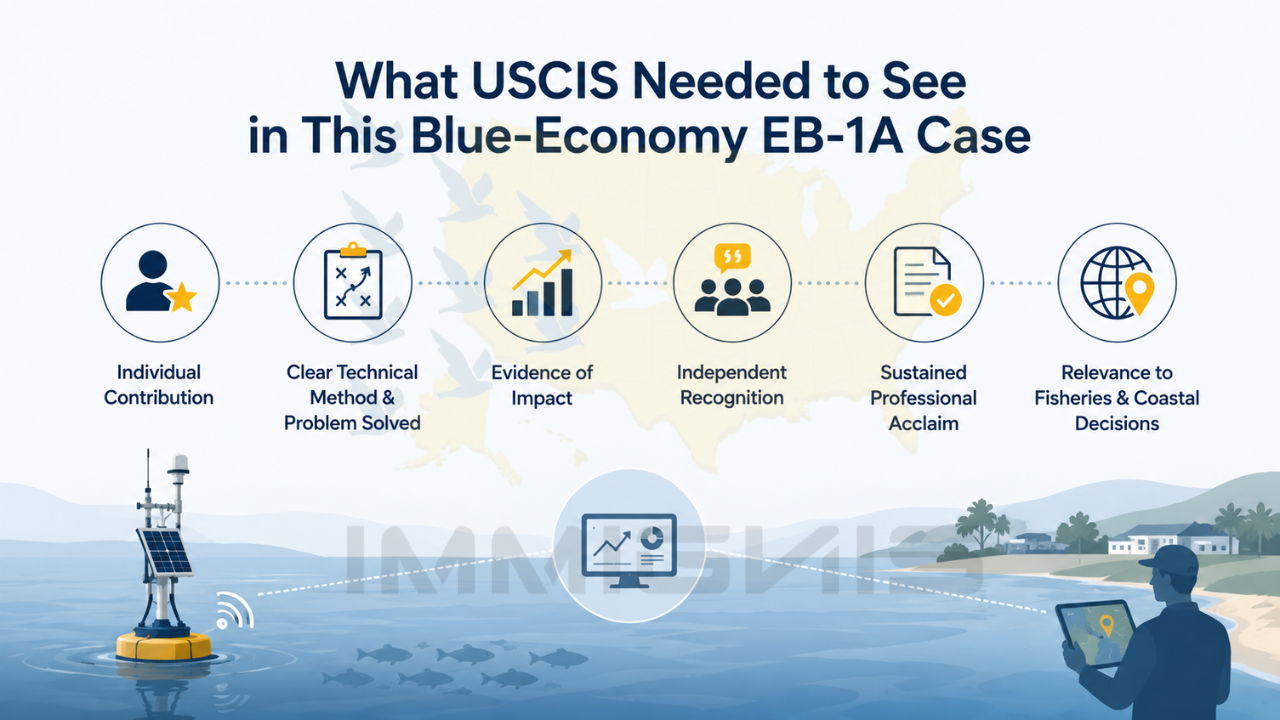
A blue-economy case can be attractive, but only if the evidence remains disciplined. Words like sustainability, resilience, and food security may be important, but they do not replace proof. USCIS still evaluates whether the petitioner meets the regulatory criteria and whether the full record shows extraordinary ability through sustained national or international acclaim.
For original contributions, the petition needed to identify his own engineering methods, monitoring designs, pilot outcomes, or data-use framework and then explain why those contributions mattered beyond a single employer or project site. A coastal project with positive social value was not enough by itself.
For scholarly articles, the publications had to connect his authorship to the sensor and monitoring niche. Articles about fisheries, ocean data, sensor networks, coastal resilience, or similar subjects helped only when they supported the same professional identity.
For published material, the record needed independent coverage about him or his work. General articles about ocean conservation or the blue economy would not carry the same weight unless they discussed his expertise, methods, or professional role.
For judging, the petition had to show actual evaluation of work by other specialists, such as peer review, technical review, or relevant selection activity. It could not treat ordinary participation in conferences as judging.
For memberships, the admission or elevation standard mattered. Open memberships were separated from memberships requiring achievement, professional review, or selective evaluation.
For leading or critical role, the petition had to show why the ocean-tech firm or a significant project relied on his technical judgment. A title alone would not prove that point. The evidence had to show the relationship between his work and important monitoring, fisheries, or coastal-resilience functions.
The record was rebuilt around a monitoring method, not a project label
Advance My Profile, powered by Immignis, worked with the available record to separate the engineering method from the project descriptions. The revised evidence did not rely on broad language about protecting the ocean. It traced the work through practical questions.
What was being measured? Why did the measurement matter? How was data collected under field conditions? What made the information reliable enough to use? Who could act on the results? Which part of the system was attributable to him?
Those questions created a stronger evidentiary structure. Pilot materials, technical notes, role evidence, field summaries, and non-confidential project examples were grouped around monitoring design, sensor performance, data quality, and the use of information in fisheries or coastal decisions.
The petition did not expose protected customer information, proprietary technical details, or confidential partner data. It used safe, non-confidential evidence to show the technical problem and the petitioner’s role in addressing it.
That approach also reduced overclaiming. The record did not say that one engineer solved fisheries management or coastal resilience. It said something more credible: his sensor-system work helped create better information flows for environments where weak data can lead to delayed or poorly supported decisions.
The technical papers gave the field a way to examine the work
The scholarly-authorship record was developed around the narrow subject rather than around a general environmental theme. His papers addressed sensor systems, field data reliability, sustainable fisheries monitoring, and coastal observation methods.
One paper examined why a monitoring system can fail even when the sensor itself works: poor placement, weak calibration, unreliable transmission, data gaps, or a mismatch between the measurement and the decision that stakeholders need to make. Another discussed how coastal monitoring can support fisheries when the data is organized around operational questions rather than collected as disconnected environmental readings.
The value of these papers was not simply that they added publications. They helped turn a field implementation record into an engineering subject that other professionals could read, cite, review, and discuss. For EB-1A, that public record helped identify the petitioner as a blue-economy engineer with a specific body of work, not only as someone employed on useful projects.
Pilot data was useful because it was tied to the right claim
Coastal monitoring pilot data became part of the original-contribution argument, but only where the available records supported it. The petition used pilot evidence to show how his work functioned in real environments and how the monitoring approach supported fisheries or coastal use cases.
This evidence was handled carefully. Pilot data can be persuasive when it documents the problem, the technical method, the petitioner’s role, and the resulting use or improvement. It becomes weaker when it turns into unsupported claims about economic outcomes, community-wide change, or environmental recovery.
The file therefore avoided claiming more than the evidence could show. Where monitoring improved data availability, reduced gaps, supported field review, or helped stakeholders compare conditions more consistently, the petition explained that contribution. Where broader food-security or resilience claims required additional proof, the narrative stayed within the documented record.
The international organization brief connected ocean engineering to food security
A key part of the public profile was an international organization brief written for people who work across fisheries, coastal resilience, ocean technology, and development policy. The brief explained why sustainable fisheries often depend on information systems that are accurate enough, affordable enough, and usable enough for local or regional stakeholders.
It did not turn the petitioner into a policy official. It made his engineering work more legible to a wider professional audience. The brief described how sensor systems can support coastal monitoring, identify changes over time, improve reporting, and help fisheries stakeholders respond with better information.
For EB-1A, this type of document helped bridge a gap. USCIS may not be familiar with the technical importance of ocean-sensor design. The brief showed why the work mattered in an applied blue-economy context without exaggerating the evidence or claiming that technology alone solves fisheries or coastal-management challenges.
Media commentary made the subject understandable without simplifying it too much
Media coverage and commentary were also developed around the same niche. The public explanations did not present him as a generic climate innovator. They focused on the practical problem of collecting usable coastal data and translating it into decisions for fisheries and resilience planning.
He discussed why small-scale and regional fisheries can face monitoring gaps, why delayed information can weaken management, and why sensor systems must be designed with field realities in mind. A sensor that is accurate in a controlled setting may still struggle when maintenance, biofouling, connectivity, power supply, weather, cost, or local training become part of the deployment environment.
That kind of commentary helped the published-material criterion because it made his expertise visible to an audience outside his employer. It also helped the final record by showing that the field could understand his contribution in practical terms.
Invited panels and peer review showed professional trust
The invited ocean-tech panel gave the record another form of recognition. Rather than treating the invitation as a generic speaking item, the petition explained what he was asked to discuss: sensor systems for coastal monitoring, sustainable fisheries, and the use of field data in blue-economy decision-making.
The panel also showed how other professionals engaged with the substance of the work. Questions about data reliability, deployment conditions, cost, maintenance, and stakeholder use helped show that his expertise was being considered in a professional setting.
Peer review provided separate judging evidence. The record documented where he evaluated technical work by other researchers or specialists in ocean technology, fisheries systems, environmental monitoring, sensor engineering, or related fields. That evidence mattered because EB-1A judging requires actual assessment of the work of others, not merely attendance or participation.
Membership evidence was judged by the standard, not the name
Professional membership evidence was reviewed with care. A membership can support EB-1A only when the organization or membership level requires outstanding achievement, selective admission, or professional assessment connected to the field. Paying dues or joining an open association normally does not prove sustained acclaim.
In this case, the petition focused on the membership evidence that could be documented through admission rules, advancement standards, review criteria, or other proof of selectivity. The goal was not to list organizations. The goal was to show that the relevant membership evidence reflected professional recognition in ocean technology, engineering, fisheries, or a related technical field.
Independent letters explained why the work mattered beyond one firm
Independent expert letters helped connect the technical record to field significance. The strongest letters did not simply praise the petitioner or repeat his resume. They explained the blue-economy problem, the monitoring challenge, the petitioner’s specific contribution, and why the work was relevant to sustainable fisheries or coastal resilience beyond a single project.
For this kind of case, expert letters are most useful when they do three things. First, they identify the method or contribution. Second, they explain the field problem in language USCIS can understand. Third, they show why the contribution has broader professional significance.
That was especially important here because the starting record had development impact but weak EB-1A criteria. The letters helped translate local or project-based evidence into a field-level explanation without turning the case into unsupported advocacy.
How the EB-1A evidence came together
The approval record did not depend on one document. It depended on evidence that reinforced the same professional identity from several directions.
Scholarly articles connected his authorship to sensor systems, sustainable fisheries, coastal monitoring, and data use in blue-economy settings.
Original contributions were supported by technical methods, pilot evidence, documented use, and independent expert explanations showing why his work mattered in the field.
Published material showed that his expertise and work had entered public discussion beyond the employer or project team.
Judging evidence came from peer review and other documented evaluation of work by professionals in related fields.
Membership evidence was limited to the parts of the record that showed selectivity or achievement-based recognition.
Leading or critical role evidence showed that significant ocean-tech and monitoring work relied on his technical judgment and contribution.
At final merits, these strands needed to describe the same person: a Senegalese blue-economy engineer whose work in sensor systems for fisheries and coastal monitoring had moved beyond implementation into recognized professional authority.
Why the approval matters for similar professionals
This approval offers a useful lesson for engineers, scientists, founders, researchers, and program specialists working in ocean technology, fisheries, climate adaptation, conservation technology, water systems, and sustainable development.
A meaningful project does not automatically become an EB-1A case. A field deployment does not automatically show original contribution. A sustainability mission does not replace evidence of acclaim. The petition must still identify the individual’s work, document how it was used or recognized, and explain why it matters in a defined field.
For this Senegalese engineer, the stronger case emerged after the record stopped trying to describe everything and began explaining one thing well: how his sensor-system work helped make coastal and fisheries data more usable for real decisions.
USCIS approved the petition on March 26, 2026.
Practical lessons from this EB-1A success story
- Do not rely on the social importance of a project alone. Explain the technical contribution and the petitioner’s individual role.
- Define the field narrowly enough that publications, pilots, media, judging, and letters all support the same authority niche.
- Use pilot data carefully. Metrics help only when the record shows attribution, method, and documented use.
- Translate technical work for USCIS without exaggerating it. A clear explanation is stronger than broad claims about saving the ocean or solving food security.
- Separate real judging and selective membership evidence from ordinary participation or open enrollment.
- Use independent letters to explain significance, not merely to praise the applicant.
FAQ
Can a blue-economy or ocean-tech professional qualify for EB-1A?
Yes, but the case must be built around evidence, not only mission value. Ocean-tech professionals may have strong EB-1A potential when they can document original contributions, authorship, independent recognition, judging, selective memberships, leading roles, or other qualifying evidence in a defined field.
Can coastal monitoring or fisheries technology count as an original contribution?
It can, if the record identifies the specific method, system, technical improvement, documented use, and broader significance. USCIS needs more than proof that a project existed. The petition must show what the person contributed and why that contribution mattered.
Is pilot data enough for EB-1A?
Pilot data can support an EB-1A case, but it rarely stands alone. The strongest use of pilot data connects the technical problem, the applicant’s role, the method used, and the effect or adoption shown by the records. Unsupported outcome claims can weaken credibility.
Does media coverage help if the field is technical?
Media coverage can help when it discusses the applicant or the applicant’s work in a meaningful way. General coverage of sustainability, fisheries, or climate issues is less useful unless it connects to the person’s recognized expertise or contribution.
What is the biggest mistake in EB-1A cases for sustainable-development professionals?
The most common mistake is assuming that public benefit equals extraordinary ability. A project may be important, but EB-1A still requires evidence of the individual’s achievements, recognition, and standing in the field.
Build an EB-1A record around the work the field can actually recognize
Many blue-economy and sustainability professionals have serious technical work hidden inside pilots, field deployments, monitoring systems, and partner reports. That work may support an EB-1A case when it is documented carefully, connected to a narrow professional niche, and supported by independent recognition.
Immignis and Advance My Profile help professionals identify defensible authority areas, develop public evidence, organize technical records, and prepare EB-1A cases around proof that can be verified and explained.