Key facts at a glance
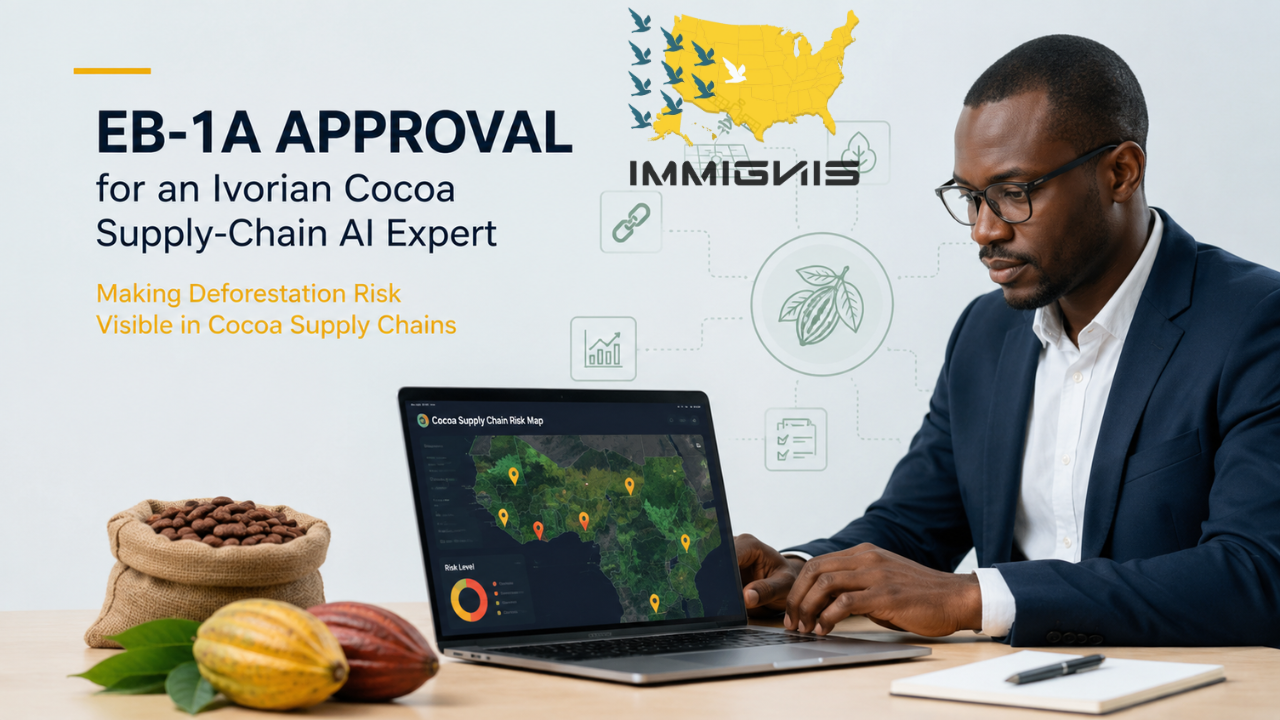
| Outcome | EB-1A approval for an Ivorian cocoa supply-chain AI expert working with a Belgium-based food-supply platform. |
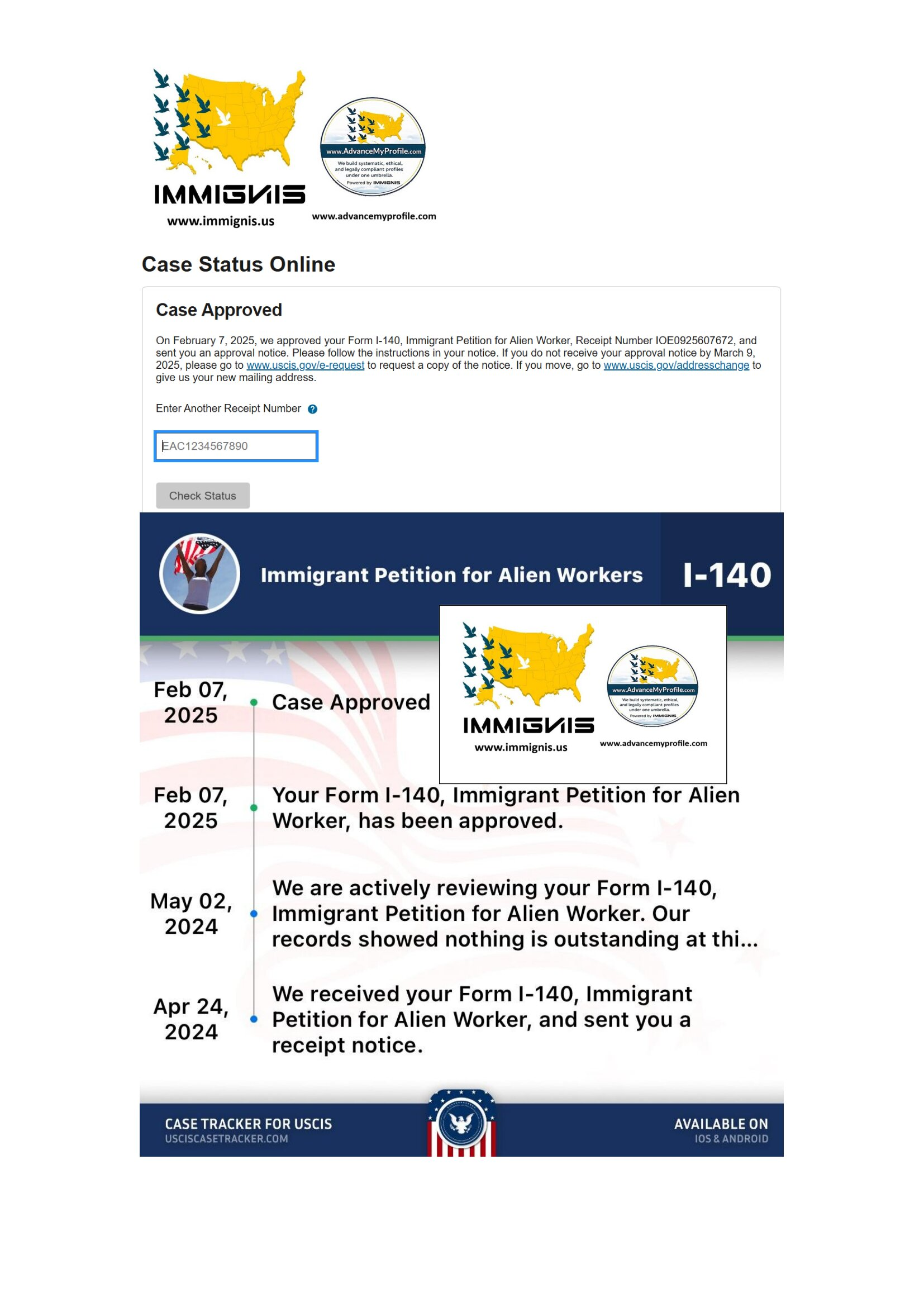
| Approval date | Approved on February 7, 2025. |
| Field niche | Traceability and deforestation-risk AI for cocoa supply chains, with a focus on mapping risk, verifying supply-chain links, and supporting better commodity-traceability decisions. |
| Starting problem | His work had sustainability value, but the record risked reading like corporate ESG activity rather than evidence of extraordinary ability in supply-chain AI. |
| Profile-building path | Advance My Profile, powered by Immignis, developed a focused authority record through supply-chain AI publications, a traceability white paper for food industry groups, media coverage, open-risk map evidence, award-related documentation, judging activity, and independent expert letters. |
| EB-1A criteria supported | Original contributions, scholarly articles, published material, awards or award-related recognition where supported, judging, and leading or critical role evidence. |
The approval came after the case stopped sounding like ESG
USCIS approved his Form I-140 on February 7, 2025.
The approval did not rest on a broad claim that sustainability is important. It came after the petition showed something more specific: an EB-1A Cocoa Supply Chain AI specialist had developed and documented AI-driven traceability methods that helped make deforestation risk more visible inside cocoa supply chains.
That distinction mattered. Before the record was rebuilt, his work could have been misunderstood as corporate environmental reporting. The file referred to cocoa, sustainability, responsible sourcing, supplier records, and platform work. Those words sounded useful, but they did not by themselves prove extraordinary ability.
The stronger story was technical. His work used data systems, risk indicators, supplier relationships, geographic information, and evidence links to help food companies and supply-chain partners ask a practical question: when a cocoa shipment moves through several hands, what can the buyer actually know about where it came from and what risk may be attached to it?
That became the center of the EB-1A case.
The first problem was not the cocoa. It was the label attached to the work
Many professionals working in responsible sourcing face the same problem. Their best work is described in company language: ESG, sustainability, compliance, vendor management, due diligence, supplier engagement, or reporting. Those labels can be accurate. They can also hide the technical method.
For this client, the field was not general sustainability. It was not public relations. It was not a corporate statement about ethical sourcing. It was supply-chain AI for traceability and deforestation-risk analysis in cocoa.
Cocoa supply chains can pass through farms, cooperatives, traders, processors, exporters, importers, manufacturers, and retailers. A weak record may say only that a company improved sourcing transparency. A stronger record explains how the professional helped connect data points across that chain, identify risk signals, and create a more defensible basis for review.
That was the work Advance My Profile and Immignis had to make visible. The petition needed to show not only that the industry problem was important, but that this particular specialist had made original, recognized contributions to solving it.
What USCIS needed to see in a cocoa traceability EB-1A case
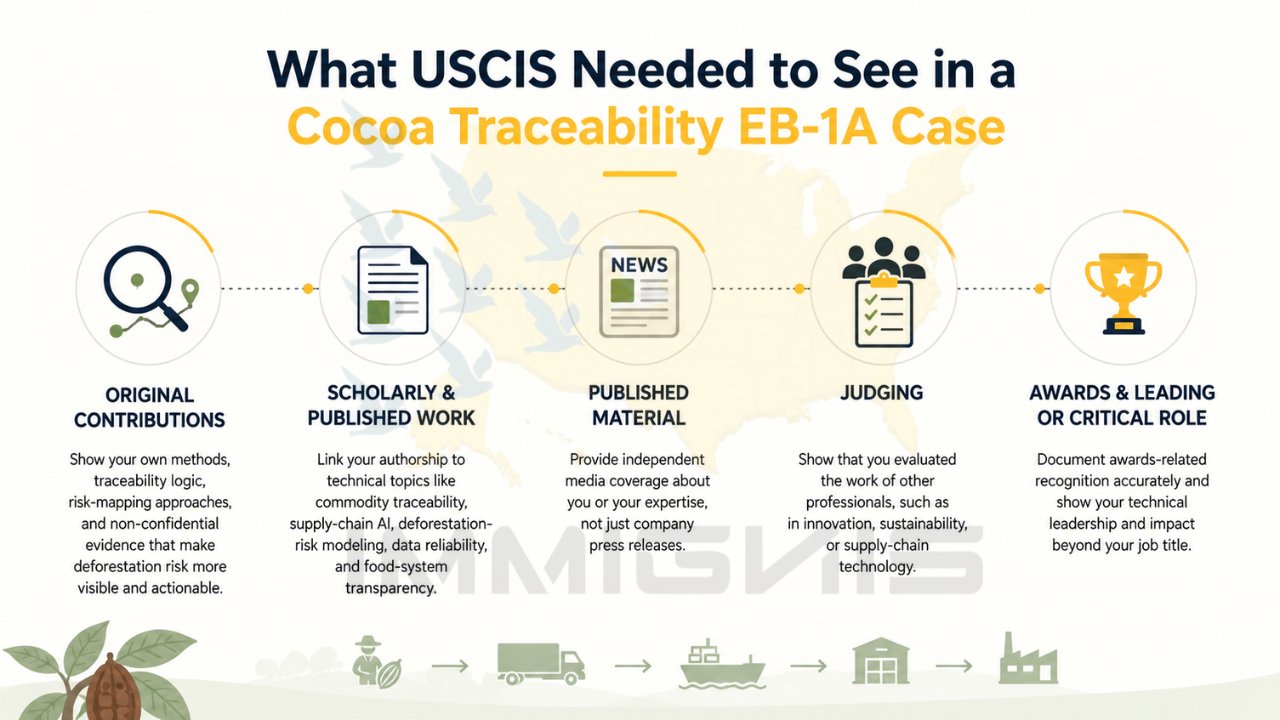
A strong EB-1A case in this field could not depend on moral urgency alone. Deforestation risk, commodity transparency, and supply-chain accountability are serious issues, but USCIS still evaluates the person. The evidence had to identify the client’s own methods, explain why they mattered, and show recognition beyond routine employment.
For original contributions, the petition focused on traceability logic, risk-mapping methods, non-confidential platform evidence, and an open-risk map that helped others understand how data could be used to prioritize supplier review. The petition did not claim that one AI model could prove every shipment was clean or that every cocoa source had been verified beyond dispute. It kept the claim disciplined: his contribution helped make risk more visible and more actionable.
Scholarly articles needed to connect his authorship to a technical subject: commodity traceability, supply-chain AI, deforestation-risk modeling, data reliability, and food-system transparency. Published material had to show independent coverage about him or his expertise, not merely a company press release. Judging evidence required actual evaluation of other professionals’ work, such as innovation, sustainability, or supply-chain technology submissions.
The awards portion required careful handling. Award submissions, nominations, finalist status, or recognition materials were documented accurately. The record did not treat a submission as an award win unless the evidence supported that result. That kind of precision protects credibility in an EB-1A petition.
For leading or critical role, the evidence had to show that the food-supply platform or related projects relied on his technical judgment in traceability, data design, risk analysis, or system implementation. A job title was not enough. The record had to explain why his role mattered to the organization’s supply-chain technology work.
The case was rebuilt around traceability decisions, not sustainability slogans
The team reorganized the record around decisions that supply-chain actors actually need to make. What data identifies a source? Which supplier link is documented? Which location information can be trusted? Which risk signals should trigger more review? Which gaps make a claim too weak to rely on?
Those questions changed the case. Instead of presenting a general portfolio of sustainability activities, the petition showed a repeated method: gather supply-chain data, connect it to geographic or supplier-risk indicators, identify weak links, prioritize review, and explain the level of confidence behind a traceability claim.
This was especially important because AI can easily be oversold in sustainability work. The petition avoided that. It did not suggest that the system replaced auditors, local verification, government records, or responsible sourcing teams. It explained how AI and data tools could help identify patterns, inconsistencies, missing information, and risk areas that human teams should examine more closely.
That made the contribution more credible. USCIS did not need a dramatic promise. It needed a documented method, attributable to the petitioner, with evidence that others recognized its significance.
The publications turned responsible sourcing into a technical record
With domain support, he developed and strengthened publications on supply-chain AI, cocoa traceability, risk mapping, deforestation indicators, and data quality in commodity systems. These papers gave the petition something a corporate project record could not provide: public authorship tied to the technical problem.
One article examined why traceability systems fail when supplier records, location information, and purchasing data are not linked in a usable way. Another addressed the risk of treating incomplete supply-chain data as proof of compliance. A third focused on how AI models can help rank or flag risk without pretending to deliver certainty where the underlying records remain incomplete.
The publications also helped define the field niche. He was not presented as a general ESG professional. He was presented as an expert in traceability and deforestation-risk AI for cocoa supply chains.
The open-risk map made the method easier to understand
An open-risk map became one of the most useful pieces of non-confidential evidence. It gave the petition a public-facing way to show how risk could be organized and communicated without exposing protected supplier contracts, pricing data, customer relationships, or private platform architecture.
The map did not claim to certify a shipment or accuse any specific supplier. Its value was different. It showed how data layers, origin information, risk indicators, and supply-chain uncertainty could be visualized so that reviewers knew where deeper verification might be needed.
For EB-1A purposes, that mattered because it helped move the case away from abstract sustainability language. Independent experts could see the technical logic. They could discuss why the method was useful, where it fit in commodity traceability, and how it could influence the way food-supply teams evaluate risk.
The white paper spoke to food companies, not immigration officers
The traceability white paper was written for food industry groups, sourcing teams, and professionals working with commodity-risk systems. It explained why cocoa traceability becomes difficult when supply chains contain many small source points, incomplete records, changing supplier relationships, and inconsistent location data.
The paper’s strongest argument was practical: a traceability system should not merely collect records. It should show where records are strong, where the chain of evidence weakens, and where risk indicators justify further review.
That approach gave the case field relevance. The white paper was not written as a petition exhibit first. It was written to educate a professional audience. In the EB-1A record, it helped show that his work had been translated into a public technical contribution that other supply-chain and food-industry stakeholders could use.
Media coverage helped explain the difference between ESG language and AI evidence
Independent media coverage and expert commentary gave the public record another layer. The coverage did not simply state that cocoa sustainability matters. It explained how traceability tools, data gaps, geographic risk, and supply-chain uncertainty affect the ability of companies to evaluate sourcing claims.
His commentary helped make a technical point accessible: a dashboard can look complete while still relying on weak evidence. A responsible-sourcing claim can sound confident while still missing crucial links in the supplier chain. AI becomes useful when it helps identify those weak points and directs attention to the records, locations, or transactions that require closer review.
That public explanation supported the published-material criterion and strengthened the final merits narrative. It showed a specialist whose expertise could be recognized outside his employer’s internal platform.
Judging evidence showed that others trusted his supply-chain judgment
The record also included judging activity related to supply-chain technology, sustainability innovation, data systems, or food-industry risk analysis. This evidence mattered because judging is not the same as being invited to attend an event. It requires evaluation of work created by other professionals.
The petition documented the judging role, the subject matter, the selection basis where available, and the type of submissions or professional work he evaluated. This helped show that other organizations relied on his judgment in the same general area in which he claimed extraordinary ability.
For professionals in corporate technology fields, judging can be a particularly useful form of independent recognition. It shows that the field is not only receiving the person’s work, but also asking the person to evaluate others.
Independent letters did more than praise him
The independent letters were not written as personal endorsements. Their purpose was to explain the field, the problem, the petitioner’s specific methods, and why those methods mattered beyond one company.
Supply-chain AI experts, food-system specialists, and traceability professionals explained why cocoa is a difficult setting for risk analysis. They addressed the technical value of linking supplier records, origin indicators, deforestation-risk data, and uncertainty scoring. They also explained why an open-risk map or non-confidential platform method could help professionals understand where verification should focus.
The best expert letters in an EB-1A case do not simply call the applicant brilliant. They help USCIS understand why the work was original, how it was used or recognized, and why the contribution had significance in the field. That is the role these letters served.
How the EB-1A evidence came together
The final petition did not rely on one impressive item. It presented a consistent professional identity across several types of evidence.
The scholarly articles showed authorship in supply-chain AI, commodity traceability, and deforestation-risk analysis. The original-contribution evidence linked his methods, open-risk map, non-confidential platform logic, and traceability work to practical use in food-supply decisions. Published material and media commentary showed that his expertise had entered the public conversation around cocoa traceability. Judging evidence demonstrated that outside organizations trusted him to evaluate related work. Award-related materials were documented with care and used only to the extent the record supported them. Leading or critical role evidence showed that his technical judgment mattered inside a significant food-supply platform.
Together, the record answered the question USCIS had to evaluate at final merits: whether the evidence showed a specialist with sustained acclaim and a level of expertise placing him among the small percentage who have risen to the top of the field.
What this approval teaches supply-chain, ESG, and food-technology professionals
This case is useful because it separates impact language from evidence. Many professionals work on important problems. That does not automatically make an EB-1A case strong. The petition must show what the professional personally contributed, how the contribution can be verified, and how the field recognized it.
For supply-chain technology professionals, the lesson is direct. Do not let company terminology define the entire case. If the work is described only as ESG, compliance, vendor management, or responsible sourcing, the record may miss the actual technical expertise. The stronger case may be in the method: the model, the evidence structure, the risk logic, the adoption pattern, the review process, or the way the work changed decisions.
For this Ivorian cocoa supply-chain AI expert, EB-1A approval came after the record showed that his work was not just a startup, corporate, or sustainability story. It was a traceability and risk-analysis contribution in a field where food companies, regulators, and buyers increasingly need better evidence about where commodities come from and what risks travel with them.
Frequently asked questions
Can sustainability or ESG work support an EB-1A petition?
Yes, but the petition should not rely only on broad sustainability language. The strongest cases identify a specific professional contribution, such as a technical method, data system, policy framework, engineering process, or measurable adoption that can be attributed to the applicant.
Can corporate supply-chain work qualify if most evidence is internal?
It can, but internal evidence usually needs careful handling. A petition may use non-confidential summaries, public-facing methods, expert letters, publications, media coverage, judging, and role evidence to show significance without exposing protected company information.
Is a white paper useful for EB-1A?
A white paper can help when it translates a real professional method into a public technical contribution. It should not be generic marketing. It should explain a field problem, the method, the limits of the method, and why the subject matters to professional practice.
Do award submissions count as awards?
No. A submission by itself is not an award. If the record includes a nomination, finalist placement, prize, or recognition, it must be documented accurately. USCIS credibility can be harmed when applicants overstate award evidence.
What made this case different from a normal ESG profile?
The record moved beyond ESG branding. It showed a defined supply-chain AI niche, public authorship, traceability tools, open-risk evidence, expert recognition, judging activity, and independent explanations of why the work mattered in cocoa traceability and deforestation-risk analysis.
Ready to build an EB-1A record around your real technical contribution?
If your work sits inside supply-chain technology, food systems, sustainability analytics, commodity traceability, responsible sourcing, or ESG data infrastructure, your strongest EB-1A evidence may not be your job title. It may be the method you developed, the decisions your work changed, and the independent recognition that can be built around it.
Immignis and Advance My Profile help professionals identify a defensible authority niche, document original contributions, develop credible public evidence, and prepare a record around facts that can be verified and defended professionally.