How a Cameroonian renewable-energy specialist converted practical AI-managed mini-grid work into an EB-1A approval
Key facts at a glance
| Outcome | EB-1A approval for a Cameroonian renewable mini-grid engineer working with a U.S.-based energy nonprofit. |
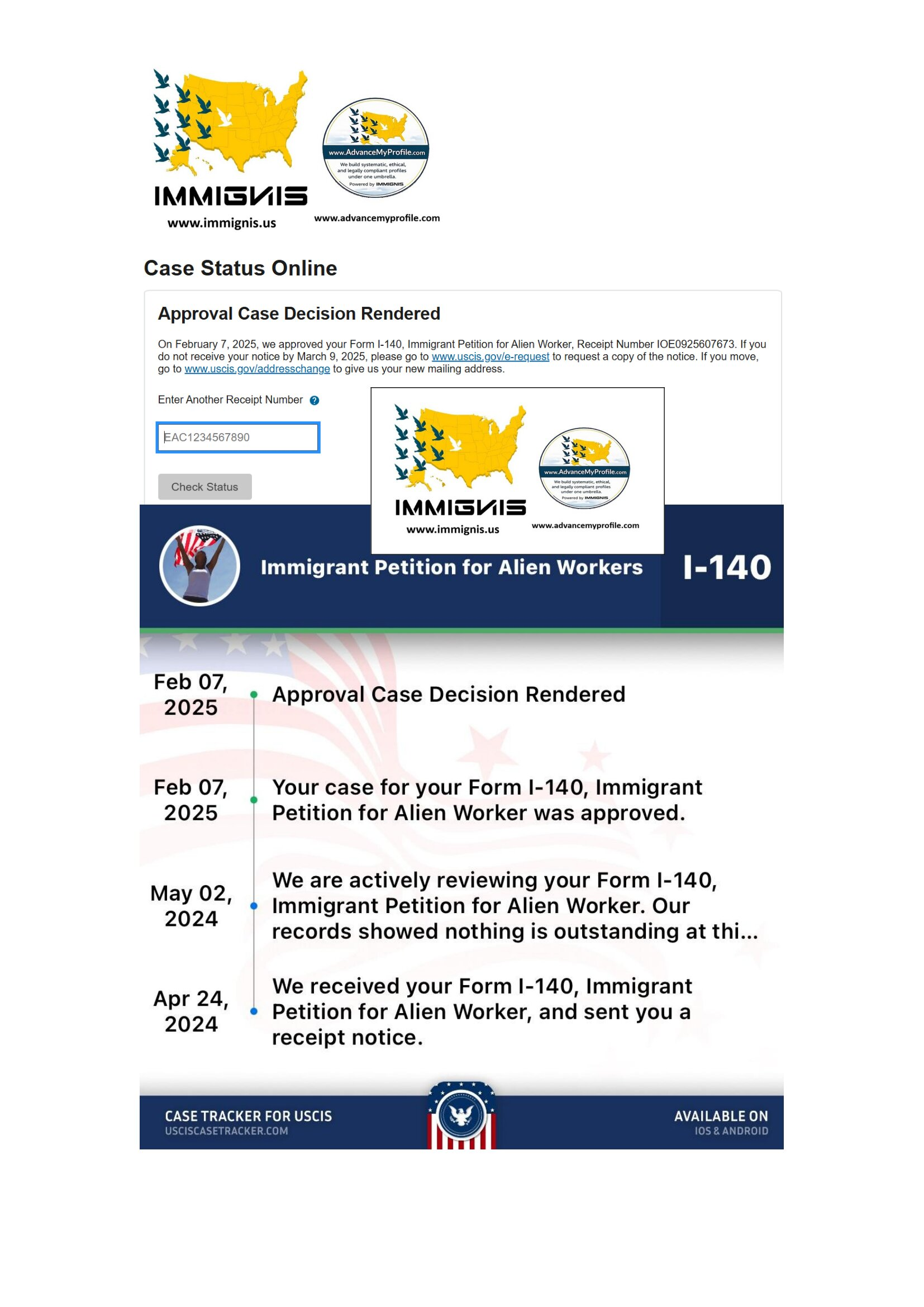
| Approval date | Approved on February 7, 2025. |
| Field niche | AI-managed mini-grids for underserved communities, with a focus on load prediction, battery dispatch, reliability planning, and practical energy access. |
| Starting problem | The engineering work was useful and practical, but the public record was under-published and did not yet show sustained acclaim or field-level recognition. |
| Profile development path | Technical papers, mini-grid deployment data, an energy-access white paper, podcast and media coverage, invited workshops, patent disclosure, peer review, and independent expert letters. |
| Evidence presented under EB-1A criteria | Scholarly articles, original contributions, published material, judging, and leading role. Patent disclosure helped support attribution and the original-contribution record. |
| Approval hook | The petition showed that AI-managed mini-grid methods had scalable energy-access value beyond one deployment program. |
USCIS approved the case. The harder work had started long before filing.
The EB-1A Mini-Grid Engineer received USCIS approval of his Form I-140 petition on February 7, 2025, as a Cameroonian renewable mini-grid engineer whose work centered on AI-managed mini-grids for underserved communities.
The approval did not come from presenting him as a general renewable-energy professional. It came from showing a narrower and more defensible story: he had developed practical methods for using data, load behavior, battery operation, and system reliability analysis to make community-scale electricity more dependable.
That distinction mattered. A solar panel can be visible. A battery bank can be photographed. A distribution line can be mapped. The engineer’s most valuable contribution, however, often sits in the decisions behind the system: when to store power, when to dispatch it, how to anticipate demand, how to prevent avoidable outages, and how to keep a small grid useful after the installation team leaves.
His original record showed real work. It did not yet show an EB-1A-level authority record.
The problem was not whether the mini-grids mattered
Mini-grids can matter deeply in communities where centralized grid access is unreliable, expensive, or unavailable. They can support homes, clinics, schools, cold storage, water systems, phone charging, small businesses, and local economic activity.
But EB-1A is not approved because a field is important. USCIS still has to see evidence that the individual beneficiary has achieved sustained acclaim and has a record of recognized achievement in that field.
That was the case challenge. The client’s strongest work lived inside implementation files, project reports, operational records, and partner-facing engineering decisions. Those records showed that he helped solve difficult energy-access problems. Standing alone, however, they risked looking like practical project management or ordinary renewable-energy consulting.
The petition had to answer a more precise question: what method, judgment, or technical contribution could be attributed to this engineer, and why should the broader field care?
His niche became the intelligence layer inside community power systems
The profile was narrowed to AI-managed mini-grids for underserved communities. That niche was not a branding phrase. It described the recurring technical problem that connected his work across projects.
A mini-grid serving a remote or underserved community has to deal with uneven demand, battery limits, weather variation, appliance growth, maintenance gaps, payment or usage patterns, and the risk that a system designed for one level of load will be stressed by another. A technically sound installation can still struggle if the operator cannot predict demand, manage storage, or recognize early signs of performance decline.
The evidence therefore focused on the decisions that made the grid more reliable after installation: load forecasting, battery dispatch, inverter constraints, generator or backup use where applicable, demand clustering, outage patterns, and system-level monitoring. The story was not simply that the client worked on renewable energy. It was that he helped small energy systems behave more intelligently under real operating conditions.
What USCIS needed to see in this renewable mini-grid EB-1A case
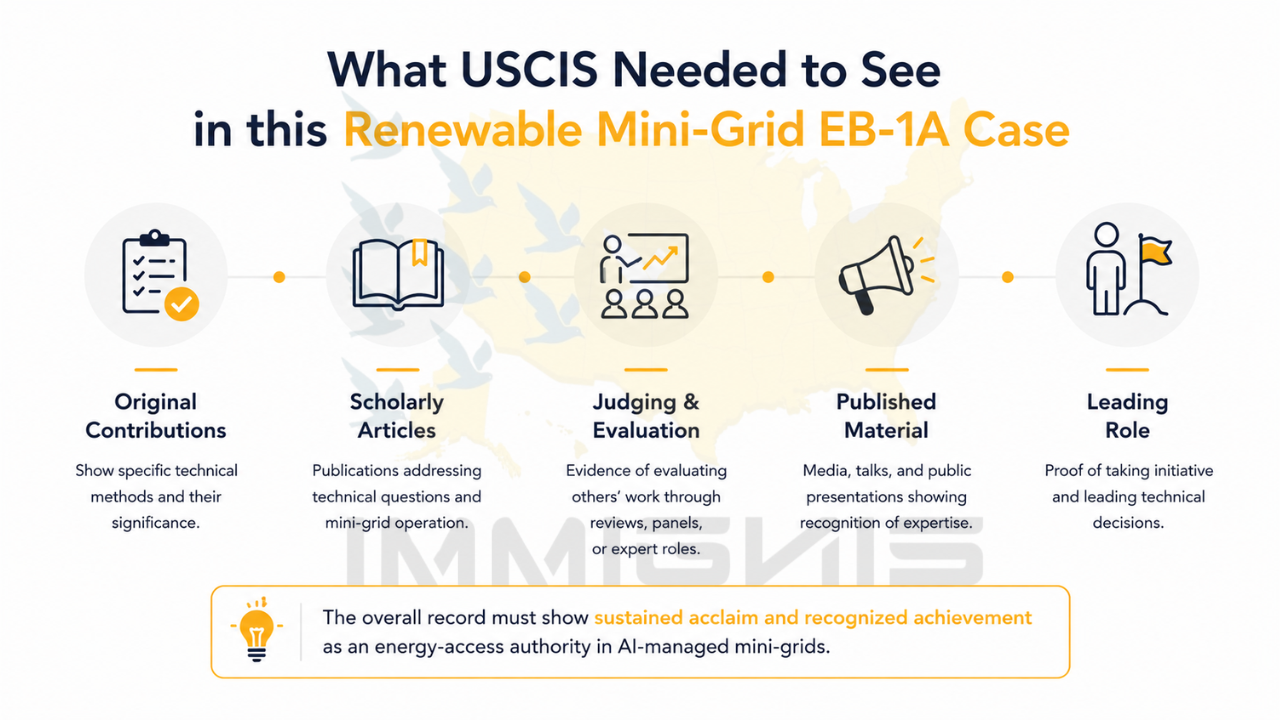
For USCIS, the petition could not rely on the social value of electricity access alone. It needed proof that the beneficiary met the EB-1A regulatory criteria and that the total record supported a final merits finding of extraordinary ability.
For original contributions, the case had to identify his specific technical methods and show why they had significance beyond a routine job assignment. The petition therefore connected his work to mini-grid operation, load prediction, dispatch logic, reliability monitoring, and documented implementation or adaptation of the methods.
For scholarly articles, the publications needed to do more than repeat development-sector language about energy access. They had to address technical questions: demand variability, storage behavior, control decisions, reliability measurement, and the use of data to manage small-scale renewable systems.
For published material, the case required independent coverage about him or his work. General articles about mini-grids, climate finance, or rural electrification would not be enough unless they discussed his expertise or contribution in a meaningful way.
For judging, peer review and competition evaluation had to show that he assessed the work of others. Being invited to speak about his own project was useful professional recognition, but it was not the same as judging.
For leading role, the evidence had to show why the energy nonprofit or project relied on his technical judgment, not merely that he held a visible title. Patent disclosure and invention materials helped establish attribution, but they were not treated as a separate EB-1A criterion. They strengthened the original-contribution analysis by connecting technical concepts to him.
The implementation record was rebuilt around engineering decisions
Advance My Profile, powered by Immignis, reviewed the record with legal strategists and renewable-energy specialists. The first task was not to make the case sound bigger. It was to make the technical contribution clearer.
Deployment data, engineering notes, non-confidential project summaries, role evidence, and safe examples of system operation were grouped by decision point. What did the system need to predict? Which usage pattern created stress? When did storage management matter? How did monitoring data change operating decisions? Which part of the method could be traced to him?
That structure helped convert scattered project records into a coherent contribution record. The petition did not need to disclose community identities, partner contracts, private usage data, or protected operational details. It needed to show the method and the professional judgment behind the method.
The strongest evidence showed a sequence: collect operating data, identify demand or reliability patterns, use those patterns to improve mini-grid management, and document how the approach supported practical energy access.
The publications gave practical engineering a public language
One of the initial weaknesses was that the work was under-published. The client had been building and improving systems, but the public record did not yet reflect the technical thinking behind those systems.
With domain support, the profile development plan focused his authorship on AI-managed mini-grids, rural load prediction, storage dispatch, reliability analytics, and energy-access infrastructure. The purpose was not to create generic renewable-energy articles. The purpose was to publish the engineering questions that already appeared in his work.
One paper examined how demand patterns in small communities can change faster than a static planning model expects. Another addressed the operational importance of battery dispatch decisions when solar generation, evening demand, and essential services compete for limited stored energy.
These publications made the field niche visible. They showed that his work was not only about installing renewable-energy assets, but about managing community-scale power systems in a way that could be evaluated, reused, and discussed by other energy professionals.
Mini-grid deployment data helped show use without exaggerating impact
Deployment evidence can be powerful in an EB-1A case, but it has to be handled carefully. A mini-grid project may involve funders, local teams, equipment suppliers, community operators, engineers, and program managers. It would be inaccurate to claim that every result came from one person.
The petition therefore used deployment data to show where his technical work entered system planning or operation. It connected available metrics to specific engineering decisions without inventing unsupported percentages, universal claims, or community-wide outcomes that the records could not prove.
Where the data showed better visibility into demand, reliability, storage behavior, or system planning, the case explained what role his method played. Where other factors also contributed, the petition stayed disciplined.
That restraint made the evidence more credible. USCIS did not need a marketing claim that one engineer solved rural electrification. It needed a documented record showing that his identifiable methods had practical significance in renewable mini-grid operations.
The energy-access white paper moved the discussion beyond one program
The energy-access white paper was written for readers who think about mini-grids as infrastructure, not as isolated technology demonstrations. Its audience included energy nonprofits, development organizations, utilities, rural electrification programs, climate and infrastructure stakeholders, and professionals working on distributed-energy systems.
The paper explained why mini-grid reliability depends on more than generation capacity. It discussed demand growth, storage limits, operator visibility, maintenance needs, monitoring data, affordability concerns, and the difference between a project that is installed and a system that continues to serve users.
It also avoided an overclaim. AI management is not a magic layer that fixes every local constraint. A model is only useful when it is connected to trustworthy data, appropriate controls, technical maintenance, and the actual needs of the community it serves.
The white paper helped show that his work had a broader professional audience. It also gave independent experts a public document they could evaluate when explaining why his mini-grid methods mattered beyond the internal project record.
Podcast and media coverage made the technical issue understandable
Media coverage in this case was not used as decoration. It served a practical function: it helped translate a technical mini-grid problem for readers outside the engineering team.
In podcast and media discussions, the client explained why rural electrification is not only a question of installing equipment. A system must match local demand, protect stored energy, support essential services, and give operators enough information to respond before a small problem becomes a service failure.
That public explanation strengthened the published-material record because it connected the beneficiary’s name to the specific energy-access expertise claimed in the petition. It also helped avoid a common weakness in EB-1A energy cases: public coverage that praises a project but never identifies the person’s individual contribution.
Invited workshops showed that other professionals wanted the method explained
The invited workshops gave the record a different form of recognition. Rather than simply presenting a success story, the sessions walked practitioners through decisions that arise in community-scale power systems.
Participants could consider scenarios involving evening peak demand, battery depletion, unexpected appliance growth, limited maintenance capacity, and the tradeoffs between reliability, affordability, and available generation. The technical discussion stayed close to the work that made the client’s niche credible.
These workshops supported the broader authority record because they showed that other professionals were interested in learning from his approach. They also helped demonstrate that the claimed expertise was not trapped inside one nonprofit program.
Patent disclosure helped establish attribution, not a separate shortcut
The patent disclosure was useful because it helped connect a technical concept to the engineer. In EB-1A practice, that kind of evidence can support original contributions, especially when the invention materials identify the beneficiary’s role and the problem being addressed.
But the petition did not treat the disclosure as a shortcut. A patent filing or disclosure does not automatically prove major significance. The record still needed technical explanation, implementation evidence, publications, outside recognition, and expert analysis.
Here, the patent-related evidence helped answer one of the central questions in the case: which part of the mini-grid management method belonged to him?
Peer review and judging evidence showed trust in his technical judgment
The profile development also addressed peer review and professional evaluation. The client’s record was strengthened by evidence that he reviewed technical work or evaluated innovation submissions connected to renewable energy, energy access, distributed systems, or related engineering subjects.
That mattered because judging is not measured by prestige language alone. USCIS looks for evidence that the beneficiary actually evaluated the work of others. The file therefore documented the assignment, the subject matter, and the professional context where available.
This evidence helped show that other organizations were not only hearing about his projects; they were relying on his judgment to assess work in the field.
Independent expert letters tied the evidence together
Independent letters can be weak when they merely praise a person as talented, hardworking, or important. The letters in this case had a more specific purpose.
Energy-access specialists, renewable-systems professionals, and mini-grid experts explained why AI-managed operation, load prediction, storage decisions, and reliability analytics matter in underserved-community power systems. They also addressed why the client’s work was not just a local implementation story.
The most persuasive letters did not ask USCIS to accept a conclusion. They explained the field problem, identified the beneficiary’s method, and connected the evidence to broader energy-access challenges.
How the EB-1A evidence worked together
The strongest part of the final record was that the evidence did not feel like disconnected achievements. Each category pointed back to the same professional identity: a renewable mini-grid engineer focused on AI-managed energy access for underserved communities.
- Scholarly articles gave the technical methods a public and reviewable form.
- Original-contribution evidence connected his methods to mini-grid operation, reliability analytics, deployment use, and invention materials.
- Published material linked his name to the claimed expertise rather than merely discussing renewable energy in general.
- Judging and peer review showed that others trusted his technical assessment of renewable-energy or innovation work.
- Leading-role evidence showed that project outcomes depended on his engineering judgment, not just organizational affiliation.
At final merits, the petition presented a specialist whose record was consistent across publications, implementation evidence, public commentary, evaluation activity, and independent expert analysis. That coherence helped transform a practical engineering background into an EB-1A-ready authority record.
The approval showed why practical engineers should not wait for perfect academic profiles
USCIS approved the Form I-140 on February 7, 2025.
The approval is important because many renewable-energy professionals assume EB-1A is only for researchers with long university publication lists. This case showed a different pathway. Practical engineering work can support EB-1A when the record identifies the individual contribution, documents its use, builds credible public recognition, and explains why the field sees the person as more than an employee on a good project.
For this Cameroonian mini-grid engineer, the case did not depend on calling every rural energy project groundbreaking. It depended on showing the technical layer that made the work distinctive: using data and system intelligence to improve the way community-scale renewable power is operated.
What renewable mini-grid professionals can learn from this case
If your strongest work sits inside energy-access projects, donor-funded programs, utility pilots, nonprofit deployments, or private engineering files, your resume may not tell the EB-1A story by itself. USCIS needs more than proof that the project was useful.
A stronger record usually starts with a narrow question: what are you known for solving? In mini-grids, that question may involve reliability, storage management, tariff modeling, demand forecasting, maintenance planning, smart metering, inverter control, community load growth, or integration with productive-use equipment.
From there, the evidence must be built honestly. Public authorship should explain real technical work. Media coverage should identify your expertise, not just the project. Adoption evidence should be documented without exaggeration. Peer review and judging should involve actual evaluation. Expert letters should explain why your method matters beyond one employer or one community.
That is how an under-published engineering profile can become a credible EB-1A record.
Frequently asked questions
Can renewable-energy implementation work support an EB-1A petition?
Yes, implementation work can support EB-1A when the record identifies the individual’s technical contribution, documents use or influence, and shows recognition beyond ordinary employment. A project’s social value helps explain context, but USCIS still needs evidence of the beneficiary’s own acclaim and achievements.
Are patents required for a renewable-energy EB-1A case?
No. Patents are not required, and a patent is not a separate EB-1A regulatory criterion. Patent filings, disclosures, or invention records can strengthen an original-contribution argument when they help establish attribution and technical substance.
Can under-published engineers build a stronger EB-1A profile?
Often, yes. Many engineers have strong technical work hidden inside internal systems or project files. Profile development may involve focused authorship, peer review, public technical commentary, professional evaluation roles, documented adoption, and independent expert recognition. The work must be truthful and supportable.
What made this case different from a normal renewable-energy job?
The petition did not rely on a job title or a general renewable-energy mission. It showed a narrow specialty in AI-managed mini-grids for underserved communities and connected that specialty to publications, deployment evidence, public recognition, judging, and independent expert letters.
Can a nonprofit or development-sector role qualify for EB-1A?
A nonprofit role can be part of a strong EB-1A record if the evidence shows individual achievement, field-level recognition, and significant contributions. USCIS evaluates the beneficiary’s record, not simply the organization’s mission.
Build an EB-1A success story around the engineering method others can recognize
Renewable-energy professionals often work on projects that matter to communities, but EB-1A requires more than meaningful service. The petition must show what the professional contributed, how that contribution was recognized, and why the field should view the person as an authority.
Immignis and Advance My Profile help engineers, researchers, founders, and technical leaders identify a defensible niche, document original contributions, build public recognition, and prepare EB-1A records around evidence that can be verified and defended professionally.