How a U.S.-based pharma analytics specialist built an EB-1A record around explainable AI for therapy selection in complex diseases
Key facts at a glance
| Outcome | EB-1A approval for a Swiss precision-medicine AI scientist working with a U.S.-based pharma analytics team. |
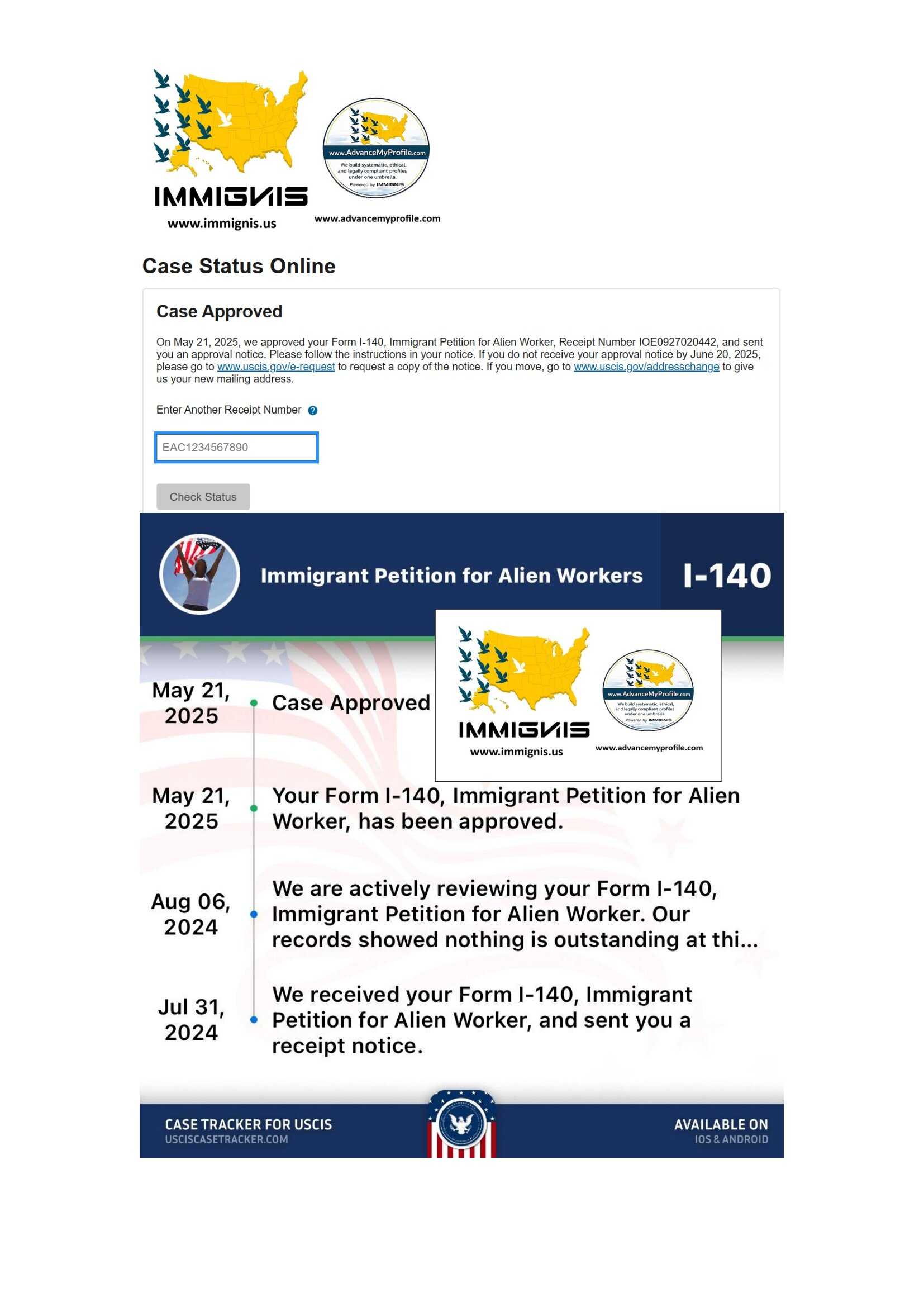
| Approval date | Approved on May 21, 2025. |
| Field niche | Explainable AI for therapy selection in complex diseases, with a focus on model validation, interpretable treatment-response signals, patient stratification, and decision support in precision-medicine analytics. |
| Starting problem | He had a strong role and high salary, but the public record did not yet show enough independent evidence that his AI methods were recognized beyond the employer setting. |
| Profile-building path | Focused publications, model-validation evidence, a precision-medicine white paper, expert media commentary, invited talks, peer review, selective membership evidence, independent letters, leading-role documentation, and high-salary analysis. |
| Evidence presented under EB-1A criteria | Scholarly articles, original contributions, published material, judging, memberships, leading or critical role, and high salary. |
USCIS approved his Form I-140 on May 21, 2025.
At first glance, the case looked strong. The petitioner, an EB-1A Swiss AI scientist, had a senior technical role in precision-medicine analytics, compensation that placed him in a high professional tier, and work connected to therapy selection in complex diseases.
That was useful. It was not enough.
EB-1A does not approve a person simply because the employer is important, the salary is high, or the field uses artificial intelligence. The petition had to show that this Swiss scientist had become a recognized specialist in a defined area of precision medicine: explainable AI methods that help researchers and clinical teams understand why a model points toward one therapy pathway, patient subgroup, or response signal rather than another.
Advance My Profile, powered by Immignis, helped organize the record around that narrow authority niche. The case became less about “AI in medicine” and more about a specific question: how can therapy-selection models be made credible, interpretable, and useful in complex-disease analytics?
A high salary and a strong role still needed a field story
The petitioner’s salary helped. His role helped. But those facts did not automatically answer the EB-1A question.
A high salary can support an EB-1A petition when the comparison is reliable and the compensation reflects work at a distinguished level. A leading or critical role can also be persuasive when the record shows that an important organization or project depended on the person’s judgment. Still, both criteria have a limit. They do not, by themselves, explain what the field recognized or why the person’s contribution mattered beyond one employer.
That was the starting weakness. The internal record showed serious pharma analytics work, but the public record needed independent evidence: publications, peer review, media discussion, invited speaking, selective membership, expert letters, and model-validation documentation that could be explained without revealing confidential data.
The petition therefore did not rely on job title or compensation alone. It used those facts as part of a broader record showing recognized expertise in explainable AI for precision-medicine decision support.
The case was not about a black-box prediction
In therapy-selection analytics, prediction is only part of the problem.
A model may indicate that a patient subgroup appears more likely to respond to a therapy, or that certain biological or clinical signals separate one group from another. But for precision medicine, a bare output can be hard to trust. Researchers need to ask why the model reached that result, whether the signal is stable, whether it reflects meaningful biology or data artifacts, and how the finding should be reviewed before anyone treats it as useful.
That is why explainability mattered in this case. His work was presented around methods for making AI-driven therapy-selection analysis more transparent: identifying influential features, checking response patterns, validating model behavior, assessing subgroup signals, and communicating analytical limits in a way that specialists could evaluate.
The petition avoided overclaiming. It did not say that a model personally cured patients or replaced physicians. It showed a specialist whose analytical methods helped precision-medicine teams examine therapy-selection questions more responsibly.
What USCIS needed to see in a precision-medicine AI EB-1A case
USCIS needed evidence that fit the EB-1A criteria and also worked at final merits. The case had to show more than technical employment. It had to show a coherent record of recognized expertise in a narrow field.
For original contributions, the petition identified model-validation methods, explainability approaches, patient-stratification logic, and analytical frameworks connected to therapy-selection research. Independent experts explained why these methods mattered in precision medicine and why interpretability is central when AI is used to study treatment response.
For scholarly articles, the record used focused publications on explainable AI, therapy-response modeling, precision-medicine analytics, patient stratification, validation, and decision-support methods. The articles gave the technical work a public scientific record.
For published material, the petition documented independent media commentary and expert coverage that discussed his work or his expertise, not merely the popularity of AI in health care. For judging, peer review showed that journals or professional venues trusted him to evaluate other specialists’ work. For memberships, the case relied on evidence of selective or achievement-based admission rather than ordinary open enrollment.
For leading or critical role and high salary, the petition used documented role evidence and a careful compensation comparison. Those arguments were strongest because they supported the same professional identity shown by the rest of the record.
The internal analytics record was rebuilt around therapy-selection decisions
Before profile building, the evidence was scattered across analytics projects, role descriptions, model work, and compensation documentation. The petition reorganized those materials around the decisions that explain his professional contribution.
Which patients or disease subgroups were being compared? What signals did the model treat as important? How was the model validated? What happened when a signal appeared strong but lacked clinical or biological plausibility? Which outputs needed specialist review before they could inform a therapy-selection discussion?
Those questions helped turn an internal analytics record into an EB-1A evidence record. The focus stayed on the methods attributable to him, the precision-medicine problem they addressed, and the independent recognition that developed around the work.
Protected patient information, proprietary drug-development strategy, confidential datasets, and employer-owned workflows stayed outside the public story.
The publications made the scientific contribution visible
The publications were not used as a simple count. They were used to show a focused body of work.
With domain support, the petitioner developed and documented articles addressing explainable AI in precision medicine, therapy-response modeling, patient subgroup analysis, model validation, and the risks of treating high-performing models as automatically trustworthy.
One line of work examined how model explanations can help researchers understand which signals contribute to therapy-selection analysis. Another addressed validation: whether a response pattern remains meaningful when tested against different assumptions, subgroups, or data conditions.
This helped USCIS see the difference between a professional who used AI tools and a scientist whose public work contributed to the way AI methods are evaluated in precision-medicine settings.
Model-validation evidence connected the work to real analytical practice
Model-validation evidence was important because AI claims can sound impressive while remaining difficult to assess.
The record documented non-confidential validation logic: how models were checked, how subgroup signals were reviewed, how interpretability methods were used, and how analytical uncertainty was handled. Where internal examples could be discussed safely, the petition showed the sequence from model output to specialist review.
The case did not claim that every downstream decision resulted from one model or one scientist. It explained how his methods contributed to more credible therapy-selection analytics and gave independent experts a concrete basis for discussing significance.
This distinction mattered. In precision medicine, an AI model is rarely persuasive because it produces a score. It becomes useful when experts can examine the evidence behind the score, test its limits, and decide whether the finding deserves further scientific or clinical review.
The white paper addressed the trust problem in precision-medicine AI
The precision-medicine white paper gave the petitioner a public document that connected his niche to a wider concern in pharmaceutical analytics and health data science: trust.
It explained why therapy-selection models need more than predictive performance. They need validation, traceability, interpretability, subgroup review, data-quality checks, and disciplined communication of uncertainty. A model that cannot be examined may be difficult to use responsibly, especially when the subject involves complex diseases and possible treatment pathways.
The white paper avoided broad slogans about AI transforming medicine. Its value was practical. It helped define what responsible therapy-selection analytics should ask before a model output is treated as meaningful.
Media commentary and invited talks moved the expertise outside the employer
Independent recognition was a major part of the case because the original file was too employer-centered.
Expert media commentary helped explain the field to a broader professional audience. The petitioner discussed why explainability matters in therapy-selection AI, how precision-medicine models can create false confidence when validation is weak, and why human review remains necessary when analytical results affect research or clinical decision pathways.
Invited talks gave him another public platform. These presentations focused on the practical questions that precision-medicine teams face: how to interpret model outputs, how to assess subgroup signals, how to avoid confusing correlation with clinical relevance, and how to document model limitations.
This evidence helped show recognition beyond an internal pharma analytics team. Other professionals were looking to him for explanation of a defined technical problem.
Peer review and membership evidence showed outside professional trust
Peer review supported the judging criterion because it showed that journals or professional venues trusted him to evaluate work by other researchers and specialists. The record documented the subject matter reviewed and the analytical judgment required.
In a field like precision-medicine AI, peer review can be especially relevant because the reviewer must assess whether the methods are sound, whether the validation is sufficient, whether conclusions follow from the evidence, and whether authors are overstating what a model can do.
Membership evidence was treated with the same discipline. The petition identified the selective or achievement-based standard, the professional body involved, and the basis for admission or elevation. Ordinary memberships that anyone could buy were not presented as major recognition.
The leading-role and high-salary evidence was useful because it matched the niche
This case had strong employment evidence. The petitioner held a serious role in a U.S.-based pharma analytics environment, and his compensation supported a high-salary argument.
The petition did not leave those points isolated. Leading or critical role evidence showed why important analytics work depended on his technical judgment. High-salary evidence used compensation documentation and a relevant comparison group, rather than a general claim that he was well paid.
The strongest part of this evidence was consistency. His role, compensation, publications, model-validation record, media commentary, judging, and expert letters all pointed toward the same professional identity: a precision-medicine AI scientist focused on explainable therapy-selection analytics.
Independent letters explained why explainability mattered
Independent expert letters helped USCIS understand the importance of the work without relying on confidential employer documents.
The strongest letters did not simply call him talented. They identified the technical problem, explained the methods attributed to him, and described why explainable AI matters when precision-medicine teams study therapy selection, patient stratification, and complex-disease response patterns.
They also helped clarify the practical significance of the contribution. In drug development and precision medicine, a model that produces an unexplained therapy signal may be difficult to trust. A model that can be examined, validated, and interpreted can support better scientific review and more disciplined decision pathways.
How the EB-1A evidence came together
The approval did not depend on one impressive fact. The petition worked because the evidence formed one coherent record.
- Scholarly articles showed focused authorship in explainable AI, model validation, patient stratification, and therapy-selection analytics.
- Original-contribution evidence identified methods and analytical frameworks connected to interpretable precision-medicine decision support.
- Published material and expert commentary showed public recognition of his expertise beyond the employer setting.
- Judging evidence documented peer review and evaluation of work by other specialists.
- Selective membership evidence supported professional recognition where admission or elevation standards were documented.
- Leading-role evidence and high-salary documentation strengthened the record because both matched the same specialized authority niche.
- Independent letters explained why his work mattered to precision-medicine analytics and responsible use of AI in therapy-selection research.
At final merits, the petition presented a scientist whose evidence was consistent: public authorship, technical contribution, independent recognition, professional judgment, compensation evidence, and expert explanation all described the same narrow field.
The approval
USCIS approved the Form I-140 on May 21, 2025.
For the petitioner, the approval showed that a highly technical pharma analytics career can support EB-1A when the record goes beyond title, salary, and internal project work.
The case also offers a useful lesson for AI and precision-medicine professionals. Strong compensation and a respected role may help, but they should not be treated as the whole case. EB-1A requires a record that shows recognized expertise, independent corroboration, and a field-level contribution that USCIS can understand.
What precision-medicine AI professionals can learn from this case

Many professionals working in pharmaceutical analytics, health AI, bioinformatics, clinical decision support, and precision medicine have strong internal records. They may build models, validate algorithms, develop patient-stratification methods, and support important research decisions. Yet their public record may still be thin.
This case shows why the authority niche matters. “AI in medicine” is too broad. “Explainable AI for therapy selection in complex diseases” is specific enough for publications, peer review, media commentary, expert letters, and USCIS analysis to point in the same direction.
The strongest EB-1A records do not merely list technical tasks. They explain the problem, identify the person’s method, document recognition, and show why the contribution matters beyond the employer.
For this client, the story was not that an AI model predicted something. The story was that his work helped make therapy-selection analytics more interpretable, more testable, and more credible for precision-medicine decision pathways.
FAQ
Can precision-medicine AI work support an EB-1A petition?
Yes. Precision-medicine AI work can support EB-1A when the petition documents the applicant’s individual contributions, independent recognition, scholarly authorship, judging or peer review, and field-level significance. A job title in AI or pharma analytics is not enough by itself.
Is high salary enough for EB-1A approval?
No. High salary can be useful evidence when properly documented and compared against the right market, occupation, and seniority level. It is strongest when it supports a broader record of original contributions, recognition, and leading or critical work.
Why is explainable AI important in precision medicine?
Explainable AI helps researchers and clinical teams examine why a model produced a therapy-selection or patient-stratification signal. In complex diseases, interpretability, validation, and review of uncertainty are essential before model outputs can be treated as meaningful.
Can internal pharma analytics work be used in an EB-1A case?
Internal work can help, but it usually needs careful documentation. The petition should identify the methods attributable to the applicant, separate confidential details from safe public evidence, and use independent experts or public recognition to explain significance beyond the employer.
What was the main lesson from this EB-1A approval?
The main lesson is that strong role evidence should be converted into a recognized authority record. For this petitioner, the case succeeded by tying publications, validation evidence, media commentary, peer review, selective membership, high salary, and expert letters to one narrow specialty in precision-medicine AI.
Build an EB-1A record around the precision-medicine expertise you can prove
Advance My Profile, powered by Immignis, helps researchers, engineers, founders, physicians, and technical leaders identify a defensible authority niche, develop credible public evidence, and prepare EB-1A records around facts that can be verified and explained professionally.