How a transportation safety record was rebuilt around predictive maintenance, risk signals, and infrastructure reliability rather than routine project management
Key facts at a glance
| Outcome | EB-1A approval for an Austrian rail safety engineer working with a U.S.-based transportation contractor. |
| Approval date | Approved on June 26, 2026. |
| Field niche | Predictive maintenance and safety analytics for rail networks, with a focus on asset-condition signals, failure-mode risk, maintenance prioritization, and infrastructure reliability. |
| Starting problem | His work was important to rail operations, but the early record could be read as operational project management rather than recognized engineering expertise. |
| Profile-building path | Focused technical papers, rail safety dashboard evidence, an agency-facing white paper, trade-media coverage, invited talks, judging evidence, selective membership documentation, leading-role evidence, and independent letters from transportation safety and rail analytics experts. |
| Evidence presented under EB-1A criteria | Original contributions, scholarly articles, published material, judging, memberships, and leading or critical role. |
USCIS approved his Form I-140 on June 26, 2026.
The approval belonged to an Austrian engineer whose strongest work did not look dramatic from the outside. There was no single bridge collapse, derailment, or emergency scene at the center of the case. The important work happened earlier, inside the maintenance decisions that keep rail networks from reaching that point.
A wheelset vibration pattern, a track-condition trend, a repeated fault code, a component that fails more often after certain operating conditions, a maintenance window that closes before the next inspection cycle. For rail systems, these details can decide whether a risk is handled as planned maintenance or becomes a service disruption with safety consequences.
The petitioner worked with a U.S.-based transportation contractor. His field was predictive maintenance and safety analytics for rail networks. The first version of the record, however, did not fully show that specialty. It showed projects, dashboards, reports, and transportation operations. It needed to show a rail safety engineer whose methods helped teams understand maintenance risk before it became an operational failure.
Advance My Profile, powered by Immignis, helped organize the case around that narrow professional identity. The petition moved away from a general transportation-management story and focused on a specific engineering question: how can rail networks use data to identify which maintenance problems deserve attention first, and why?
The early record looked like project work, not field-level safety expertise
That was the main risk in the case. Rail infrastructure projects are often large, complex, and important, but EB-1A does not approve a person simply because a project is important. The petition had to show the petitioner’s own methods, judgment, recognition, and contribution within the field.
His original evidence could have been read as operational support. He worked with maintenance data, safety dashboards, contractor deliverables, asset records, and reliability reporting. Those materials were useful, but without explanation they did not clearly separate his technical contribution from ordinary project execution.
The record needed a sharper frame. Predictive maintenance in rail is not just scheduling repairs. It involves reading asset-condition signals, understanding failure modes, deciding which warnings are meaningful, prioritizing inspections, and helping operators act before the risk becomes harder to control. That was the work the petition had to make visible.
The case therefore became an evidence exercise in attribution. Which analytical methods were his? Which safety questions did they answer? Where did the work enter maintenance or reliability decisions? Who outside the employer recognized the value of those methods?
His niche was the decision before the maintenance failure
Rail networks contain many assets that age, move, vibrate, heat, wear, and fail under different operating conditions. Tracks, switches, rolling stock components, signal equipment, power systems, and station infrastructure all produce records that may contain early signs of risk.
The challenge is that data volume can create false confidence. A dashboard may show many alerts without telling engineers which one matters most. A repeated fault code may reflect a known nuisance condition, or it may show a pattern that deserves closer review. A component may remain within a normal threshold while still showing a trend that changes the inspection question.
The petition presented the petitioner’s work around that decision point. His methods helped connect inspection records, sensor data, maintenance history, asset condition, service reliability, and safety review. The goal was not to replace engineering judgment with an algorithm. The goal was to give maintenance and safety teams better evidence for deciding what to inspect, when to intervene, and how to prioritize limited maintenance windows.
The petition avoided overclaiming. It did not say that predictive analytics can eliminate all rail failures or guarantee safety. It showed a specialist whose work helped make maintenance risk more visible, more structured, and easier to act upon in rail network environments.
What USCIS needed to see in a rail safety analytics EB-1A case
USCIS needed more than a description of transportation projects. The petition had to present evidence under the EB-1A criteria and then show, at final merits, that the record reflected sustained acclaim and a level of expertise consistent with extraordinary ability.
For original contributions, the petition identified predictive-maintenance methods, rail safety dashboard logic, maintenance-prioritization approaches, and analytics frameworks tied to the petitioner. Independent experts explained why those contributions mattered to transportation safety, infrastructure reliability, and rail maintenance practice.
For scholarly articles, the record used focused technical publications on rail predictive maintenance, safety analytics, asset-condition monitoring, failure-mode analysis, and maintenance prioritization. The articles gave his work a public technical language rather than leaving it inside contractor documentation.
For published material, trade-media coverage and expert commentary had to discuss his expertise or the specific rail safety problem, not merely the general growth of transportation technology. For judging, the petition documented real evaluation of work by other professionals, including technical submissions, innovation competitions, or peer-review activity connected to transportation, infrastructure, or safety analytics.
Membership evidence required selective admission or advancement standards based on achievement, not ordinary paid enrollment. Leading or critical role evidence had to show why significant rail safety or maintenance analytics work depended on his technical judgment.
The internal record was rebuilt around the path from signal to decision
Before profile building, the evidence was scattered across dashboards, project descriptions, contractor materials, and maintenance records. The petition reorganized those materials around the decisions they supported.
What asset was being monitored? Which signal changed? Was the change connected to a known failure mode? Did the risk affect safety, service reliability, maintenance cost, or inspection priority? Which engineering decision followed from the analysis?
Those questions helped turn operational records into EB-1A evidence. The record showed a sequence: collect rail asset information, identify relevant condition signals, evaluate the failure-mode risk, compare the urgency of competing maintenance needs, and support a documented engineering or maintenance decision.
The public version did not expose protected client information, contractor-sensitive data, system vulnerabilities, or confidential infrastructure details. It focused on methods, decision logic, and non-confidential examples that could be reviewed by independent experts.
The rail safety dashboard evidence showed use, not just software
Dashboard evidence was important because the case was not about writing code for a screen. A useful rail safety dashboard must help people make decisions.
The record documented how condition data, inspection history, maintenance events, reliability indicators, and safety-relevant signals were organized for review. It showed how the petitioner’s work helped turn raw records into risk categories, priority views, or decision support for maintenance and safety teams.
The petition stayed disciplined about metrics. Where records supported a connection between the analytics work and improved inspection focus, maintenance prioritization, or reliability review, the case explained that connection. It did not claim that every service improvement or risk reduction resulted from one dashboard or one engineer.
That restraint made the evidence more credible. In rail systems, many factors affect reliability: staffing, parts availability, weather, inspection frequency, funding, operating schedules, and engineering decisions. The petition focused on the petitioner’s contribution to the analytical method and its practical use within the maintenance process.
The publications turned a contractor record into a public engineering record
The scholarly and technical papers helped answer a problem common to transportation engineers: the best work often lives inside internal systems. Without public authorship, USCIS may see employment activity but not field recognition.
The publications addressed predictive maintenance for rail assets, failure-mode interpretation, dashboard design for safety review, condition-monitoring methods, and the risk of treating every alert as equally urgent.
One line of work examined how rail systems can prioritize maintenance when several assets show warning signs at the same time. Another addressed the difference between a data anomaly and a safety-relevant pattern. These subjects matched the work he had already been doing, but they made the technical contribution visible to the field.
The papers were not presented as a simple publication count. They supported the central story: he was not only managing rail projects; he was contributing to the way predictive analytics can help rail networks understand and act on maintenance risk.
The white paper translated rail analytics for transit agencies
The agency-facing white paper gave the case a practical bridge between engineering detail and public infrastructure policy.
It explained why predictive maintenance matters to transit agencies and rail operators. Rail networks often operate with aging assets, constrained maintenance windows, passenger-service obligations, and safety responsibilities. When maintenance decisions are made too late, the cost is not only technical. It can affect reliability, service planning, public trust, and safety oversight.
The white paper organized the subject around asset condition, early warning signals, failure modes, maintenance prioritization, reliability planning, and the need to keep human engineering review in the decision loop.
This document helped position the petitioner’s work in a broader infrastructure context without turning the petition into a general policy essay. It showed why his narrow analytics specialty mattered to transportation agencies that must decide how to maintain complex rail systems under real constraints.
Media coverage and invited talks moved the expertise outside the project file
Independent recognition was necessary because the original evidence was too employer-centered. Trade-media coverage and invited talks helped move the petitioner’s expertise into the public professional record.
In media commentary, he explained why predictive maintenance is not simply about collecting more data. Rail operators need to know which signals are trustworthy, how historical maintenance records should be interpreted, and when a trend should change inspection priority.
His invited talks addressed practical rail safety questions. What happens when a dashboard produces too many alerts? How should teams treat low-frequency but high-consequence failure modes? When should a maintenance team act on a trend that has not yet crossed a formal threshold? How can analytics support, rather than replace, experienced rail engineers?
These public explanations mattered because they showed that the field was not only receiving his work through internal contractor channels. Other professionals were being asked to hear his analysis of rail maintenance and safety problems.
Judging and membership evidence showed outside professional trust
Judging evidence was handled carefully. The petition documented assignments where he evaluated the work of others, such as technical submissions, transportation innovation proposals, safety analytics projects, or peer-reviewed work connected to infrastructure reliability.
This mattered because judging is not the same as attending a conference or presenting a talk. The evidence had to show that other organizations trusted his professional judgment to assess the merit of work produced by other specialists.
Selective membership evidence was also reviewed by the actual admission or advancement rules. Ordinary membership in a professional organization was not enough. The petition used membership evidence only where the record showed a standard tied to professional achievement, expertise, or expert assessment.
Together, judging and membership evidence helped support a broader recognition record. They showed that his expertise was being used outside one employer or contractor relationship.
Independent letters explained why the work was not ordinary maintenance support
Independent expert letters were central to the case because rail analytics can look routine when explained only through project records.
The strongest letters did not simply say that the petitioner was skilled. They explained the technical problem: rail networks generate condition data, fault records, maintenance histories, and operational signals, but the value comes from interpreting those records in a way that supports safer and more reliable decisions.
Experts described why predictive maintenance and safety analytics can matter when aging infrastructure, tight maintenance windows, and service demands compete for attention. They also explained why his contribution was more than software support. It involved engineering judgment about risk signals, failure modes, prioritization, and the practical use of analytics in rail maintenance environments.
Those letters gave USCIS a way to understand the significance of the work without reviewing confidential transit-system data or proprietary contractor files.
How the EB-1A evidence came together
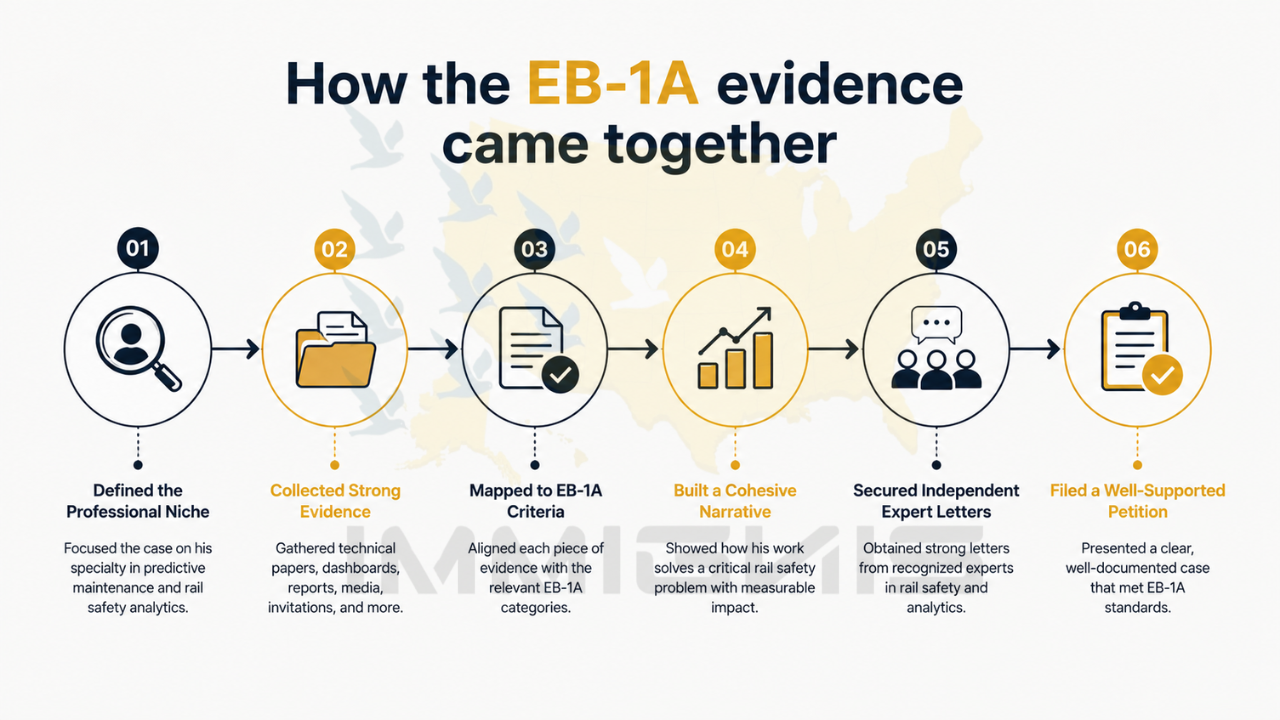
The approval did not rest on one document. The case worked because the evidence pointed to one professional identity: a rail safety engineer focused on predictive maintenance and infrastructure reliability analytics.
Original-contribution evidence identified the petitioner’s safety analytics methods, dashboard logic, maintenance-prioritization work, and rail risk frameworks.
Scholarly articles gave the internal engineering work a public technical record.
Published material and trade-media commentary showed recognition of his expertise outside the employer setting.
Judging evidence documented his evaluation of work by other professionals in transportation, infrastructure, safety analytics, or allied technical fields.
Selective membership evidence supported professional recognition where the standard was based on achievement or expert assessment.
Leading-role evidence showed that important rail maintenance or safety analytics work depended on his judgment, rather than treating him as a routine project participant.
At final merits, the evidence told a consistent story. The petitioner had technical authorship, identifiable contributions, public recognition, professional judgment, selective recognition, and independent expert support in one defined rail safety niche.
The approval
USCIS approved the Form I-140 on June 26, 2026.
For the petitioner, the approval showed that transportation engineering work can support EB-1A when the record does more than list projects. The petition had to explain how his methods helped rail networks interpret risk, prioritize maintenance, and protect infrastructure reliability.
The case also offers a useful lesson for engineers in transportation, utilities, energy, aviation, logistics, and other infrastructure fields. Internal systems can contain strong EB-1A evidence, but the evidence must be organized around the person’s contribution, not merely the organization’s project.
What rail and infrastructure professionals can learn from this case
Many rail engineers, safety specialists, reliability engineers, and infrastructure analytics professionals work on systems that are important but not public. Their work may be documented in dashboards, contractor reports, maintenance files, inspection records, safety reviews, and confidential client materials.
That kind of record can be valuable, but it usually needs translation. USCIS must be able to see the professional niche, the method, the applicant’s role, the significance of the contribution, and the recognition outside ordinary employment.
For this petitioner, the strongest story was not that he worked on rail projects. The story was that his predictive-maintenance and safety analytics work helped convert rail asset data into better maintenance and reliability decisions.
That distinction mattered. Project participation can show experience. A well-documented authority record can show extraordinary ability.
FAQ
Can rail safety or predictive-maintenance work support an EB-1A petition?
Yes. Rail safety and predictive-maintenance work can support EB-1A when the petition documents the applicant’s individual technical contribution, field-level significance, independent recognition, scholarly or technical authorship, judging evidence, and other qualifying criteria. A transportation job title alone is not enough.
Why did this case need a narrow field niche?
A broad label such as transportation engineering can make the evidence look scattered. The narrower niche, predictive maintenance and safety analytics for rail networks, allowed the petition to connect publications, dashboards, media commentary, judging, membership evidence, and expert letters to one recognizable area of expertise.
Can internal rail project evidence be used in an EB-1A case?
Internal project evidence can be useful if it is documented carefully. The petition should identify the applicant’s methods, explain how the work entered decisions, protect confidential details, and use independent evidence to show significance beyond routine employment.
Does a rail safety dashboard count as an original contribution?
A dashboard by itself is not automatically an original contribution. The stronger argument comes from the method behind it: how data is selected, how risk is categorized, how failure modes are evaluated, how decisions are supported, and whether independent experts can explain why the work matters in the field.
What was the main lesson from this EB-1A approval?
The main lesson is that infrastructure professionals should not rely only on project importance. The petition must show the applicant’s own contribution, recognition, and field-level expertise. In this case, the record succeeded by presenting rail predictive maintenance as a safety and reliability contribution, not ordinary operational project management.
Build an EB-1A record around the infrastructure expertise you can prove
Advance My Profile, powered by Immignis, helps engineers, researchers, founders, physicians, and technical leaders identify a defensible authority niche, develop credible public evidence, and prepare EB-1A records around facts that can be verified and explained professionally.