How a cross-border AI systems specialist turned legally adjacent work into a technical EB-1A record
Key facts at a glance
| Outcome | EB-1A approval for a Belgian data privacy architect working at a U.S.-based enterprise software company. |
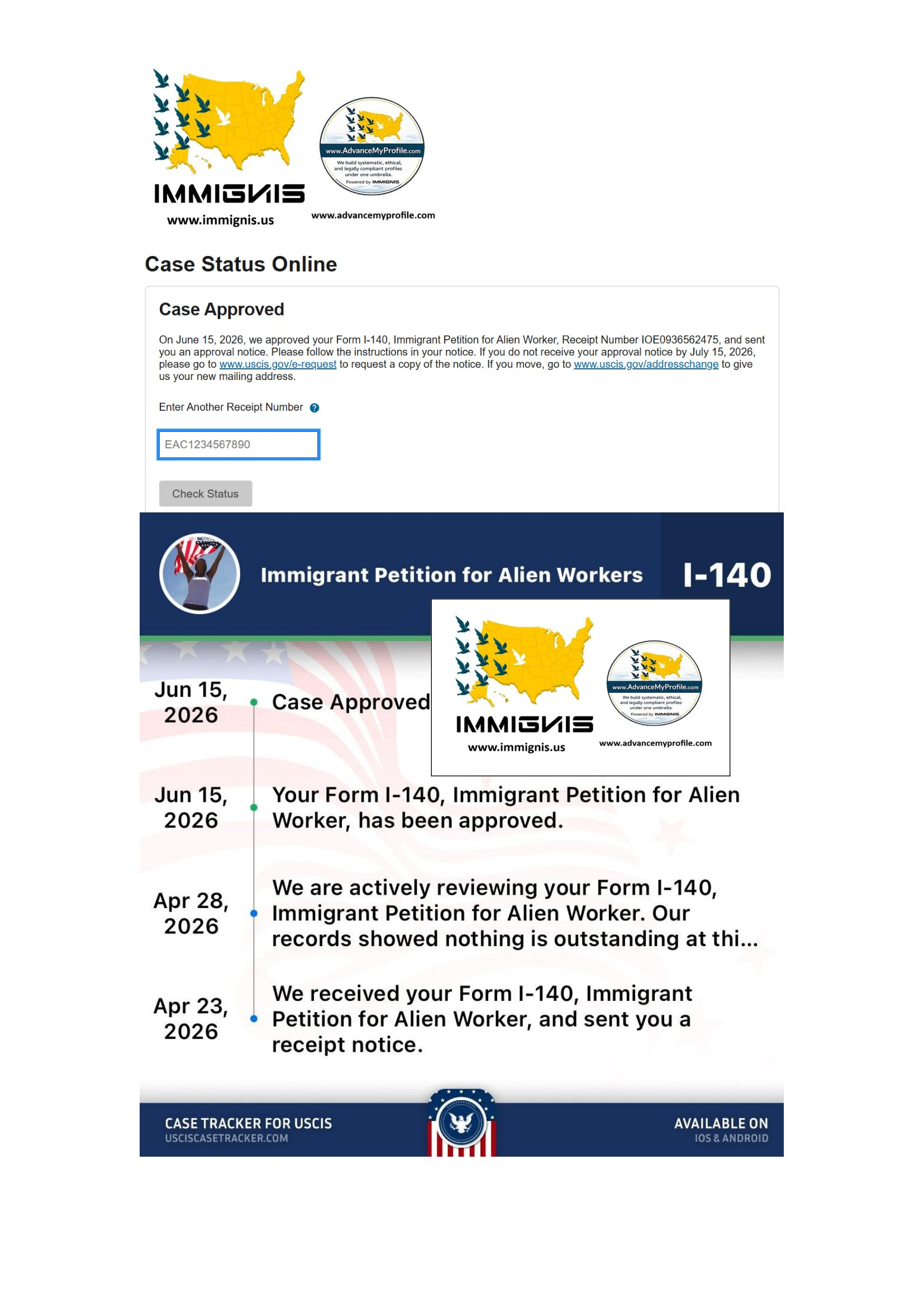
| Approval date | Approved on June 15, 2026. |
| Field niche | Privacy engineering for cross-border AI systems, with a focus on data flows, access boundaries, model lifecycle controls, retention, auditability, and trustworthy AI deployment across jurisdictions. |
| Starting weakness | The record sounded legally adjacent. It showed privacy reviews, governance activity, and enterprise software work, but it did not yet show his technical authorship of privacy architecture or sustained recognition as a specialist. |
| Profile-building path | Advance My Profile, powered by Immignis, built a privacy-engineering authority record through technical articles, a governance white paper, standards participation, expert commentary, invited panels, peer review, membership elevation, leading-role evidence, and independent letters from privacy-engineering leaders. |
| Evidence presented under EB-1A criteria | Original contributions, scholarly articles, published material, judging, memberships, and leading or critical role. |
| Approval focus | The petition showed that privacy architecture was not only a compliance function. It was a technical contribution to trustworthy AI systems used across borders. |
On June 15, 2026, USCIS approved the Form I-140 petition of a Belgian EB-1A AI Privacy Architect working for a U.S.-based enterprise software company.
The approval did not come from presenting him as a lawyer, a compliance manager, or an employee who had sat in enough governance meetings. The case worked because the record was rebuilt around a more exact proposition: modern AI privacy is an engineering problem.
A cross-border AI system does not become trustworthy because a policy document says it should. It becomes safer when the architecture controls where data travels, who can access it, which logs are created, what the model lifecycle retains, what is reviewed after deployment, and how a change in purpose or geography is detected before the risk becomes invisible.
That was the professional space where his work belonged. The challenge was that his original record did not say it clearly enough.
The first problem was not privacy. It was translation.
His work sat between engineering, product design, data governance, security, and privacy law. That made the career valuable, but also easy to misunderstand. A technical reviewer could see system design. A lawyer could see compliance language. USCIS needed evidence that his individual work showed extraordinary ability in a defined field.
The first version of the profile leaned too heavily on broad descriptions: privacy reviews, global governance, enterprise AI, cross-border data, and responsible technology. Those phrases described a working environment. They did not yet identify a field-level contribution.
The narrower field was privacy engineering for cross-border AI systems. That field gave the petition a technical center. It allowed the evidence to focus on system architecture, lifecycle controls, data-flow design, retention logic, access models, auditability, and the privacy risks created when AI systems operate across different legal, operational, and geographic settings.
The distinction mattered. Many professionals help companies comply with data-protection obligations. Fewer can show that they designed technical methods for controlling how AI systems collect, transform, monitor, retain, and expose information across borders.
Why a legal-adjacent profile can be risky in EB-1A
Privacy professionals often have impressive responsibilities but uneven EB-1A evidence. Their work may be embedded in internal reviews, product documentation, control frameworks, risk assessments, and confidential system diagrams. The company may rely on them, but public evidence may still be thin.
For this petitioner, the risk was that USCIS could view the record as ordinary corporate privacy work. A strong title, a major employer, and involvement in sensitive projects would not be enough by themselves. The petition needed to show original technical contribution, recognition outside the company, and a record that was consistent with sustained acclaim.
That meant the profile could not stay at the level of “privacy governance.” Governance is too broad. It can mean policy drafting, legal review, risk reporting, product approval, or technical design. The petition had to explain which part of the work belonged to him and why other specialists should recognize it as significant.
The field was defined around the AI data lifecycle
The case was organized around the path data takes through an AI system. Data may enter through user input, product activity, business records, customer systems, support channels, integrations, or monitoring tools. Once inside an AI workflow, it may be transformed, filtered, embedded, logged, retained, sampled for evaluation, or reused for model improvement.
Cross-border systems add another layer. A product may serve users in multiple countries, rely on cloud infrastructure in several regions, support different customer contracts, and involve teams with different operational access. A feature that appears minor from a product standpoint can change the privacy architecture if it creates a new data flow, new retention practice, new inference, or new access route.
The petition therefore did not describe his niche as generic AI governance. It described his role in building technical controls that allowed enterprise AI systems to be deployed with clearer data boundaries and better accountability.
That framing made the evidence easier to evaluate. It also prevented the case from drifting into a discussion of legal compliance alone.
What USCIS needed to see in this privacy-engineering EB-1A case
A privacy job title could show experience. It could not, by itself, show extraordinary ability.
For original contributions, the petition had to identify the petitioner’s technical methods: how he mapped data flows, controlled access, documented lifecycle decisions, handled logs and derived information, structured privacy review triggers, and connected architecture decisions to trustworthy AI deployment. It also had to explain why those methods mattered beyond a routine job assignment.
For scholarly articles, the record needed focused writing on privacy engineering, cross-border AI systems, data-flow architecture, model lifecycle controls, and technical governance. General privacy opinion pieces would not have carried the same value.
For published material, the petition needed independent coverage about him or his expertise. A company announcement or internal biography would not have been enough.
For judging, the evidence had to show actual evaluation of other specialists’ work, such as peer review or review activity tied to privacy engineering, AI governance, security, data systems, or responsible technology. Participation in a panel did not automatically become judging.
For memberships, the record had to show selective admission or elevation based on professional achievement. Open enrollment or paid membership was kept separate.
For leading or critical role, the evidence had to show why significant enterprise AI privacy architecture depended on his technical judgment. The company’s importance alone was not enough; the petition needed his role in the work.
The internal record was rebuilt around decisions engineers could recognize
The profile-building work began by separating labels from decisions.
Instead of grouping evidence under broad categories such as privacy review, compliance support, or AI governance, the record was reorganized by engineering question: What data entered the system? Which stage of the model lifecycle used it? Who could access it? What new information was created? What should be retained? What should be logged? Which model or product change should trigger another review?
This gave the case a technical spine. Role documents, non-confidential architecture descriptions, governance materials, and safe examples were connected to design choices rather than to policy titles.
The petition did not expose customer data, proprietary system diagrams, internal controls, or confidential product information. It described the method, the problem, the petitioner’s role, and the technical importance of the work at a level that could be evaluated without disclosing protected material.
That balance was important. Privacy architects often cannot publish the most sensitive details of their work. The EB-1A record therefore has to show enough technical substance to prove expertise while protecting the systems and users the work was designed to safeguard.
Technical articles made the work visible outside the employer
The petitioner’s public authorship had to do more than repeat that privacy is important. The articles developed for the record explained how privacy questions arise inside AI architecture.
One article examined data minimization across the model lifecycle: not only whether a system should receive a data field, but whether that field remains necessary during evaluation, monitoring, logging, and later review. Another article addressed cross-border access boundaries in enterprise AI systems, explaining why regional deployment, support access, telemetry, and product analytics can change the risk picture after launch.
The articles were written for professionals who build, evaluate, or govern AI products. They helped establish that the petitioner was not merely commenting on privacy from the outside. He was explaining the technical decisions that allow AI systems to be operated with privacy controls built into the architecture.
The governance white paper treated privacy as a system design problem
The white paper became one of the clearest public documents in the record because it used a practical structure: trace the data, define the purpose, map access, identify derived information, document retention, review monitoring, and revisit controls after a material system change.
It was not a legal memorandum. It did not try to summarize every privacy law. Its value was more concrete. It gave product, security, privacy, and engineering teams a way to discuss whether an AI system’s technical design still matched the privacy assumptions under which it had been approved.
For EB-1A purposes, the white paper helped convert internal professional judgment into public technical authorship. It also gave independent experts a document they could evaluate when explaining why his work had significance in privacy engineering and trustworthy AI.
Standards participation helped show recognition beyond one company
Standards-related activity was handled carefully. The petition identified the relevant groups, the subject matter, his participation, and the technical comments or working activity that could be documented. It did not claim that simple attendance was a major contribution.
The value of this evidence was that other privacy, data, AI, and security professionals were considering the same problems he had been addressing in enterprise systems. His participation showed that his technical judgment was part of a wider professional conversation, not only an internal company process.
That mattered for final merits. EB-1A requires more than a well-described job. The record must show recognition and a level of expertise that places the person among the small percentage who have risen to the top of the field.
Expert commentary translated the field for a broader audience
The published material and media commentary focused on the question many non-specialists miss: AI privacy risk does not end when a user submits data.
He explained that prompts, logs, telemetry, model outputs, evaluation records, and monitoring streams can create new privacy questions after a system is deployed. He also discussed why cross-border AI products need technical controls that follow data through operation, support, and change management.
This coverage helped the public record in two ways. It showed that independent outlets viewed his expertise as useful, and it gave USCIS a clearer understanding of why privacy architecture is a technical field rather than a box-checking exercise.
Invited panels showed a specialist other professionals wanted to hear from
The invited panels were not treated as a substitute for judging. They were documented as evidence of recognition, speaking, and field engagement.
His presentations addressed issues that enterprise AI teams face in practice: what happens when a model feature changes, when monitoring data becomes sensitive, when support access crosses a region boundary, or when a product team wants to reuse data for a new purpose.
Those discussions helped connect his internal architecture experience with public professional education. They also supported the story that the petitioner had become a recognizable voice in privacy engineering for AI systems.
Peer review and membership evidence required discipline
Peer review provided the judging evidence. The file documented review activity in subjects tied to privacy engineering, data governance, security architecture, responsible AI, and enterprise technology. The work required him to assess technical claims, method design, risk reasoning, controls, and whether conclusions followed from the evidence.
Membership evidence was also reviewed carefully. The petition relied on selective membership or elevation where the record showed professional achievement, expert assessment, or a meaningful advancement process. It did not rely on ordinary open membership as though it were evidence of extraordinary ability.
That discipline was important because weak memberships can hurt credibility. In a technical EB-1A case, the record should not make every professional association look equally selective.
Independent letters explained why the work mattered
The expert letters were not written as general praise. They had a specific job: to explain why the petitioner’s privacy-engineering work mattered to cross-border AI systems.
Privacy-engineering leaders described the technical problem, the petitioner’s identifiable contribution, and why lifecycle controls, data-flow architecture, access boundaries, and change-triggered review are significant in trustworthy AI deployment. Where appropriate, they connected his methods to wider concerns in enterprise AI, data protection, and system accountability.
Good expert letters do not simply say that someone is impressive. They help USCIS understand what the person contributed, how the contribution is used or recognized, and why the field should care.
How the EB-1A evidence came together
The successful record did not depend on one document. It worked because the evidence described the same specialist from different angles.
The technical articles established focused authorship in privacy engineering for AI systems. The white paper gave the record a public method. Standards participation showed professional engagement beyond one employer. Published material and expert commentary showed independent attention to his expertise. Peer review supported judging. Membership elevation supported professional recognition. Leading-role evidence connected the work to significant enterprise AI privacy architecture. Independent letters explained why the technical contribution mattered.
Together, those pieces addressed the core weakness: a career that originally looked legally adjacent became a technical EB-1A record built around privacy architecture for cross-border AI systems.
What changed after the profile was rebuilt
The final petition no longer asked USCIS to infer extraordinary ability from a prestigious employer or a sophisticated job title. It showed a defined field, an identifiable technical contribution, and multiple forms of independent recognition.
The record also avoided overclaiming. It did not say that the petitioner alone solved AI privacy. It did not present compliance work as invention. It did not treat every panel, membership, or article as equally important. Instead, it explained how his technical work helped build privacy controls into AI systems that operate across borders.
That approach gave the case the credibility it needed. On June 15, 2026, USCIS approved the Form I-140.
Why this case is useful for privacy, security, and AI professionals
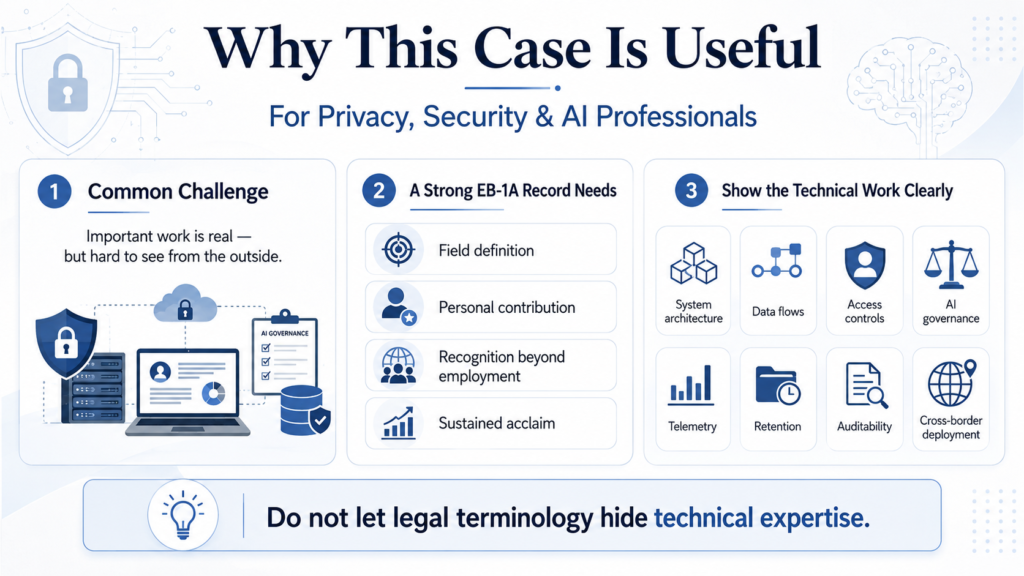
This success story is especially relevant for professionals whose work sits between technology and regulation. Privacy engineers, AI governance architects, security leaders, data-protection specialists, trust-and-safety professionals, and enterprise software architects often face the same problem: their most important work is real, but it is not easy to see from the outside.
A strong EB-1A case requires more than proving that the work is sensitive or important to an employer. It requires a field definition, evidence of personal contribution, recognition beyond ordinary employment, and a final record that shows sustained acclaim.
For privacy professionals, the lesson is direct. Do not let legal terminology hide technical expertise. If your work involves system architecture, data flows, access controls, AI lifecycle governance, telemetry, retention, auditability, or cross-border deployment, the record should show those technical decisions clearly.
Frequently asked questions
Can privacy engineering qualify for EB-1A?
Yes, where the evidence shows extraordinary ability in a defined technical field. A petition should not rely only on compliance duties or privacy-policy work. It should identify the person’s technical contribution, public recognition, judging activity, authorship, membership evidence, leading role, and the significance of the work.
Is AI governance enough for EB-1A?
AI governance is usually too broad by itself. The stronger approach is to define the technical niche more precisely, such as privacy engineering for cross-border AI systems, model lifecycle controls, data-flow architecture, or trustworthy AI infrastructure.
Can confidential enterprise software work support EB-1A?
Yes, but it has to be documented carefully. The petition can use non-confidential summaries, safe technical descriptions, public authorship, expert letters, and evidence of recognition without exposing customer data, proprietary systems, or protected architecture details.
Does participation in standards work count as a separate EB-1A criterion?
Standards participation is not a separate regulatory criterion. It can still strengthen the record when it shows technical judgment, professional recognition, original contribution, or engagement with experts beyond one employer.
What is the biggest mistake in privacy-related EB-1A cases?
The biggest mistake is presenting the person as generally important because privacy is important. USCIS needs evidence that the petitioner has personally made recognized contributions and has achieved sustained acclaim in the defined field.
Build an EB-1A record around your technical privacy architecture
If you work in AI privacy, data governance, security architecture, enterprise software, cross-border data systems, or trustworthy AI, your strongest work may be hidden inside internal reviews, control frameworks, and confidential platform decisions.
Immignis and Advance My Profile help professionals identify a defensible authority niche, document individual contributions, build credible recognition, and prepare an EB-1A record around evidence that can be verified and professionally defended.