Key facts at a glance
| Outcome | EB-1A approval for an Estonian digital identity expert working at a U.S.-based government-technology company. |
| Approval date | Approved on May 7, 2026. |
| Field niche | Secure digital identity and fraud-resistant public services, with a focus on identity proofing, authentication risk, credential trust, auditability, and safer access to government services. |
| Starting problem | His government-technology background was strong, but the record had limited U.S.-specific recognition and did not yet present his identity work as a clear EB-1A authority niche. |
| Profile-building path | Advance My Profile, powered by Immignis, helped build a digital-identity authority record through publications, a public-sector modernization policy brief, expert media commentary, invited government-technology talks, judging in civic-technology competitions, membership elevation, leading-role evidence, and independent letters. |
| EB-1A criteria supported in the petition | Original contributions, scholarly articles, published material, judging, memberships, and leading or critical role. |
The approval came from a narrow public-service security record, not from a broad technology title
USCIS approved his Form I-140 on May 7, 2026.
The approval did not rest on the fact that he had worked in government technology. That kind of background can be impressive, but it can also be difficult to explain in an EB-1A Digital Identity Expert. Public-sector technology is often described through program names, vendor roles, security policies, implementation timelines, and modernization goals. Those descriptions may show responsibility. They do not automatically show extraordinary ability.
The stronger story was more specific. He was an Estonian digital identity expert working at a U.S.-based government-technology company, and his field niche was secure digital identity and fraud-resistant public services. His work sat at the point where a resident, applicant, patient, license holder, taxpayer, or benefits recipient tries to prove identity through a digital system, and the public agency must decide whether the access request can be trusted.
That question sounds simple until the system fails. A weak identity process can allow fraud. A harsh or poorly designed process can block real users from services they need. A credential may be valid in one context and unsafe in another. A login may pass basic authentication while still presenting risk because of device behavior, data mismatch, unusual access patterns, or gaps in proofing. The petition had to show that he was not merely managing a government technology project. It had to show that he had developed recognized expertise in how secure digital identity should work for public services.
Why the original profile was too broad for EB-1A
His early profile had the common problem seen in government-technology cases: it sounded important, but not yet personal enough.
It showed public-sector modernization, digital services, identity systems, security reviews, and work with government or enterprise technology. Those facts helped establish a professional background. They did not yet answer the adjudication question that matters in an EB-1A case: what original contribution can be traced to this person, and why has the field recognized it?
Another issue was geography. He came from Estonia, a country known for advanced digital-government infrastructure, and he later worked in the United States through a government-technology company. That international background helped, but the petition could not rely on national reputation, employer reputation, or the general strength of a digital-government ecosystem. The record had to identify his own authority.
The case therefore moved away from a broad label such as “government technology expert.” It focused on a narrower and more defensible professional field: secure digital identity and fraud-resistant public services.
The technical question behind the case: who should the system trust?
Digital identity is not just a sign-in feature. In public services, it can control access to benefits, permits, records, health information, tax services, business registrations, transportation systems, and other government-facing functions. The system must recognize real users, detect fraud, protect personal information, and leave an audit trail that can be reviewed when something goes wrong.
His work involved the design questions that sit behind that trust decision: what evidence proves identity, how risk should be scored, when an authentication step is enough, when additional verification is required, how credentials should be accepted across services, and how agencies can detect misuse without turning every public service interaction into a barrier.
That focus gave the petition a clearer technical center. The evidence did not describe him as a lawyer, compliance officer, or general IT manager. It described him as a privacy-aware identity and security architect whose work helped public-service systems decide when digital access was reliable and when it needed additional review.
What USCIS needed to see in a digital identity EB-1A case
In this type of case, USCIS needed more than a list of projects. The petition had to connect six kinds of evidence into one coherent record.
First, it needed original contributions. The file identified identity-proofing methods, fraud-resistance design, credential trust logic, auditability structures, and public-service security decisions that could be attributed to him. The petition did not treat “worked on a digital identity platform” as the contribution. It explained what part of the identity architecture and fraud-risk method belonged to him.
Second, the scholarly-articles evidence needed a consistent subject. Articles were developed around secure digital identity, authentication risk, fraud-resistant public services, and identity governance in public-sector modernization. That helped turn practical system knowledge into a public technical record.
Third, published material had to be independent and useful. Media commentary and expert discussion were organized around questions that public agencies, civic-technology leaders, and security teams actually face: identity fraud, access barriers, cross-border credentials, and the role of secure identity in digital public services.
Fourth, judging evidence had to show real evaluation of other professionals’ work. Judging in civic-technology and government-technology competitions helped demonstrate that outside organizations trusted his ability to assess identity, security, and public-service innovation.
Fifth, membership evidence required more than paying dues. The membership elevation used in the case was documented through the actual admission or advancement standard, including professional achievement or expert assessment where applicable.
Finally, the leading-role evidence had to show that significant work at the U.S.-based government-technology company relied on his technical judgment. A title was not enough. The record traced how his identity and security decisions affected product design, public-service workflows, fraud controls, and implementation strategy.
The record was rebuilt around identity decisions, not program names
Advance My Profile reviewed the existing materials with legal strategy and technology-domain support. The core task was to remove the fog that often surrounds public-sector technology projects.
Instead of organizing the case around employer names, project labels, or general modernization language, the evidence was grouped around identity decisions:
- What evidence should a digital service require before trusting a user?
- Which credentials can be reused across services, and under what conditions?
- When should a user be allowed through, challenged, or referred for review?
- What signals suggest identity fraud or account takeover?
- How should a public agency preserve accountability without collecting more personal data than needed?
- How can security be strengthened without excluding real users from essential services?
This structure gave the petition a field-specific logic. It also helped independent experts review the work without exposing confidential government systems, protected user data, procurement details, or internal platform architecture.
Publications made the identity-security method visible
The publication strategy did not try to make him appear broader than he was. It did the opposite. It made the niche tighter.
The papers addressed secure digital identity for public services, authentication risk, fraud-resistant identity proofing, credential trust, and digital-service auditability. One article examined how public agencies can reduce fraud risk without creating unnecessary exclusion for legitimate users. Another discussed credential trust across public-service systems and the importance of clear evidence, risk scoring, and review paths.
The value of these papers was not simply that they added authorship evidence. They gave the petition a public vocabulary for work that otherwise remained inside project documents and technical reviews. They also helped show that his expertise was tied to a defined field, not scattered across unrelated government-technology topics.
The policy brief explained why digital identity is public-service security infrastructure
A policy brief for public-sector modernization audiences became one of the clearest pieces of the record. It explained digital identity as infrastructure rather than a convenience feature.
The brief addressed identity proofing, credential trust, fraud risk, service access, data minimization, auditability, and public confidence in digital services. It was written for decision-makers who may not write code but must still understand the consequences of weak or poorly designed identity systems.
That mattered for EB-1A because the contribution was not only technical. It was technical work applied to a public-service setting where failure can affect government resources, citizen access, privacy, and institutional trust. The brief helped show why the field niche had practical significance.
Media and invited talks expanded recognition beyond the employer
The public record also needed independent recognition. Expert media commentary allowed him to explain digital identity in the language of current public concerns: fraud, secure access, identity theft, digital benefits, and the modernization of government services.
His invited talks focused on the same professional question from different angles. What makes a digital identity trustworthy? How should systems handle risk without punishing legitimate users? How can public agencies build secure access across services when users, devices, documents, and credentials vary?
These public-facing activities were not presented as decoration. They helped show that outside audiences wanted his technical judgment on problems facing the digital public-service field.
Judging and membership evidence showed professional trust
Judging civic-technology competitions was useful because it placed him in a position to evaluate the work of other innovators. The evidence documented the competitions, the subject matter, the evaluation role, and the relationship between the judging activity and his identity-security expertise.
The membership evidence was handled with the same discipline. The petition did not rely on ordinary professional affiliation. It documented the elevated or selective membership standard and explained why the membership supported recognition in a field connected to digital identity, cybersecurity, public-sector technology, or trusted digital services.
Together, judging and membership evidence helped move the case beyond “experienced employee” and toward professional standing. They showed that other organizations had reason to trust his assessment, not merely his employer.
Independent letters tied the technical work to field significance
Independent letters from digital identity, cybersecurity, civic-technology, and public-sector modernization leaders helped connect the record. Their role was not to repeat praise. Their role was to explain why the identity methods mattered.
The strongest letters addressed the specific contribution: fraud-resistant identity architecture for public services, credential trust, access-risk design, auditability, and secure modernization. They also explained why these problems matter beyond one company or one government program.
That distinction was important. EB-1A cases often weaken when expert letters say only that the person is talented or important to an employer. Here, the letters were used to explain the professional problem, the petitioner’s role in the solution, and why the solution had broader relevance to the field.
How the EB-1A evidence worked together
By the time the petition was filed, the evidence no longer looked like a collection of unrelated technology achievements. It described one specialist through several independent forms of proof.
- Original contributions: identity-proofing methods, fraud-resistance logic, credential trust design, and public-service security architecture linked to him.
- Scholarly articles: focused publications on secure digital identity and fraud-resistant public services.
- Published material: independent commentary and media discussion about his expertise in digital identity and government-technology security.
- Judging: evaluation of civic-technology or public-sector innovation work by other professionals.
- Memberships: selective or elevated membership evidence tied to professional achievement.
- Leading or critical role: documentation showing that significant identity and public-service security work depended on his technical judgment.
The final-merits argument then brought those categories together. The petition did not ask USCIS to approve a general technology manager. It presented a digital identity expert whose work, public recognition, judging activity, professional standing, and independent support all pointed to the same field niche.
Why this approval is useful for other digital identity and government-technology professionals
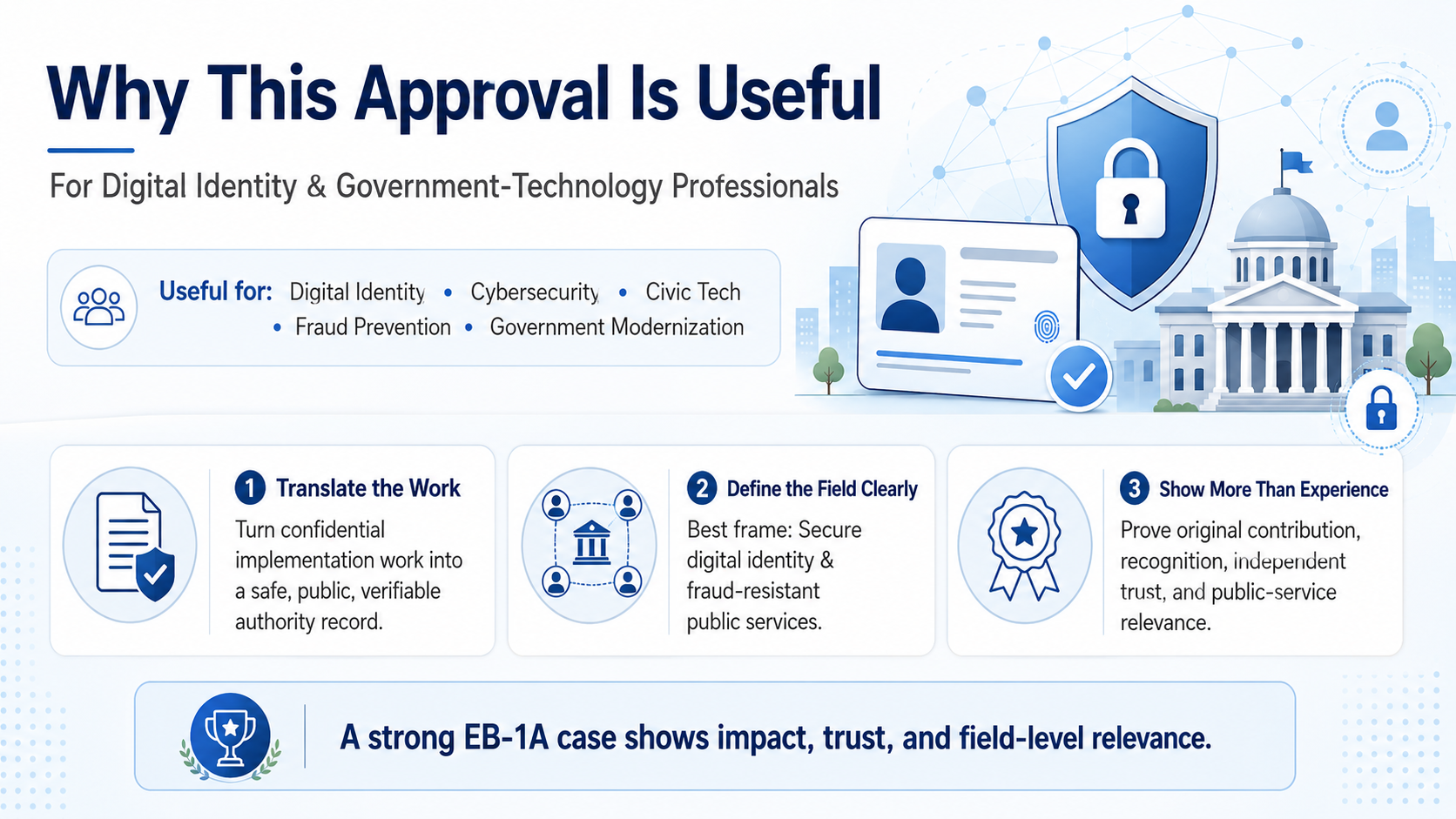
This case carries an important lesson for professionals in digital identity, cybersecurity, civic technology, public-sector platforms, fraud prevention, and government modernization.
Government-technology work can be hard to prove because the most important evidence may sit inside implementation files, security reviews, product decisions, agency requirements, or confidential architecture documents. A strong EB-1A case cannot simply expose that material. It must translate the work into a safe, public, verifiable authority record.
It also shows why the field must be defined carefully. “Digital transformation” is usually too broad. “Government technology” may be too vague. “Secure digital identity and fraud-resistant public services” gave USCIS a technical and public-interest frame that could be evaluated through specific evidence.
The result was a petition that showed more than experience. It showed original contribution, recognition, independent trust, and relevance to a field that affects how public services are delivered securely.
Frequently asked questions
Can digital identity work qualify for EB-1A?
Yes, digital identity work may support an EB-1A petition when the record shows recognized expertise and evidence under the EB-1A criteria. The case should identify the professional niche, the individual contribution, the importance of the work, and the recognition received from independent sources.
Is working on government technology enough for EB-1A?
Not by itself. Government-technology experience can be useful, but USCIS needs evidence of the petitioner’s own achievements and recognition. Employer reputation, project importance, or public-sector context does not automatically prove extraordinary ability.
Can civic-technology judging help an EB-1A petition?
It can, if the evidence shows that the petitioner actually judged or evaluated the work of others in a relevant field. The record should document the event, selection basis, judging role, and connection between the judged work and the petitioner’s expertise.
How can confidential public-sector technology work be documented?
The record can use non-confidential descriptions, role evidence, public technical writing, safe examples, independent letters, media commentary, and professional recognition. The goal is to explain the method and significance without disclosing protected user data, government system details, or proprietary platform information.
Why did the digital identity niche matter in this case?
The niche turned a broad government-technology background into a focused professional identity. It allowed the petition to explain the petitioner’s work around a specific public-service problem: how digital systems verify identity, reduce fraud, preserve access, and maintain accountability.
Build an EB-1A record around the security work that actually belongs to you
Professionals in digital identity, cybersecurity, public-sector platforms, fraud analytics, and government technology often work on systems that affect thousands or millions of users, but their public record may still look thin. The issue is usually not that the work lacks value. The issue is that the evidence has not been organized around a clear authority niche.
Advance My Profile, powered by Immignis, helps professionals identify a defensible field, document original contributions, develop public authorship, build independent recognition, and prepare an EB-1A record around evidence that can be verified and defended.