Key facts at a glance
| Outcome | EB-1A approval for a Latvian rehabilitation robotics scientist working within a U.S.-based rehabilitation hospital research program. |
| Approval date | Approved on May 12, 2026. |
| Field niche | Robotic gait rehabilitation for neurological injury, with a focus on therapy protocols, sensor-supported progress tracking, clinician-supervised robotic assistance, and measurable rehabilitation outcomes. |
| Starting problem | The work had real clinical-engineering value, but the evidence was scattered across protocols, internal program records, and rehabilitation practice. The public record needed stronger publications, media recognition, peer review, awards evidence, selective membership support, and independent expert explanation. |
| Profile-building path | Advance My Profile, powered by Immignis, helped build a focused rehabilitation robotics authority record through clinical robotics papers, protocol adoption data, patient-outcome evidence, rehabilitation media coverage, invited talks, peer review, awards, selective membership evidence, and independent letters from rehabilitation technology experts. |
| EB-1A criteria supported in the petition | Scholarly articles, original contributions, published material, awards, judging, and memberships. |
Approval came after the petition made rehabilitation robotics understandable
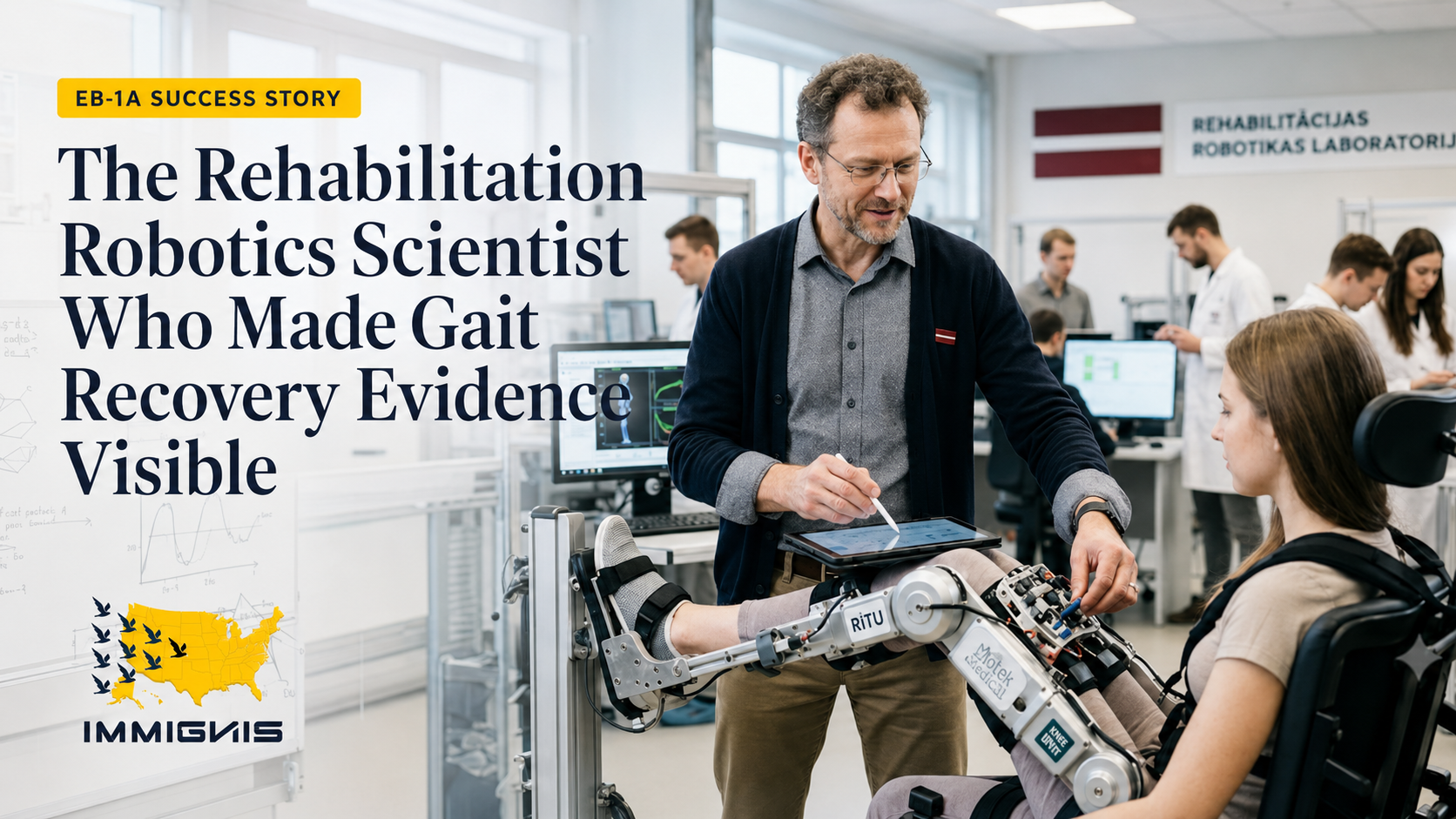
USCIS approved the Form I-140 petition on May 12, 2026. This EB-1A Rehabilitation Robotics Scientist success story involved a Latvian rehabilitation robotics scientist working in a U.S.-based rehabilitation hospital research program.
At first glance, the case looked like a familiar research profile: robotics, clinical engineering, rehabilitation protocols, patient data, and hospital-based work. The harder question was not whether the work was useful. It was whether the record showed extraordinary ability in a defined field.
That distinction mattered. In rehabilitation technology, valuable work often happens inside clinical programs where engineers, therapists, physicians, and research teams are solving problems together. A device may help support movement. A protocol may organize therapy. Sensors may track progress. But unless the evidence identifies the scientist’s own contribution and explains why other professionals recognize it, the strongest work can look like ordinary participation in a hospital research program.
This EB-1A case was built around a more precise story: robotic gait rehabilitation for neurological injury, and the way sensor-supported robotic therapy can help clinicians evaluate walking recovery, therapy response, and progression after neurological damage.
The problem was not the robot. It was what the therapy team could measure and repeat
Robotic gait rehabilitation can sound impressive even when the evidence is vague. A petition cannot rely on that. USCIS does not approve a case because the word “robotics” appears in a resume. The record must show what the individual did and why it matters.
For this scientist, the central issue was not simply building or using a rehabilitation robot. His work sat at the point where engineering decisions entered therapy decisions. How should robotic assistance be adjusted? Which walking measurements should be tracked? What did the therapy team need to know when a patient showed progress in one parameter but not another? How could clinical staff use sensor data without turning rehabilitation into a black-box technology exercise?
Those questions gave the case its shape. The petition did not describe him as a broad robotics researcher or a general medical-device engineer. It presented him as a specialist in robotic gait rehabilitation for neurological injury, with a record tied to therapy protocols, gait metrics, patient-response evidence, and clinician-supervised use of rehabilitation technology.
That field definition also helped avoid a common mistake. Rehabilitation robotics is not only a hardware story. It is a clinical-engineering story. The value of the technology depends on whether therapists and rehabilitation physicians can use it safely, interpret its data, and connect the data to treatment decisions.
Why the original record was vulnerable
The starting record had substance. It included clinical engineering experience, research participation, protocol-related work, and evidence that rehabilitation teams were using structured technology-supported methods. Still, it had weaknesses that are common in hospital-based EB-1A cases.
First, much of the evidence was internal. Clinical protocols, program records, patient-measurement data, and implementation materials may be important, but they do not automatically show recognition beyond the institution.
Second, the public story was incomplete. A reader could see a rehabilitation robotics professional, but not yet a clear authority niche. Without that niche, the record risked looking like useful clinical engineering rather than recognized expertise.
Third, patient-outcome evidence needed discipline. A petition cannot turn every improvement in gait training into a claim that one scientist caused a patient’s recovery. Neurological rehabilitation involves physicians, therapists, patient condition, therapy intensity, assistive technology, adherence, and many other variables. The evidence had to show what the robotics method contributed without making unsupported clinical claims.
Fourth, the case needed recognition signals. Strong work inside a rehabilitation hospital can be persuasive when it is connected to scholarly authorship, independent media, peer review, awards, selective professional membership, invited presentations, and letters from experts who can explain the work outside the employer’s own perspective.
What USCIS needed to see in a rehabilitation robotics EB-1A case
The petition had to do more than list projects. It had to explain how the evidence supported EB-1A criteria and how the full record demonstrated the level of expertise required for extraordinary ability.
For original contributions, the record identified the scientist’s rehabilitation robotics methods, protocol structures, patient-assessment logic, and data-use framework. Independent experts then explained why these contributions mattered to robotic gait therapy and neurological rehabilitation.
For scholarly articles, the publications had to connect directly to the field niche. Articles on clinical robotics, gait rehabilitation, neurological injury, therapy measurement, or related rehabilitation technology were stronger than scattered publications that did not show a consistent professional identity.
Published material required independent coverage about him or his work, not merely company announcements or hospital publicity. The media record needed to show that outside publications treated his rehabilitation robotics expertise as newsworthy or educational.
Judging evidence came from peer review and evaluation of other specialists’ work. Reviewing research in rehabilitation engineering, robotics, medical devices, neurorehabilitation, or allied fields helped show that journals or professional venues trusted his technical judgment.
Awards evidence had to be handled carefully. A real award could support recognition. A nomination, application, paid listing, or participation certificate could not be overstated. The petition documented the award evidence according to what the record actually proved.
Membership evidence depended on selectivity. Open enrollment was not enough. The petition had to show that the relevant membership or elevation required achievement, expert assessment, or a meaningful professional standard.
At final merits, the case still had to work as a whole. The articles, original contributions, media, peer review, awards, membership, and independent letters had to describe the same person: a recognized rehabilitation robotics scientist whose work was tied to neurological gait recovery and clinical technology use.
The profile was rebuilt around a clinical-engineering question
Advance My Profile, powered by Immignis, worked with the evidence as a clinical-engineering record rather than a generic robotics file. The core question became: how does robotic gait therapy become measurable, repeatable, and useful to a rehabilitation team?
That question allowed the record to be organized by method. One evidence stream concerned gait metrics and sensor-supported assessment. Another concerned how protocols guided the use of robotic assistance during therapy. A third addressed patient-response data and the limits of what could be claimed from that data. A fourth showed professional recognition outside the hospital setting.
This structure made the petition more credible. It did not claim that the scientist owned every rehabilitation outcome. It showed where his technical work entered the rehabilitation process: measurement design, robotic-assistance logic, protocol organization, data interpretation, and documentation of therapy response.
The record also protected sensitive clinical information. Patient identifiers, private health information, unpublished hospital data, and confidential program materials remained outside the public narrative. The petition relied on non-confidential descriptions, documented roles, publications, adoption evidence, and expert analysis.
Clinical robotics papers gave the work a public scientific record
The scholarly record became one of the most important parts of the case. Rehabilitation robotics is a technical field, but EB-1A evidence cannot depend only on internal use of a device or protocol. The scientist needed a public record that other professionals could read, evaluate, and cite.
The publications addressed the problem at the center of the case: robotic gait rehabilitation for neurological injury. They discussed therapy measurement, sensor-supported progress tracking, robotic assistance, protocol design, and the relationship between engineering data and clinical rehabilitation decisions.
One line of work examined how gait parameters can help rehabilitation teams understand progress without reducing therapy to a single number. Another addressed the need for structured protocols when robotics, therapist judgment, and patient-specific recovery patterns interact.
The articles did not need to exaggerate the technology. Their strength came from explaining what rehabilitation teams actually face: a patient may improve cadence, step symmetry, endurance, or assisted walking time, but those measurements must be interpreted in clinical context. That practical scientific framing helped the petition show expertise rather than promotional enthusiasm.
Protocol adoption evidence showed that the work moved into practice
In this case, protocol adoption evidence was central because the field itself is practice-facing. Robotic gait rehabilitation becomes meaningful when a clinical team can use the method consistently.
The evidence documented where protocol elements connected to therapy planning, patient assessment, robotic assistance, session structure, progress tracking, or rehabilitation review. The petition traced the problem, the method linked to the scientist, and the part of the rehabilitation process affected.
This kind of evidence required restraint. The petition did not claim that every patient improvement came from one scientist’s work. Instead, it showed that the protocol and data framework helped organize how robotic gait therapy was delivered, monitored, or evaluated.
That distinction was important. For USCIS, internal adoption can support an original-contribution argument when the record shows what was adopted, who used it, why the petitioner’s role mattered, and how independent experts evaluate its significance.
Patient-outcome evidence was used carefully
Patient-outcome evidence can be persuasive in a rehabilitation case, but it can also create risk if it is overstated. A recovery outcome is rarely the result of one variable. The petition therefore treated patient-outcome evidence as supporting documentation, not as a simplistic claim of causation.
Where the record supported it, the evidence showed how patient progress, therapy participation, gait measurements, or functional indicators were tracked in connection with robotic rehabilitation protocols. The focus remained on the method: what the technology measured, how the team reviewed the information, and how the protocol supported clinical decision-making.
This careful handling made the case stronger. It showed that the petitioner understood the clinical environment and did not use patient outcomes as marketing language. In EB-1A practice, disciplined evidence often persuades more effectively than inflated claims.
Rehabilitation media made the technical work accessible
The public-facing record also needed to explain the work in language that non-specialist readers could understand. Rehabilitation robotics can sound futuristic, but patients and clinicians care about more practical questions: Can the patient practice walking safely? Can the therapist see meaningful progress? Can the technology support therapy without replacing clinical judgment?
Media coverage helped translate those questions. The articles and interviews discussed robotic gait therapy, neurological injury, rehabilitation measurement, and the role of technology in supporting clinical teams.
The media evidence was not treated as decoration. It supported the published-material criterion and helped show that his expertise had become visible outside internal hospital or research settings.
Invited talks and peer review showed professional trust
Invited talks gave the scientist a forum to explain the method to rehabilitation, robotics, and medical-technology audiences. These presentations addressed the practical difficulty of using robotic gait data in therapy: which measurements matter, when robotic assistance should be adjusted, and how clinicians can interpret progress without handing the entire decision to software.
Peer review added a different kind of recognition. Journals and professional venues invited him to evaluate work by other specialists. That activity supported the judging criterion because it showed that his professional judgment was being used to assess the research of others.
The petition documented the nature of the reviews where available, including the subject matter and the technical or clinical issues he evaluated. This helped avoid a weak judging argument based only on vague statements that he had reviewed manuscripts.
Awards and selective membership were kept honest
Awards evidence can help an EB-1A case when the recognition is real, documented, and relevant to the field. In this petition, awards were presented with their selection basis, scope, and connection to rehabilitation technology or clinical innovation.
The same discipline applied to professional memberships. The petition separated ordinary participation from selective recognition. Where the membership or elevation required achievement or expert assessment, it was documented as part of the EB-1A record.
This approach avoided a common evidence problem. USCIS can look past labels. A line on a resume is not enough. The file must show why the award or membership reflects professional recognition.
Independent expert letters connected the evidence
Independent letters mattered because the record crossed several domains: robotics, rehabilitation medicine, clinical engineering, patient measurement, and neurological recovery. Experts helped USCIS understand why the work was not merely a hospital technology project.
The strongest letters did not simply praise the scientist. They explained the field, identified his specific contributions, and discussed why protocol-based robotic gait rehabilitation and sensor-supported progress tracking can matter in clinical practice.
They also helped connect separate evidence streams. Publications showed public scientific work. Protocol adoption showed use. Patient-outcome evidence showed what the program could measure. Media and talks showed public recognition. Peer review, awards, and membership showed professional trust. The expert letters explained how those pieces described one coherent authority record.
How the EB-1A evidence worked together
The approved petition did not depend on one document. It depended on a record that made the field, the contribution, and the recognition understandable.
Scholarly articles connected the scientist’s authorship to robotic gait rehabilitation, neurological injury, therapy measurement, and clinical robotics.
Original-contribution evidence identified the protocol methods, sensor-supported assessment framework, patient-response documentation, and adoption evidence tied to his work.
Published material showed that rehabilitation media and professional outlets recognized the relevance of his expertise beyond an internal hospital setting.
Judging evidence showed that journals or professional venues trusted him to evaluate work by other specialists.
Awards and selective membership supported the recognition record when the evidence documented genuine selection standards and professional achievement.
Together, those materials answered the question USCIS needed resolved: whether the beneficiary had built sustained acclaim and recognized expertise in a defined rehabilitation robotics specialty.
Why this approval matters for other rehabilitation technology professionals
This approval is useful because many rehabilitation technology professionals face the same evidence problem. Their work is practical, clinical, and interdisciplinary. It may improve therapy delivery or data interpretation, but the public record often remains thin.
A strong EB-1A case usually requires more than proof that a hospital program used a technology. The petition must show the individual’s method, the significance of that method, and recognition from outside the immediate workplace.
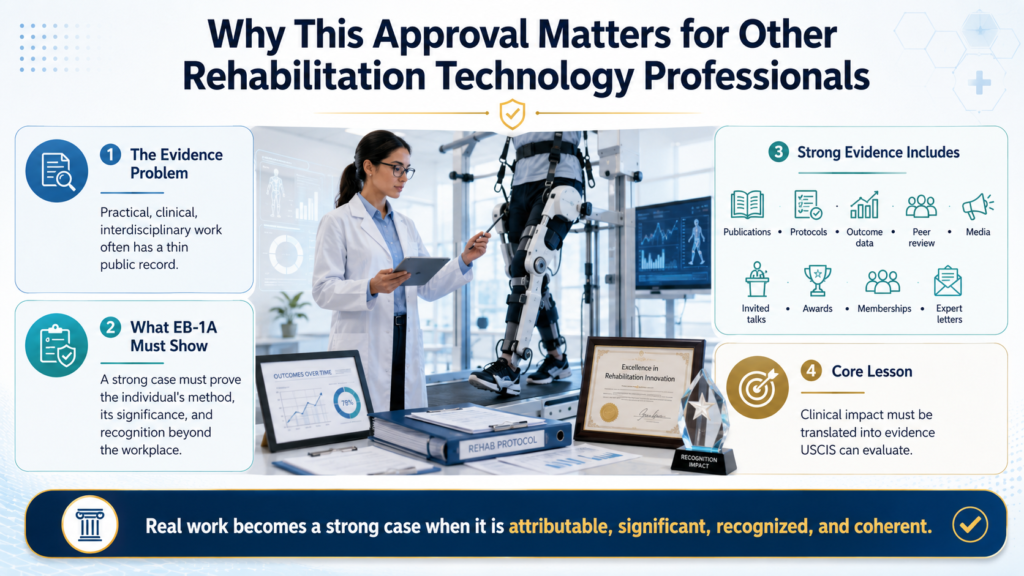
For rehabilitation robotics scientists, that may mean focused publications, protocol documentation, careful outcome evidence, peer review, media explanation, invited talks, awards, selective memberships, and independent expert letters. The goal is not to manufacture a profile. The goal is to document real expertise in a form USCIS can evaluate.
The strongest lesson from this case is simple: clinical impact must be translated into evidence. A rehabilitation robotics professional may have years of meaningful work, but EB-1A approval depends on whether that work is attributable, significant, recognized, and presented as part of a coherent field-level record.
Frequently asked questions
Can clinical rehabilitation work support an EB-1A petition?
Yes, but it must be documented carefully. Clinical rehabilitation work can support EB-1A when the record shows the petitioner’s own contribution, its significance, and recognition beyond routine employment or internal clinical duties.
Are patient outcomes enough to prove original contributions?
Patient outcomes can help, but they should not be overstated. A petition should explain the method, the petitioner’s role, the evidence available, and what can reasonably be concluded from the data. Unsupported claims of causation can weaken the case.
Can peer review count as judging for a rehabilitation robotics scientist?
Yes, when the evidence shows that the petitioner actually evaluated the work of other professionals. Reviews of manuscripts, conference submissions, grant materials, or technical research can support the judging criterion if properly documented.
Does a rehabilitation robotics scientist need patents for EB-1A?
No. Patents can help in some cases, but they are not required for EB-1A and are not a separate regulatory criterion. This type of case can be built through publications, original contributions, adoption evidence, judging, media, awards, memberships, and independent letters when the evidence is strong.
What is the biggest mistake in rehabilitation robotics EB-1A cases?
A common mistake is presenting the work as impressive technology without explaining the clinical method. USCIS needs to see what the petitioner contributed, how the work was used or recognized, and why it matters in the field.
Build an EB-1A record around the rehabilitation method, not just the technology
If your work involves rehabilitation robotics, wearable rehabilitation systems, gait analysis, neurorehabilitation, assistive devices, or clinical engineering, your strongest evidence may be hidden inside protocols, patient-measurement systems, and research programs.
Immignis and Advance My Profile help professionals identify a defensible niche, document original contributions, build independent recognition, and prepare EB-1A evidence around work that can be verified and professionally defended.