Key facts at a glance
| Outcome | EB-1A approval for a Pakistani contemporary miniature painter trained in Lahore and working in neo-miniature contemporary art. |
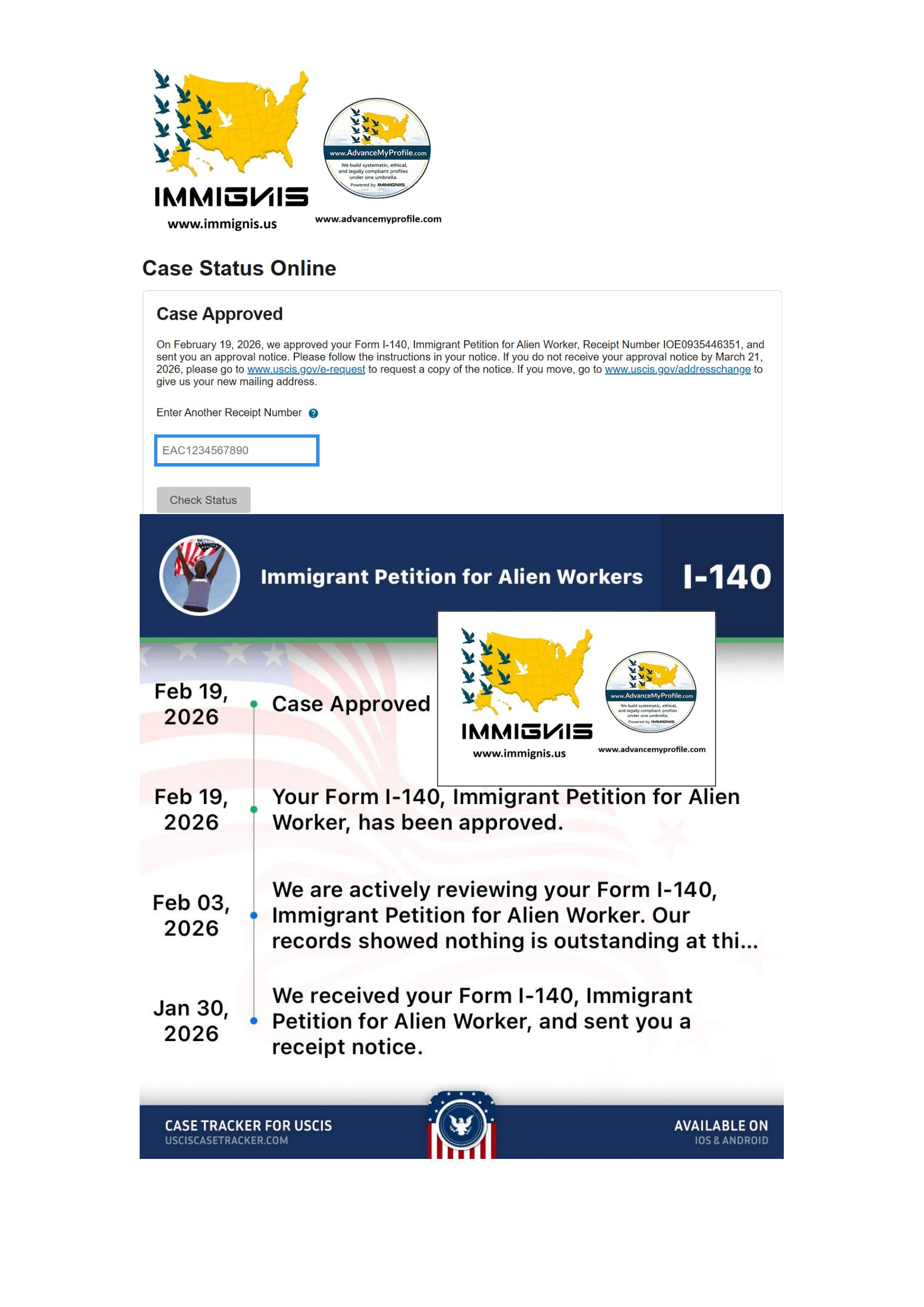
| Approval date | Approved on February 19, 2026. |
| Field niche | Neo-miniature contemporary art, with a focus on reworking South Asian and Mughal miniature technique for contemporary themes. |
| Starting problem | The artist had a strong body of work and regional exhibitions, but the record lacked curated international exhibitions, critical art-media coverage, and enough independent recognition outside the local gallery environment. |
| Profile built | Immignis and Advance My Profile helped build a publishable authority record through juried international group shows, gallery representation evidence, critical reviews, an artist residency, jury service for emerging-artist prizes, and curator and museum letters. |
| EB-1A evidence presented | Display at artistic exhibitions or showcases, published material, judging, original artistic contributions, and awards evidence. |
Approval came after the record stopped calling the work merely local
USCIS approved the Form I-140 petition on February 19, 2026. The beneficiary was an EB-1A Pakistani Miniature Painter and contemporary artist whose training came from Lahore, a city deeply associated with South Asian miniature practice and its contemporary revival.
The case was not weak because the art was weak. The artist had a serious body of work. The problem was that the record still looked regional. Most of the proof sat in local exhibitions, informal art world references, and images of finished pieces. That may be enough to show talent, but EB-1A asks a different question: has the artist received the level of recognition that shows extraordinary ability in the field?
For this painter, the answer required more than adding a longer biography. The petition had to show how a Lahore trained practice became part of a recognized neo-miniature contemporary art conversation, and how curators, critics, juries, and institutions outside the artist’s immediate circle had begun to treat the work as significant.
A strong portfolio was not the same as an EB-1A record
Many visual artists begin with the same misunderstanding. They believe the artwork should speak for itself. In a studio, a gallery, or a collector conversation, that may be true. In an EB-1A petition, the work must speak through evidence.
USCIS is not an art critic. It does not decide whether one painting is beautiful, whether a brush line is emotionally successful, or whether a particular image deserves to be collected. The petition must document recognition that already exists in the field: curated exhibitions, published criticism, jury service, awards, institutional interest, and independent expert analysis.
That distinction shaped the strategy. The profile did not try to make the artist sound famous through adjectives. It built a record showing where the work was selected, reviewed, exhibited, interpreted, and relied upon by people who understood contemporary miniature art.
The field niche became neo-miniature contemporary art
The first strategic decision was to avoid describing the artist simply as a painter. That was too broad. It also failed to explain why the work was culturally and artistically specific.
The field was framed as neo-miniature contemporary art: a practice that draws from the discipline, scale, materials, visual language, and historical memory of South Asian and Mughal miniature painting while using those methods to address modern identity, social change, gender, memory, urban life, displacement, or other contemporary subjects.
This field definition mattered because it gave the petition a coherent artistic question. The painter was not presented as someone copying an inherited technique. The record showed an artist using miniature language as a contemporary method. The brushwork, surface, scale, symbolism, and compositional discipline were not decorative background; they were part of the artist’s contribution.
Once the niche was clear, the evidence could be organized around it. Exhibitions, reviews, residency work, curator letters, and jury service all had to point back to the same artistic identity.
What USCIS needed to see in this visual art EB-1A case
For a visual artist, the display criterion can be one of the most direct parts of an EB-1A petition. USCIS regulations allow evidence that the applicant’s work has been displayed at artistic exhibitions or showcases. But not every exhibition carries the same weight. A self-arranged display, an open local event, or a pay-to-participate listing may show activity, but it may not prove meaningful recognition.
The petition therefore focused on curated and juried exhibitions. It documented how the artist was selected, who curated or organized the exhibition, the scope of the event, the venue, the other participating artists when relevant, and whether the exhibition connected the artist to a broader contemporary miniature or South Asian art context.
Published material required more than calendar listings. A short announcement saying an exhibition opened is not the same as a critical review. The strongest press discussed the artist, the work, the technique, the themes, or the significance of the practice. This helped move the record from presence to recognition.
Judging evidence required proof that the artist evaluated other artists’ work. Jury service for emerging-artist prizes, art competitions, or selection panels helped show that the field trusted the artist’s eye and professional judgment.
For original artistic contributions, the petition had to do more than say the work was original. Every serious artist has an original voice. EB-1A required evidence that the contribution had significance in the field. Curator letters, museum letters, critical reviews, exhibition records, and the artist’s role in a named neo-miniature practice helped make that argument.
Juried international exhibitions changed the way the record read
The strongest shift in the case came from exhibition evidence. Before profile building, the artist’s record showed regional activity and a developing body of work. After the record was strengthened, the petition could show juried international group exhibitions and curated opportunities outside the immediate local environment.
That did not mean every exhibition was treated as equal. The petition separated stronger evidence from weaker evidence. Curated shows, juried selections, international group exhibitions, and venues with real art world context were emphasized. Routine displays and informal events were used carefully or not at all.
This helped because the display criterion is not just about hanging work on a wall. It is about showing that the artist’s work has been selected and presented in a professional artistic setting. For this painter, juried exhibitions allowed USCIS to see that the work had crossed from local participation into broader field recognition.
Critical reviews gave the art a public record
The petition also needed independent art media coverage. For artists, published material can be especially powerful when it does something a portfolio cannot do: it shows how others interpret the work.
The published material developed for the record addressed the artist’s neo-miniature practice, the use of traditional miniature discipline, and the contemporary themes being explored. It did not merely repeat a biography. It gave readers a way to understand why the artist’s practice belonged in a serious art conversation.
That distinction mattered. A press release written by a gallery is useful background, but it is not the same as independent critical attention. The stronger record included reviews or features that discussed the work from outside the artist’s own promotional materials.
For EB-1A, this kind of press helped solve two problems at once. It supported published-material evidence, and it gave independent experts a public record they could discuss when explaining the artist’s significance.
Gallery representation and residency evidence added professional context
Gallery representation was not treated as an automatic EB-1A criterion. It still mattered because it helped establish professional positioning. A gallery record can show that the artist’s work is being represented, placed, exhibited, and discussed through recognized art channels rather than only through self-promotion.
The artist residency served a related purpose. A credible residency can show selection by a professional program, time devoted to artistic development, exposure to curators or peers, and a structured environment for producing or presenting work. In this case, residency evidence helped show that the artist’s practice had been reviewed and accepted by people outside the local network.
The petition presented these items for what they were. It did not overstate them. A residency is not the same as an award unless the evidence proves an award standard. Gallery representation is not the same as critical acclaim unless supported by other recognition. But together with exhibitions and press, they helped build a more complete professional record.
Jury service showed that the artist was trusted to evaluate others
Judging is often underdeveloped in artist cases. Many artists focus only on showing their own work. The EB-1A record becomes stronger when the field also asks the artist to evaluate the work of others.
For this painter, jury service for emerging-artist prizes became a useful piece of the recognition record. It showed that the artist was not only participating in the field, but was being asked to apply artistic judgment in a professional selection process.
The documentation needed to be specific. The petition identified the competition or prize, the artist’s role, the work being evaluated, and the selection or review function. The point was not to use a vague title such as judge. The point was to show actual evaluation of other artists’ submissions or portfolios.
This mattered at final merits because it showed trust. In art, being invited to judge or serve on a jury signals that others consider the artist capable of evaluating quality, originality, and artistic relevance.
Curator and museum letters explained what the paintings meant
Independent letters were central to the petition because visual art can be difficult to translate into legal evidence. A USCIS officer may not know why miniature technique, scale, surface treatment, symbolic layering, or a contemporary use of historical form matters.
The strongest letters did not simply call the painter talented. They explained the field. They described how neo-miniature art developed from inherited miniature traditions into a contemporary practice. They then explained where this artist’s work fit within that movement and why the work was not merely decorative or derivative.
Curators and museum professionals were especially useful because they could interpret the work in field-specific terms. They could discuss technique, exhibition context, selection standards, thematic development, and the importance of bringing traditional miniature grammar into contemporary subjects.
Those letters also helped connect separate evidence streams. A curator could explain why a juried exhibition mattered. A museum professional could explain why a residency or review had professional significance. That kind of explanation helped the petition become more than a bundle of documents.
Awards evidence was handled carefully
The profile-building work also looked at awards and prize opportunities. For EB-1A, awards can help, but only when the record shows the nature of the recognition, the selection criteria, the scope of the competition, and the connection to the artist’s field.
The petition did not treat every certificate, participation honor, or paid listing as a qualifying prize. Where awards evidence was used, it was supported by documentation. Where the evidence was weaker, it was kept in context rather than inflated.
This restraint was important. Artist cases can lose credibility when they overstate routine recognition. A careful petition shows the strongest items clearly and does not force weak evidence to carry more weight than it deserves.
How the EB-1A evidence worked together
The approved petition did not depend on one exhibition, one review, or one curator letter. It worked because the evidence described the same artist from different directions.
The exhibition evidence showed that the paintings had been displayed in artistic settings, including juried and curated contexts. The published material showed that independent art writers or media outlets had discussed the artist, the work, and the neo-miniature practice. Judging evidence showed professional trust in the artist’s ability to evaluate other artists. Curator and museum letters explained the artistic contribution in language USCIS could understand.
Together, these materials turned the case from a local art biography into an EB-1A record. The petition did not ask USCIS to become an art critic. It asked USCIS to look at field recognition, artistic selection, critical discussion, and expert analysis.
That was the difference. The record no longer said only that the painter had talent. It showed that the field had begun to recognize the painter as an international voice in neo-miniature contemporary art.
What other visual artists can learn from this case

The lesson for artists is not that every exhibition creates an EB-1A case. It is that the right exhibition record can become a powerful legal asset when it is documented properly and supported by independent recognition.
Artists often have scattered evidence: a portfolio, several shows, a few interviews, a gallery biography, an award certificate, and praise from people who know their work. That evidence may be real, but it may not yet tell a legal story.
A stronger record identifies the artistic niche first. Then it asks which evidence proves recognition in that niche. For a contemporary miniature painter, the question was not simply, where has the artist exhibited? The question was: who selected the work, what was the artistic context, what did critics or curators say, and how did the work contribute to a named movement?
When those answers are documented, the petition becomes clearer. The artist is no longer presented as a local painter with a portfolio. The artist becomes a professional whose work has been displayed, reviewed, judged, and interpreted within a recognized field.
Frequently asked questions
Can a visual artist qualify for EB-1A without a science or business background?
Yes. EB-1A is available to people in the arts as well as in sciences, education, business, and athletics. For artists, the petition must document sustained acclaim and recognized achievements through evidence such as exhibitions, published material, judging, awards, original artistic contributions, and other qualifying proof.
Is a strong portfolio enough for an EB-1A artist case?
Usually not by itself. A portfolio shows the artwork, but EB-1A requires evidence of recognition. The stronger record explains where the work was displayed, who selected it, how critics or curators discussed it, and why the artist’s contribution matters in the field.
Why are juried exhibitions important for artists?
Juried exhibitions can show that the work was selected through a professional process rather than merely self-displayed. They are strongest when the petition documents the venue, selection process, curator or jury, artistic context, and the relevance of the exhibition to the artist’s field.
Can art reviews support the published, material criterion?
Yes, when the review or article discusses the artist, the work, or the artist’s expertise in a meaningful way. A simple event listing or copied gallery announcement is usually weaker than independent art criticism or a feature that analyzes the work.
What made this Pakistani miniature painter’s case stronger?
The record was narrowed to neo-miniature contemporary art and supported with juried international exhibitions, critical reviews, gallery and residency evidence, jury service, and independent curator and museum letters. That made the artist’s recognition clearer and more credible.
Build an EB-1A record around the artistic contribution your work actually makes
If you are a painter, sculptor, photographer, installation artist, curator, textile artist, digital artist, or interdisciplinary visual artist, your strongest EB-1A evidence may already exist in fragments. The challenge is to organize it around a defensible artistic niche and then build the missing recognition signals with care.
Immignis and Advance My Profile help artists identify a credible authority niche, document exhibitions and published material, develop independent recognition, obtain appropriate expert letters, and prepare an EB-1A record around evidence that can be verified and defended professionally.