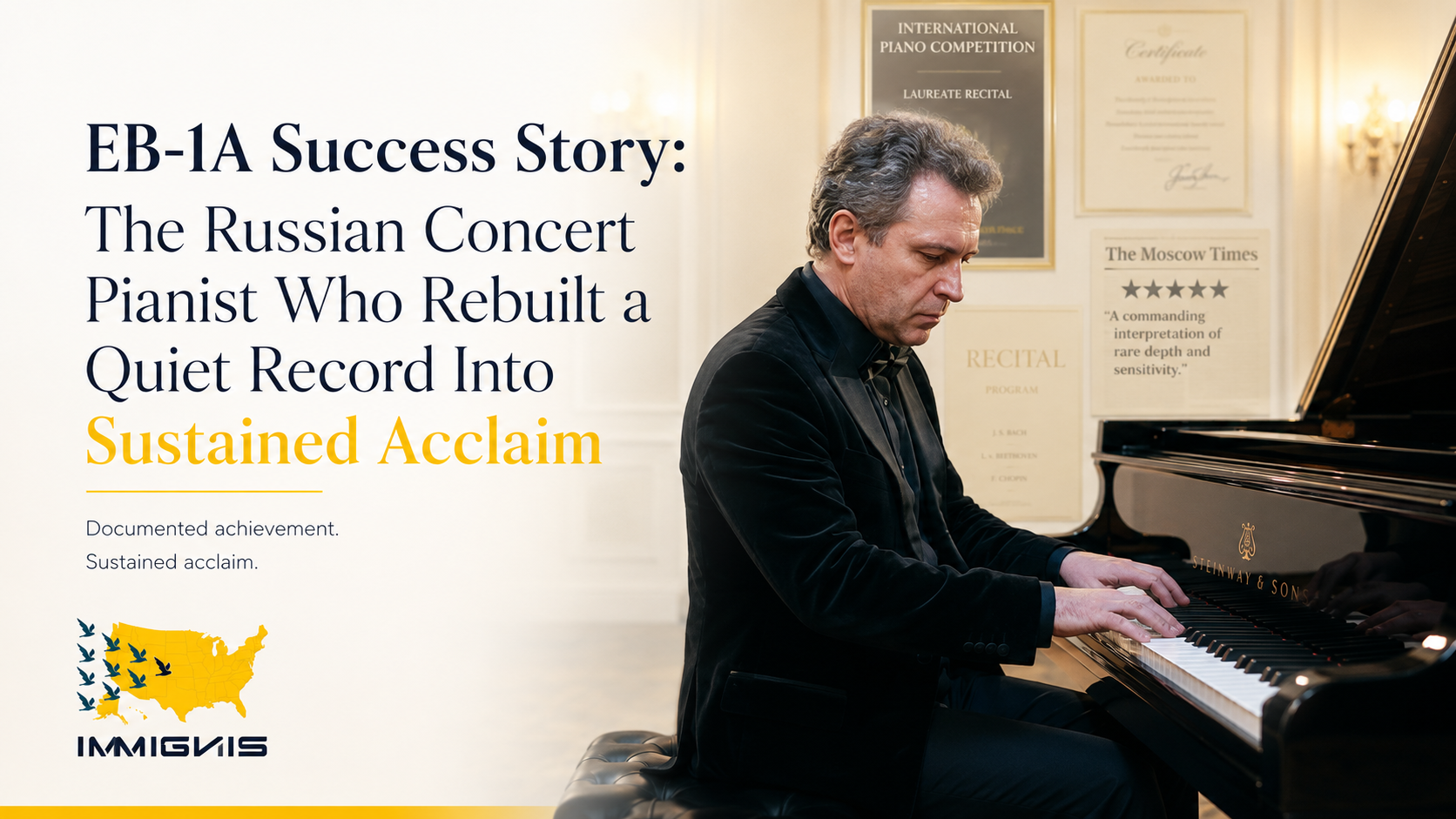
A performing-arts EB-1A approval after early competition success had gone quiet
Key facts at a glance
| Category | Details |
| Outcome | EB-1A approval for a Russian concert pianist whose record was rebuilt around sustained recognition in performance, interpretation, and musical leadership. |
| Approval date | Approved on April 30, 2026. |
| Field niche | Interpretation of Russian romantic repertoire, with emphasis on performance, recording, teaching, and artistic continuity. |
| Starting problem | He had conservatory training and earlier competition history, but the record had become quiet. Recent public evidence of sustained acclaim, critical reviews, jury service, festival visibility, and performance distinction was limited. |
| Profile-building path | Immignis and Advance My Profile helped document new recital and orchestra engagements, recordings with critical reviews, competition jury service, festival appearances, commercial-success evidence from streaming and ticketing, teaching and master class activity, and letters from recognized artistic directors and music professionals. |
| EB-1A criteria supported in the petition | Awards, published material, judging the work of others, commercial success in the performing arts, leading or critical role, and evidence of performance/showcase activity where applicable. |
On April 30, 2026, USCIS approved his Form I-140 petition under the EB-1A extraordinary ability category.
For this EB-1A Concert Pianist, the approval did not come from simply reminding USCIS that he had trained well, won early competitions, and knew a difficult repertoire. Many serious musicians can say the same. The harder question was different: had his acclaim remained alive?
That question shaped the whole case.
He was a conservatory trained pianist whose artistic identity was tied to Russian romantic repertoire. Earlier in his career, he had earned competition recognition and built a respected performance record. But then the documentation slowed. He continued performing and teaching, yet the public file did not clearly show recent critical attention, jury invitations, festival visibility, or commercial evidence that could carry an EB-1A petition through final merits.
The case therefore did not start with a lack of talent. It started with a gap between artistic ability and immigration evidence.
The early prizes were real, but they could not do the whole job
In performing arts cases, old awards can be helpful. They can show that the artist was recognized by qualified evaluators at a particular time. But EB-1A is not only a memory test. USCIS still asks whether the person has sustained national or international acclaim and whether the evidence as a whole shows that the person belongs among the small percentage who have risen to the top of the field.
His early competition history gave the petition a foundation. It did not solve the sustained acclaim problem by itself. A prize won years earlier can lose force when the record after that point is thin, especially if the petition cannot show ongoing performances, reviews, invitations, judging, or influence in the field.
That became the central strategy. The case would not try to inflate old honors. It would rebuild the record around what had happened since those prizes and show that his work as a pianist, interpreter, teacher, and musical voice had continued to receive meaningful recognition.
A narrow artistic identity made the record easier to understand
The petition did not describe him simply as a pianist. That would have been too broad. It defined his field around the interpretation of Russian romantic repertoire.
That focus mattered. It connected his conservatory training, recital programming, recordings, master classes, and critical commentary to one coherent artistic identity. It also gave reviewers a way to understand why his work belonged in a specific musical conversation rather than in a generic performing-arts file.
Russian romantic repertoire can demand a particular combination of technique, phrasing, tonal color, structural control, and historical understanding. The case did not need to overstate that point. It needed to show that his own interpretation of that repertoire had been performed, reviewed, invited, recorded, and evaluated by others in ways that supported continuing recognition.
What USCIS needed to see in a concert pianist EB-1A case
For a concert pianist, the EB-1A analysis can look different from a science or engineering case. Citations, patents, and technical adoption are not usually the center of the file. USCIS instead looks at evidence such as awards, published material, judging, commercial success in the performing arts, leading or critical roles for distinguished organizations, and display or performance records where they fit the regulatory language.
The awards evidence had to do more than list old competitions. The petition needed to explain the level of the competitions, the selection process, the reputation of the awarding bodies, and how the prizes fit into his career record.
Published material had to be independent coverage about him or his artistic work, not publicity copied from a venue listing. Reviews, interviews, and serious music coverage could help only if they showed real editorial attention.
Judging evidence required actual evaluation of other artists, such as jury service for competitions, festivals, or emerging artist prizes. Merely teaching students or giving feedback in a class would not automatically qualify as judging under the EB-1A criterion.
Commercial success in the performing arts had to be documented through reliable evidence. Streaming numbers, ticketing records, recording distribution, audience data, or paid engagements could help, but only when the numbers were placed in context and tied to him.
For leading or critical role, the record needed programs, contracts, institutional materials, artistic-director letters, and other proof showing why a company, festival, orchestra, or educational institution relied on his artistic role. Adjectives alone would not carry that criterion.
The dormant record was rebuilt through recent performances
The first practical step was to make the recent career visible. Recital programs, orchestra engagements, festival appearances, institutional invitations, and teaching records were organized chronologically. The goal was not to create the impression of constant celebrity. It was to show continuity.
For musicians, continuity matters because careers often move through different forms: solo recitals, chamber work, guest appearances, teaching posts, master classes, recordings, and jury service. A weak file treats these as scattered activities. A stronger file shows the artistic thread connecting them.
In this case, the thread was interpretation. The petition connected his repertoire choices, performance settings, and public reviews to a sustained artistic identity rather than to isolated events.
When a performance record included distinguished institutions or recognized collaborators, that evidence was separated from ordinary venue activity. USCIS did not need a long list of every appearance. It needed the right appearances, documented clearly.
Recordings and reviews made the recent artistic work public again
A quiet record often has one simple problem: the artist is still working, but almost no one outside the immediate circle can see it. Recordings changed that.
The profile building process focused on creating and documenting recordings that matched his artistic niche. The recordings were not treated as self-published proof of excellence. They became useful because critics, music writers, or qualified reviewers engaged with the work and explained what they heard.
Critical reviews helped the petition avoid a common performing arts weakness. Instead of asking USCIS to accept that the performances were excellent because the artist said so, the record showed that independent music voices had evaluated his interpretation, technique, programming, or artistic contribution.
The petition remained careful. A review does not become important simply because it is positive. Its value depends on the credibility of the publication, the substance of the commentary, and whether the coverage is about the artist rather than merely announcing an event.
Jury service showed that other musicians trusted his judgment
One of the most useful developments was jury service for competitions and emerging-artist prizes. This evidence did something different from a review. It showed that organizations had asked him to evaluate the work of other musicians.
For USCIS, that distinction matters. Judging evidence is not about applause. It is about professional reliance on the petitioner’s expertise. A musician who is invited to serve on a jury is being asked to apply artistic judgment to other performers.
The case documented the event, the organizer, the selection or invitation, the role performed, and the type of work he evaluated. Where available, programs, invitation letters, jury listings, and event materials were used.
This helped answer the sustained-acclaim problem in a direct way. He was no longer presented only as a former prizewinner. He was also shown as a musician whose judgment had become useful to the next generation of performers.
Commercial success evidence was used carefully
Commercial success in the performing arts can be powerful, but it is often mishandled. A file can become weak when it lists streams, followers, ticket sales, or downloads without context.
In this case, the evidence was treated as corroboration, not decoration. Streaming and ticketing records were used where they could be documented and tied to recordings, performances, or audience engagement. The petition did not claim that every stream proved artistic acclaim. It explained how the numbers supported the broader record of public reception.
Commercial evidence worked best when it sat beside reviews, programming, institutional invitations, and jury service. Together, those records showed that the pianist had not merely uploaded music. He had rebuilt an audience, drawn professional attention, and maintained a public artistic presence.
The leading-role evidence came from documents, not praise
The strongest leading role evidence in performing arts cases often comes from the documents people forget to collect: programs, contracts, playbills, rehearsal records, commission letters, institutional descriptions, and formal invitations.
The petition used records showing where he held a featured, leading, or artistically important role in performances, festivals, educational programs, or music organizations. Letters from artistic directors helped explain why those roles mattered, but the letters did not stand alone.
That approach protected the case from empty language. Instead of saying that he was ‘widely respected’ or ‘deeply influential,’ the petition showed where he was placed, what he was asked to perform or teach, and why the organization considered his participation important.
How the EB-1A evidence came together
By the time the petition was filed, the record no longer depended on a distant competition history. The early prizes were still part of the case, but they were no longer the whole story.
Awards showed recognized achievement at earlier stages of his career. Published material showed that recent recordings and performances had attracted independent attention. Judging showed that his musical expertise was being used to evaluate others. Commercial success evidence showed audience response and market activity in the performing arts. Leading-role evidence showed that organizations relied on him in meaningful artistic settings.
The final merits argument then became clearer: this was not a local teacher with old prizes. This was a concert pianist whose artistic record had been made current, documented, and tied to a defined musical niche.
Why this approval matters for performing artists
USCIS approved the Form I-140 on April 30, 2026.
The approval is useful for other performing artists because it addresses a common problem. Many musicians, dancers, actors, choreographers, and visual artists have uneven public records. Their careers may include early awards, long periods of teaching, regional work, private commissions, or performances that were real but poorly documented.
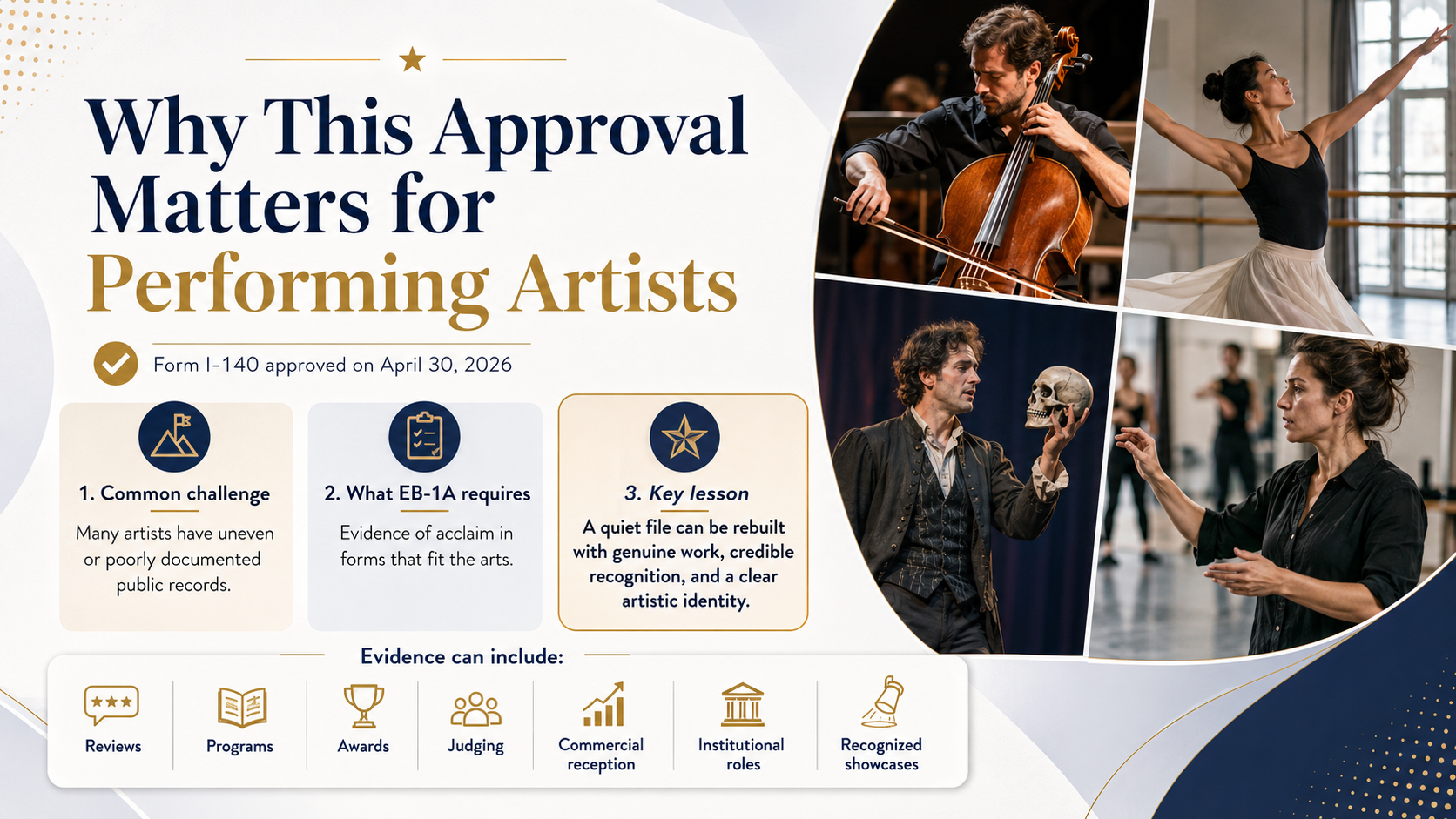
EB-1A does not require an artist to have the same career shape as a scientist or executive. But it does require evidence. A performing artist must show acclaim through the forms that make sense in the arts: reviews, programs, awards, judging, commercial reception, institutional roles, and recognized showcases.
The lesson is not that every old competition record can be revived. The lesson is that a quiet file can sometimes be rebuilt when the artist still has genuine work, credible recognition, and a clear artistic identity that can be documented.
What other musicians can learn from this case
A long career does not automatically create a strong EB-1A petition. A short public burst followed by silence can create risk. A famous institution does not replace evidence of individual acclaim. And a performance resume is not the same as a legal record.
Musicians considering EB-1A should look carefully at four questions. What is the specific artistic niche? Which recent records show continued recognition? Who has independently reviewed or evaluated the work? What documents prove leading roles, performances, audience reception, or judging?
For this pianist, the answer was not to pretend the quiet years did not exist. The answer was to confront them and build a current record that made sustained acclaim visible again.
Frequently asked questions
Can an older competition award still help an EB-1A case?
Yes, but usually not by itself. Older awards can support the awards criterion and show early recognition, but USCIS will still examine whether the artist has sustained acclaim. Recent performances, reviews, judging, commercial evidence, and institutional roles can help connect earlier honors to a current professional record.
Can a pianist use streaming numbers for EB-1A?
Streaming numbers may support commercial success in the performing arts if they are reliable, documented, and placed in context. They are stronger when combined with reviews, performance records, ticketing data, recording distribution, or other evidence showing real audience reception.
Does teaching count as EB-1A judging?
Ordinary teaching does not automatically count as judging. Jury service, competition evaluation, festival adjudication, peer review, or formal evaluation of other artists can support the judging criterion when properly documented.
What if most performances were regional?
Regional performance work can be part of the record, but the petition should identify which appearances involved distinguished organizations, recognized festivals, major venues, critical attention, or other evidence of significance. The goal is not to list every performance. The goal is to show recognized artistic standing.
Can a performer qualify for EB-1A without current major awards?
Possibly. Awards are only one criterion. A performer may also rely on published material, judging, commercial success, leading or critical roles, artistic showcases, and other qualifying evidence. The full record must still show sustained acclaim and top-level ability in the field.
Build an EB-1A record around the career you can prove
For many artists, the strongest work is real but under documented. Immignis and Advance My Profile help performing artists identify a defensible field niche, organize performance and recognition evidence, develop credible public documentation, and prepare a record built around evidence that can be verified and explained.
If your artistic record includes awards, performances, reviews, jury service, recordings, commissions, teaching, festival appearances, or commercial activity, a focused EB-1A profile assessment can show whether those materials can be developed into a stronger extraordinary-ability record.