Key facts at a glance
| Outcome | EB-1A approval for a Bahraini port cybersecurity specialist working with a Bahrain-based port authority contractor. |
| Approval date | Approved on June 16, 2026. |
| Field niche | Cyber-resilience for smart ports and maritime logistics, with a focus on operational continuity, port technology environments, tabletop exercises, incident readiness, and secure movement of cargo data. |
| Starting problem | His work protected a local port environment, but the record initially looked narrow, employer-based, and difficult to connect to sustained field-level recognition. |
| Profile development | The record was strengthened through technical articles, a maritime cybersecurity white paper, tabletop-exercise evidence, expert media commentary, conference judging, peer review, membership elevation, and independent letters from port-security leaders. |
| EB-1A evidence presented | Original contributions, scholarly articles, published material, judging, memberships, and leading or critical role. |
On June 16, 2026, USCIS approved the Form I-140 petition of a Bahraini EB-1A Cybersecurity Expertcyber whose work focused on smart ports and maritime logistics.
The approval did not rest on the fact that he worked in a sensitive infrastructure environment. Many cybersecurity professionals do. The stronger question was different: could his record show that his methods for port cyber-resilience were recognized beyond one contractor, one terminal, or one internal security team?
That distinction shaped the case. A port can depend on digital systems for vessel scheduling, gate operations, cargo movement, terminal equipment, billing, customs interfaces, vendor access, and operational technology. A cyber weakness in that environment is rarely just an information technology problem. It can become an operations problem, a logistics problem, and, in the wrong circumstances, a regional trade problem.
His original record did not make that point clearly enough. It showed serious work, but much of it sat inside security plans, port exercises, contractor responsibilities, and employer-controlled materials. To an immigration officer, the file risked looking like competent local cybersecurity work rather than evidence of extraordinary ability.
The first challenge was that good cybersecurity work often leaves little public trace
Cybersecurity professionals are often judged by incidents prevented, systems kept running, vulnerabilities contained, and response plans that never become public. Those achievements may be real, but EB-1A requires evidence that can be examined.
The petitioner had helped secure smart-port and maritime-logistics systems, including environments where information technology, operational technology, vendors, terminal processes, and physical cargo flow meet. His work involved risk review, access boundaries, incident readiness, exercise design, and practical safeguards for systems used in port operations.
That did not automatically create an EB-1A record. Internal dashboards, security meetings, and confidential remediation efforts can show employment responsibility, but they do not always prove an original contribution of major significance or sustained acclaim in the field.
The strategy therefore began by defining the field narrowly. He was not presented as a general cybersecurity employee. The petition identified him as a specialist in cyber-resilience for smart ports and maritime logistics.
Why the niche mattered
Smart ports are not ordinary office networks with cranes attached. They combine cargo data, identity systems, terminal operating processes, sensors, vendor connections, maintenance workflows, communications platforms, and equipment that must keep moving even when a cyber event is suspected.
In that setting, resilience means more than blocking an intrusion. A port security team must understand which systems are critical, which third parties connect to them, which operations can continue manually or through fallback processes, and when a cyber issue should trigger operational escalation.
The petition framed his contribution around that decision environment: how port teams prepare, test, prioritize, and respond when cyber risk threatens maritime logistics rather than only a server or an application.
That framing helped separate the case from routine security administration. It allowed the evidence to focus on methods for continuity, tabletop exercises, incident pathways, access segmentation, vendor-risk scenarios, and recovery planning for port operations.
What USCIS needed to see in a smart-port cybersecurity EB-1A case
USCIS needed evidence that the beneficiary had become recognized for more than a job title. A senior role in a port-related project could support the record, but the case still needed to show individual work, field relevance, and recognition by others.
For original contributions, the petition had to identify the cybersecurity methods connected to him and explain why they mattered to smart-port resilience. That meant documenting the problem, the method, the protected or improved process, and independent expert analysis of its significance.
For scholarly articles, the record needed focused authorship on maritime cybersecurity, smart-port risk, cyber-resilience, incident readiness, or related infrastructure-security subjects. General cybersecurity writing would have been less persuasive unless it was tied back to the port environment.
Published material required independent coverage about him or his expertise. Media pieces were useful only where they discussed his professional judgment, technical explanation, or recognized role in the field. A brief employer announcement would not have carried the same weight.
Judging evidence required actual evaluation of work by others. Peer review, conference judging, and other technical evaluation activities are not interchangeable with attendance or speaking. In this case, the strongest judging evidence came from activities tied to maritime security, cyber innovation, infrastructure protection, or allied technical work.
Membership evidence depended on the admission or elevation standard. Paying dues to join a professional body was not treated as enough. The petition used membership elevation where the record showed achievement-based review or professional assessment.
For leading or critical role, the file needed to show why important port-security or maritime-logistics work depended on his judgment. The evidence focused on responsibility, project importance, and the relationship between his cybersecurity role and operational resilience.
The internal record was rebuilt around operational risk, not job duties
The first evidence problem was organization. The original file described tasks: reviews, meetings, security controls, exercises, and reports. The stronger record grouped the same work around operational questions.
Which systems keep the cargo process moving? Which vendor connections can create risk? What happens if a terminal operating function becomes unavailable? Which identity or access decision affects both security and operations? What should a port team do during the first hour of a suspected cyber event?
By organizing the record around these questions, the petition showed a method rather than a list of duties.
The case did not disclose protected port architecture, security weaknesses, customer details, or operational vulnerabilities. The public-facing evidence used safe descriptions of system categories, exercise logic, continuity planning, and response methods.
That discipline mattered. A cybersecurity petition must prove expertise without publishing the very information a security professional is expected to protect.
The technical articles made smart-port cybersecurity understandable outside the employer
With domain support, he developed technical articles on cyber-resilience in smart ports, maritime-logistics continuity, access control for connected terminal environments, and the design of tabletop exercises for port operations.
The articles avoided turning the case into a generic cybersecurity profile. They stayed close to the port context: cargo movement, third-party connections, terminal systems, operational technology, recovery planning, and the point at which a security alert becomes a logistics issue.
One article explained why port cyber-resilience cannot be measured only by whether a firewall blocks traffic. Another addressed the difficulty of testing incident response when the real objective is not simply system restoration, but safe continuation or controlled suspension of port operations.
These publications helped convert employer-based security experience into a public professional record. They also gave independent experts a technical language for evaluating his contribution.
The maritime cybersecurity white paper became the public center of the case
The white paper was written for port authorities, terminal operators, logistics providers, technology vendors, and security professionals who work near maritime infrastructure.
Its central argument was practical: smart-port security should be tested against operational consequences, not only technical compromise. If a cyber event affects gate processing, cargo visibility, vessel coordination, or vendor access, the response plan must account for how port operations will continue, slow down, or shift to a fallback process.
The paper organized the issue around critical functions, system dependencies, third-party access, tabletop exercises, escalation paths, communication between cyber and operations teams, and recovery planning.
It did not claim that any single framework could make a port immune to cyber risk. Instead, it explained how ports can test readiness before a real incident forces decisions under pressure.
That approach supported the EB-1A theory. The contribution was not merely that he had worked on security controls. It was that he had helped define a usable method for thinking about cyber-resilience in a smart-port setting.
Tabletop-exercise evidence showed how the method entered practice
Tabletop exercises were one of the most important evidence streams because they connected theory to use.
The record documented non-confidential exercise scenarios, the operational functions being tested, the role he played in designing or evaluating the exercise, and the lessons that affected readiness planning.
The exercises were not presented as dramatic simulations or proof that a port was fully secure. They were presented as evidence that his methods were used to test decision-making: who should be informed, what function should be isolated, when operations should escalate, which fallback process should begin, and what evidence should be preserved for technical review.
That made the evidence concrete. USCIS could see not only that he had ideas about port cybersecurity, but that those ideas were translated into professional practice.
Media commentary helped explain the public stakes without revealing vulnerabilities
Public commentary can be difficult for cybersecurity professionals. The useful explanation is often not the most detailed one. A responsible security expert cannot describe live weaknesses, current defense architecture, or sensitive incident information.
His media commentary therefore focused on safer and more educational topics: how smart-port systems are connected, why third-party access matters, why cyber events can affect logistics, and why preparation must include operational decision-makers rather than only technical teams.
This coverage helped show that his expertise was recognized outside his employer. It also gave general readers a way to understand why maritime cybersecurity is part of infrastructure resilience.
The petition used the media evidence carefully. It did not treat every quotation as major acclaim. Instead, the file connected the coverage to his recognized ability to explain a specialized port-security problem to a broader professional audience.
Judging and peer review showed that other specialists relied on his evaluation
A common weakness in cybersecurity EB-1A cases is that the professional has protected important systems but has little evidence of evaluating the work of others. This record addressed that gap directly.
Conference judging and related evaluation activity showed that he had reviewed cybersecurity, smart-infrastructure, or maritime-technology submissions by other professionals. Peer review showed that journals or technical venues trusted him to assess methods, assumptions, threat models, validation logic, and the relationship between claims and evidence.
The petition separated actual judging from attendance, speaking, or participation. Only documented evaluation of other professionals’ work was used for the judging criterion.
That separation made the record cleaner. It avoided the common mistake of stretching conference participation into judging when the evidence does not support it.
Membership elevation helped, but only because the standard mattered
Membership evidence was handled in the same disciplined way. The case did not rely on open professional membership.
Where the record included membership elevation, the petition documented the level, the admission or advancement requirements, and the role of professional achievement or expert assessment in that process.
For USCIS, the point was not that he belonged to a group. The point was whether the group recognized a level of professional standing through selective standards.
Independent letters connected local port work to a wider field
Independent expert letters were especially important because the starting weakness was local framing. His work involved a Bahrain-based port authority contractor, and much of the evidence came from a specific operational environment.
The strongest letters did not merely praise him as reliable or hard-working. They explained why cyber-resilience in smart ports matters, how his methods addressed a recognized infrastructure problem, and why the work had relevance beyond one terminal or employer.
Port-security leaders, maritime technology specialists, and cybersecurity experts discussed operational continuity, third-party risk, exercise design, and the difficulty of protecting logistics systems that cannot simply be switched off without consequences.
Those letters helped bridge the gap between local implementation and field-level significance.
How the EB-1A evidence worked together
Original contributions: The petition identified smart-port cyber-resilience methods, tabletop-exercise structures, operational continuity planning, and documented use of his work in port-security settings. Independent experts explained why the methods mattered to maritime logistics.
Scholarly articles: Focused articles connected his authorship to maritime cybersecurity, smart-port resilience, operational technology risk, and incident-readiness methods.
Published material: Independent media and trade commentary discussed his expertise in cyber risk affecting ports, logistics systems, or critical infrastructure.
Judging: Conference judging and peer-review records documented actual evaluation of work by other specialists.
Memberships: The record used membership elevation or selective membership evidence where the standard required professional achievement or expert assessment.
Leading or critical role: The petition showed that important port cybersecurity and resilience work depended on his technical judgment and security leadership.
The approval showed why infrastructure cases need more than an employer record
USCIS approved the Form I-140 on June 16, 2026.
The approval was significant because the original case risk was clear. Without careful development, the record could have looked like a strong cybersecurity employee performing important work for a local contractor. The final petition told a more precise story: a smart-port cyber-resilience specialist whose methods, public authorship, judging, peer review, professional recognition, and independent expert support showed field-level expertise.
That is the lesson for many infrastructure and cybersecurity professionals. The value of the work may be obvious to an employer, but EB-1A requires a record that explains the individual’s contribution to the field.
For cybersecurity specialists, that often means building safe public evidence without exposing confidential systems. For port and logistics professionals, it also means explaining why operational continuity, vendor access, cargo data, and incident readiness are not narrow local concerns. They are part of how modern trade infrastructure keeps functioning.
What other port, logistics, and cybersecurity professionals can learn from this case
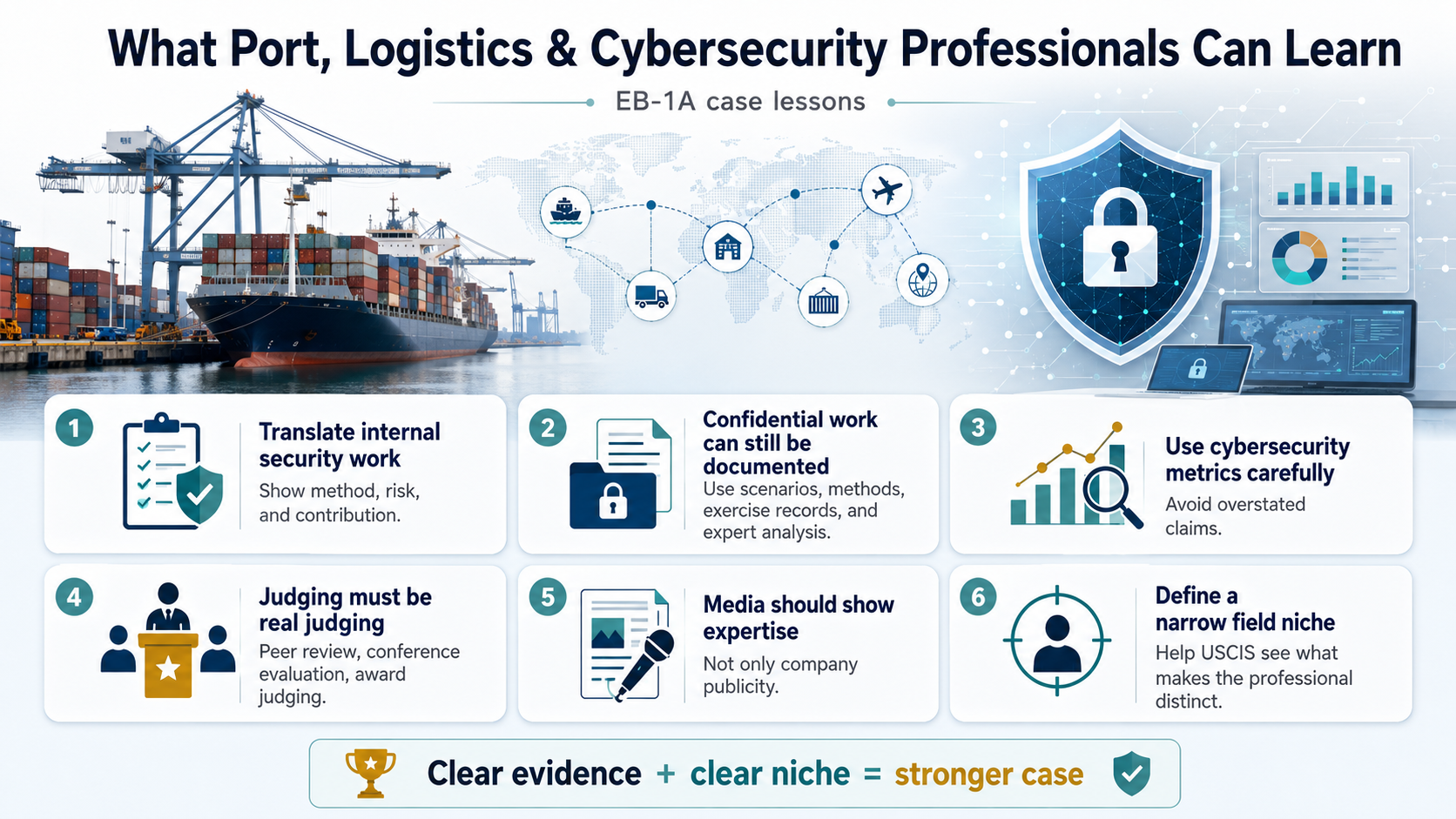
– Internal security work needs translation. Job duties should be reorganized around the method, risk, and professional contribution.
– Confidentiality is not a reason to leave the record empty. A careful petition can use non-confidential scenarios, method descriptions, exercise records, public writing, and independent expert analysis.
– Cybersecurity metrics should be used carefully. Avoid claiming that one professional prevented every incident or secured an entire infrastructure environment unless the evidence truly supports that claim.
– Judging must be real judging. Peer review, conference evaluation, and award judging are useful when they show actual assessment of other professionals’ work.
– Media coverage is strongest when it shows recognized expertise, not only company publicity.
– The field niche should be narrow enough for USCIS to understand why the person is different from other competent cybersecurity professionals.
Frequently asked questions
Can a cybersecurity professional qualify for EB-1A if most work is confidential?
Yes, but the petition must use evidence that can be disclosed and verified. Non-confidential method summaries, public articles, peer review, judging, media commentary, expert letters, and safe descriptions of implementation can help show the work without revealing protected systems.
working on critical infrastructure enough for EB-1A?
No. Critical infrastructure work may show importance, but EB-1A requires evidence of the individual’s recognized ability, original contribution, and sustained acclaim. The petition must connect the person, the method, and the field significance.
Can tabletop exercises support an EB-1A original-contribution argument?
They can help when the evidence shows a method linked to the beneficiary, actual use in professional practice, and expert explanation of why the method matters. A tabletop exercise by itself is usually not enough.
Does media commentary count as published material?
It may support the published-material criterion when the coverage is independent and discusses the beneficiary or the beneficiary’s expertise. A company announcement or self-published post is weaker.
Why was the field niche so narrow in this case?
A narrow niche helped distinguish the beneficiary from general cybersecurity professionals. The petition focused on smart-port and maritime-logistics cyber-resilience, where cybersecurity affects operational continuity and trade systems.
Build an EB-1A record around the infrastructure problem your work actually solves
Many cybersecurity professionals protect systems that the public never sees. Their strongest work may be buried inside incident-preparation plans, risk reviews, tabletop exercises, vendor controls, and confidential infrastructure projects.
Immignis and Advance My Profile help identify a defensible professional niche, document individual methods, build credible field recognition, and prepare an EB-1A record around evidence that can be verified and responsibly disclosed.