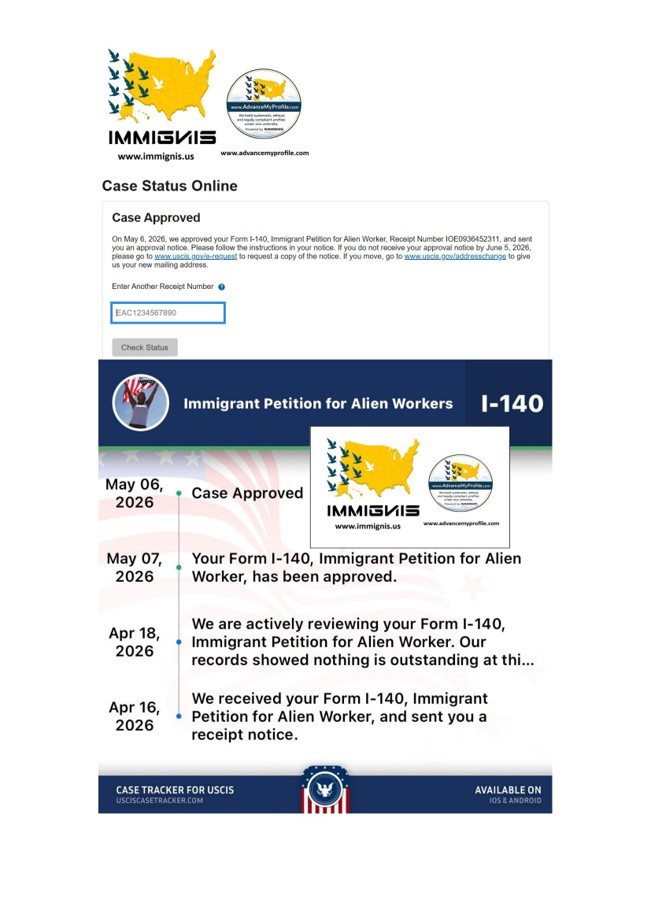
How an EB-1A Sustainability Executive from Bangladesh transformed apparel factory safety into a USCIS-approved record through audit-score improvements, international-brand letters, industry-initiative leadership, conference visibility, trade-press coverage, and compensation benchmarking.
Key facts at a glance
| Petition outcome | Form I-140 approved under EB-1A on May 6, 2026. |
| Professional profile | Bangladeshi compliance and sustainability head who transformed factory-safety outcomes after an industry-wide reckoning. |
| Field niche | Apparel supply-chain safety and sustainability transformation. |
| Starting weakness | Life-saving work was buried inside corporate compliance paperwork, confidential audits, and buyer communications. |
| Profile-building focus | Audit-score transformation evidence, international-brand letters, industry-initiative leadership roles, conference platforms, trade-press coverage, and compensation benchmarking. |
| EB-1A criteria supported | Leading role, original contributions, published material, membership, and high remuneration. |
| Central issue | Proving individual field-level impact when factory-safety and sustainability outcomes were credited to the company or kept inside confidential compliance systems. |
| Approval lesson | Brand letters from household-name retailers can become powerful independent validation when they explain the petitioner’s specific role and the significance of the safety transformation. |
The approval
On May 6, 2026, USCIS approved the Form I-140 petition of a Bangladeshi garment-sustainability executive whose work helped improve factory-safety and sustainability outcomes in one of the world’s most scrutinized apparel supply chains.
Inside the apparel industry, his value was clear. International buyers trusted his judgment. Factory leadership relied on him to move safety systems from paperwork into daily practice. Auditors, brand teams, and industry partners saw measurable improvement in conditions that directly affected workers and export readiness.
For EB-1A, however, the petition had to prove more than responsible employment or strong internal performance. It had to show extraordinary ability in a defined field, supported by evidence that reached beyond routine corporate compliance.
That became the center of the case: converting life-saving factory-safety and sustainability work, often buried inside audits and brand communications, into a record of field-level leadership that USCIS could evaluate.
The evidence problem in garment-sustainability work
Garment-sustainability and compliance careers are difficult to document because the strongest proof often sits inside confidential audits, buyer scorecards, corrective-action plans, factory records, and brand communications. These documents may show real transformation, but they are rarely written for immigration purposes.
The petitioner’s starting weakness was not lack of impact. The weakness was visibility and attribution. Factory-safety improvements were treated as corporate compliance results, while the individual leader who designed, coordinated, and drove those changes remained mostly invisible.
This required a focused field definition. The case was not presented as general apparel management or ordinary quality assurance. It was framed as apparel supply-chain safety and sustainability transformation, with emphasis on measurable factory outcomes, buyer trust, and industry-facing compliance leadership.
That field definition gave the petition a realistic measuring stick. The question was not simply whether the factory passed audits. The question was whether this executive had helped create a safer, more sustainable, and more credible operating model in a field where those improvements carry serious commercial and human importance.
Why factory-safety work was not just compliance
It would have been risky to describe the case only as compliance work. To a non-specialist reader, compliance can sound administrative: checklists, inspections, documents, and corrective-action reports. In reality, after major industry safety failures, apparel compliance can become a life-and-death discipline tied to worker protection, brand risk, export access, and global supply-chain trust.
The petition therefore treated compliance as the setting, not the full achievement. The evidence had to show what the petitioner personally changed, how those changes improved safety or sustainability outcomes, and why respected brands or industry partners viewed his role as important.
The strongest evidence came from audit-score transformations, international-brand letters, industry-initiative leadership roles, conference platforms, trade-press coverage, and carefully presented compensation data. Together, those materials showed that his work was not routine file management. It was measurable operational change with field relevance.
That distinction changed the case. Instead of asking USCIS to accept a private corporate compliance story, the petition translated factory-safety transformation into evidence of recognized expertise in apparel supply-chain sustainability.
Audit-score transformation became the proof of real impact
In some EB-1A fields, impact appears through citations, patents, published research, or public awards. In garment sustainability, impact often appears through audit results, remediation milestones, certification progress, workplace-safety indicators, buyer evaluations, and repeated trust from international brands.
The petition used that evidence carefully. The goal was not to claim that every audit improvement automatically proved extraordinary ability. The goal was to show that the petitioner led a documented transformation that improved safety systems, strengthened compliance performance, and made the factory more reliable within international apparel supply chains.
Good evidence did not say only that audit scores improved. It explained what he led, which systems changed, how corrective-action processes were strengthened, how sustainability practices became more consistent, and why those outcomes mattered to brands, auditors, workers, and the wider supply chain.
Those materials gave USCIS a concrete way to understand the petitioner’s contribution. Audit-score transformation became the public-facing fingerprint of work that was otherwise hidden inside factory systems and buyer files.
Leading-role evidence had to show operational authority, not job title alone
Executives often assume that a senior title proves a leading role. For EB-1A, that is not enough. The petition had to show that the petitioner carried responsibility that was important to the organization and meaningful within the field.
The record documented his authority over factory-safety systems, sustainability strategy, audit readiness, international-brand communication, corrective-action implementation, and supplier-compliance planning. It showed that he was not merely completing forms after decisions were made. He was helping decide what had to change and how the organization would meet higher standards.
That evidence helped separate real leadership from routine compliance employment. The case showed that his role influenced how the factory operated, how buyers assessed risk, and how sustainability requirements were translated into actual systems on the ground.
For business and manufacturing professionals, this distinction matters. A company profile may show certifications or buyer relationships. An EB-1A petition has to prove the individual’s responsibility inside those outcomes.
Original contribution in an apparel safety and sustainability case
Original contribution can be hard to explain in apparel cases because innovation may look practical rather than academic. A sustainability executive may not publish a scientific paper or own a patent, yet may still design systems that meaningfully improve worker safety, audit performance, and international buyer confidence.
For this petitioner, the original-contribution argument was built around factory-safety transformation and sustainability implementation. The evidence showed how his work improved audit outcomes, strengthened risk controls, and helped the organization meet the expectations of major international brands.
That mattered because USCIS looks for contributions of significance, not ordinary job performance. The record had to show that his work produced measurable change and was recognized by serious external stakeholders, not only appreciated by his employer.
The petition did not claim that he transformed the entire global garment industry alone. It made a narrower and stronger point: within the specialized field of apparel supply-chain safety and sustainability transformation, his work produced significant, verifiable, and externally recognized improvements.
Published material and trade-press visibility
The original profile had limited public visibility because apparel sustainability work is often discussed through brands, factories, certifications, or national export statistics. Individual compliance leaders rarely become the headline, even when they do the difficult work behind the improvement.
Trade-press coverage, conference visibility, and industry commentary helped make the petitioner’s expertise visible beyond private factory records. This mattered because published material gave USCIS an independent way to see that his work belonged to a broader conversation about apparel safety, supply-chain sustainability, and responsible manufacturing.
The petition treated published material as support rather than decoration. The most useful public evidence connected his name to factory transformation, sustainability leadership, audit improvement, or credible apparel-industry discussion.
Industry-initiative leadership and membership showed external trust
Membership evidence can be weak when it reflects ordinary enrollment. In apparel sustainability, however, leadership in industry initiatives, recognized working groups, safety programs, or professional bodies can show that the field trusts the petitioner to participate in serious discussions and implementation efforts.
The petition therefore used membership and industry-initiative evidence in context. It showed where the petitioner was not just present, but active: contributing to safety improvement, sustainability adoption, brand-aligned compliance systems, or industry knowledge-sharing.
That evidence became stronger when paired with brand letters, audit documentation, trade visibility, and conference platforms. Together, it showed that his expertise was recognized outside the walls of one factory.
High remuneration evidence needed careful benchmarking
High remuneration can help EB-1A business and executive cases, but only when it is presented with the right comparison. A salary figure alone does not prove extraordinary ability. USCIS needs context showing that the petitioner was compensated above ordinary peers in a relevant market and role.
The petition therefore used compensation benchmarking carefully. The goal was not simply to say that he earned well. The goal was to show that his specialized combination of compliance, sustainability, brand-facing leadership, and factory-safety expertise had real market value.
That evidence supported the larger record. It showed that the same expertise recognized through brand trust, audit outcomes, and industry platforms was also valued economically at a level consistent with senior field leadership.
How the EB-1A criteria worked together
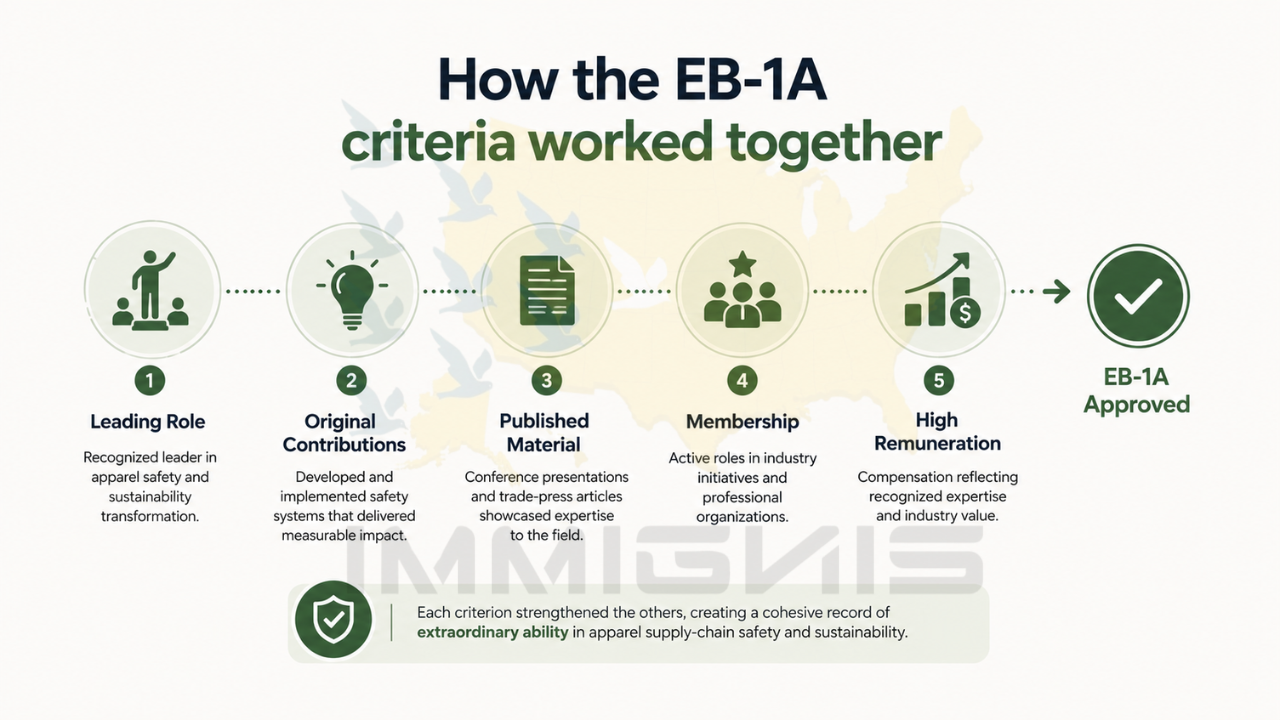
The petition did not depend on one perfect exhibit. It worked because several forms of evidence pointed in the same direction and supported the same theory of the case:
- Leading role: Factory-safety, sustainability, audit-readiness, and brand-facing records showed that the petitioner held real authority in a critical compliance and sustainability function.
- Original contributions: Audit-score transformations, safety-system improvements, corrective-action leadership, and sustainability implementation showed measurable contribution beyond ordinary paperwork.
- Published material: Trade-press coverage, conference visibility, and industry commentary made his expertise visible beyond private audits and internal buyer communications.
- Membership: Industry-initiative roles and professional affiliations helped show external trust from the apparel-sustainability field.
- High remuneration: Compensation benchmarking supported the claim that the market valued his specialized sustainability and compliance leadership above ordinary roles.
The strongest part of the record was coherence. The case did not drift into generic factory management, broad apparel exporting, or vague social-impact language. It stayed focused on apparel supply-chain safety and sustainability transformation.
The final-merits argument
At the final-merits stage, the petition had to show more than satisfaction of individual criteria. It had to demonstrate that, taken together, the evidence established sustained acclaim and extraordinary ability in the petitioner’s field.
The argument centered on verifiable transformation rather than private compliance files alone. The petitioner was not presented merely as an employee who helped a factory pass inspections. He was presented as a field specialist whose leadership improved safety performance, strengthened sustainability systems, and earned trust from recognized brands and industry participants.
The final record showed that his expertise had been recognized through audit-score improvements, international-brand validation, industry-initiative involvement, conference platforms, trade visibility, and compensation evidence.
That is why the case was stronger than a file built around job duties alone. It told USCIS what the apparel-sustainability field values and then showed how the petitioner had already been recognized inside that field.
Why the approval mattered
The approval mattered because it showed how a private compliance and sustainability career can become a strong EB-1A record when the evidence is organized around measurable outcomes, external validation, and a clear field niche.
For this Bangladeshi garment-sustainability executive, the petition did not try to expose confidential buyer files or overstate corporate achievements as personal accomplishments. It identified the public and disclosure-safe proof that could fairly show his own role: audit outcomes, brand letters, initiative leadership, public visibility, and market valuation.
The approval confirmed the central lesson of the case: when factory-safety work is hidden inside corporate compliance systems, the petition must make the human and commercial significance visible without breaking confidentiality.
Lessons for garment executives, compliance leaders, and sustainability professionals
This case is useful for apparel executives, compliance heads, sustainability managers, factory-transformation leaders, sourcing specialists, and supply-chain professionals whose strongest proof often sits inside confidential business records.
A strong record usually begins with the following questions:
- Can audit improvements, safety outcomes, or sustainability milestones be documented without exposing sensitive buyer or factory information?
- Can international brands, auditors, industry partners, or initiative leaders explain the petitioner’s personal contribution?
- Do trade publications, industry conferences, professional bodies, or working groups recognize the petitioner’s expertise?
- Can compensation benchmarking show that the market values the petitioner’s specialized sustainability and compliance leadership?
- Can the business result be connected to original safety or sustainability transformation rather than routine compliance administration?
When those questions are answered with documents, a private factory-safety story becomes much easier for USCIS to evaluate. That is often the difference between respected internal leadership and a successful EB-1A record.
Frequently asked questions
Can a garment-sustainability executive qualify for EB-1A?
Yes. A garment-sustainability executive may qualify for EB-1A if the evidence shows sustained acclaim and extraordinary ability in a clearly defined field such as apparel supply-chain safety, sustainability transformation, or responsible manufacturing leadership.
Can confidential audit records support an EB-1A case?
Yes, but they should be handled carefully. Disclosure-safe summaries, redacted documents, employer-cleared impact letters, certification records, and brand letters can help show impact without exposing sensitive business information.
Can international-brand letters help prove extraordinary ability?
Yes. Letters from major brands, buyers, auditors, or industry partners can be strong evidence when they explain the petitioner’s specific role, the importance of the work, and why the contribution mattered beyond routine compliance.
Can audit-score transformation prove original contribution?
It can support original contribution when the record explains what changed, who led the change, why the improvement was significant, and how the outcome affected worker safety, sustainability performance, buyer trust, or industry standards.
Does high remuneration matter for an EB-1A sustainability executive?
High remuneration can support EB-1A when it is compared against relevant industry and market benchmarks. The evidence should show that the petitioner was paid at a level reflecting unusually valuable expertise, not merely seniority.
Can Immignis and Advance My Profile help apparel and sustainability professionals build EB-1A evidence?
Immignis and Advance My Profile help apparel executives, sustainability leaders, compliance professionals, and supply-chain specialists define a credible field niche, document impact, strengthen visibility, and build a petition-ready EB-1A evidence record.
Build an EB-1A record around factory-safety leadership and verifiable impact
Many apparel and sustainability professionals create life-changing and business-critical improvements, but their strongest proof stays inside audits, buyer files, certification records, and confidential compliance systems.