How a black-belt world medalist turned scattered tournament records and coaching impact into an EB-1A-approved sports profile
Key facts at a glance
| Outcome | EB-1A approval for a Brazilian Jiu-Jitsu athlete-coach. |
| Approval date | USCIS approved the Form I-140 on March 10, 2026. |
| Field niche | Competitive Brazilian Jiu-Jitsu athletics and team coaching. |
| Starting problem | The medal record existed, but it was scattered across federations and events. The move from active athlete to coach also made the field harder to explain. |
| Profile-building path | Immignis consolidated federation results, ranking records, martial-arts press, seminar documentation, referee and judging credentials, team-results attribution, academy leadership evidence, and expert letters. |
| EB-1A criteria supported | Awards, judging, published material, leading or critical role, and qualifying membership evidence, with coaching methodology and athlete outcomes supporting the final-merits narrative. |
| Approval hook | The petition showed that his field did not end when he left the mat as a competitor. His recognized skill continued through coaching, athlete development, judging, and leadership in competitive BJJ. |
The approval came after the field was defined correctly
On March 10, 2026, USCIS approved the Form I-140 petition of an EB-1A BJJ Coach , a Brazilian Jiu-Jitsu athlete-coach. The public case timeline showed a quick sequence: receipt on February 25, active review on February 27, and approval on March 10, 2026.
The short timeline did not mean the case was simple. Sports cases often look easier from the outside than they are on paper. A medal list can impress fans, teammates, and students, but USCIS does not adjudicate reputation inside a gym. It reviews evidence. For this athlete-coach, the challenge was to convert a life built around competition mats, federation brackets, black-belt recognition, and athlete development into a record an immigration officer could read and evaluate.
The strongest fact was clear: he was a Brazilian Jiu-Jitsu black belt and world medalist who later led a competition team in the United States. The harder question was legal and practical: was this still one coherent field, or had the record split into two weaker stories--one about past athletic medals and another about current coaching work?
That question became the center of the case.
The record had medals, but not yet an EB-1A story
In combat sports, achievements often live in places that are messy from an immigration-evidence standpoint. A tournament result may appear on an old federation webpage. A medal may be shown in a photograph but not linked to the bracket. A ranking may change after the season ends. A black-belt promotion may be respected throughout the community but issued through a lineage system rather than a formal institution with an admissions office. Coaching work may be based on trust, reputation, and results, not long contracts.
That was the starting weakness. The athlete had real achievements, but the record was scattered. Some results were easy to recognize. Others needed context: the event level, the federation, the belt division, the bracket size, and the significance of a podium finish. Without that context, a medal can become just another certificate in a file.
The coaching side created a second problem. Many athletes move into coaching after elite competition, but EB-1A requires proof that the person will continue work in the area of extraordinary ability. If the petition treats athletic medals and coaching work as separate careers, the record can lose force. If it treats coaching as the natural extension of elite BJJ expertise, the evidence can work together.
Immignis built the case around that second approach. The field was not described broadly as "sports" or vaguely as "martial arts." It was defined as competitive Brazilian Jiu-Jitsu athletics and team coaching, with the athlete-to-coach transition explained as part of the same professional arc.
Why the athlete-to-coach transition mattered
A strong sports case has to answer a simple question: what exactly is the field?
For an active competitor, the answer may be easier. The athlete competes in a named sport, earns rankings or medals, and continues to compete. For a coach, the answer can be more complicated. USCIS may need to see whether the person is still working in the same field of extraordinary ability or has moved into a related but different occupation.
In this case, the bridge came from three evidence streams.
- First, the petition documented the athlete record: medals, federation results, belt level, ranking evidence, and tournament history.
- Second, it documented coaching authority: leadership over a competition team, seminar invitations, athlete development, and responsibility for training methods.
- Third, it connected the two through recognition from the field: referee or judging credentials, athlete-result attribution letters, martial-arts press, membership or federation evidence, and expert letters from respected BJJ figures.
That bridge was important. The case did not ask USCIS to approve a retired athlete based only on memories of competition. It presented a professional who continued to operate inside elite BJJ through coaching, judging, instruction, and team leadership.
What did USCIS need to see in a Brazilian Jiu-Jitsu EB-1A case?
A BJJ record can look strong to people inside the sport and still be incomplete for EB-1A. The petition had to translate sport-specific prestige into evidence that matched the regulatory criteria and supported final merits.
For awards, the case needed more than a list of medals. It had to identify the level of each competition, the federation or organizer, the belt division, the competitive class, and why a podium finish at that level mattered. In BJJ, a gold medal at a small local event and a medal at a major international championship do not carry the same evidentiary weight.
For judging, the petition had to show actual evaluation of others, not merely participation in events. Referee credentials, judging assignments, athlete-selection panels, or formal evaluation roles could help if they were documented and tied to the field.
For published material, media had to be about him, his work, his team, his competition results, or his coaching methodology. A general article about a tournament was not enough unless it identified his role and explained his significance.
For leading or critical role, the file needed proof that he led a competition team or held a meaningful role within a distinguished academy, organization, or competitive program. Titles alone were not the evidence. Athlete outcomes, leadership responsibilities, program structure, and letters from organizational leaders gave the role substance.
For membership, the petition had to be careful. A black belt is powerful field context, but it is not automatically the same as a qualifying professional membership under EB-1A. If membership evidence was used, the record needed admission or advancement standards, selection rules, or other proof that the association recognized achievement rather than merely collecting dues.
Finally, the petition had to show that the record as a whole reflected sustained acclaim. In a sport built on rankings, mats, academies, and word-of-mouth reputation, that meant organizing evidence in a way that showed continuity, not isolated moments.
The federation results were rebuilt as evidence, not decoration
The first practical step was to consolidate the competition record. This meant identifying which results could be verified, which events were prestigious, which rankings had reliable documentation, and which medals should be treated as central rather than merely listed.
For BJJ, context matters. Belt level, weight division, open-class participation, bracket size, and federation standing can all affect the significance of a result. A strong petition does not simply say "world medalist" and hope the officer understands the sport. It explains why the event matters, what level of competition it represents, and how the result placed the athlete among serious competitors in the field.
The strongest results were grouped by significance. The record avoided padding. Lesser tournaments were useful for continuity, but the case focused on achievements that showed national or international recognition.
This helped solve a common sports-case problem: too much information without hierarchy. USCIS does not need every medal photograph in the same weight. It needs to understand which awards show acclaim and why.
Coaching was documented through results, not general praise
The coaching record required a different kind of proof. In BJJ, coaches often shape athletes through daily training, tournament preparation, strategy, belt development, and competition culture. Much of that work is visible to athletes but invisible to outsiders.
Immignis focused on attribution. The file gathered letters from athletes, academy leaders, and field professionals who could explain his role in the development of competitors. The strongest letters did not merely say he was dedicated or respected. They described what he changed: training structure, competition preparation, guard-passing systems, defensive decision-making, pressure management, or tournament strategy.
Team-results evidence helped as well. Where athletes under his coaching reached podiums, improved rankings, joined major competitions, or advanced within the sport, those results gave the coaching role an external frame. The case did not claim that every athlete's success belonged to him. It showed that his coaching formed a documented part of a competitive development system.
That distinction mattered. In sports immigration, vague praise can weaken a case. Specific attribution strengthens it.
Martial-arts press helped move the record beyond the gym
Published material played a practical role. Many BJJ professionals are known inside academies, at tournaments, and through seminar circuits, but they do not have the kind of press file that actors, musicians, or startup founders may have.
The media evidence was built around what the field would actually recognize: coverage of competition achievements, interviews about training philosophy, features on the competition team, discussion of coaching methods, or press connected to seminars and tournament appearances. The goal was not publicity for its own sake. It was to create independent public evidence of recognition.
This also helped readers outside BJJ understand the difference between a local instructor and a high-performance athlete-coach. Press coverage can explain the field's hierarchy in a way that raw certificates cannot.
Judging and referee evidence showed trust from the field
Judging evidence was especially useful because it showed that the field trusted him to evaluate others. In martial arts, that kind of evidence can come from referee roles, judging assignments, athlete-selection work, competition panels, or formal roles in evaluating performance.
The petition treated this evidence carefully. It did not turn every coaching opinion into judging. It looked for documented assignments where he assessed competitors, officiated or evaluated performance, or helped select athletes in a recognized setting.
That kind of evidence helped show that his expertise was not limited to his own competition career. Others in the sport relied on his judgment.
Membership and black-belt evidence were handled without exaggeration
The black belt was important, but it had to be used correctly. In BJJ, a black belt carries meaning. It reflects years of training, competition, technical development, and recognition through lineage. But for EB-1A, rank evidence must be explained rather than assumed.
The petition used black-belt documentation to establish field level and professional context. It showed why the rank mattered within competitive BJJ and how it supported the credibility of the athlete-coach record.
For the membership criterion, the petition focused only on evidence that could meet the legal standard. If an organization or association required achievement, vetting, rank, competitive history, or professional recognition for membership or advancement, that could support the record. If it was merely an open registration, it was not treated as qualifying evidence.
This conservative approach made the case stronger. USCIS does not reward inflated claims. It rewards evidence that can survive close reading.
The leading-role argument came from responsibility and results
A leading role is not proved by calling someone a leader. The record has to show the importance of the organization or program and the person's role within it.
Here, the leading-role evidence centered on his work with a U.S. competition team. The file explained the team's competitive purpose, his authority within training and preparation, and the way athletes relied on his experience. It also documented seminar activity, academy recognition, team-results attribution, and letters from people who could describe his responsibilities with specificity.
The strongest evidence did not sound like a recommendation letter from a friend. It read like a professional account of what he did, who depended on him, and why his role mattered to competitive performance.
How the EB-1A record worked together
The case did not depend on one medal, one article, or one title. It worked because the evidence told one coherent story.
His awards showed that he had competed at a high level. His published material helped move that recognition into the public record. His judging and referee evidence showed that the field trusted his evaluation of others. His leading-role evidence showed that he was not merely a former athlete but a current figure shaping competitors. His membership and rank documentation gave structure to the hierarchy of the sport. Expert letters explained the significance of those facts for people outside BJJ.
That was the central legal and narrative achievement: the petition made the athlete-to-coach transition understandable. It showed continuity instead of a break.
USCIS approved the petition
USCIS approved the Form I-140 on March 10, 2026. The approval followed a record that connected past athletic recognition with current coaching leadership and field trust.
For the client, the approval meant that his professional life in BJJ had been understood on its own terms. The petition did not force a traditional office-based career model onto a martial-arts record. It explained how accomplishment, reputation, leadership, and expertise operate in competitive Brazilian Jiu-Jitsu.
That is often the difference in sports EB-1A cases. The evidence may already exist, but it has to be collected, ranked, explained, and tied to the correct field.
What other martial artists and coaches can learn from this case
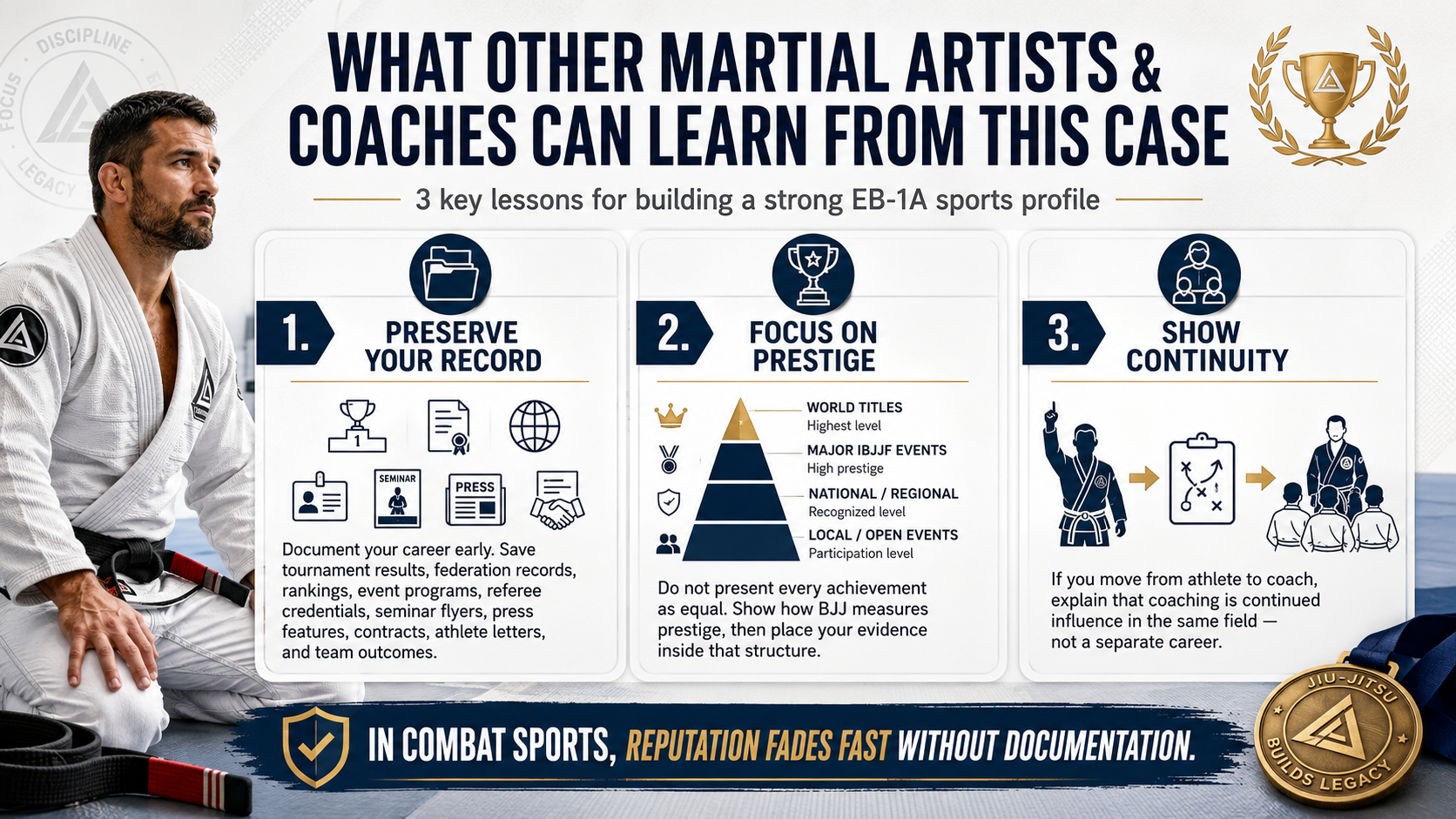
Many combat-sports professionals wait too long to document their careers. Tournament websites change. Brackets disappear. Event pages get archived. Coaches leave academies. Athletes move teams. Press links break. A reputation that was obvious in the gym can become difficult to prove years later.
A serious EB-1A sports profile should begin with preservation. Save tournament results, federation records, ranking pages, event programs, referee credentials, seminar flyers, press features, coaching contracts, athlete letters, and proof of team outcomes. The more informal the sport's culture is, the more important documentation becomes.
The second lesson is focus. A BJJ athlete-coach should not present every achievement as equal. The petition should teach the officer how the sport measures prestige and then place the evidence inside that structure.
The third lesson is continuity. If the person is moving from athlete to coach, the record must explain why coaching is not a different life after competition. It is often the next form of influence inside the same field.
Frequently asked questions
Can a Brazilian Jiu-Jitsu athlete qualify for EB-1A?
Yes, but the case must be documented carefully. Medals, rankings, press, judging roles, leading roles, membership evidence, and expert letters may help if they show sustained acclaim and recognized achievement in the field.
Are medals enough for EB-1A?
Medals can be important, but they are rarely enough by themselves. The petition should explain the level of each competition, the federation or organizer, the division, the size and quality of the field, and why the result indicates distinction beyond ordinary participation.
Can a former athlete qualify as a coach?
A former athlete may qualify when the record shows continuity between athletic achievement and current coaching work. Coaching contracts, athlete-result attribution, academy leadership evidence, seminar invitations, press, and judging roles can help show that the person remains active in the field of extraordinary ability.
Does a black belt count as a professional membership?
A black belt is valuable field evidence, but it is not automatically a qualifying EB-1A membership. The petition should explain the rank and use separate membership evidence only where an association has selective standards based on achievement or expert assessment.
Why is documentation difficult in martial-arts cases?
Many martial-arts careers are built through tournaments, gyms, seminars, federation pages, social reputation, and personal networks. Those records are often scattered. EB-1A requires the evidence to be collected, verified, organized, and explained in a way USCIS can evaluate.
Build an EB-1A case around the field you actually mastered
If your strongest record is in Brazilian Jiu-Jitsu, combat sports, coaching, martial-arts instruction, referee work, or athlete development, your evidence may not look like a traditional professional file. That does not mean it lacks value. It means the record has to be translated into the language of EB-1A evidence.
Immignis helps athletes, coaches, artists, researchers, founders, and technical specialists identify a defensible field niche, preserve proof of recognition, build credible public evidence, and prepare an EB-1A record around facts that can be verified and defended professionally.