EB-1A Digital Payments Executive: How a Kazakh payments-platform executive secured EB-1A approval by turning Central Asian fintech expansion into a documented record built on transaction-scale evidence, fintech-press profiles, regional-summit keynotes, regulator-engagement records, international fintech-association membership, and compensation benchmarking.
Key facts at a glance
| Petition outcome | Form I-140 approved under EB-1A on May 4, 2026. |
| Professional profile | Kazakh executive who led a payments platform’s expansion across Central Asia. |
| Field niche | Emerging-market digital-payments infrastructure. |
| Starting weakness | The petitioner had regional fame and market impact, but very limited Western-facing documentation. |
| Profile-building focus | Fintech-press profiles, transaction-scale documentation, regional-summit keynotes, regulator-engagement records, international fintech-association membership, and compensation benchmarking. |
| EB-1A criteria supported | Leading role, original contributions, published material, membership, and high remuneration. |
| Central issue | Making regional digital-payments leadership understandable and credible to a U.S. adjudicator unfamiliar with the Central Asian fintech market. |
| Approval lesson | Regional market dominance can support EB-1A when the petition translates it into disclosure-safe, independent, and globally legible evidence. |
The approval
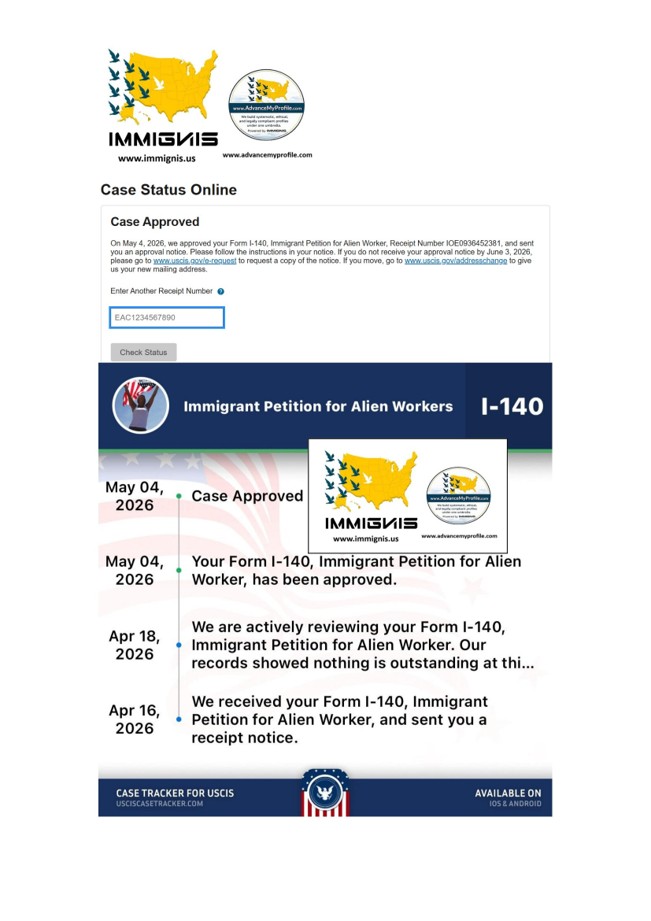
On May 4, 2026, USCIS approved the Form I-140 petition of a Kazakh digital-payments executive whose work helped expand a payments platform across Central Asia and strengthen emerging-market financial infrastructure.
Inside the region, his reputation was already meaningful. He had helped build payment adoption, supported platform growth, worked around regulatory and market-entry barriers, and contributed to a fintech system that connected merchants, consumers, and financial institutions across multiple markets.
For EB-1A, however, regional recognition was not enough by itself. The petition had to show that his achievements were legible outside the local market and that the evidence proved extraordinary ability in a defined field, not merely senior employment in a growing company.
That became the central challenge of the case: translating regional market dominance into globally understandable proof of field-level expertise in emerging-market digital-payments infrastructure.
The evidence problem in emerging-market fintech cases
Digital-payments work in emerging markets can be difficult to document because the strongest proof often sits inside transaction dashboards, merchant-network data, partner agreements, regulator communications, product-expansion reports, and internal strategy documents. Those materials may show major impact, but they are not automatically usable in an immigration petition.
The petitioner’s starting weakness was not lack of achievement. The problem was that his reputation lived mainly inside Central Asian business and fintech circles. Western-facing documentation was limited, and an adjudicator unfamiliar with the regional payments market could easily underestimate the significance of the work.
The case therefore needed a precise field definition. It was not framed as generic business leadership or ordinary fintech employment. It was presented as emerging-market digital-payments infrastructure, with emphasis on platform expansion, payment adoption, transaction scale, regulatory navigation, and cross-market execution.
That field definition mattered because it gave USCIS a way to measure the work. The question was not whether the company was successful in the region. The question was whether the petitioner had personally contributed to recognized digital-payments infrastructure growth at a level that distinguished him from ordinary executives.
Why regional fame had to become officer-readable evidence
Many professionals in fast-growing regional markets are well known to customers, regulators, investors, partners, and competitors, but almost invisible in Western documentation. That creates a major EB-1A problem because USCIS cannot approve a case based on reputation that is not proven in the record.
The petition therefore treated regional fame as a starting point, not as the final argument. It had to convert that reputation into exhibits: fintech-press profiles, transaction-scale documentation, keynote invitations, regulator-engagement records, association membership, and evidence of unusually high market value.
This conversion was important because digital payments are often judged through local adoption and infrastructure outcomes rather than traditional academic or research markers. The petition had to explain why those outcomes were meaningful in the field and how they were connected to the petitioner’s own leadership.
That shift made the case stronger. Instead of asking USCIS to trust a regional success story, the petition gave the officer independent, organized, and disclosure-safe evidence showing why the work mattered beyond one employer.
Transaction-scale documentation became the backbone of the case
In payments infrastructure, scale matters. A strong record can include transaction volume, merchant adoption, user growth, geographic expansion, platform reliability, partner integration, and documented improvements in how digital payments reach underserved or developing markets.
The petition used transaction-scale evidence carefully. Confidential numbers were not overexposed, and the filing did not depend on raw internal screenshots alone. Instead, the record used disclosure-safe summaries, cleared business documentation, and corroborating materials that explained the scale and significance of the petitioner’s work.
The best evidence answered practical questions. What markets did the platform enter? What problem did the expansion solve? What parts of the strategy did the petitioner lead? How did merchants, users, partners, or financial institutions benefit from the work?
Those materials helped turn business growth into EB-1A evidence. The petition showed that the petitioner’s leadership was tied to measurable infrastructure development, not just general corporate success.
Leading-role evidence had to show more than an executive title
Executive titles are useful, but they do not automatically prove extraordinary ability. A petition must show what the person actually controlled, why the role was important, and how the organization or field relied on that expertise.
The record documented the petitioner’s authority over regional expansion strategy, payment-platform execution, partnership development, product-market adaptation, and cross-border digital-payments growth. It showed that he was not simply occupying a senior role. He was helping shape how the platform entered and scaled in complex emerging markets.
That evidence helped establish a leading or critical role within a distinguished organization and showed why his work mattered to the broader fintech ecosystem. It connected his position to specific outcomes rather than leaving USCIS with a title and a list of duties.
For business and fintech professionals, this distinction is essential. A company may grow quickly. EB-1A requires proof that the petitioner’s own leadership was central to that growth and recognized as exceptional.
Original contribution in a payments-infrastructure case
Original contribution in fintech does not always look like a patent or a research paper. In digital payments, a meaningful contribution can appear through market-entry models, merchant-adoption systems, regulatory execution, platform infrastructure, fraud-reduction design, partner integration, or methods that make payment systems more accessible and reliable.
For this petitioner, the original-contribution argument was built around emerging-market execution. The case showed how his work helped expand a digital-payments platform in markets where payments infrastructure, user trust, merchant onboarding, and regulatory coordination were serious practical barriers.
That mattered because USCIS looks for contributions of significance, not ordinary job performance. The petition therefore explained why the petitioner’s work had field value: it helped modernize payment access, support business digitization, and improve the infrastructure through which commerce moved in the region.
The petition did not claim that he personally created the entire payments ecosystem. It made a narrower and stronger point: within the field of emerging-market digital-payments infrastructure, his leadership produced documented, recognized, and commercially significant results.
Fintech press and summit visibility made the record legible
The original profile had limited Western documentation, so public visibility had to be built carefully and ethically. Fintech-press profiles, industry commentary, and regional-summit keynotes helped explain the petitioner’s role to readers outside Central Asia.
This evidence was valuable because it translated local market relevance into language the adjudicator could understand. It showed that the petitioner was not only known internally, but was visible in the professional conversation around digital payments, financial inclusion, platform growth, and regional fintech modernization.
The petition treated press and speaking evidence as support for the broader record. The most useful materials connected the petitioner by name to payments infrastructure, market expansion, regulatory issues, transaction scale, or strategy in emerging fintech markets.
Regulator engagement and international membership strengthened credibility
Digital-payments infrastructure is not built in isolation. It depends on regulator trust, compliance structures, banking relationships, merchant networks, and professional legitimacy. In this case, regulator-engagement records helped show that the petitioner operated at a serious level of the field.
International fintech-association membership also helped when presented in context. The petition did not treat membership as a checkbox. It used membership and professional affiliation evidence to show that the petitioner’s standing extended beyond one company and one domestic market.
Together, regulator engagement and international membership helped solve the initial weakness. They showed that the petitioner’s work could be understood in a broader fintech ecosystem rather than only as regional corporate employment.
High remuneration supported the market-value argument
High remuneration can be persuasive in EB-1A business cases when it is benchmarked properly. The point is not simply that an executive earned well, but that the compensation reflects unusual value in the relevant market and role category.
For this petitioner, compensation evidence supported the claim that the market placed a premium on his digital-payments expertise. The record compared his remuneration against relevant executive and fintech leadership benchmarks and explained why his compensation matched the level of responsibility and impact documented elsewhere in the petition.
That evidence worked best because it did not stand alone. When paired with transaction-scale documentation, press visibility, leading-role proof, regulator engagement, and association membership, high remuneration helped confirm that the field valued the petitioner at an elevated level.
How the EB-1A criteria worked together
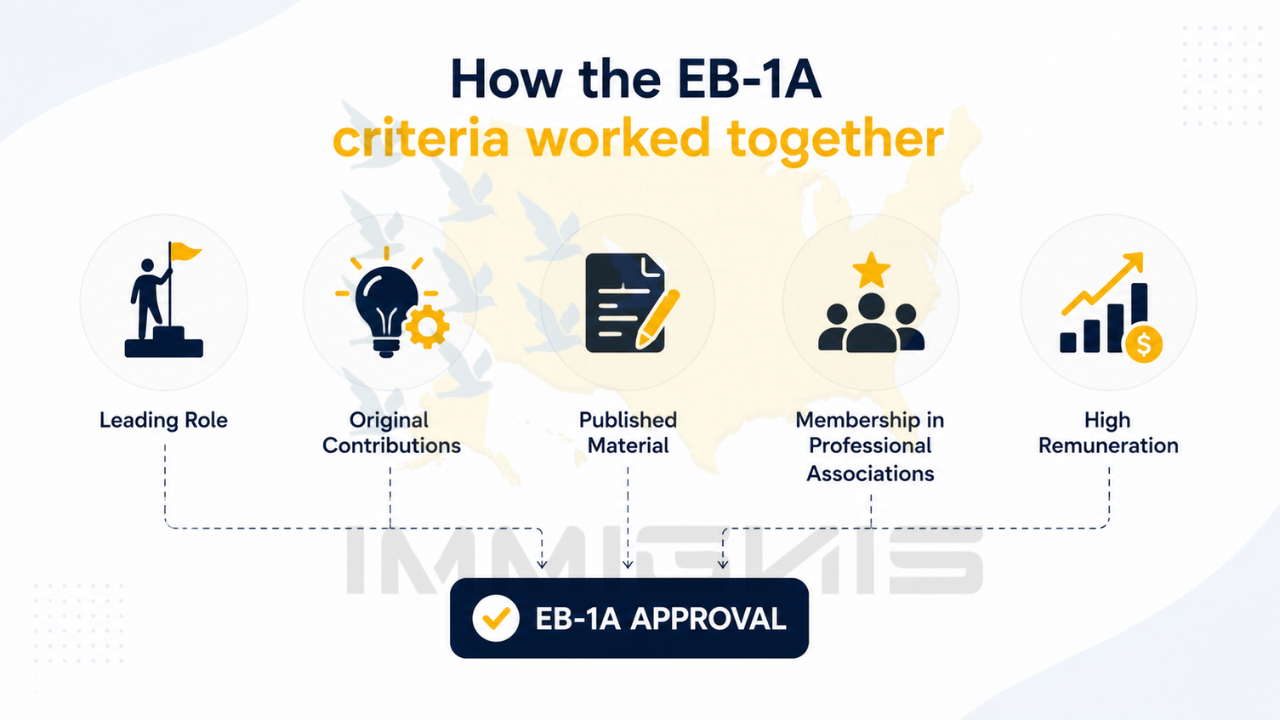
The petition did not depend on one perfect exhibit. It worked because several forms of evidence pointed to the same conclusion:
- Leading role: Records showed that the petitioner held strategic authority in regional digital-payments expansion and platform execution.
- Original contributions: Transaction-scale evidence, market-expansion documentation, and professional explanations showed that his work contributed to payments infrastructure growth in emerging markets.
- Published material: Fintech-press profiles and industry visibility made his regional achievements understandable to a non-specialist adjudicator.
- Membership: International fintech-association membership and professional affiliations helped show standing beyond one employer or domestic market.
- High remuneration: Compensation benchmarking supported the claim that the market valued his payments-infrastructure expertise above ordinary executive service.
The strongest part of the record was coherence. The case did not drift into generic business success or vague startup language. It stayed focused on the petitioner’s specific niche: emerging-market digital-payments infrastructure.
The final-merits argument
At the final-merits stage, the petition had to show that the evidence as a whole established sustained acclaim and extraordinary ability. This required more than proving that the petitioner worked for a successful payments platform.
The argument focused on professional distinction. The petitioner had led work that helped expand digital-payments infrastructure across a region, had been visible in fintech media and summit platforms, had engaged with serious regulatory and professional ecosystems, and had been compensated at a level consistent with unusually high value.
The final record showed that his achievements were not confined to internal company claims. They were supported through transaction-scale evidence, public recognition, external engagement, international membership, and market valuation.
That is why the petition became stronger than a standard executive case. It did not simply say he helped a company grow. It showed that he was a recognized digital-payments infrastructure executive whose work had regional significance and could be understood globally.
Why the approval mattered
The approval mattered because it showed how professionals from emerging markets can succeed in EB-1A when their achievements are documented in a way that travels across borders. Regional prominence can be powerful, but only when it is translated into evidence USCIS can evaluate.
For this Kazakh digital-payments executive, the petition did not try to replace regional proof with artificial Western validation. It kept the real story centered on Central Asia, then added the documentation needed to make that story clear to a U.S. adjudicator.
The approval confirmed the central lesson of the case: market dominance in one region can support EB-1A when the record shows individual leadership, measurable impact, professional visibility, and independent indicators of field-level value.
Lessons for fintech executives and emerging-market business leaders
This case is useful for fintech founders, payments executives, market-expansion leaders, product-growth heads, banking-platform professionals, and emerging-market business leaders whose strongest achievements are real but not easily visible in Western records.
A strong record usually begins with the following questions:
- Can transaction scale, market expansion, or platform adoption be documented in a disclosure-safe way?
- Can fintech press, summit invitations, or public commentary make the petitioner’s role visible outside the company?
- Do regulator-engagement records, association memberships, or professional affiliations show serious field-level credibility?
- Can compensation benchmarking show that the market values the petitioner above ordinary executives in similar roles?
- Can the petition define the work as payments infrastructure or market-expansion expertise rather than generic business management?
When those questions are answered with documents, regional success becomes much easier for USCIS to understand. That is often the difference between being known in a market and being provable under EB-1A.
Frequently asked questions
Can a digital-payments executive qualify for EB-1A?
Yes. A digital-payments executive may qualify for EB-1A if the evidence shows sustained acclaim and extraordinary ability in a clearly defined field such as payments infrastructure, fintech market expansion, digital-banking adoption, or emerging-market financial technology.
Can regional fintech success support an EB-1A petition?
Yes, if the record translates regional success into evidence USCIS can evaluate. Useful documentation may include transaction-scale records, independent press, keynote invitations, regulator-engagement proof, professional memberships, and compensation benchmarking.
How can confidential transaction data be used in an EB-1A case?
Confidential data can sometimes be presented through disclosure-safe summaries, employer-cleared statements, redacted reports, or independent corroborating evidence. The goal is to document scale and significance without exposing protected business information.
Does fintech-press coverage help prove extraordinary ability?
Yes. Fintech-press profiles, industry commentary, and professional coverage can help show that the petitioner is visible beyond internal company records and recognized in the field.
Can international fintech-association membership support EB-1A?
It can help when the membership reflects professional standing, selectivity, or meaningful participation in the field. It is strongest when paired with evidence of leadership, impact, and recognition.
Can Immignis and Advance My Profile help fintech executives build EB-1A evidence?
Immignis and Advance My Profile help fintech executives, payments leaders, and emerging-market business professionals define a credible field niche, document impact, improve visibility, and build a petition-ready EB-1A evidence record.
Turn regional fintech success into a globally understandable EB-1A record
Many fintech leaders have strong regional achievements, but their proof stays inside internal dashboards, private contracts, regulator communications, and local-market reputation.