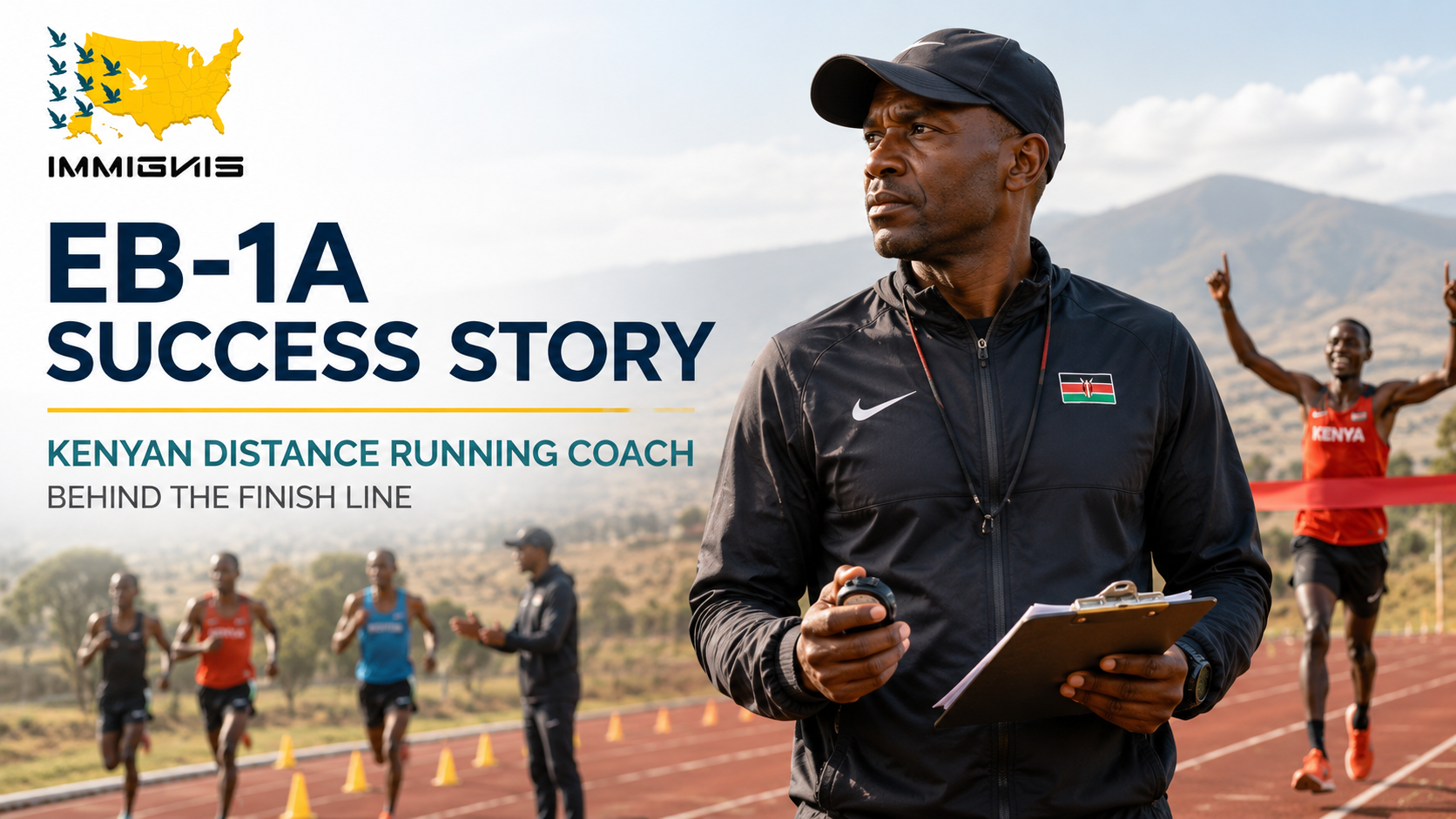
How a coach whose athletes were already visible turned high-altitude training judgment into an EB-1A record built around attribution, methodology, and sustained field recognition.
Key facts at a glance
| Outcome | EB-1A approval for a Kenyan distance running coach whose training group produced international podium finishers. |
| Approval date | Approved in May 05, 2026. |
| Field niche | High-altitude distance running coaching methodology. |
| Starting problem | The athletes were visible. Their podiums, race times, and national team progress were documented. The coach behind the training system had a much thinner public record. |
| Profile-building path | Immignis built the record through athlete-results attribution letters, federation coaching credentials, sports-press features on training methodology, conference lectures, coaching-award submissions, remuneration evidence, and judging or athlete-selection panel records. |
| EB-1A criteria supported | Original contributions, published material, leading or critical role, high remuneration, and judging. Coaching awards and submissions strengthened the wider record where supported by evidence. |
| Approval hook | The petition showed that a coach can qualify for EB-1A when the record proves more than athlete success: it proves a recognized method, attributable results, and authority in the field behind the finish line. |
EB-1A for Running Coaches: USCIS approved his Form I-140 in May 05, 2026.
For a distance runner, the finish line is where the camera turns. For the coach, it is often the moment he disappears from the public record.
That was the central problem in this EB-1A case. The petitioner was a Kenyan distance-running coach whose training group had produced athletes with international podium finishes. On paper, however, the public attention belonged to the runners. Race coverage named the winners. Federation announcements named the athletes. Medal tables recorded the result. The coach appeared, if at all, in a passing sentence, a staff list, or a team photograph.
The case did not ask USCIS to approve an athlete. It had to show that the coach himself had reached the level of extraordinary ability in a defined field: high altitude distance running coaching methodology.
The problem was not lack of achievement.It was lack of attribution.
Many EB-1A cases fail not because the professional has done ordinary work, but because the evidence does not show whose work it was. Coaching cases make that problem unusually clear.
A runner wins a race. A national team improves. A training group produces stronger qualifying times. Younger athletes move into international competition. Those facts may be impressive, but they do not automatically prove that one coach made an original contribution to the field. They can also reflect athlete talent, sponsorship, nutrition, team selection, favorable conditions, or years of development by several people.
Immignis therefore treated this case as an attribution case first. The record had to connect the petitioner to a recognizable training method, then connect that method to results, then show that others in the sport understood his role as more than routine supervision.
The goal was not to inflate a coaching biography. It was to document what the sport already knew but had not written down in a way USCIS could evaluate.
His field was defined around coaching method,not athlete fame
The petition did not define the field as athletics generally, Kenyan running generally, or sports coaching generally. Those descriptions were too broad. They would have left USCIS with no useful measuring stick.
The stronger field was high-altitude distance-running coaching methodology. That field allowed the record to focus on what the petitioner actually did: training-block design, altitude adaptation, aerobic-volume management, recovery timing, race-specific preparation, injury-risk decisions, and the progression of athletes from local promise to international readiness.
That narrower field also helped separate the coach from the athletes. The evidence did not say, simply, that his runners won. It asked more precise questions. What training approach did he design? Which athletes worked under that approach? What changed after they entered his program? Which federations, clubs, athlete representatives, or sports professionals recognized his method? Did other coaches, selectors, or writers discuss his judgment?
The answer to those questions became the spine of the EB-1A petition.
What USCIS needed to see in a distance running coach case
A coaching case cannot rely on admiration alone. Words such as "respected," "legendary," or "well known" do little unless the file contains independent proof. USCIS needed evidence that fit the regulatory criteria and, at final merits, showed a coach with sustained recognition and authority in his field.
For original contributions, the petition had to explain the coaching methodology and show why it mattered beyond ordinary athlete management. The record needed more than race results. It needed letters and documents showing how his training principles, selection judgment, development methods, or high altitude preparation model were used, relied upon, or recognized by others.
For published material, sports coverage had to be about him or his coaching work, not merely about athletes he had trained. Articles about race winners were useful only when they identified his role or when they were supported by other evidence connecting him to the result.
For leading or critical role, the petition had to document the significance of the training group, club, federation program, or athlete development structure in which he worked and then show why his role was critical to that organization or program.
For high remuneration, the comparison had to be fair. A coach cannot be compared with the prize money of elite runners or the salary of a club administrator in another sport. The evidence had to compare his compensation, consulting fees, sponsorship-linked compensation, or coaching income against relevant coaching-market data where available.
For judging, the strongest evidence came from formal athlete-selection panels, talent evaluation committees, coaching award review, or related decision-making roles where he evaluated the work, performance, or potential of others in the sport. Casual scouting was kept separate.
Athlete results became useful only after the record showed how they happened
Race results were not ignored. They were reorganized.
Instead of listing every athlete and every finish, Immignis built evidence around progression. The file showed where an athlete started, when the athlete trained under the petitioner, which training block or preparation period mattered, and how later results aligned with that documented work. This made the evidence more credible because it did not pretend that a coach single-handedly created every result.
Attribution letters became central. Athletes, federation officials, club directors, and sports professionals explained the coach's role in training design, discipline, recovery, race preparation, and long-term development. The strongest letters did not simply praise him. They described specific coaching decisions and why those decisions mattered.
The petition also separated medals from method. A podium finish was evidence of outcome. The original contribution argument came from the documented coaching approach behind the outcome and from the way others in the field treated that approach as valuable.
The sports press record had to move beyond race day headlines

Sports journalism often follows winners. That creates a problem for coaches. Even when a journalist mentions a coach, the article may still be centered on the athlete. For EB-1A, the record needed coverage that helped establish the petitioner himself as a recognized figure.
Immignis therefore developed a more careful media record. Sports-press features addressed the petitioner's training philosophy, high altitude methodology, athlete development model, and role in building competitive runners. Where race coverage already existed, it was used only when the text actually identified him or when other documents made the connection clear.
This approach made the published material evidence cleaner. It showed a coach with a public professional identity, not only a coach attached to famous athletes.
Federation credentials and program roles showed that the sport trusted his judgment
Coaching credentials alone rarely prove extraordinary ability. Many qualified coaches hold licenses or certificates. In this case, credentials were useful because they supported a larger picture: the petitioner was trusted to develop and evaluate runners in a competitive field where small decisions can determine whether an athlete reaches international standard.
The record documented federation coaching credentials, formal development roles, athlete-selection responsibilities, and participation in coaching or performance panels where available. These materials helped show that his judgment had been relied upon by organizations with a real stake in competitive outcomes.
This mattered for both leading or critical role and judging. A coach who is trusted to design training, identify talent, and evaluate athlete readiness is doing more than supervising workouts. The evidence had to show that responsibility in documents USCIS could read.
Conference lectures turned private training knowledge into public authority
A great deal of coaching knowledge travels orally: between coach and athlete, coach and federation, coach and younger trainers. That is normal in sport, but it creates a thin immigration record.
The profile-building work therefore included conference lectures and professional presentations on high altitude preparation, training-load management, athlete progression, recovery timing, and race-specific strategy. These talks were not treated as decoration. They showed that other professionals wanted to hear his method explained and that his knowledge could be evaluated outside his own training group.
The lectures also helped solve a cultural documentation problem. In distance running, influence often spreads through camps, mentorship, informal training groups, and federation networks. The petition converted that influence into agendas, invitations, speaker materials, and attendee records.
High remuneration was handled with discipline
Sports compensation can be difficult to present. Elite athletes may earn through prize money, endorsements, appearance fees, or sponsorship contracts, while coaches may be paid through salaries, consulting fees, bonuses, private training arrangements, or federation work.
The petition did not compare the coach to athletes. It compared his compensation to the relevant coaching market where documentation was available. The goal was to show that the field valued his services at a high level, not to create an unfair comparison.
Where remuneration evidence was strongest, it supported the broader final-merits picture: athletes, organizations, and programs were willing to pay for his coaching judgment because it had recognized competitive value.
The coaching award record supported recognition without overclaiming
Coaching-award submissions and nominations were used carefully. A submitted award entry is not the same as winning a major award. A nomination is not always enough by itself. An internal club honor may not carry the weight of a recognized national or international award.
Still, award materials can be useful when they document how the field evaluates a coach. In this case, the record used coaching award evidence to show the criteria by which his work was being considered: athlete development, training innovation, international results, and contribution to the wider distance running ecosystem.
That restraint made the file stronger. The petition did not ask USCIS to treat every honor as a major award. It used the evidence for what it actually proved.
How the EB-1A evidence worked together
The strongest point of the case was not one document. It was the way the evidence began to describe the same coach from several directions.
Athlete letters explained his method. Federation and program records showed responsibility. Race results showed outcomes. Sports media created a public professional record. Conference lectures showed that his knowledge was being shared with others. Judging and selection-panel evidence showed that the field trusted him to evaluate athletic ability. Remuneration evidence showed that his services were valued above ordinary coaching work.
Together, those materials changed the case from "he coached successful runners" to "he is a recognized expert in high-altitude distance running coaching methodology whose work has shaped athlete development and competitive performance."
That distinction mattered. EB-1A is not a reward for being near success. It requires evidence that the petitioner himself has sustained acclaim and recognized achievements in the field.
The approval
USCIS approved the Form I-140 in May 05, 2026.
The approval did not rest on the fame of the athletes alone. The petition showed why their results were relevant to his record, how his method could be identified, and how independent evidence confirmed his role in the field.
For coaches, this is the central lesson. The field may know who built the athlete. The immigration record must prove it.
What other coaches can learn from this case
If you are a coach, trainer, performance strategist, or athlete development specialist, do not assume that your athlete roster speaks for itself. USCIS will not simply transfer an athlete's medals, rankings, or sponsorship value to you.
The stronger path is to document your own professional authority. That may include athlete progression records, training plans that can be safely described, letters from athletes and sports organizations, sports-press coverage about your method, judging or selection roles, compensation comparisons, coaching credentials, speaking invitations, and evidence that other professionals rely on your approach.
A coach can build an EB-1A record, but the file must show the field behind the finish line.
Frequently asked questions
Can a sports coach qualify for EB-1A?
Yes. A coach may qualify when the evidence shows extraordinary ability in a defined coaching field, sustained acclaim, and recognized achievements. The petition must focus on the coach's own methodology, recognition, responsibility, and field impact, not only the athletes' results.
Are athlete medals enough to prove a coach's EB-1A case?
Usually not by themselves. Athlete results can help, but the record must show attribution: what the coach did, how the athlete worked under that coach, and why the coach's methods mattered.
Can coaching methods count as original contributions?
They can, but only when the petition identifies the method and supports its significance. Strong evidence may include adoption by training groups, federation reliance, independent letters, athlete development outcomes, and professional discussion of the method.
Can selection panels support the judging criterion?
They may support judging when the role involved formal evaluation of other athletes, coaches, or sports professionals in the field. casual scouting or informal advice is weaker unless documented as an official evaluative role.
Does high remuneration help a coach's EB-1A petition?
It can help if the comparison is accurate. The evidence should compare the coach's compensation to relevant coaching market data, not to athlete prize money or unrelated sports salaries.
Build an EB-1A record around your coaching method, not only your athletes
If your athletes, teams, or performers are visible but your own role is buried behind their results, your strongest evidence may need careful attribution. Immignis helps coaches and performance professionals identify a defensible field niche, document their methodology, build independent recognition, and prepare an EB-1A record around evidence that can be verified and defended professionally.