How a coach from a wrestling powerhouse nation turned medal-attribution records, federation credentials, foreign consulting invitations, wrestling-media coverage, seminar service, and judging roles into a USCIS-approved EB-1A case.
Key facts at a glance
| Petition outcome | Form I-140 approved under EB-1A on May 14, 2026. |
| Professional profile | Georgian freestyle wrestling coach developing international medalists. |
| Field niche | Freestyle wrestling technical coaching. |
| Starting weakness | National federation acclaim and athlete success did not automatically translate into cross-border proof on paper. |
| Profile-building focus | Medal-attribution documentation, international federation credentials, foreign-federation consulting invitations, wrestling-media coverage, seminar records, and judging-related service. |
| EB-1A criteria supported | Original contributions, leading role, memberships, published material, and judging. |
| Central issue | Proving the coach’s own field-level standing rather than relying on athlete outcomes or domestic reputation alone. |
| Approval lesson | In coaching cases, a respected national reputation becomes much stronger when it is documented in forms USCIS can read across borders. |
The approval
On May 14, 2026, USCIS approved the Form I-140 petition of an EB-1A for Freestyle Wrestling Coaches whose reputation in the sport was real, respected, and well established, but not yet organized in a way an immigration officer could easily evaluate.
He had worked in one of the world’s strongest wrestling traditions and had helped develop athletes who later reached serious international competition. Inside the sport, that kind of background carries weight. On paper, however, it can still look thin if the record does not clearly show what the coach himself contributed.
For EB-1A, that gap matters. It is not enough that athletes won medals or that a federation knew his name. The petition had to show that the petitioner’s own work, expertise, and recognition rose to the level of extraordinary ability in freestyle wrestling technical coaching.
That became the central challenge of the case: translating a nationally respected name into cross-border, petition-ready proof.
The evidence problem in wrestling coaching
Wrestling coaching is a field where real standing often lives in training halls, national camps, competition mats, and federation circles rather than in glossy public profiles. Many top coaches are known immediately by athletes, officials, and other coaches, yet have very little public-facing documentation that explains why they matter.
That was the petitioner’s starting weakness. His accomplishments were not invented or exaggerated. The problem was that much of the strongest recognition sat inside a national system and did not automatically travel well to a U.S. adjudicator reading an immigration file.
This meant the petition needed a precise field definition. The case was not framed as general sports instruction or broad athletic leadership. It was presented as freestyle wrestling technical coaching, with emphasis on athlete development, competition preparation, and the specialized expertise recognized by peers and federations.
That field definition mattered because it gave the petition a believable measuring stick. The question was not whether he was famous to the general public. The question was whether he had reached an extraordinary level inside the elite coaching side of freestyle wrestling.
Why athlete medals were only the beginning
It would have been easy to build the whole case around athlete medals. That would have been risky. USCIS does not automatically assume that every athlete result proves the extraordinary ability of a coach, especially in sports where multiple coaches, national systems, and federation structures may all be involved.
The record therefore treated medal results as a starting point, not the final argument. The real question became: what shows that this coach had a specific, meaningful role in the development and technical preparation of those athletes?
The strongest evidence included attribution letters, competition-linked records, federation documents, and professional explanations showing how his technical guidance, training structure, and coaching decisions influenced athlete performance and progression.
That distinction changed the entire petition. Instead of asking USCIS to guess from medal tables, the case gave the officer a direct path from athlete outcomes back to the petitioner’s own contribution.
Medal-attribution evidence became the backbone of the case
In some fields, acclaim appears in publications, patents, major awards, or citation counts. In wrestling coaching, a great deal of real authority appears through who trusts the coach, which athletes he develops, and whether serious wrestling bodies recognize his role in performance outcomes.
The petition used that reality carefully. Medal-attribution documentation was not treated as vague praise. It was organized as technical evidence showing who the petitioner coached, at what level, in what capacity, and how his work connected to competitive achievement.
The best letters answered practical questions. Which athletes did he coach? What period did he work with them? What technical areas did he shape? How was his role different from general team support? Why did respected wrestling professionals consider his contribution important?
Those materials gave USCIS a way to understand a career that does not always produce polished public records. They also helped move the case from local reputation to documented field standing.
Leading-role evidence had to show real technical authority
A coaching title by itself does not win an EB-1A case. Many professionals are called coaches, trainers, or instructors. The petition therefore had to show not just what the petitioner was called, but what he was trusted to do.
The record focused on his actual responsibilities in training environments, competitive preparation, technical instruction, and athlete development. It showed where he held meaningful authority, how his expertise was relied upon, and why his role was important within respected wrestling settings.
That evidence helped show that his work was leading or critical within distinguished organizations or recognized programs. For a wrestling coach, this often matters more than a formal title alone.
This is a common dividing line in sports cases. A résumé can list positions. An EB-1A petition has to prove that the petitioner was central to serious work in the field.
Original contribution in a coaching case
Original contribution can be harder to explain in sports than in academic or scientific cases because coaching methods are often practical and applied. A coach may change outcomes significantly without publishing a theory or inventing a product.
For this petitioner, the original-contribution argument was built around technical coaching value. The petition showed how his training approach, athlete preparation, and technical input were recognized by others as meaningful within freestyle wrestling competition and development.
That mattered because USCIS looks for contributions of significance, not ordinary job performance. The evidence had to show that his work was trusted, repeated, and valued in ways that went beyond routine coaching service.
The petition did not claim that he reinvented wrestling. It made a narrower and stronger point: within the specialized field of freestyle wrestling technical coaching, his contribution had produced results and earned recognition serious enough to distinguish him from the ordinary level of the profession.
Published material and media coverage
Sports coverage often follows athletes, medals, and events rather than the technical experts behind them. Wrestling is no exception. Coaches may be mentioned briefly, inconsistently, or not at all, even when their role is substantial.
Published material therefore served two purposes in this case. First, it made the petitioner visible outside private federation records and internal sporting circles. Second, it helped explain his role to a non-specialist reader who would not otherwise understand how wrestling coaching prestige is reflected in the field.
The petition used media evidence as support rather than decoration. Coverage was useful when it identified his coaching role, reflected recognition from the sport, or helped confirm that his reputation extended beyond one internal network.
Memberships and federation credentials had to be put in context
Membership evidence can be weak when it reflects ordinary enrollment. In wrestling, however, certain federation roles, certifications, and credentials can say something much more meaningful. They may show formal trust, recognized technical standing, or access to serious levels of the sport.
The petition therefore did not present memberships as a standalone shortcut. It used federation credentials and professional affiliations as part of a broader record demonstrating that recognized wrestling institutions had already treated the petitioner as a credible and authoritative coach.
That evidence became especially useful when paired with the other materials in the file. The point was not that any one credential proved extraordinary ability. The point was that the credentials aligned with athlete-attribution evidence, leadership roles, consulting invitations, and peer recognition.
Judging and seminar service reflected peer trust
The judging criterion in a sports case does not have to look like a television judging panel. In wrestling, it can appear through technical evaluation roles, selection responsibilities, sanctioned judging activity, or invitations to teach and assess others in respected settings.
For this petitioner, judging and seminar-related service helped show that the sport trusted him not only to coach his own athletes, but also to evaluate, instruct, and contribute knowledge in ways that affected other professionals and competitors.
That kind of evidence rounded out the petition well. It showed peer-level trust from the field itself, which is often exactly what a strong EB-1A coaching case needs.
How the EB-1A criteria worked together
The petition did not depend on one perfect exhibit. It worked because several forms of evidence pointed in the same direction and supported the same theory of the case:
- Leading role: Records and letters showed that the petitioner held real technical authority within serious wrestling training and competition environments.
- Original contributions: Athlete-attribution evidence and professional explanations showed that his coaching input made a meaningful difference in athlete development and performance.
- Memberships: Federation credentials and professional affiliations helped show recognized standing within the wrestling field when properly explained in context.
- Published material: Wrestling-media coverage made his work legible beyond internal sporting circles and helped document field recognition.
- Judging: Evaluation, judging, and seminar service showed that the sport trusted him to assess and guide others at a serious level.
The strongest part of the case was coherence. The evidence did not drift into unrelated sports accomplishments or general claims about passion and hard work. It stayed focused on what the petitioner had achieved in freestyle wrestling technical coaching.
The final-merits argument
At the final-merits stage, the petition had to show more than satisfaction of separate criteria. It had to demonstrate that, taken together, the evidence established sustained acclaim and extraordinary ability in the petitioner’s field.
The argument centered on cross-border recognition rather than celebrity. The petitioner did not need to be widely known outside wrestling. He needed to be shown as a coach whose work had earned serious respect from the sport itself, including people and organizations beyond a purely domestic circle.
The final record showed exactly that. Athlete-attribution documentation, federation credentials, consulting invitations, media recognition, seminar involvement, and peer trust all pointed toward the same conclusion: this was not a routine coach, but a highly regarded technical coach with sustained recognition.
That is why the case was stronger than a file built around medals alone. It told USCIS who the coach was within the field and why that standing mattered.
Why the approval mattered
The approval mattered because it showed how a wrestling coach can qualify for EB-1A without being the athlete in the spotlight. Many elite coaches live behind the results. This case proved that their work can be documented persuasively when the field is defined correctly and the evidence is built carefully.
For this Georgian coach, the petition did not try to make him look like a celebrity or to force his career into a generic template. It documented him as what he actually was: a technically respected freestyle wrestling coach whose reputation had already travelled beyond his home system.
The approval confirmed the central lesson of the case: in coaching matters, national prestige is not enough by itself. The petition must convert that prestige into records, letters, and recognition that USCIS can evaluate.
Lessons for wrestling coaches and high-performance sports professionals
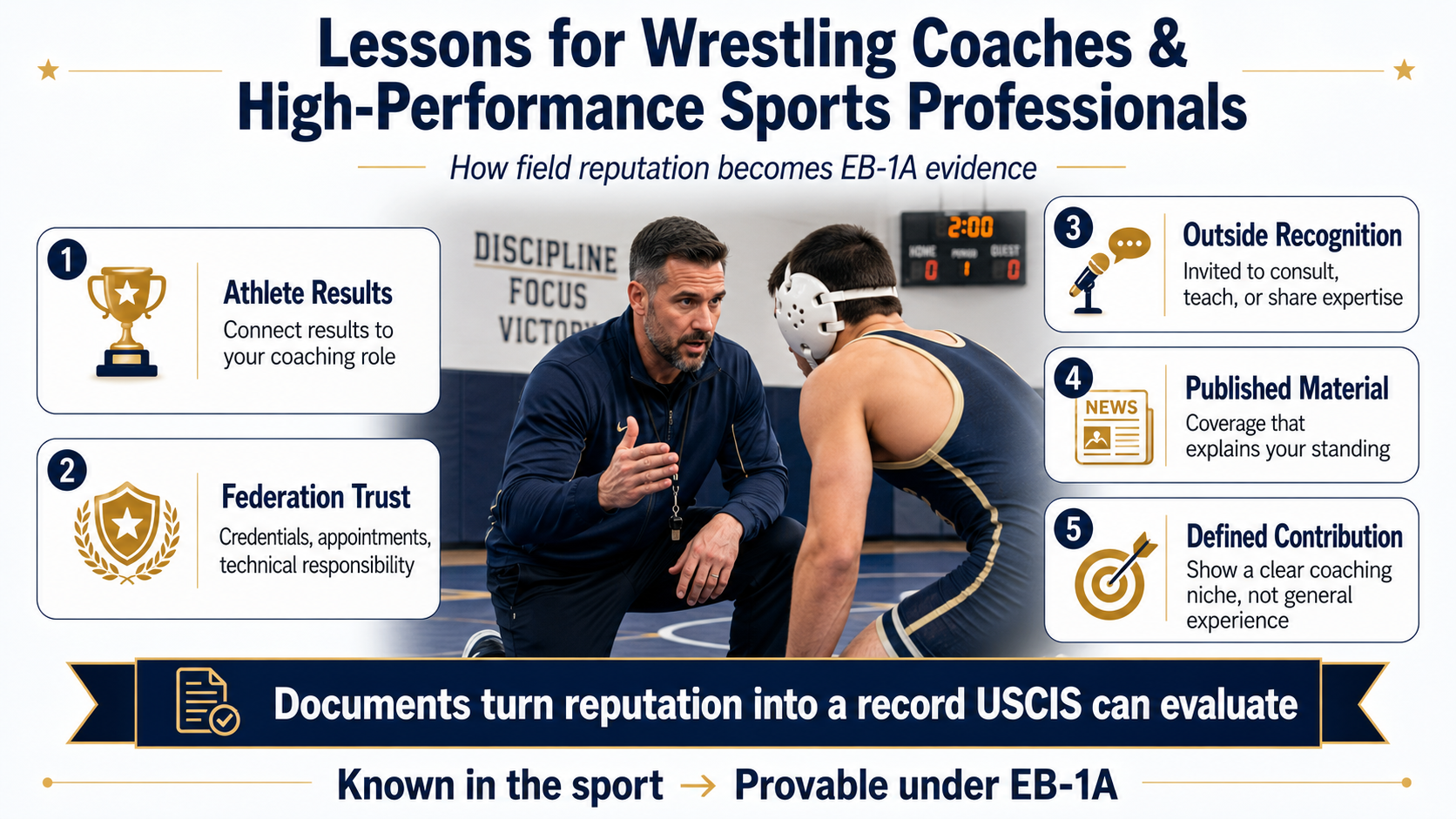
This case is useful for wrestling coaches, combat-sport trainers, federation instructors, and high-performance sports professionals whose strongest reputation exists inside the field rather than in public-facing media.
A strong record usually begins with the following questions:
- Can athlete results be connected to your specific coaching role through credible letters and records?
- Do federation documents, credentials, or appointments show that the sport entrusted you with serious technical responsibility?
- Have outside organizations, federations, or programs invited you to consult, teach, or share your expertise?
- Is there published material or media coverage that helps explain your standing to a non-specialist reader?
- Can your work be presented as a defined contribution within a clearly identified coaching field rather than as general sports experience?
When those questions are answered with documents, a coach’s reputation can become a record USCIS can evaluate. That is often the difference between being known in the sport and being provable under EB-1A.
Frequently asked questions
Can a wrestling coach qualify for EB-1A?
Yes. A wrestling coach may qualify for EB-1A if the evidence shows sustained acclaim and extraordinary ability in the coaching field. The petition must document the coach’s own recognition, responsibilities, and contributions, not only the success of athletes he trained.
Do athlete medals help a coach’s EB-1A petition?
They can help when the record clearly connects those results to the coach’s work. Useful evidence may include attribution letters, training records, federation documents, athlete statements, and explanations from respected professionals who can describe the petitioner’s role in performance and development.
What kind of evidence is strongest for a wrestling coach?
The strongest evidence usually includes athlete-attribution documentation, federation roles or credentials, published material, peer letters, judging or evaluation service, consulting invitations, and records showing the petitioner’s technical importance within serious training environments.
Can federation credentials support an EB-1A case?
Yes, when they reflect selective professional standing, trusted technical authority, or formal recognition within the sport. They are strongest when paired with other evidence showing how the petitioner’s expertise was used and respected in practice.
Can seminar service or technical evaluation count as judging for EB-1A?
It may help when the petitioner was entrusted to assess, instruct, or evaluate others in a recognized professional setting. The petition should explain the level of the event or program and why the role reflects trust from the field.
Can Immignis and Advance My Profile help coaches build EB-1A evidence?
Immignis and Advance My Profile help coaches and sports professionals define a defendable field niche, organize attribution evidence, document recognition, and build a professional record that can be presented clearly and credibly in an EB-1A petition.
Turn wrestling reputation into a petition-ready record
Many coaches are highly respected in their sport but nearly invisible on paper. Athlete results, federation credentials, technical leadership, consulting invitations, judging roles, and seminar records can support an EB-1A case when they are organized around a clear coaching niche.