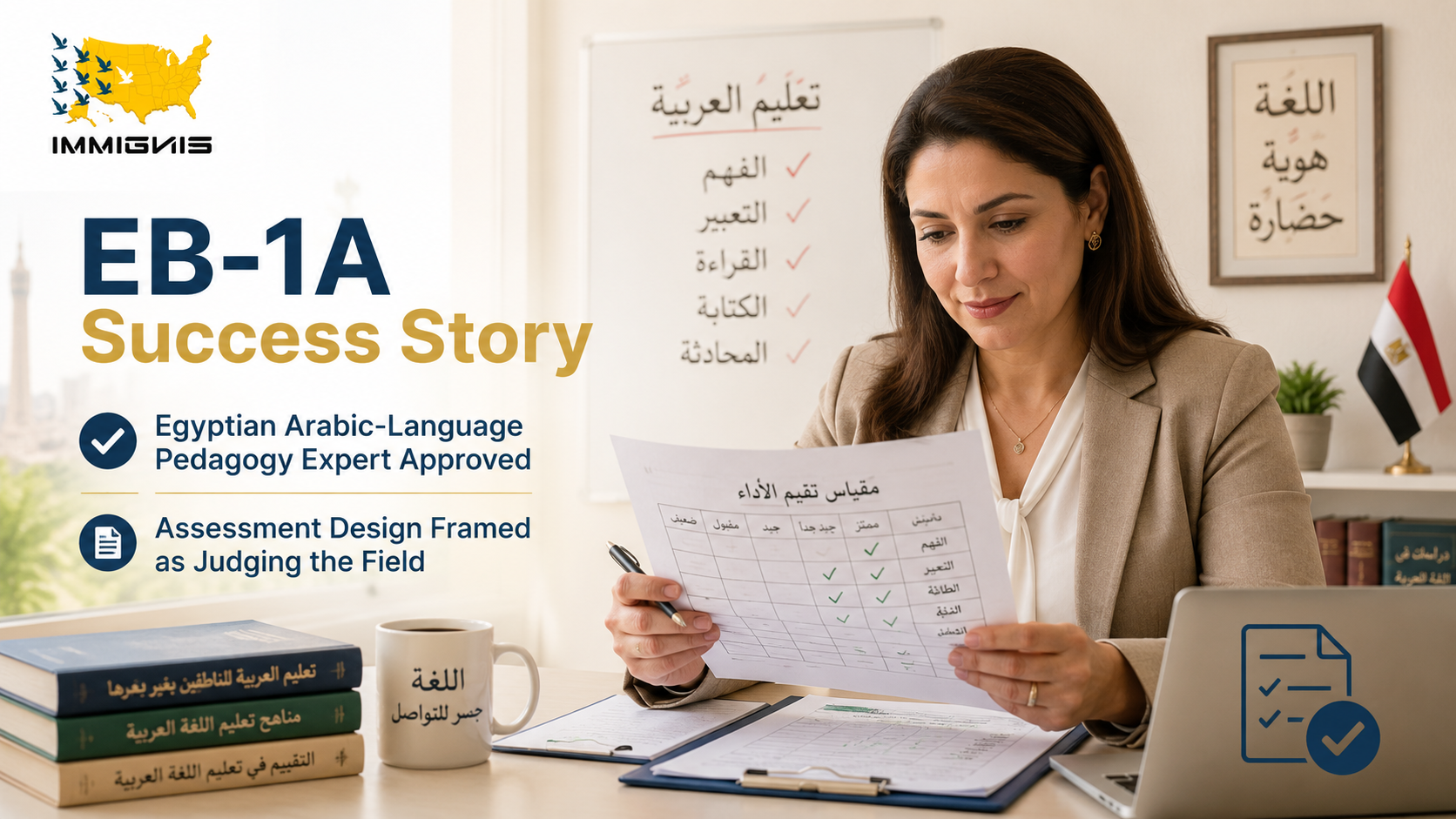
EB-1A for Arabic Language Experts: How an Egyptian Arabic language pedagogy expert secured EB-1A approval by turning institutional adoption into a person-centered record built on institute adoption letters, textbook authorship, applied linguistics publication, examiner and assessment design roles, conference keynotes, and independent expert validation.
Key facts at a glance
| Petition outcome | Form I-140 approved under EB-1A on May 5, 2026. |
| Professional profile | Egyptian developer of methods for teaching Arabic as a foreign language used by cultural institutes. |
| Field niche | Arabic second language acquisition pedagogy. |
| Starting weakness | Institutional adoption existed, but the record did not yet clearly attribute the adopted methods to the individual creator. |
| Profile building focus | Institute adoption letters, textbook authorship, applied-linguistics publication, examiner and assessment-design roles, conference keynotes, and independent letters. |
| EB-1A criteria supported | Original contributions, scholarly articles, judging, published material, and leading role. |
| Central issue | Showing that the petitioner was not simply a language instructor, but a field level pedagogy expert whose methods shaped how Arabic was taught, assessed, and implemented across institutional settings. |
| Approval lesson | Assessment design and examiner work can become powerful judging evidence when the petition shows that the petitioner helped define how language ability and instructional quality were evaluated. |
The approval
On May 5, 2026, USCIS approved the Form I-140 petition of an Egyptian Arabic-language pedagogy expert whose methods for teaching Arabic as a foreign language had been used by cultural institutes and language-learning programs.
Inside Arabic-language education circles, the petitioner was already known as a specialist who could turn language acquisition theory into practical teaching systems. His work helped institutions teach Arabic to non native learners through structured materials, clearer progression, and more reliable assessment practices.
For EB-1A purposes, however, the strongest achievements were not automatically visible. The methods were being used through institutes, programs, textbooks, and examiner systems, but much of the public credit stayed with the institution rather than the individual developer.
That made the case a useful example of how language-pedagogy records should be built. The petition had to show that institutional adoption was not vague background activity, but evidence of a field-level contribution tied directly to the petitioner.
The evidence problem in Arabic language pedagogy cases
Language education cases can be difficult because professional influence often flows through schools, institutes, textbooks, training programs, and assessment systems. A pedagogy expert may shape how thousands of learners are taught, yet the visible record may name the institute, not the person behind the method.
That was the petitioner’s starting weakness. His work had institutional value, but adoption alone was not enough. USCIS needed to see what he created, how the method was used, why it mattered, and why other professionals relied on it.
The petition therefore defined the field carefully. It was not framed as ordinary Arabic teaching or general classroom instruction. It was framed as Arabic second-language acquisition pedagogy, a specialized area involving curriculum design, learner progression, assessment design, applied linguistics, and teaching methodology for non-native Arabic learners.
That field definition gave USCIS a workable lens. The question was not whether the petitioner was a good Arabic teacher. The question was whether he had produced recognized work that shaped how Arabic was taught and evaluated within a specialized professional field.
Why institutional adoption needed personal attribution
A common weakness in education-based EB-1A cases is assuming that institutional use proves the petitioner’s extraordinary ability by itself. It does not. An institute may adopt a curriculum or method, but unless the record clearly identifies the creator and explains the reason for adoption, the evidence remains incomplete.
The petition therefore focused on person-centered documentation. Institute adoption letters explained what the petitioner developed, how the method was implemented, which teaching or assessment problems it addressed, and why the institution considered the method valuable.
This converted institutional adoption into individual evidence. The record did not merely show that Arabic programs used certain materials or practices. It showed that those materials and practices came from the petitioner’s work and that institutions relied on his expertise to improve Arabic-language instruction.
That reframing was central to the case. The adoption evidence became proof that the petitioner’s method had moved beyond personal teaching and entered the professional practice of cultural institutes and Arabic-language programs.
Original contributions through Arabic second language pedagogy
Original contributions in pedagogy do not always look like patents or laboratory discoveries. In language education, originality may appear through a method that changes how learners move from basic comprehension to fluency, how teachers sequence instruction, or how programs assess progress.
The petition documented the petitioner’s method as a structured approach to Arabic second-language acquisition rather than a general teaching style. It explained how the method addressed non-native learner challenges, grammar progression, vocabulary development, listening and speaking skills, reading comprehension, and culturally appropriate language use.
Independent expert letters were important because they translated the contribution for USCIS. Applied linguistics specialists, institute leaders, examiners, and language educators explained why the method mattered and why it was useful beyond one classroom or one program.
This evidence helped show that the petitioner’s work was not merely effective teaching. It was a documented pedagogical contribution recognized and used by others in the field.
Textbook authorship made the method concrete
Textbook authorship was one of the strongest parts of the record because it gave the contribution a tangible form. In pedagogy cases, a method can sound abstract until the petition shows the actual instructional materials that carry it into classrooms.
The textbook evidence showed how the petitioner organized Arabic language learning, sequenced skills, introduced grammar, structured exercises, and guided teachers or learners through the method. It also helped demonstrate that the work was transferable and usable across institutional settings.
This mattered for attribution. When a method is captured in a textbook or instructional series, the individual author becomes easier to identify and the contribution becomes easier for USCIS to evaluate.
The petition therefore used textbook authorship not simply as a publication claim, but as proof that the petitioner had built a formal pedagogy capable of being adopted, taught, and assessed by others.
Applied linguistics publication gave the case academic credibility
The applied-linguistics publication helped connect the petitioner’s practical method to a recognized academic and professional discipline. Because much of the petitioner’s impact came through institutes and teaching practice, the publication served an important credibility function.
It showed that the petitioner could explain his method in field-facing terms and situate it within broader questions of second-language acquisition, Arabic pedagogy, assessment, and curriculum development.
The petition did not overstate the publication. It did not claim that one article alone proved extraordinary ability. Instead, the article was used as one part of a larger record that also included institutional adoption, textbook authorship, examiner service, assessment design, conference keynotes, and independent validation.
This balanced approach helped USCIS see both sides of the record: scholarly grounding and real-world adoption.
Assessment design as judging:grading the graders
The strongest approval hook in this case was the assessment-design evidence. In education cases, judging does not always appear as a competition panel or award jury. It can appear through examiner roles, assessment design, curriculum review, standards development, and evaluation of learner performance or instructional quality.
The petition showed that the petitioner was not only teaching Arabic. He was helping define how Arabic ability should be tested, evaluated, and measured. That is a high trust role in language education because assessment design shapes what institutions consider proficiency, progress, and instructional success.
This became a powerful EB-1A judging argument. The petitioner was involved in systems that evaluated the work or performance of others, including learners, teachers, materials, or exam structures. In practical terms, he helped grade the graders.
That made the judging evidence unusually field-specific and persuasive. It reflected peer trust in the petitioner’s expertise to assess standards in Arabic second language education.
Conference keynotes showed field recognition
Conference keynotes and invited presentations strengthened the record because they showed that the petitioner’s expertise was requested beyond his own institutional environment. In applied education fields, invitations to speak can be strong evidence when they are tied to professional audiences and substantive expertise.
The petition used keynote and conference evidence to show that the petitioner was recognized as a voice in Arabic-language pedagogy, not merely as an internal curriculum worker.
These speaking roles also helped explain the field to USCIS. They showed that Arabic second-language acquisition is a professional discipline with its own conferences, standards, teaching debates, assessment systems, and expert communities.
By placing the petitioner within those communities, the petition made his recognition easier to understand and evaluate.
Published material made the individual visible
Published material was important because institutional adoption can hide individual contribution. Articles, interviews, professional features, textbook references, and education sector coverage can make the person behind the method visible to an adjudicator.
The strongest published material named the petitioner directly and connected him to Arabic pedagogy, textbook authorship, language assessment, examiner work, or institute adoption. Coverage that discussed only the institute would have been less useful.
This person-centered visibility helped solve the attribution problem. It showed that the petitioner’s name, work, and method were recognized in sources outside private institutional files.
For EB-1A, this distinction matters. The officer needs to see that recognition attaches to the petitioner, not only to the organization where the petitioner worked.
Leading role evidence through institutional trust
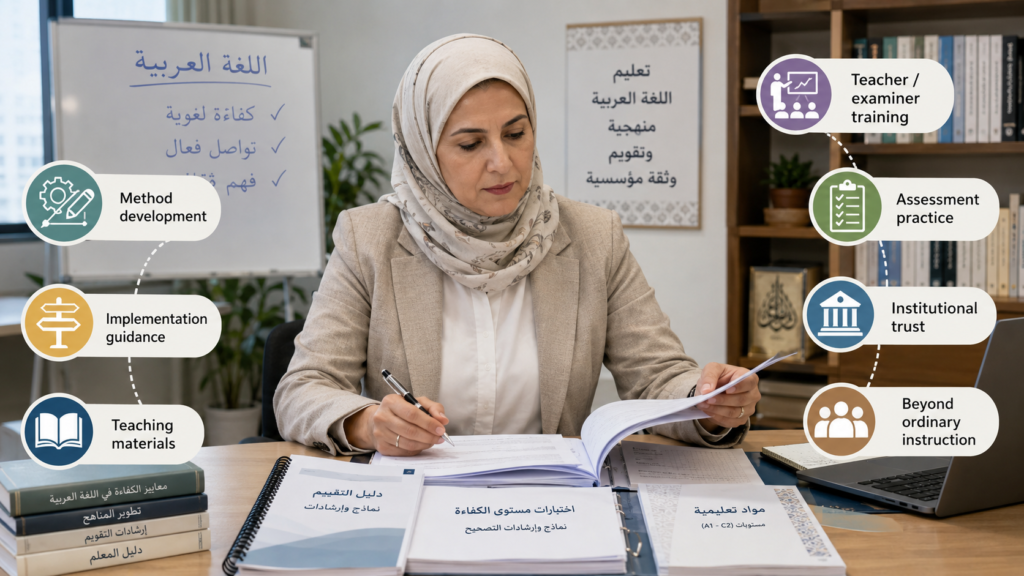
Leading role evidence was built around the petitioner’s responsibility for developing methods, guiding implementation, authoring teaching materials, supporting teacher or examiner training, and shaping assessment practices in cultural institute settings.
A title alone would not have been enough. The petition focused on authority, responsibility, and the importance of the petitioner’s work to the institutions that used his methods.
The record showed that he was not merely delivering a pre-existing curriculum. He was helping create and guide the system through which Arabic was taught and assessed for non native learners.
That is what made the leading role evidence persuasive. It showed institutional trust in his expertise and a level of responsibility beyond ordinary classroom instruction.
Why the petition worked
The petition worked because it translated a practical education career into adjudicator readable evidence. It did not rely on vague praise or general statements about teaching quality. It built a structured record around method, adoption, authorship, assessment, visibility, and peer trust.
The evidence categories reinforced one another. Institute adoption letters showed reliance. Textbook authorship made the method concrete. Applied linguistics publication gave scholarly credibility. Examiner and assessment design roles supported judging. Conference keynotes showed recognition. Published material made the individual visible. Leading role evidence showed institutional trust.
Together, these materials created a coherent record: the petitioner had developed a recognized Arabic second language pedagogy method and influenced how institutions taught and assessed Arabic learners.
Why the approval mattered
The approval mattered because it showed that institutional adoption can support EB-1A when it is documented properly and tied clearly to the individual creator.
Many language educators, curriculum developers, and assessment specialists have strong professional impact, but the evidence often stays inside institute records, textbooks, training programs, and exam systems. Without careful framing, that kind of influence can look ordinary on paper.
This case showed how to solve that problem. The petition respected the way the field actually worked and built the evidence around adoption, authorship, assessment, and peer recognition.
Most importantly, the approval confirmed that assessment design can be powerful judging evidence in education cases. When a professional helps define how language ability is evaluated, the record can show more than teaching skill. It can show authority over the standards of the field.
The broader lesson for language educators and pedagogy experts
This case offers a useful roadmap for Arabic-language educators, second-language acquisition specialists, curriculum developers, textbook authors, examiner trainers, assessment designers, and education researchers whose impact appears through institutional adoption rather than public fame.
Many such professionals already have strong records, but the evidence is scattered across institute letters, course materials, textbooks, examiner appointments, conference programs, training records, and student or teacher feedback. The key is to convert those materials into a structured professional record USCIS can evaluate.
Useful evidence may include method documentation, institute adoption letters, textbook authorship, scholarly publication, examiner and assessment-design service, conference keynotes, published material, teacher-training leadership, and independent expert letters.
The central lesson is simple: adoption matters when it is attributed. If institutions use a method because of the petitioner’s expertise, that adoption can become strong EB-1A evidence.
Lessons for Arabic language, curriculum, and assessment professionals
This case is especially relevant to Arabic language teachers, foreign language pedagogy experts, curriculum designers, applied linguists, examiner trainers, testing specialists, and education professionals whose work shapes how language learning is delivered or measured.
A strong EB-1A case in this field usually depends on a precise niche. “Arabic teacher” is too broad. “Arabic second-language acquisition pedagogy” gives USCIS a specific way to understand the petitioner’s contribution and compare it against a defined professional field.
It also helps to recognize the field’s own forms of recognition. Textbook authorship, institute adoption, examiner service, assessment design, keynote speaking, and curriculum leadership may be more relevant than celebrity-style public acclaim.
Questions to ask before building the record
For professionals in this space, the evidence should be built around documented authorship, institutional reliance, and peer evaluation rather than general praise for teaching ability.
A strong record usually begins with the following questions:
- Can the petitioner’s Arabic language pedagogy be documented as a defined method rather than a general teaching style?
- Can institute adoption letters explain what was adopted, why it was adopted, and how the petitioner created or guided the method?
- Can textbook authorship or instructional materials show that the pedagogy was formalized and transferable?
- Can applied linguistics publication connect the work to a recognized academic or professional conversation?
- Can examiner roles, assessment design, or curriculum review show judging of the work, performance, or standards of others?
- Can conference keynotes, published material, and independent letters show recognition beyond the petitioner’s own institution?
When those questions are answered with documents, institutional adoption becomes much easier for USCIS to evaluate as extraordinary-ability evidence.
Frequently asked questions
Can an Arabic language pedagogy expert qualify for EB-1A?
Yes. An Arabic language pedagogy expert may qualify for EB-1A when the evidence shows extraordinary ability in a defined field through original contributions, scholarly articles, judging, published material, leading roles, or other recognized indicators of distinction.
Do institute adoption letters help an EB-1A petition?
Yes. Institute adoption letters can be very valuable when they explain what the petitioner created, why the institution adopted it, and how the work influenced teaching, curriculum, or assessment practice.
Can textbook authorship support EB-1A?
Yes. Textbook authorship can support an EB-1A case when the materials reflect a recognized teaching methodology and are used in educational settings.
Can assessment design count as judging for EB-1A?
Yes. In education, assessment design, examiner work, curriculum review, standards evaluation, and testing related roles can support the judging criterion because they involve evaluating performance, materials, or professional standards.
Do scholarly articles matter in applied pedagogy cases?
Yes. Scholarly articles help connect practical teaching work to recognized academic or professional discourse, especially when combined with adoption evidence and independent validation.
Can Immignis and Advance My Profile help language and education professionals build EB-1A evidence?
Immignis and Advance My Profile help educators, pedagogy specialists, researchers, curriculum experts, examiner professionals, and practitioner-experts define a credible niche, document achievement, improve visibility, and build a petition ready EB-1A evidence record.
Build an EB-1A record around authorship, adoption, and assessment authority
Many language education professionals create methods that institutions rely on every day, but the evidence remains hidden inside classrooms, textbooks, training systems, and assessment programs.