How an Indian math educator secured EB-1A approval by turning student olympiad success into a person-centered record built on student-result attribution, training-material publication, olympiad jury and problem-setting roles, education-press features, invited lectures at talent programs, and independent letters.
Key facts at a glance
| Petition outcome | Form I-140 approved under EB-1A on April 28, 2026. |
| Professional profile | Indian educator whose students consistently reached international math olympiad podiums. |
| Field niche | Advanced mathematical-talent development. |
| Starting weakness | Students earned the visible medals, while the teacher’s role, authorship, and influence needed clearer documentation. |
| Profile-building focus | Student-result attribution, training-material publication, olympiad jury and problem-setting roles, education-press features, invited lectures at talent programs, and independent letters. |
| EB-1A criteria supported | Judging, original contributions, published material, leading role, and membership. |
| Central issue | Proving that the acclaim belonged not only to gifted students, but also to the educator whose methods and leadership produced the results. |
| Approval lesson | Problem-setting and olympiad service can function as unusually strong EB-1A evidence because they show trust in the educator to shape and evaluate the field’s future elite. |
The approval
On April 28, 2026, USCIS approved the Form I-140 petition of an EB-1A for Math Educators whose students had repeatedly advanced to and succeeded at the highest levels of competitive mathematics.
Within the education community, the petitioner was already respected as a teacher capable of identifying exceptional mathematical talent, building rigorous training systems, and preparing students for olympiad-level performance under intense standards. The public proof, however, was scattered across student score sheets, competition results, informal reputation, and internal academic circles.
That created a classic EB-1A problem. The visible honors belonged to the students. The educator’s role was obvious to insiders, but not obvious to an immigration officer reading a file.
The case therefore had to show, with discipline and credible documentation, that the petitioner was not simply a classroom teacher attached to successful students. He was an advanced mathematical-talent developer whose methods, authorship, and service placed him among the recognized professionals in a specialized field.
The evidence problem in olympiad and elite-math education cases
Math-olympiad educators often have extraordinary outcomes but weak paper trails. The field does not always reward teachers with public prizes under their own names. Instead, recognition appears through student medals, team placements, coaching invitations, committee service, and internal academic respect.
That means many strong educators face the same starting weakness: the results are real, but the acclaim is indirect. Students become visible. The teacher remains largely invisible outside the training ecosystem.
For this case, the petition had to define the field carefully. It was not framed as general school teaching or ordinary tutoring. It was framed as advanced mathematical-talent development, a specialized area focused on olympiad training, high-level problem solving, talent selection, curriculum design, and preparation of elite mathematical competitors.
That field definition mattered because it gave USCIS a meaningful way to evaluate distinction. The question was not whether the petitioner was a good teacher in a broad sense. The question was whether he had risen to the top of a specialized field that trains future mathematical elite.
Why student medals could not be treated as automatic personal acclaim
A common mistake in education-based EB-1A cases is assuming that student success automatically proves the extraordinary ability of the teacher. USCIS still needs a clear evidentiary bridge between the achievements of the student and the professional distinction of the educator.
The petition therefore did not ask the officer to make that leap on faith. It did not merely attach medal tables and claim the educator deserved credit. Instead, it built a person-centered record that connected student outcomes to the petitioner’s training structure, materials, mentorship, and leadership roles.
This included attribution evidence explaining which students were trained directly by the petitioner, what programs or camps he led, what materials he authored or used, how long he mentored top competitors, and why peers regarded him as a serious figure in olympiad preparation.
That approach made the results readable. Student medals remained important, but they functioned as one part of a larger record showing that the petitioner’s educational work had measurable and repeatable impact.
Problem-setting and olympiad jury service as literal judging of the field
One of the strongest parts of the case was the use of olympiad jury, evaluation, and problem-setting roles. These roles are unusually powerful in EB-1A terms because they amount to judging the work of others in one of the clearest possible ways.
In the olympiad world, trusted educators do not merely train students. They may also help draft problems, review solutions, assess performance, evaluate training potential, or serve on committees that shape the standards by which young mathematicians are measured.
The petition showed that such work is not routine administrative service. It is a mark of peer trust. A person invited to set or evaluate olympiad-level problems is being trusted to define difficulty, rigor, and merit for the next generation of high-level talent.
That made the approval hook especially strong. Problem-setting for olympiads was not framed as a side activity. It was presented as proof that the field trusted the petitioner to judge the future elite of competitive mathematics.
Published training materials and mathematical authorship
Published material served two important functions in the case. First, it helped establish authorship. Second, it showed that the petitioner’s influence extended beyond direct classroom contact and into the broader educational field.
Training materials, olympiad notes, problem compilations, instructional guides, and advanced mathematical-preparation content can be powerful evidence when they are used by serious students and respected programs. They show that the educator is not simply delivering lessons, but also contributing intellectual tools to the field.
The petition therefore treated the petitioner’s training materials as more than internal notes. It presented them as evidence of original educational contribution and public or semi-public professional authorship, especially where the materials were circulated, adopted, cited, or relied upon in talent-development environments.
For advanced-math educators, this point matters. A student medal is a result. A published training system is a professional contribution. Together, they help show not only success, but influence.
Education-press visibility made the educator legible to USCIS
Published material about the petitioner was also essential because it made the individual visible outside closed academic circles. Education-press profiles, interviews, feature stories, competition commentary, and talent-program coverage can transform an insider reputation into evidence an adjudicator can actually review.
The strongest pieces were those that named the petitioner directly and connected him to elite math training, student success, program leadership, or notable educational methods. Coverage that discussed only the students was less useful. Coverage that explained the educator’s own role was far stronger.
This distinction is important in many education cases. Public attention usually goes to the young winners. The petition must therefore pull the teacher into the frame and show that the field itself recognizes the individual behind the results.
Leading-role evidence had to show authority, not just employment
A title such as teacher, mentor, or coach is not enough by itself. For EB-1A, the record had to show that the petitioner held a leading or critical role in organizations, programs, teams, or educational initiatives with distinguished outcomes.
The petition documented leadership in olympiad training camps, advanced math programs, selection structures, curriculum planning, mentoring systems, and student-preparation initiatives. The goal was to show authority, responsibility, and trust—not mere participation.
This helped distinguish the petitioner from ordinary teaching roles. He was presented as an educator whose work shaped the structure and direction of elite mathematical training, especially in environments where competition results, national representation, or advanced-talent pipelines were at stake.
That distinction matters because many accomplished teachers are respected locally. EB-1A requires more. It requires proof that the petitioner’s role was important in a field-recognized setting.
Original contributions in mathematical-talent development
Original contributions can be difficult to document in education because the best work is often pedagogical rather than patentable. The petition therefore focused on the petitioner’s contribution to method, system, and talent development rather than trying to force the case into a research-only model.
The record explained how the petitioner’s instructional methods, problem-solving frameworks, training sequences, selection insights, and mentoring approach produced consistently strong outcomes among high-performing students. In EB-1A terms, the contribution was not framed as ordinary teaching effort, but as a recognizable method of developing top mathematical talent.
This was strengthened by independent letters from peers, program leaders, and education professionals who explained why the petitioner’s methods mattered and why his contribution was significant inside the olympiad ecosystem.
For officers unfamiliar with talent-development cases, this framing is crucial. It shows that educational excellence can be original and field-shaping even when it does not look like laboratory research or commercial invention.
Membership and invited lectures showed standing in the field
Selective or meaningful membership can support an EB-1A record when it reflects real standing within the field. In this case, membership-related evidence was used to show that the petitioner belonged to respected mathematical or olympiad-oriented professional circles connected to talent development and advanced instruction.
Invited lectures further strengthened the record. Speaking at camps, advanced study programs, olympiad workshops, and talent-development events showed that the petitioner’s expertise was not only privately appreciated, but publicly sought out by organizers and peers.
These invitations mattered because they demonstrated recognition beyond the petitioner’s own institution. The field was asking him to teach, guide, or explain advanced methods to other educators and high-performing students.
Why the petition worked
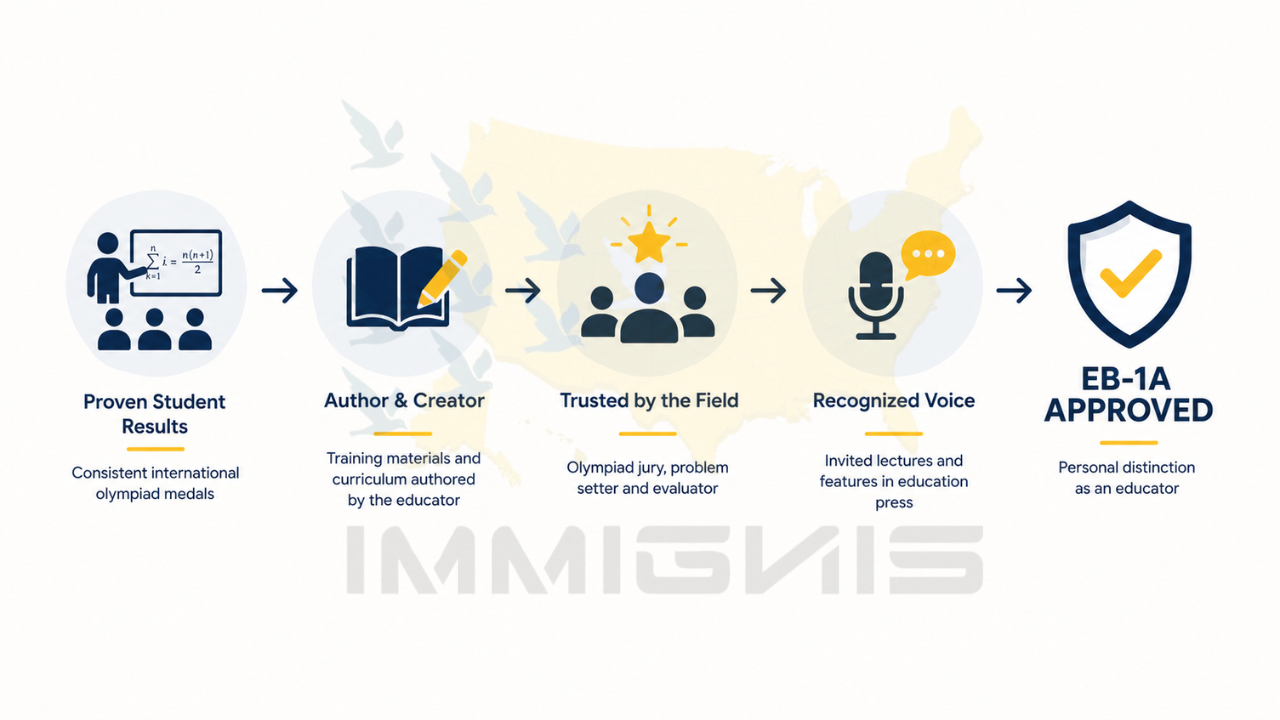
The petition worked because it solved the attribution problem directly. Instead of presenting brilliant students and hoping USCIS would infer the teacher’s importance, the record documented how the petitioner’s role, authorship, leadership, and judging activity connected to the visible outcomes.
The evidence categories reinforced one another. Student results showed impact. Problem-setting and jury roles showed judging. Published training materials showed authorship and contribution. Education-press coverage showed visibility. Leading-role evidence showed authority. Invited lectures and membership showed peer recognition.
Together, these materials created a coherent story: the petitioner was not merely associated with mathematical excellence. He was one of the professionals helping produce and evaluate it at a high level.
Why the approval mattered
The approval mattered because it showed that elite education and talent development can support EB-1A when the field is defined precisely and the evidence is organized around the individual rather than only around the students.
For this Indian math-olympiad educator, the petition did not depend on broad claims about teaching quality. It showed external trust, intellectual contribution, leadership, judging service, and documented impact in a field that trains future mathematical excellence.
Most importantly, the approval confirmed that olympiad problem-setting and evaluation roles can be especially persuasive. They provide adjudicator-readable proof that the educator is recognized not only for producing talent, but also for helping define the standards by which talent is measured.
The broader lesson for olympiad educators, coaches, and academic talent developers
This case offers a useful roadmap for math-olympiad educators, science coaches, competitive-academics mentors, gifted-program leaders, and advanced-talent developers whose strongest achievements are often reflected through students rather than through public personal fame.
Many such professionals already have substantial records, but the evidence is scattered across competition results, camp programs, problem sets, training notes, invitation letters, and informal reputation. The key is to convert that scattered record into a structured professional profile USCIS can understand.
Useful evidence in this space may include student-result attribution, problem-setting or jury roles, training-material publication, invited lectures, program leadership, membership in respected committees or associations, education-press features, and independent letters from peers or institutions.
The central lesson is simple: student achievement helps, but it must be translated into individual extraordinary-ability evidence through clear documentation of authorship, leadership, and peer trust.
Lessons for mathematics, olympiad, and gifted-education professionals
This case is especially relevant to olympiad mentors, mathematics educators, competition coaches, gifted-program directors, problem setters, and advanced academic trainers whose work is visible in outcomes but not always visible in authorship.
A strong EB-1A case in this field usually depends on defining the niche carefully. “Teacher” is too broad. “Advanced mathematical-talent development” gives USCIS a more specific lens for evaluating the petitioner’s achievements.
It also helps to recognize that the field has its own forms of acclaim. Olympiad problem-setting, national-team training, jury service, advanced camp instruction, and repeated student placement are not ordinary teaching tasks. They are signs of standing in a specialized educational ecosystem.
Questions to ask before building the record
For professionals in this space, the evidence should be built around documented influence rather than vague claims of mentoring success.
A strong record usually begins with the following questions:
- Can top student results be clearly connected to the petitioner through direct training, program leadership, or sustained mentorship?
- Can olympiad jury, evaluation, or problem-setting roles show that the field trusted the petitioner to assess or shape elite performance?
- Can training materials, problem collections, or instructional guides show authorship and original educational contribution?
- Can education-press coverage, interviews, or features identify the petitioner by name and explain his role in elite math training?
- Can invited lectures, camp leadership, memberships, and independent letters show standing beyond the petitioner’s own classroom or institution?
When those questions are answered with documents, student success becomes far easier for USCIS to evaluate as extraordinary-ability evidence. That is often the difference between a respected teacher and a strong EB-1A record for the professional behind the results.
Frequently asked questions
Can a math-olympiad educator qualify for EB-1A?
Yes. A math-olympiad educator may qualify for EB-1A if the evidence shows extraordinary ability in a defined field such as advanced mathematical-talent development through judging, original contributions, published material, leading roles, membership, or other recognized indicators of distinction.
Do student medals help an EB-1A petition?
Yes, but they usually help only when the petition clearly connects the student results to the educator’s own role, methods, and leadership. Student success alone is rarely enough without attribution evidence.
Can olympiad problem-setting support an EB-1A case?
Yes. Problem-setting, jury work, evaluation roles, and committee service can be especially strong evidence because they show that the field trusts the petitioner to judge, define, or evaluate high-level mathematical performance.
Do training materials count as published material or original contribution?
They can. Training materials, problem compilations, instructional guides, and advanced preparation resources may support both published-material and original-contribution arguments when they are circulated, relied upon, or recognized by serious programs or peers.
Do invited lectures help in education-based EB-1A cases?
Yes. Invited lectures at olympiad camps, advanced training programs, workshops, or talent initiatives can show peer recognition and demand for the petitioner’s expertise beyond ordinary employment duties.
Can Immignis and Advance My Profile help olympiad educators build EB-1A evidence?
Immignis and Advance My Profile help educators, coaches, academic mentors, and talent-development professionals define a credible niche, document achievement, improve visibility, and build a petition-ready EB-1A evidence record.
Build an EB-1A record around authorship, judging, and documented student impact
Many elite educators produce world-class results, but public recognition usually settles on the students rather than on the professional who trained them.