EB-1A Impact Investment Fund Manager: How an emerging-market impact-investment leader turned portfolio-outcome documentation, financial-press visibility, investment-conference panels, startup-selection judging, industry-body membership, and compensation benchmarking into a USCIS-approved EB-1A case.
Key facts at a glance
| Petition outcome | Form I-140 approved under EB-1A on May 4, 2026. |
| Professional profile | Brazilian fund manager deploying capital into Latin-American climate and inclusion ventures with strong portfolio outcomes. |
| Field niche | Emerging-market impact investing. |
| Starting weakness | Returns and portfolio performance were private, limited-partner letters were not yet available, and finance press often ignored mid-size funds. |
| Profile-building focus | Portfolio-outcome documentation, financial-press profiles, investment-conference panels, startup-competition judging, industry-body membership, and compensation benchmarking. |
| EB-1A criteria supported | Leading role, high remuneration, published material, judging, and original contributions. |
| Central issue | Showing that the petitioner’s investment judgment and portfolio-development work belonged to him personally and was recognized beyond internal fund records. |
| Approval lesson | Private investment results can support EB-1A when they are translated into disclosure-safe evidence, outside validation, and a clear field-specific narrative. |
The approval
On May 4, 2026, USCIS approved the Form I-140 petition of a Brazilian impact-investment fund manager whose work had helped direct capital into Latin-American climate and inclusion ventures with strong portfolio outcomes.
Inside the investment ecosystem, the value of his work was clear. Portfolio companies expanded. Climate and inclusion ventures gained capital. Founders benefited from strategic guidance. Limited partners and internal fund teams understood the commercial and social importance of the work.
For EB-1A, however, the petition had to prove more than good intentions or fund participation. It had to show extraordinary ability in a defined field: emerging-market impact investing, with a record of recognized investment judgment, portfolio development, and field-level participation.
That became the center of the case: turning private fund performance, portfolio outcomes, and hidden investment judgment into evidence that a U.S. adjudicator could understand and trust.
The evidence problem in emerging-market impact investing
Impact investing can be difficult to document because much of the strongest evidence is private. Fund returns, portfolio valuations, limited-partner communications, due-diligence memos, investment committee notes, and founder support records are often confidential. A fund manager may create meaningful value, but the public record may show very little.
The petitioner’s starting weakness was not lack of achievement. It was lack of visible proof. Returns were private, limited-partner letters were not yet available, and mainstream finance press often ignored mid-size funds even when those funds were doing serious work in climate, inclusion, and emerging-market entrepreneurship.
This required a focused field definition. The case was not presented as general finance, general entrepreneurship, or broad sustainability work. It was built around emerging-market impact investing: the specialized work of deploying capital into ventures where financial performance, climate outcomes, inclusion goals, and market development all matter.
That field definition gave the petition a credible measuring stick. The question was not whether the petitioner was a Wall Street celebrity. The question was whether the impact-investment field recognized his judgment, capital-deployment role, portfolio influence, and contribution to Latin-American venture development.
Why portfolio outcomes were only the beginning
It would have been tempting to rely on portfolio results alone. That would have been risky. USCIS could reasonably ask whether growth came from founders, market timing, government incentives, co-investors, or the fund’s broader platform rather than from this fund manager’s own work.
The record therefore treated portfolio outcomes as a starting point, not the conclusion. The petition had to show what the petitioner personally evaluated, led, structured, improved, or influenced, and why those actions reflected unusual investment expertise.
The strongest evidence came from disclosure-safe portfolio-outcome documentation, founder and executive confirmations, fund leadership records, financial-press profiles, investment-conference panels, startup-selection judging, industry-body membership, and compensation benchmarking.
That distinction changed the case. Instead of asking USCIS to accept private fund performance on faith, the petition translated investment impact into attributed decisions, outside validation, and field-specific recognition.
Portfolio-outcome documentation became the backbone of the case
In some EB-1A fields, strong evidence appears in patents, citations, major awards, or formal prizes. In impact investing, some of the strongest evidence may appear in portfolio growth, follow-on financing, job creation, climate metrics, inclusion outcomes, founder development, and market access created after investment.
The petition used that reality carefully. The goal was not to disclose sensitive fund returns, investor communications, valuation data, or confidential deal terms. The goal was to create a disclosure-safe record showing the scale and nature of the petitioner’s investment and portfolio-development work.
Good evidence did not say only that he “supported startups.” It explained what he did: evaluated investment opportunities, helped structure capital deployment, guided portfolio strategy, supported climate and inclusion ventures, and helped companies become stronger candidates for scale, follow-on capital, and market adoption.
Those materials gave USCIS a way to understand private investment impact without requiring the fund to release sensitive financial information. They also made the petitioner’s personal role more precise, which is essential in a field where fund results can otherwise look collective.
Leading-role evidence had to show investment authority, not fund affiliation
A fund title can help, but it is rarely enough. Many finance professionals participate in investment activity without being the person whose judgment drives deal selection, portfolio support, or strategic direction. EB-1A requires evidence showing why the petitioner’s role was leading or critical within the organization or field.
The petition documented the petitioner’s authority over investment screening, due diligence, portfolio monitoring, founder support, and capital-allocation strategy. It showed that he was not merely assisting a fund; he was helping direct capital and strategic attention toward ventures with measurable climate and inclusion relevance.
That evidence helped separate true investment leadership from ordinary finance employment. The case showed that his decisions affected which companies received attention, how portfolio companies developed, and how the fund’s impact thesis was executed in practice.
For fund managers, this distinction matters. A résumé may list assets, sectors, or portfolio companies. An EB-1A petition must prove that the petitioner’s role was important enough to distinguish him from other capable professionals in the same investment ecosystem.
Original contribution in an impact-investment case
Original contribution can be difficult in finance because the work is often expressed through judgment, structures, thesis development, and portfolio outcomes rather than public inventions. A fund manager may advance a field by showing how capital can be deployed into overlooked markets or by building repeatable methods for evaluating ventures that conventional investors miss.
For this petitioner, the original-contribution evidence was built around his approach to emerging-market impact investing. The petition showed how he helped identify climate and inclusion ventures, connect capital with underserved markets, and strengthen portfolio companies that were solving problems in Latin America.
That mattered because USCIS looks for contributions of significance, not ordinary job performance. The evidence had to show that his work influenced venture development, investment practice, or portfolio outcomes in ways that were recognized by others in the field.
The petition did not claim that he invented impact investing. It made a narrower and more defensible point: within emerging-market impact investing, his investment judgment and portfolio-development work contributed to the growth of ventures addressing climate, inclusion, and market-access problems.
Published material and financial-sector visibility
The original profile had limited public visibility. That is common for mid-size funds and emerging-market investors. Finance press often follows mega-funds, celebrity founders, and public-market news, while serious impact-investment work in developing markets remains undercovered.
Financial-press profiles, investment commentary, conference summaries, and sector-focused articles helped make the petitioner’s expertise visible outside private fund records. They also helped explain why emerging-market impact investing is a serious field, not simply philanthropy or generic startup support.
The petition treated public visibility as supporting evidence, not decoration. The most useful published material connected his name to impact investing, climate finance, inclusion ventures, Latin-American market development, portfolio strategy, or startup-capital deployment.
High remuneration and compensation benchmarking
The high-remuneration criterion can be useful for finance professionals, but it must be handled carefully. Compensation must be compared against the correct peer group, not against unrelated corporate salaries or general financial-sector averages.
In this case, remuneration evidence was organized around relevant comparators: impact-investment fund managers, venture-capital professionals, emerging-market investment leaders, and senior professionals responsible for portfolio and capital-allocation decisions.
That benchmarking helped show that the petitioner’s compensation reflected market recognition for specialized investment expertise. It also supported the broader narrative that his work was valued at a level consistent with high-performing professionals in a competitive investment field.
Judging and industry-body recognition
One of the strongest strategic opportunities in this case was the judging criterion. In finance and venture investing, judging often appears through demo-day panels, accelerator selection committees, startup competitions, investment pitch reviews, and founder-selection roles.
The petition used those roles carefully. Startup-selection and demo-day judging showed that organizations trusted the petitioner to evaluate the work of entrepreneurs, assess venture quality, and help decide which companies deserved attention, funding opportunities, or program access.
Industry-body membership added another layer when it showed recognized participation in the impact-investment ecosystem. Together, judging roles and membership evidence helped prove that the petitioner was not only investing privately; he was also participating in the field’s own process for identifying promising ventures.
How the EB-1A criteria worked together
The petition did not depend on one perfect document. It worked because multiple forms of evidence pointed in the same direction and supported the same theory of the case:
- Leading role: Fund records and supporting letters showed responsibility for investment screening, capital-deployment strategy, portfolio development, and climate-and-inclusion venture support.
- High remuneration: Compensation evidence was benchmarked against relevant impact-investment, venture-capital, and emerging-market investment peer groups.
- Published material: Financial-press profiles, investment commentary, and sector visibility made his expertise legible beyond confidential fund records.
- Judging: Demo-day panels, accelerator selection committees, and startup-competition roles showed that the field trusted him to evaluate other ventures and founders.
- Original contributions: Portfolio-outcome documentation showed that his investment judgment helped develop ventures addressing climate, inclusion, and Latin-American market-access challenges.
The strongest part of the record was coherence. The case did not drift into generic claims about entrepreneurship, sustainability, or financial ambition. It stayed focused on emerging-market impact investing and the petitioner’s specific role in that field.
The final-merits argument
At the final-merits stage, the petition had to show more than satisfaction of individual criteria. It had to demonstrate that, taken together, the evidence established sustained acclaim and extraordinary ability in the petitioner’s defined field.
The argument centered on independent validation rather than private fund results alone. The petitioner was not presented as someone who merely worked at a successful fund. He was presented as an impact-investment professional whose judgment had been recognized through portfolio outcomes, industry participation, public visibility, compensation, and trusted judging roles.
The final record showed that his expertise had been recognized through investment responsibility, disclosure-safe performance documentation, financial-sector visibility, startup-selection judging, industry-body participation, and remuneration evidence.
That is why the case was stronger than a file built around portfolio returns alone. It told USCIS who the petitioner was within the impact-investment field and why his work mattered beyond one fund’s internal dashboard.
Why the approval mattered
The approval mattered because it showed how an impact-investment professional can qualify when private financial evidence is translated into specific, attributed, and independently supported documentation. Emerging-market investing may not always produce public trophies, but it can produce strong EB-1A evidence when the record is built correctly.
For this Brazilian fund manager, the petition did not try to present him as a celebrity investor or a general finance executive. It documented him as what he actually was: an emerging-market impact-investment leader whose judgment helped climate and inclusion ventures grow in Latin America.
The approval confirmed the central lesson of the case: private portfolio outcomes can support EB-1A only when they are connected to the petitioner’s own role, supported by external recognition, and explained through a clear field-specific narrative.
Lessons for impact investors and fund managers
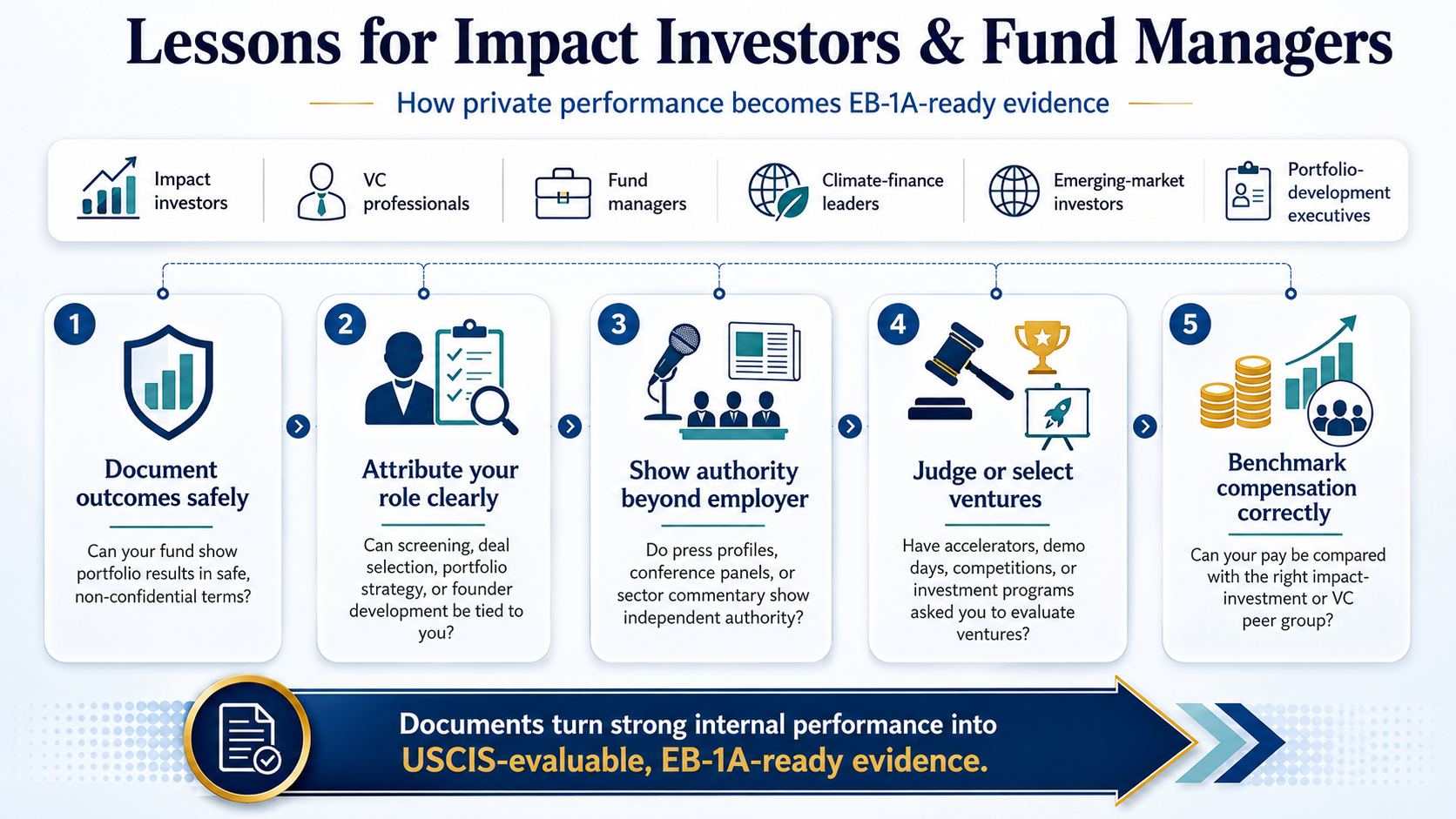
This case is useful for impact investors, venture-capital professionals, fund managers, climate-finance leaders, emerging-market investors, and portfolio-development executives whose strongest results are real but often confidential.
A strong record usually begins with the following questions:
- Can your fund document portfolio outcomes in safe, non-confidential terms?
- Can your role in investment screening, deal selection, portfolio strategy, or founder development be clearly attributed to you?
- Do financial-press profiles, conference panels, or sector commentary show authority beyond your employer?
- Have accelerators, demo days, competitions, or investment programs asked you to judge or select ventures?
- Can your compensation be benchmarked against the correct impact-investment or venture-capital peer group?
When those questions are answered with documents, a private investment career can become a record USCIS can evaluate. That is the difference between strong internal performance and EB-1A-ready evidence.
Frequently asked questions
Can an impact-investment fund manager qualify for EB-1A?
Yes. An impact-investment fund manager may qualify for EB-1A if the evidence shows sustained acclaim and extraordinary ability in a clearly defined investment field. The petition becomes stronger when it documents portfolio outcomes, investment authority, public recognition, judging roles, and compensation evidence.
Can confidential portfolio performance support an EB-1A petition?
It can support the petition when documented safely. Useful evidence may include disclosure-safe portfolio summaries, executive letters, founder confirmations, non-confidential impact metrics, follow-on funding evidence, and explanations of the petitioner’s role in investment and portfolio development.
Is emerging-market impact investing a strong EB-1A field niche?
It can be strong when defined carefully. Emerging-market impact investing is more specific than general finance because it involves capital deployment into ventures addressing climate, inclusion, market access, and development challenges in regions where traditional funding may be limited.
How can judging help an investment professional’s EB-1A case?
Judging can help when the petitioner evaluates startups, founders, pitch competitions, accelerator applicants, demo-day participants, or investment opportunities in a recognized professional setting. These roles show that others in the field trust the petitioner’s investment judgment.
Can compensation benchmarking support an EB-1A fund manager case?
Yes. Compensation benchmarking may support high-remuneration evidence when compared against the right peer group, such as impact-investment fund managers, venture-capital professionals, emerging-market investment leaders, or senior portfolio-development executives.
Can Immignis and Advance My Profile help investment professionals build EB-1A evidence?
Immignis and Advance My Profile help fund managers, venture investors, impact-investment leaders, and finance executives define a focused field niche, organize confidential impact evidence, build public visibility, document judging roles, and present a credible EB-1A record.
Build an EB-1A record around investment impact and field validation
Many fund managers and investment professionals create major value inside private funds but remain almost invisible outside them. Portfolio-outcome documentation, financial-press visibility, conference panels, startup judging, industry-body membership, and compensation benchmarking can support an EB-1A case when organized around a clear investment niche.